
Ancient Egyptian art: purpose, composition and material
Explore ancient Egyptian art through its visual conventions and documented objects. Learn how viewpoint, scale, arrangement and material shape an image, and distinguish historical evidence from contemporary Egyptian-inspired illustration.
A visual introduction
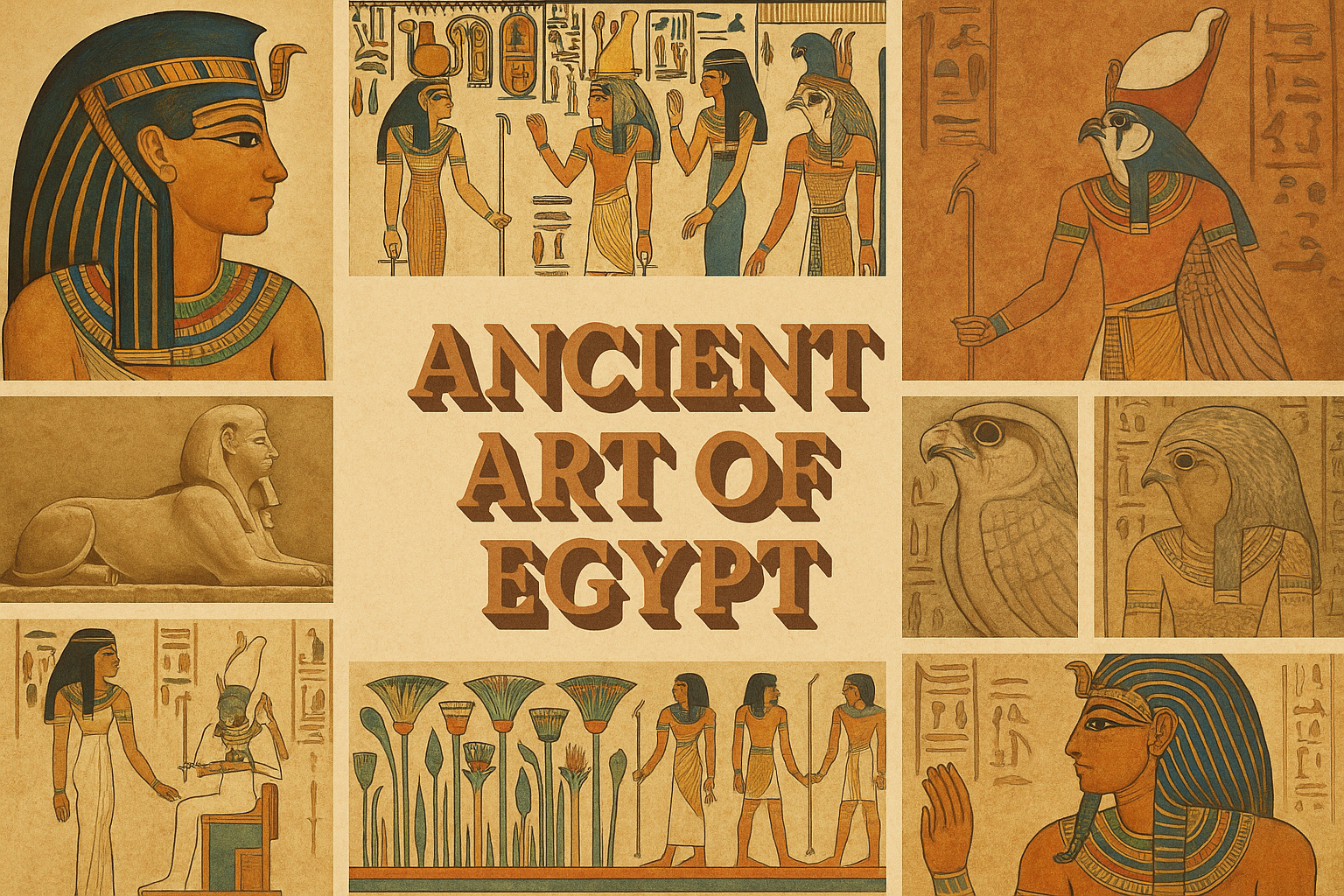
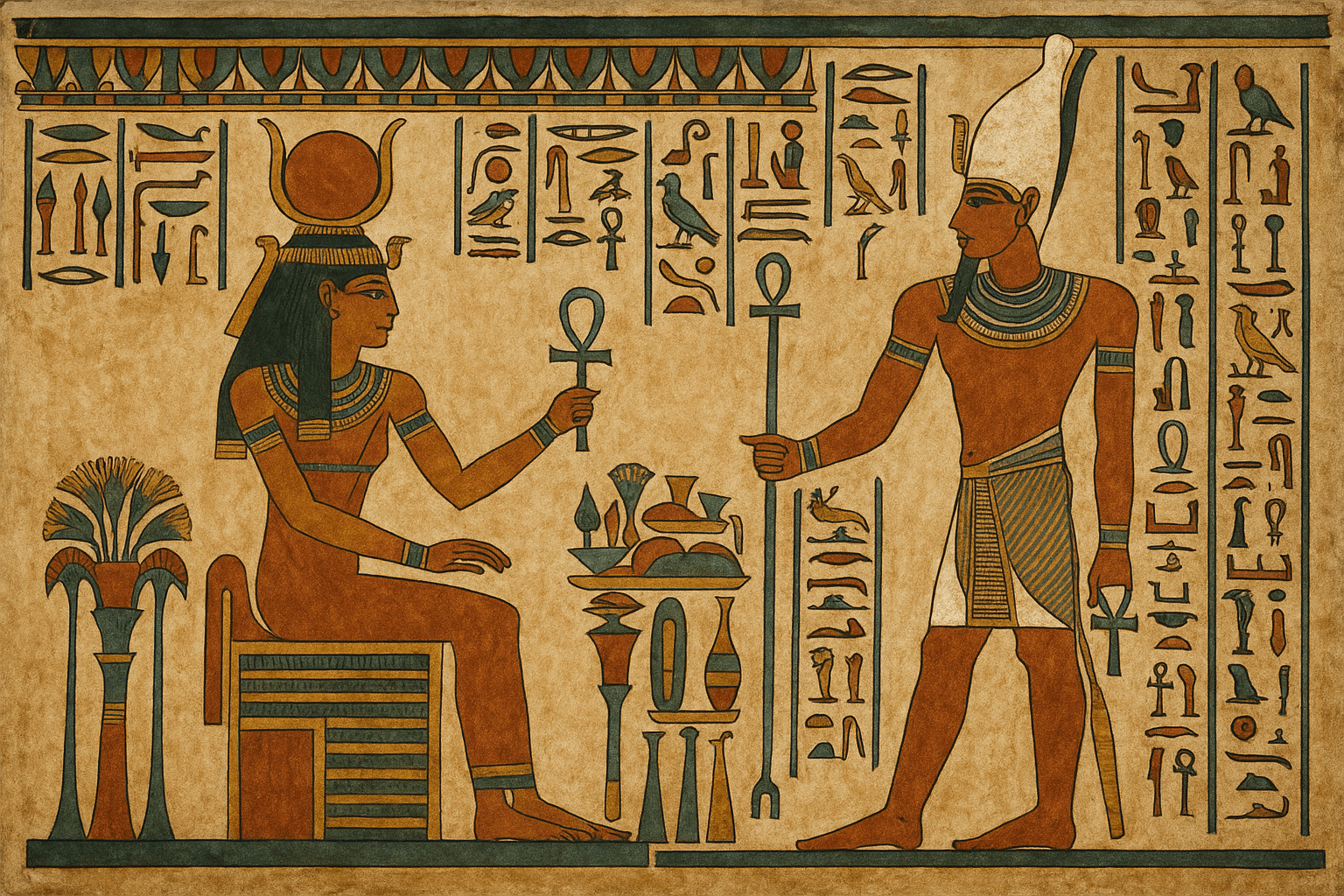
Two retained AOI interpretations of Egyptian-inspired composition. Their captions distinguish creative studies from the documented objects discussed in the article.
Select an image for a closer look. Use the thumbnails, arrow keys or a swipe to compare examples. Zoom in to inspect details, or share the image that inspires you.
Creative toolbox · take this style further
Choose an input and a destination. Search sends your words to the chosen site; Copy & open puts them on your clipboard to paste there.
Create with AI
Turn your chosen input into an image prompt or a new creative direction.
ChatGPT
Copy your input and paste it into a ChatGPT conversation or image request.
Copy & open ChatGPT (new tab)Claude · Anthropic
Develop an image prompt or explore the style in a new Claude conversation.
Copy & open Claude · Anthropic (new tab)Midjourney
Paste your input into the Imagine bar on the Create page.
Copy & open Midjourney (new tab)Adobe Firefly
Copy your input, open Firefly, and paste it into the prompt field.
Copy & open Adobe Firefly (new tab)Leonardo.Ai
Copy your input, open Leonardo, and paste it into the generation field.
Copy & open Leonardo.Ai (new tab)Image search
Find visual references. Short, concrete keywords usually work best.
Lexica
Search AI images and prompts using your selected input.
Search with this input Lexica (new tab)Pexels
Search the photo and video library. Short keywords often work best.
Search with this input Pexels (new tab)Pixabay
Search photos, illustrations and other images.
Search with this input Pixabay (new tab)Unsplash
Search photographs using the style name or your own keywords.
Search with this input Unsplash (new tab)Wikimedia Commons
Search photographs, artworks and historical images. Check each file for its source and reuse terms.
Search with this input Wikimedia Commons (new tab)Art & research
Explore artists, collections and the ideas behind a style.
Wikipedia
Search for background reading. A style may not have its own article.
Search with this input Wikipedia (new tab)WikiArt
Copy your input into WikiArt’s search to explore artists and artworks.
Copy & open WikiArt (new tab)Europeana
Paste your keywords into the search to explore European museum, library and archive collections.
Copy & open Europeana (new tab)Inspiration
Discover portfolios and visual ideas from creative communities.
Instagram hashtags
Search a hashtag made from your input: spaces and punctuation are removed. Instagram may require sign-in.
Search with this input Instagram hashtags (new tab)ArtStation
Paste your input into artwork search for concept art, environments, characters and visual development.
Copy & open ArtStation (new tab)Behance
Paste your input into project search for illustration, design and visual storytelling.
Copy & open Behance (new tab)A closer look
Follow contours, baselines, repeated bands and the relative size of forms. Compare a painted scene with sculpture and glazed faience; color and surface belong to particular materials, not one universal Egyptian palette.
Start with purpose, period and material
Ancient Egyptian art includes buildings, sculpture, painted surfaces and objects made over many centuries. It cannot be reduced to pyramids, gold and a single unchanging style. This introduction focuses on how images organize information and how material and purpose affect their appearance. The dated objects below provide concrete points of comparison rather than a complete chronology.
The Met’s educational guide explains that many images were intended to act within religious and funerary life, not merely to decorate it. An offering scene could participate in maintaining divine order, while a statue might provide an enduring presence. Ask what a particular work was made to do, where it belonged and whom it addressed before treating its forms as a set of ornaments. [1]
A clear image can combine several viewpoints
In many Egyptian depictions of people on flat surfaces, the artist combines views: a profile head with a front-facing eye, frontal shoulders and limbs shown from the side. This makes selected features legible together. Horizontal rows, often called registers, organize scenes; differences in size can signal importance. These conventions should be studied as choices within a visual system, rather than failures to imitate a single camera view. [1]
Try a simple looking exercise on a documented scene. Trace its ground lines, outline the largest figure and mark the direction of each gaze or gesture. Then remove the small details in a second sketch. If the relationships remain clear, you have found something more useful than a decorative recipe: the structure that directs attention. Compare another object before assuming every Egyptian image follows the same arrangement.
A painted marsh scene has both order and activity
The British Museum’s tomb-painting fragment EA37977, dated to about 1350 BCE, depicts Nebamun in a small boat in the marshes, accompanied by his wife and daughter. Birds, fish, plants and a hunting cat fill the setting. The museum records surviving hieroglyphic columns as part of the scene. This is a documented work from a particular tomb at Thebes, not a generic illustration of Egyptian daily life. [2]
Use it to compare a dominant human figure with clusters of much smaller living forms. A busy scene can retain a clear focal point when scale, direction and intervals work together. For your own composition, draw the main silhouette before placing secondary motifs. Leave some quiet space around an important hand or face so that the action remains readable.
Color and surface depend on the object
The Met’s faience Hippopotamus, accession 17.9.1 and popularly called William, dates to about 1961–1878 BCE in the Middle Kingdom. The museum describes faience here as a ground-quartz ceramic material, with blue glaze and painted lotus plants. It connects the plant imagery with the animal’s marsh habitat and with ideas of regeneration. The small three-dimensional body offers a very different visual experience from a painted wall. [3]
Another useful comparison is the painted bust of Nefertiti in Berlin. The Staatliche Museen zu Berlin dates its creation to around 1340 BCE and identifies Nefertiti as the queen represented. The name of a depicted person is not automatically the name of the maker. Likewise, a modern image of a ruler does not acquire a historical attribution merely by adopting a crown, profile pose or broad collar. [4]
Read the AOI illustrations as interpretations
The retained standalone illustration places a seated figure opposite a standing figure, with vessels between them, plant forms at the edge and sign-like columns above and beside the scene. Strong contours and broad areas of ochre, rust and dark blue-green make the silhouettes easy to follow. The firm baseline and repeated border motifs stabilize the composition.
The titled collage gathers profile heads, bird-headed figures, a sphinx-like form and repeated plants around a central panel. Both images are contemporary AOI archive interpretations. They are not photographs of ancient paintings, verified reconstructions of rituals or reliable examples of hieroglyphic writing. The figures have no established historical identification. Use the images to discuss arrangement and contrast, while using the museum sources for factual comparisons.
Build a specific contemporary study
Choose one visual problem rather than adding every familiar symbol. You might organize plants into horizontal bands, compare a flat silhouette with a rounded volume, or place two figures around a deliberately open central space. Name the intended medium and lighting. A matte painted surface, a shallow carved relief and a glazed object should not all have the same texture.
For a study based on a museum object, keep its identifier, material and date range with your working notes. For an invented composition, say that it is contemporary. Avoid assigning meanings to unverified signs, and leave writing out when you cannot reproduce it accurately. The three prompts below explore arrangement, contour and material without claiming ancient provenance. This article is AI-assisted editorial writing in AOI’s Penny Wraiter persona; original generation settings for the two retained images are unknown.
Read a scene as an organised field
Trace the main horizontal divisions, the direction of figures and the scale of repeated elements before interpreting individual symbols. Ask how the arrangement makes an action legible and where a change of size or direction establishes emphasis. A clear visual convention is not evidence that the maker lacked observational skill.
Compare the image at the scale of the whole surface and at the scale of a detail. A bird, plant or small gesture may introduce variation within an otherwise ordered structure. Those local differences can be lost when a generated imitation repeats the same decorative unit everywhere.
Let the object record constrain the creative brief
Choose one period, material and format when developing a historically informed study. Keep invented scenes explicitly contemporary, and leave writing out unless its meaning and use have been checked. A coherent arrangement of forms teaches more than an accumulation of familiar Egyptian-looking symbols from unrelated contexts.
A small poetic detour
Original words from the AOI studio.
Poetry
A line beneath the feet,
a space beside the hand;
a small and steady rhythm
across a painted band.
Before we name the figures,
we learn where they might stand.
The prompt workshop
Original creative exercises. These prompts create new illustrations, not documentary evidence.
Three bands of river plants
Create an original contemporary painted panel with three horizontal bands of river plants: tall stems above, broad leaves in the middle, small water shapes below. Crisp dark contours, warm cream ground, restrained rust, green and blue accents. Vary the intervals while preserving a clear overall rhythm. Matte pigment-like surface, no lettering, named deities or ancient-object claim. A new arrangement exercise informed by looking at Egyptian painted compositions.
Two figures and an open center
Create an original contemporary flat-color illustration of two fictional gardeners arranging a bowl of flowers between them. Clear side-facing silhouettes, one shared baseline, simple gestures and generous open space around the bowl. Warm ochre, charcoal and muted green, a narrow repeating plant border. No crowns, hieroglyphs or archaeological claim. Emphasize readable relationships and calm spacing rather than a simulated ancient ritual.
Silhouette beside glazed volume
Create a contemporary diptych of one original compact hippopotamus form. Left: a spare dark contour drawing on cream. Right: a rounded blue glazed ceramic-like interpretation with a few fine plant lines across the surface. Keep the same side view and proportions; let the right panel show soft reflected light. No copying of a named museum object, inscription or invented excavation history. A new comparison of flat outline and material volume.
A smile from the studio
Jokes
The border asked for one more lotus. The composition requested a little breathing room.
Sources and further exploration
British Museum: Nebamun tomb-painting, EA37977 — dated scene, figures and marsh setting
The Met: Hippopotamus (William), 17.9.1 — Middle Kingdom faience, material and lotus imagery
Staatliche Museen zu Berlin: Bust of Nefertiti — the represented queen and the sculpture’s history