
A guide to comparing distinct traditions and objects
Ancient and Tribal Art is a broad browsing label, not one historical movement. A useful approach begins with named makers, communities, places and periods, then compares materials and visual decisions without erasing their different contexts.
A visual introduction
Retained AOI interpretations show how a broad label can combine unlike visual references. Read them alongside the named, documented examples in the article.
Select an image for a closer look. Use the thumbnails, arrow keys or a swipe to compare examples. Zoom in to inspect details, or share the image that inspires you.

Creative toolbox · take this style further
Choose an input and a destination. Search sends your words to the chosen site; Copy & open puts them on your clipboard to paste there.
Create with AI
Turn your chosen input into an image prompt or a new creative direction.
ChatGPT
Copy your input and paste it into a ChatGPT conversation or image request.
Copy & open ChatGPT (new tab)Claude · Anthropic
Develop an image prompt or explore the style in a new Claude conversation.
Copy & open Claude · Anthropic (new tab)Midjourney
Paste your input into the Imagine bar on the Create page.
Copy & open Midjourney (new tab)Adobe Firefly
Copy your input, open Firefly, and paste it into the prompt field.
Copy & open Adobe Firefly (new tab)Leonardo.Ai
Copy your input, open Leonardo, and paste it into the generation field.
Copy & open Leonardo.Ai (new tab)Image search
Find visual references. Short, concrete keywords usually work best.
Lexica
Search AI images and prompts using your selected input.
Search with this input Lexica (new tab)Pexels
Search the photo and video library. Short keywords often work best.
Search with this input Pexels (new tab)Pixabay
Search photos, illustrations and other images.
Search with this input Pixabay (new tab)Unsplash
Search photographs using the style name or your own keywords.
Search with this input Unsplash (new tab)Wikimedia Commons
Search photographs, artworks and historical images. Check each file for its source and reuse terms.
Search with this input Wikimedia Commons (new tab)Art & research
Explore artists, collections and the ideas behind a style.
Wikipedia
Search for background reading. A style may not have its own article.
Search with this input Wikipedia (new tab)WikiArt
Copy your input into WikiArt’s search to explore artists and artworks.
Copy & open WikiArt (new tab)Europeana
Paste your keywords into the search to explore European museum, library and archive collections.
Copy & open Europeana (new tab)Inspiration
Discover portfolios and visual ideas from creative communities.
Instagram hashtags
Search a hashtag made from your input: spaces and punctuation are removed. Instagram may require sign-in.
Search with this input Instagram hashtags (new tab)ArtStation
Paste your input into artwork search for concept art, environments, characters and visual development.
Copy & open ArtStation (new tab)Behance
Paste your input into project search for illustration, design and visual storytelling.
Copy & open Behance (new tab)A closer look
Look closely at silhouette, scale, surface, pattern, color and use. Identify which features belong to a specific object and which are your own formal observations.
A comparison guide, not a single art movement
Ancient and Tribal Art is a broad browsing label that brings together subjects requiring different kinds of explanation. Ancient refers to a historical period; tribal may refer to a particular social or political community, but by itself identifies neither a date nor a visual style. An Egyptian burial object, an Asante stool and a contemporary Native painting cannot be explained by one recipe of earth colors, geometry and natural materials.
Start with the most specific available description: maker, community, place, period, object type, material and use. Keep an unknown maker unknown rather than supplying a famous European name. Indigenous artists and communities also have contemporary histories. This guide uses a few documented examples to show how precise identification changes both looking and creative practice.
Three examples that resist a universal formula
The Met’s Egyptian Hippopotamus, nicknamed William, is a Middle Kingdom faience object from Meir, dated in the current record to about 1961–1878 BCE. Its blue glaze and lotus imagery matter: the museum relates the plant imagery to the animal’s river habitat and to regeneration. Object number 17.9.1 provides a traceable identity. Calling it simply an earth-toned ancient animal would miss much of its material and visual character. [1]
The Met’s Asesedwa, a prestige stool by an Asante-Akan artist, is from Ghana and dates to the early–mid-nineteenth century. Its record identifies wood and metal and gives object number 1979.206.263. This is a different place, period and object type from the Egyptian figure. Use the named attribution and recorded materials as the beginning of a comparison; the word tribal alone tells us little about this particular work. [2]
The National Museum of the American Indian’s Stretching the Canvas presents a century of changing Native painting. One example is Kay WalkingStick’s Homage to Chief Joseph (Chief Joseph #1), an encaustic-on-canvas work from 1975; the museum identifies WalkingStick with the Cherokee Nation. The exhibition documents artists challenging expectations about what Native art should look like. It is a useful reminder to study individual choices and continuing innovation, not an imagined unchanging past. [3]
Compare visual decisions while keeping identities distinct
For each object, ask what carries the composition. Is emphasis created by a compact silhouette, an open space, a repeated contour, a glossy surface or a contrast of large and small forms? Note whether decoration follows the object’s shape or establishes an independent pattern. Compare these decisions without assuming that similar shapes share the same cultural meaning.
Palette should come from the selected work and material. A blue glazed surface, dark carved wood and a painted canvas create different effects; brown is not a universal color of the past. A useful comparison records both an observation and its limit: “a repeating band frames the surface” is visible, while a claim about that band’s symbolism needs a source.
Read the AOI archive images as invented combinations
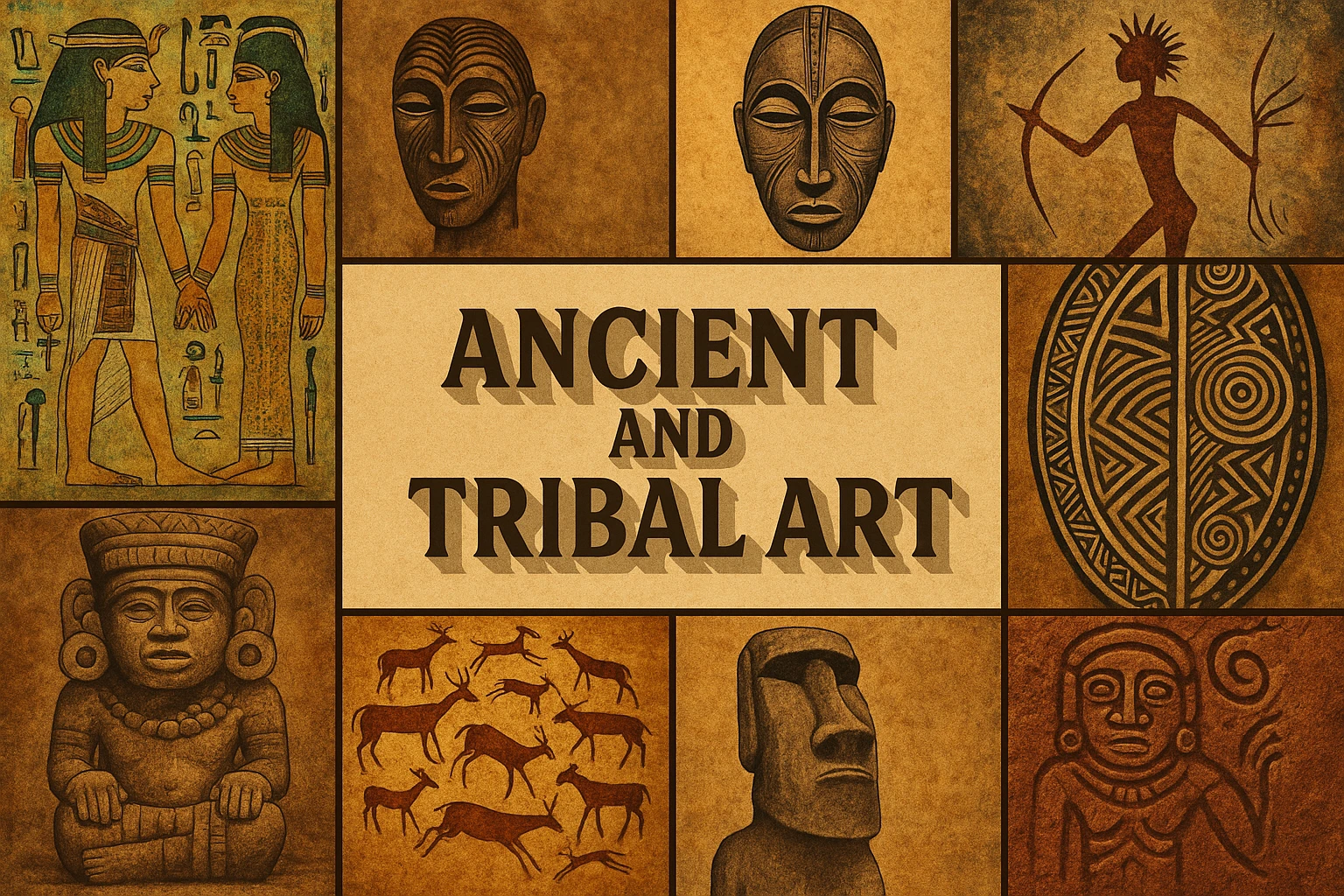
The standalone AOI illustration uses a large profile figure, smaller figures, animals, plants and a sun-like face inside a geometric border. Flat dark shapes stand against ochre and rust colors. The collage groups Egyptian-looking profiles, mask-like faces, animal silhouettes, sculptural heads and a patterned shield-like shape around its central title. These are descriptions of the visible imagery, not identifications of authentic objects.
The shared aged surface makes the collage visually coherent, but it also shows the weakness of a broad style label: objects from unlike contexts can appear to belong to one world. Treat both images as contemporary illustrative combinations. Their figures, markings and apparent artifacts have no verified cultural attribution. Use the source links for documented works rather than treating these images as museum evidence.
A practical route from research to a new image
Choose one documented object and write a short observation card: its identifier, date, material, broad shape, surface treatment and one question you cannot answer by looking. Then separate formal observations from contextual facts. You might explore a rounded volume with a contrasting surface pattern without claiming to reproduce the original object’s meaning.
For a new design, specify an object, material, viewpoint, palette and pattern rule. Describe it as a contemporary invention. Avoid asking a generator for generic tribal authenticity or adding invented inscriptions and ceremonial functions. The prompts below develop formal comparisons and material studies; they do not reconstruct the cited objects. This article is AI-assisted editorial writing in AOI’s Penny Wraiter persona. The retained archive imagery has unknown original generation settings.
A small poetic detour
Original words from the AOI studio.
Poetry
A surface catches light;
a name restores a place.
The pattern asks for looking,
the object for its story.
Leave space between resemblance
and the histories it cannot tell.
The prompt workshop
Original creative exercises. These prompts create new illustrations, not documentary evidence.
A contemporary patterned vessel
Create an original contemporary ceramic vessel with a rounded body, a narrow opening and three bands of invented short curved marks. Glossy turquoise glaze, dark blue marks, soft side light and a plain pale background. Show the object clearly in three-quarter view. No lettering, archaeological setting, cultural attribution or replica claim.
One form, three material studies
Create a clean triptych of the same original abstract arch-shaped tabletop sculpture, interpreted in matte clay, dark carved wood and brushed metal. Keep scale, viewpoint and lighting comparable. Explore how edges, surface texture and reflected light change the form. Generous neutral margins, no labels, no ceremonial symbols; contemporary design studies.
Pattern as a compositional decision
Create an original graphic composition with one large curved silhouette and a surrounding band of small asymmetric marks. Place one quiet unpatterned area beside a dense rhythmic area. Ink blue, cream and a small vermilion accent; crisp flat shapes. No invented script, costumes or claims of cultural authenticity. A contemporary formal experiment.
A smile from the studio
Jokes
The catalogue label said “miscellaneous.” The object requested a more attentive reader.