
Babylonian art: stone monuments and glazed-brick architecture
Explore Babylonian art through the Code of Hammurabi and a Neo-Babylonian lion panel: two different periods, materials and visual systems. Learn to read relief, inscription, repeated contours and glazed-brick color without confusing Babylon with Assyria.
A visual introduction
Two retained AOI interpretations for studying contour, borders and relief-like composition. Museum sources supply the historical comparisons.
Select an image for a closer look. Use the thumbnails, arrow keys or a swipe to compare examples. Zoom in to inspect details, or share the image that inspires you.
Creative toolbox · take this style further
Choose an input and a destination. Search sends your words to the chosen site; Copy & open puts them on your clipboard to paste there.
Create with AI
Turn your chosen input into an image prompt or a new creative direction.
ChatGPT
Copy your input and paste it into a ChatGPT conversation or image request.
Copy & open ChatGPT (new tab)Claude · Anthropic
Develop an image prompt or explore the style in a new Claude conversation.
Copy & open Claude · Anthropic (new tab)Midjourney
Paste your input into the Imagine bar on the Create page.
Copy & open Midjourney (new tab)Adobe Firefly
Copy your input, open Firefly, and paste it into the prompt field.
Copy & open Adobe Firefly (new tab)Leonardo.Ai
Copy your input, open Leonardo, and paste it into the generation field.
Copy & open Leonardo.Ai (new tab)Image search
Find visual references. Short, concrete keywords usually work best.
Lexica
Search AI images and prompts using your selected input.
Search with this input Lexica (new tab)Pexels
Search the photo and video library. Short keywords often work best.
Search with this input Pexels (new tab)Pixabay
Search photos, illustrations and other images.
Search with this input Pixabay (new tab)Unsplash
Search photographs using the style name or your own keywords.
Search with this input Unsplash (new tab)Wikimedia Commons
Search photographs, artworks and historical images. Check each file for its source and reuse terms.
Search with this input Wikimedia Commons (new tab)Art & research
Explore artists, collections and the ideas behind a style.
Wikipedia
Search for background reading. A style may not have its own article.
Search with this input Wikipedia (new tab)WikiArt
Copy your input into WikiArt’s search to explore artists and artworks.
Copy & open WikiArt (new tab)Europeana
Paste your keywords into the search to explore European museum, library and archive collections.
Copy & open Europeana (new tab)Inspiration
Discover portfolios and visual ideas from creative communities.
Instagram hashtags
Search a hashtag made from your input: spaces and punctuation are removed. Instagram may require sign-in.
Search with this input Instagram hashtags (new tab)ArtStation
Paste your input into artwork search for concept art, environments, characters and visual development.
Copy & open ArtStation (new tab)Behance
Paste your input into project search for illustration, design and visual storytelling.
Copy & open Behance (new tab)A closer look
Compare a focused scene above dense inscription with a continuous animal silhouette spread across a brick grid. Relief depth, repeated borders, material and light organize the surface; each object needs its own historical context.
Begin with a period and an object
Babylonian art encompasses objects and buildings associated with Babylon and its wider cultural world in ancient Mesopotamia. It is a historical subject with changing materials, patrons and purposes, rather than one decorative recipe. This introduction compares an Old Babylonian stone monument with Neo-Babylonian glazed-brick architecture. Their differences are as instructive as their shared interest in image, authority and carefully organized surfaces.
The Louvre dates the Code of Hammurabi stele to 1792–1750 BCE. The Met dates its Panel with striding lion to about 604–562 BCE, during a much later phase of Babylonian history. More than a millennium separates these examples. A useful visual study should identify which object and period it follows instead of combining everything under a single ancient date. [1, 2]
A stone monument joins image and inscription
The Code of Hammurabi, Louvre inventory SB 8, is a basalt stele with a carved scene above an extensive inscription. The museum identifies the figures as Hammurabi and the seated god Shamash, and describes the encounter as legitimizing the king’s sovereignty and the judicial decisions inscribed below. The text is written in cuneiform in Old Babylonian. [1]
For a composition study, compare the concentrated encounter at the top with the much denser field beneath it. Gesture, relative position and a change in surface density establish a hierarchy. This is an observation about the monument’s design, not a licence to replace its writing with arbitrary symbols and call them an ancient law. Hammurabi is the represented ruler; naming him does not identify the person who carved the stone.
Glazed brick makes a wall into an image
The Met’s Panel with striding lion, object 31.13.1, comes from Babylon and is made of ceramic and glaze. The museum connects its lion to Ishtar and to the Processional Way. It distinguishes these street-side lions from the bulls and dragons decorating the Ishtar Gate. Repetition had a role within a ceremonial route, beyond the appeal of a single isolated animal. [2]
Read the panel at two scales: first the large silhouette and direction of movement, then the small divisions of the brick surface. In a contemporary design exercise, a pale animal against a deep blue field creates a strong value contrast; joints can remain visible without breaking the figure’s continuity. Use a restrained supporting border so the main contour stays legible. A glazed surface also calls for different light than a uniformly rough stone carving.
Keep Babylon, Assyria and reconstruction distinct
A lion alone cannot identify an object as Babylonian. The British Museum classifies Ashurbanipal’s royal lion-hunt panel 124852 as Neo-Assyrian, dates it to 645–635 BCE and records its findspot as the North Palace at Nineveh. It is useful comparative material, but it should not be introduced as a Babylonian palace relief. [3]
The celebrated Ishtar Gate display in Berlin also needs a precise label. The Staatliche Museen zu Berlin explains that excavated glazed fragments were treated, sorted and assembled, then supplemented with modern bricks to reconstruct the gate and related façades. The reconstruction opened in 1930. It combines ancient material with modern restoration and display decisions; it is not an intact gate transported as one piece. [4]
What the retained AOI images demonstrate
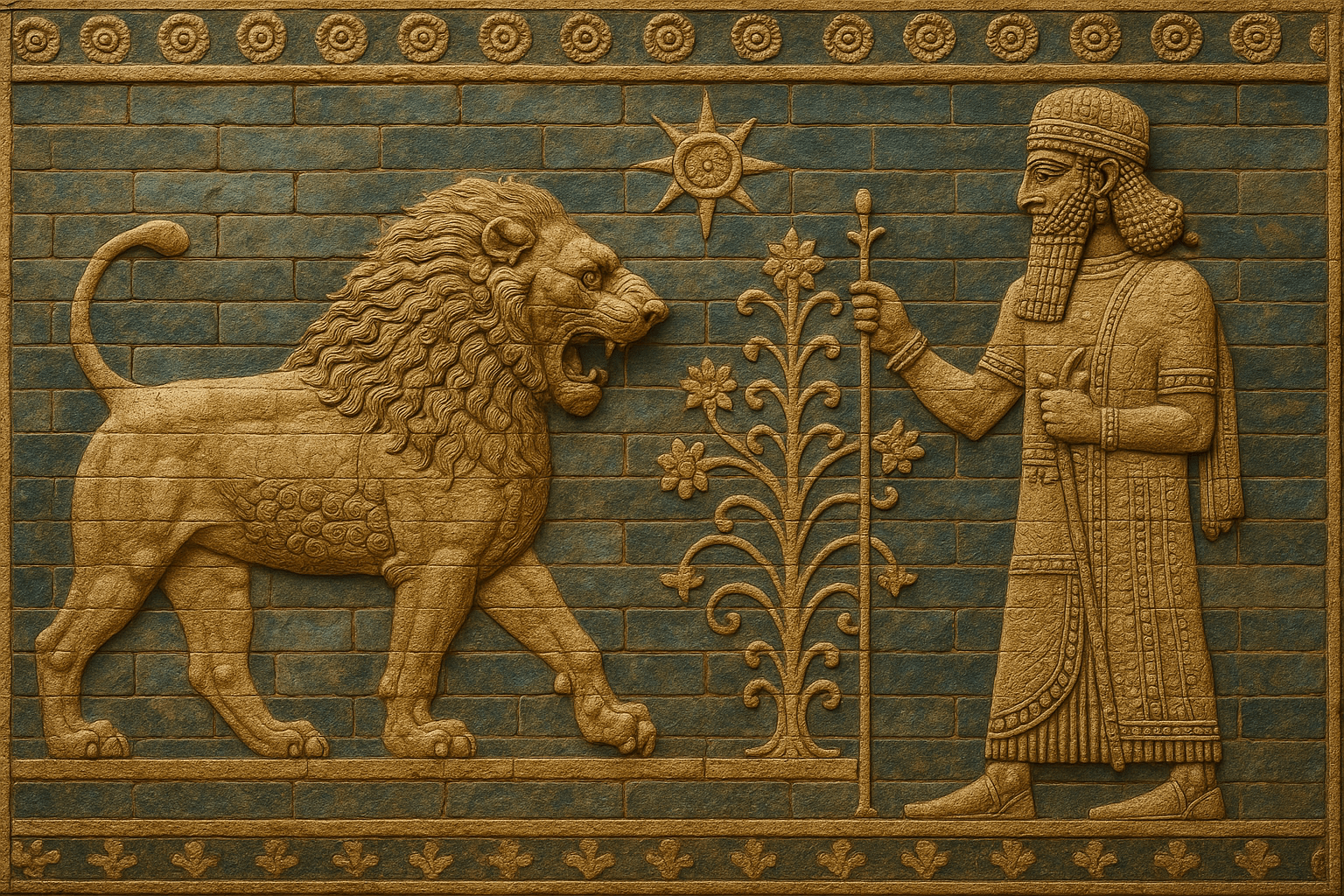
The standalone illustration places a large lion opposite a bearded figure, separated by a flowering stem. Gold-brown relief-like forms stand out against a muted blue brick field. The composition gains stability from horizontal courses, repeated rosettes and a firm lower border. Its surface is consistently rough, so it is better used to discuss contour and relief-like lighting than to demonstrate the appearance of surviving glazed brick.
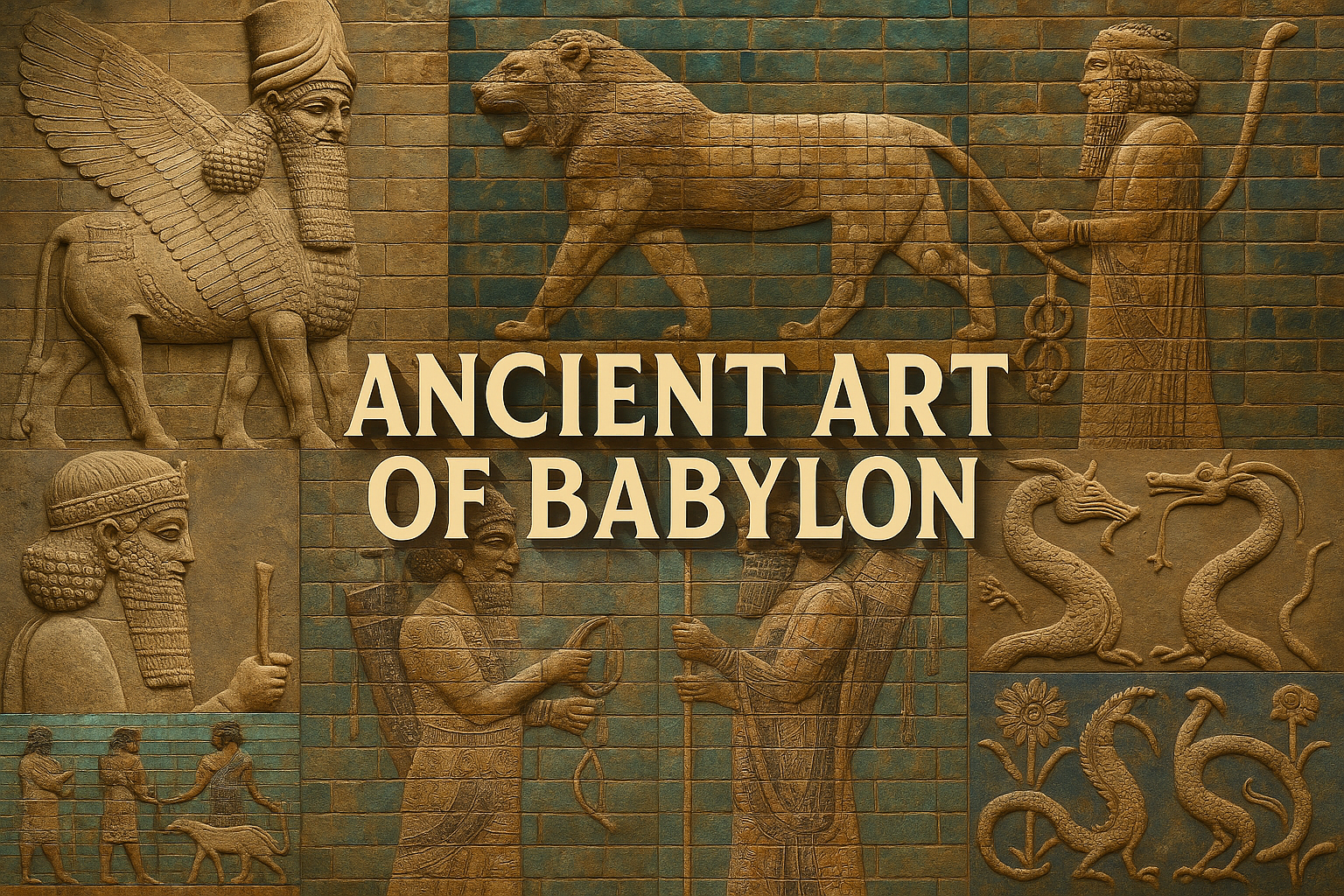
The collage arranges lions, bearded figures, a winged composite creature and serpent-like forms around its central title. These AOI archive images are contemporary imagined combinations of Mesopotamian-looking motifs. They are not photographs of excavated objects, verified representations of a named ruler or deity, or accurate reconstructions of a single Babylonian monument. Their original generation settings are unknown.
Turn observation into an original study
Start with a museum record and write down the object number, date range and medium. Sketch only its major silhouette and largest divisions. Then make a second drawing that replaces the historical subject with an original plant or abstract form while keeping one structural principle: continuous contour across a grid, a repeated motif along a route, or a small focal scene above a dense field.
Choose a palette for that particular exercise. Blue, cream and ochre can serve a glazed-wall interpretation; charcoal and soft gray can make a carved-volume study clearer. Neither palette defines all Babylonian art. Specify relief depth, light direction, border spacing and viewing angle in a prompt. Leave out invented inscriptions unless their fictional status is explicit. The prompts below are contemporary design exercises, not archaeological reconstructions. This article is AI-assisted editorial writing in AOI’s Penny Wraiter persona.
Read the architecture as well as the image
A brick panel belongs to a larger system of repeated units, joints and routes through space. Study how the outline continues across those units and how repetition changes when the viewer moves. A close photograph can make the animal appear to be an isolated illustration when its architectural setting is central to the experience.
Compare that structure with an inscribed stele. The relation between carved image and writing, the object's height and its material all affect how authority is presented. Similar subject matter does not make the two objects equivalent visual systems.
Design a clearly contemporary response
Choose either a modular wall surface or a single carved-looking object as the format. Develop one invented animal or abstract motif that fits its construction. Keep any text areas blank unless the wording is meaningful and verified. The exercise should reveal the relationship between material and image, without presenting arbitrary cuneiform-like marks as an authentic inscription.
A small poetic detour
Original words from the AOI studio.
Poetry
Across the little seams of clay
a single contour finds its way.
The wall divides; the shape proceeds,
while light attends the smallest beads.
A fragment asks us to look slow:
what do we see, and what do we know?
The prompt workshop
Original creative exercises. These prompts create new illustrations, not documentary evidence.
A silhouette across the brickwork
Create an original contemporary ceramic-wall design: one stylized walking lion in side view, cream and ochre against deep blue rectangular glazed bricks. Keep the outer contour continuous across visible joints, with a narrow quiet border and ample space ahead of the animal. Frontal view, soft side light and restrained glaze reflections. Inspired by studying Neo-Babylonian glazed-brick composition; no inscription, ruler, archaeological provenance or exact-replica claim.
A procession of invented plants
Design a contemporary garden-wall frieze of three invented flowering plants, each rising from the same baseline across a blue glazed-brick grid. Vary the leaf shapes while keeping equal spacing and a consistent cream-and-ochre palette. Oblique courtyard view makes the repetition recede in depth. Crisp large silhouettes, small glaze variations, no figures or writing. An original exercise in serial rhythm inspired by architectural relief, not a reconstructed Babylonian wall.
One form in two materials
Make a contemporary diptych of the same original abstract branching form. Left: dark stone-like shallow relief with a matte surface and raking light. Right: cream glazed ceramic relief on a deep-blue brick field with soft highlights. Match viewpoint and silhouette, but let each material change the surface and shadows. Generous margins, no lettering or historical attribution. A comparative design study, not two ancient artifacts.
A smile from the studio
Jokes
The lion requested a larger border. The bricklayer suggested a smaller ego.
Sources and further exploration
Louvre: Code of Hammurabi, SB 8 — date, material, inscription and represented figures
The Met: Panel with striding lion, 31.13.1 — glazed brick and the Processional Way
British Museum: royal lion hunt, 124852 — a Neo-Assyrian comparison from Nineveh
Staatliche Museen zu Berlin: From Fragment to Monument — how the Ishtar Gate was reconstructed