
Drawing as structural investigation
Explore analytic drawing through axes, proportion, negative space and selective lines, with Bauhaus sources, practical exercises and seven visual studies.
A visual introduction
Five new AI-generated studies and two retained AOI interpretations investigate objects, folds, a leaf, reduction and the figure. The centrally titled collage supplies a broader overview. None is an attributed historical drawing or verified measurement.
Select an image for a closer look. Use the thumbnails, arrow keys or a swipe to compare examples. Zoom in to inspect details, or share the image that inspires you.


Creative toolbox · take this style further
Choose an input and a destination. Search sends your words to the chosen site; Copy & open puts them on your clipboard to paste there.
Create with AI
Turn your chosen input into an image prompt or a new creative direction.
ChatGPT
Copy your input and paste it into a ChatGPT conversation or image request.
Copy & open ChatGPT (new tab)Claude · Anthropic
Develop an image prompt or explore the style in a new Claude conversation.
Copy & open Claude · Anthropic (new tab)Midjourney
Paste your input into the Imagine bar on the Create page.
Copy & open Midjourney (new tab)Adobe Firefly
Copy your input, open Firefly, and paste it into the prompt field.
Copy & open Adobe Firefly (new tab)Leonardo.Ai
Copy your input, open Leonardo, and paste it into the generation field.
Copy & open Leonardo.Ai (new tab)Image search
Find visual references. Short, concrete keywords usually work best.
Lexica
Search AI images and prompts using your selected input.
Search with this input Lexica (new tab)Pexels
Search the photo and video library. Short keywords often work best.
Search with this input Pexels (new tab)Pixabay
Search photos, illustrations and other images.
Search with this input Pixabay (new tab)Unsplash
Search photographs using the style name or your own keywords.
Search with this input Unsplash (new tab)Wikimedia Commons
Search photographs, artworks and historical images. Check each file for its source and reuse terms.
Search with this input Wikimedia Commons (new tab)Art & research
Explore artists, collections and the ideas behind a style.
Wikipedia
Search for background reading. A style may not have its own article.
Search with this input Wikipedia (new tab)WikiArt
Copy your input into WikiArt’s search to explore artists and artworks.
Copy & open WikiArt (new tab)Europeana
Paste your keywords into the search to explore European museum, library and archive collections.
Copy & open Europeana (new tab)Inspiration
Discover portfolios and visual ideas from creative communities.
Instagram hashtags
Search a hashtag made from your input: spaces and punctuation are removed. Instagram may require sign-in.
Search with this input Instagram hashtags (new tab)ArtStation
Paste your input into artwork search for concept art, environments, characters and visual development.
Copy & open ArtStation (new tab)Behance
Paste your input into project search for illustration, design and visual storytelling.
Copy & open Behance (new tab)A closer look
Light construction marks establish relationships; selected contours and darker accents clarify what matters. Every axis, overlap and empty interval should answer a visual question.
Draw to find out, not only to finish
Analytic drawing is used here for drawing that investigates a subject’s organization. Instead of immediately shading a finished outline, the artist compares directions, distances, overlaps and spaces. A useful line records a relation that can be checked. The result may remain representational or become an abstract diagram; precision of observation does not require a photorealistic finish.
The term also has a documented educational history. Getty’s Bauhaus Beginnings exhibition describes Kandinsky’s students studying arrangements of everyday objects, tracing structural relationships and simplifying the results. The aim extended beyond copying appearances toward understanding composition. That particular course is a historical example, not the origin of every kind of structural drawing. [1]
A documented drawing, accurately attributed
The Centre Pompidou records Dessin analytique as an ink-on-paper work by a student of Vassily Kandinsky at the Bauhaus, dated within the range 1922–1933. The maker is not identified as Kandinsky himself. This modest catalogue distinction matters: a student exercise is evidence of a teaching practice, not a licence to attribute every analytical-looking sheet to a famous master. [2]
Josef Albers’s own text Concerning Art Instruction describes drawing instruction beginning with exact observation and representation. It offers another useful educational perspective on looking carefully. The practical exercises below are contemporary AOI suggestions; they are not presented as transcriptions of either Albers’s or Kandinsky’s lessons. [3]
A line can carry several kinds of evidence
Albers’s 1934 text treats drawing as a way of developing visual judgment. Alongside close observation, he discusses problems such as foreshortening, overlap and translating three-dimensional form into a graphic language. This gives a useful distinction for our exercises: the subject is one thing, while the marks used to understand it are another. A drawing can be informative without describing every visible surface. [3]
Ask what each mark is doing. An axis proposes an orientation; a contour identifies an edge from this viewpoint; hatching suggests a surface turning away from light. A line across empty paper might compare two heights. These functions can coexist, but they should remain distinguishable. Darkening every guide equally removes the hierarchy that makes an analysis readable.
Five new studies: different questions, not more decoration
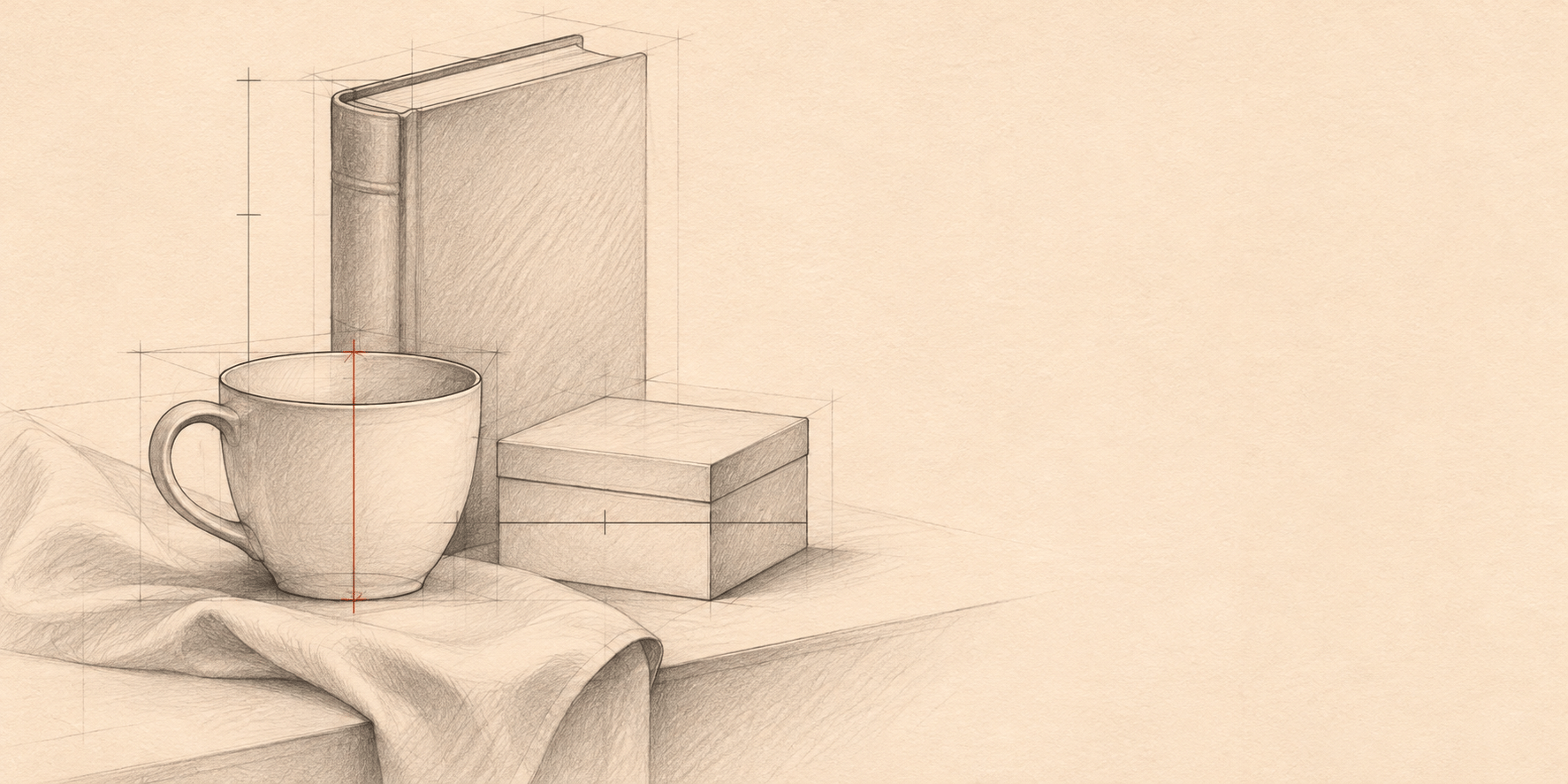
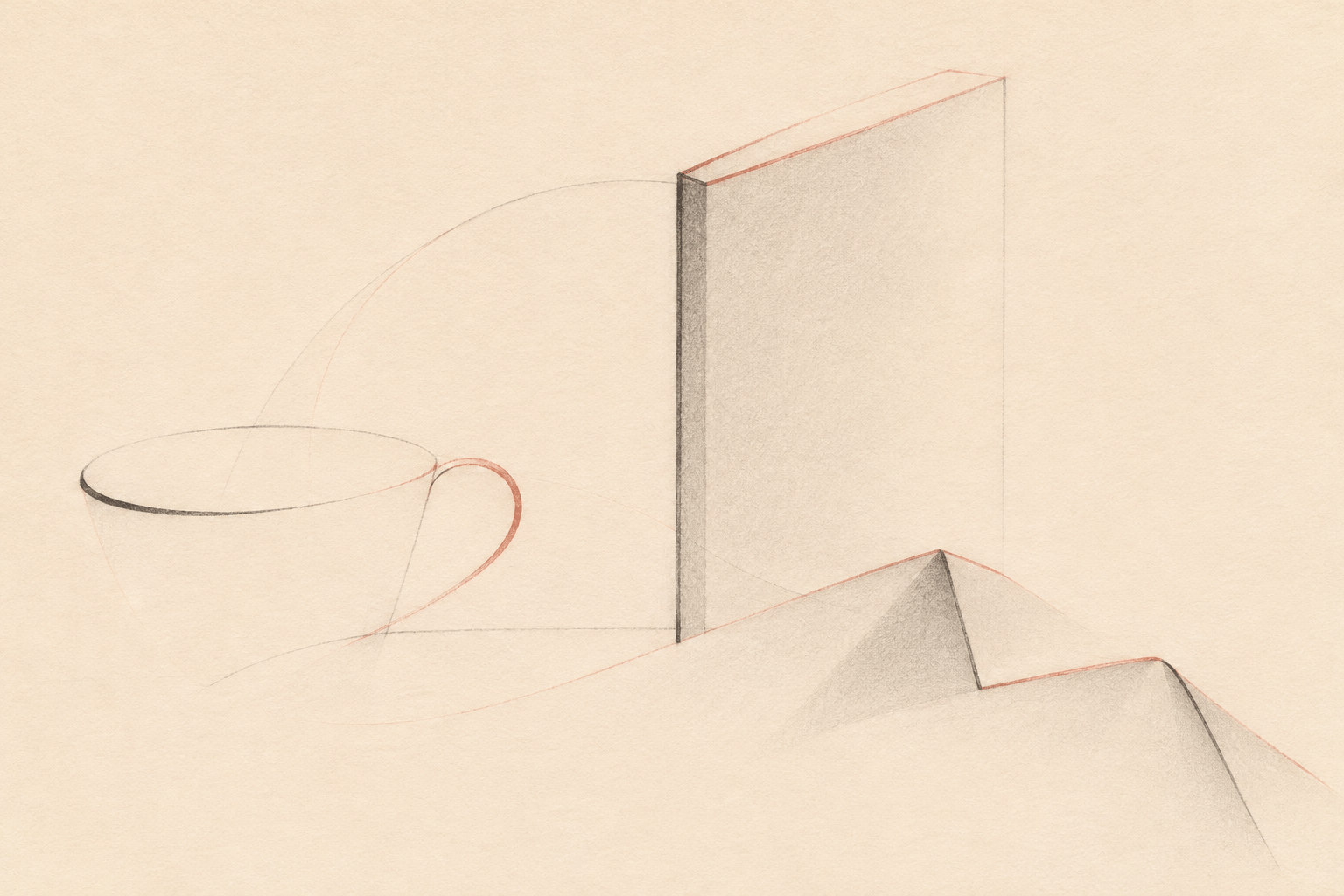
The new banner groups a handled cup, a small box, an upright book and cloth around a table corner. Light guides establish broad relationships, while a restrained red axis draws attention to the cup. The emphasis is on arrangement and overlap. It is an invented illustration of a structural approach, not a measured diagram or a record of an actual classroom exercise.
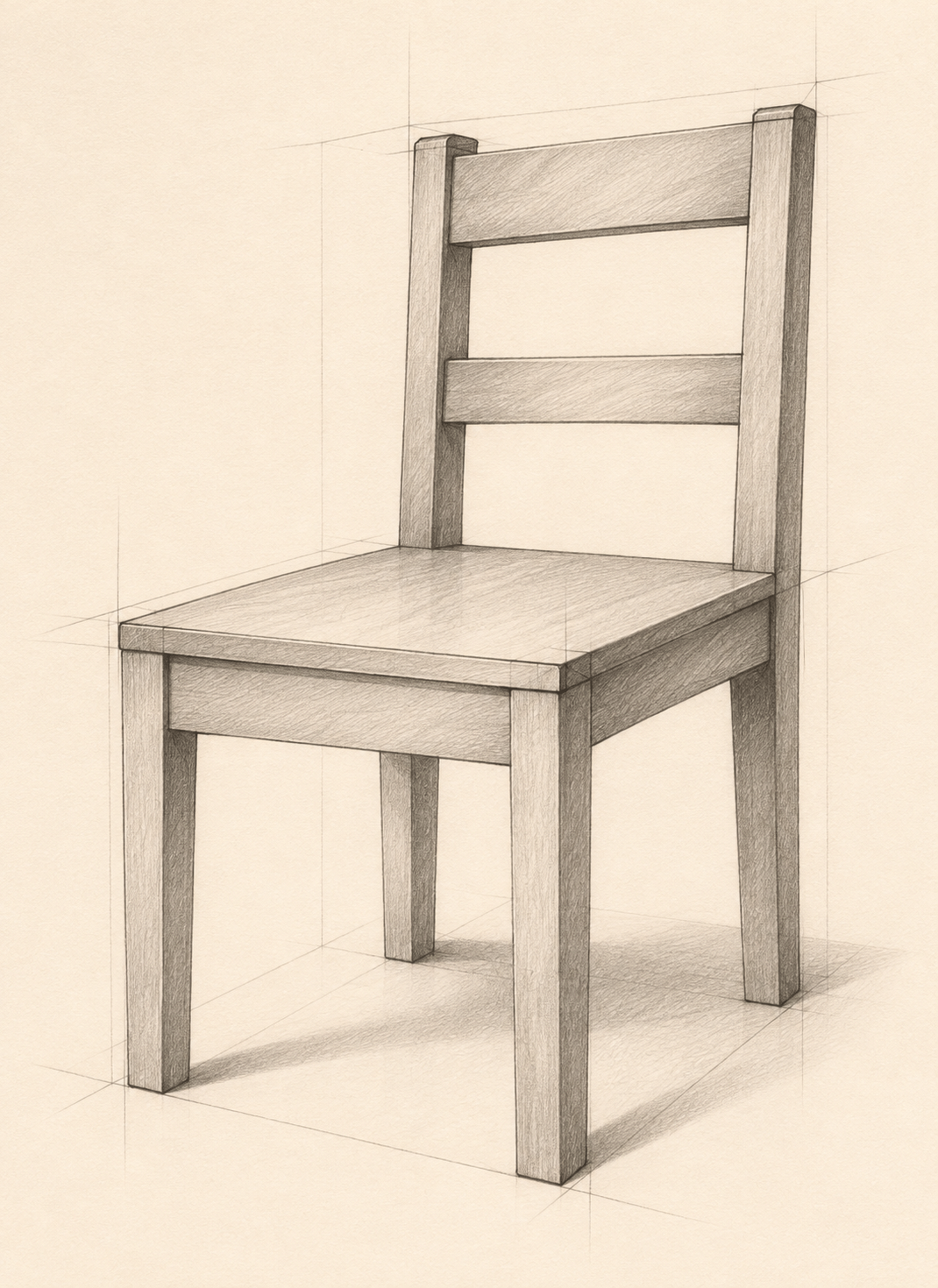
The chair study shifts attention to connections. Follow the seat toward the back and then down the legs; compare the open spaces between the supports. Pale enclosing shapes are subordinate to selected darker edges. For a drawing from life, test one joint at a time against the actual chair instead of assuming that a plausible silhouette guarantees consistent perspective.
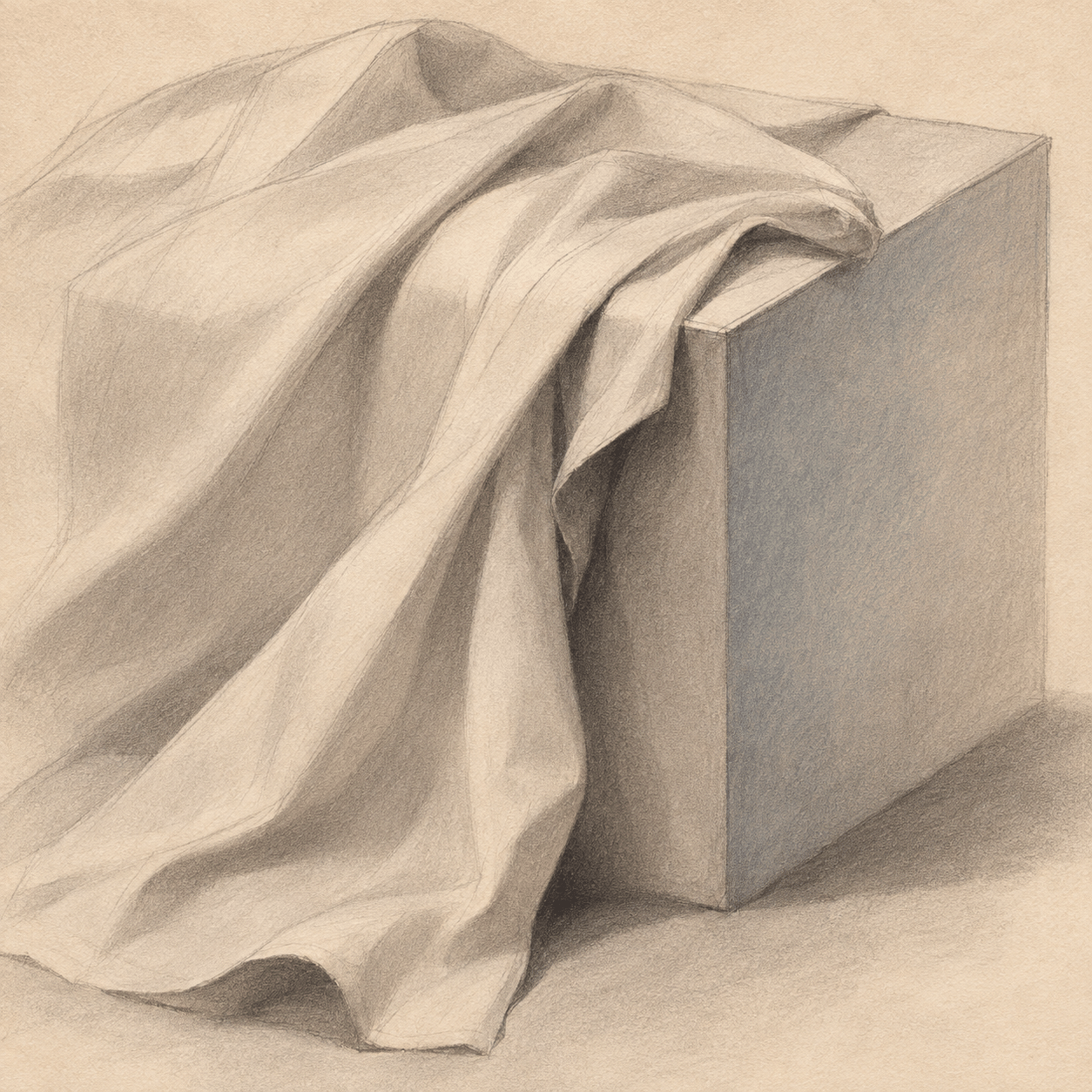
The cloth study makes a different demand. A soft surface bends over a rigid box, and the folds change direction as they pass its edge. A blue-grey shadow plane helps separate the side from the top. Trace one fold from its support to its hanging end: a structural decision should explain a change in surface direction rather than merely add a decorative stripe.
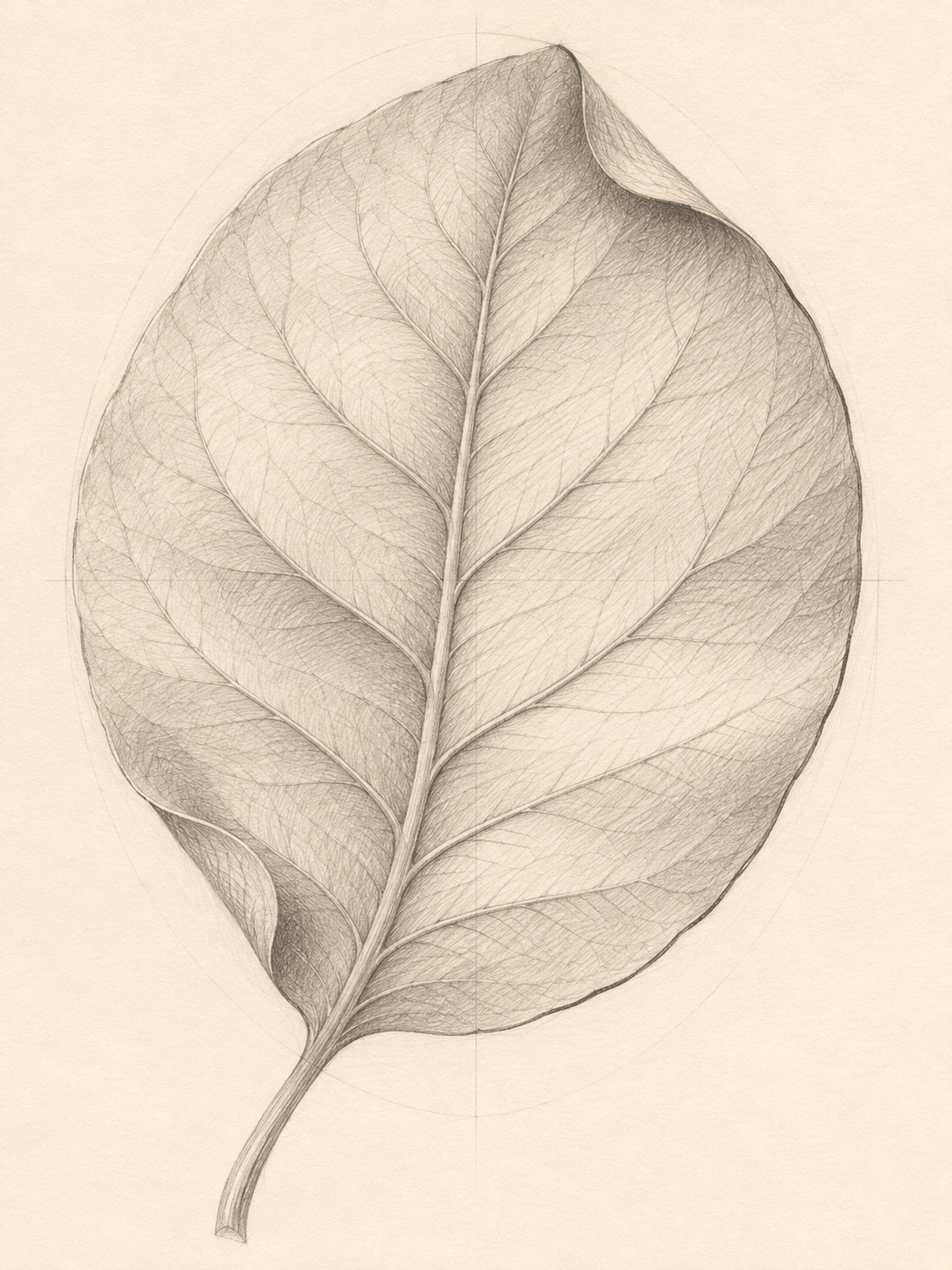
The leaf study uses a central rib, branching veins and a light enclosing oval to relate the parts to the whole. Small turned edges interrupt its outline. This is an artistic investigation of a broad leaf form, not a botanical identification plate. The important question is how the side structures meet the central one and how the outer contour changes as the surface turns.
The final new study reduces a cup, book and folded surface to a few directional relationships, with red accents and generous empty paper. It is an independent arrangement, not the final frame of a literal step-by-step transformation of the banner. Reduction works when the selected relationships still explain the composition; simply erasing detail does not ensure clarity.
What the retained illustrations show
The standalone portrait combines a readable head, hand and draped shoulder with many straight construction-like lines and broad shaded planes. It is useful for comparing light exploratory marks with darker descriptive edges. Some lines extend beyond the figure, so the image also shows a limit: a diagrammatic appearance does not prove that the marks record measured anatomical relationships.
The titled collage brings together figures, heads, a horse, architectural details, basic volumes and a chair. Their shared pencil-like vocabulary suggests different subjects that can be investigated through drawing. These are AOI archive interpretations, not authenticated studies by the historical artists discussed here and not engineering or anatomical reference plates.
Try a small, checkable study
Place a cup beside a box and choose a viewpoint you can keep. First mark their overall height and width lightly. Compare the cup’s tilt with a vertical reference, then compare the size of its opening with its body. Draw the shape of the gap between cup and box. Correct those relationships before adding texture or dark shading.
Choose a few marks to strengthen: an important overlap, a turning edge, or the darkest contact. Leave rejected trials lighter so that the process remains legible. If all marks have equal weight, the viewer cannot tell a tentative comparison from a final decision. A small value study can help, but shading should explain form rather than conceal uncertain proportions.
A short review you can perform yourself
Compare a drawing with the subject before polishing it. Check one overall proportion, one angle, one overlap and one negative space. If a correction changes several relationships, make it while the marks are still light. Then remove or soften a guide that no longer helps. A drawing can become clearer through subtraction as well as addition.
For generated studies, inspect the same relationships rather than judging by the number of construction lines. Look for connections that terminate in the wrong place, ellipses that disagree with their vessels, or guides that merely decorate the background. Use the image as a prompt for observation, then make a fresh study of a real object to test what it suggested.
Useful vocabulary and common failures
For an original image study, ask for exploratory construction lines, selective contours, axis comparisons, simple volume blocks, restrained hatching and visible negative space. Specify a subject and a question: how a handle joins a cup, how a chair supports a seat, or how a folded cloth crosses an edge. A page filled with random diagonals can look technical while explaining nothing.
Use these studies for observation, design exploration and developing compositions. A generated illustration cannot certify measurements, perspective construction or anatomy merely because it resembles a study sheet. Test practical relationships against the actual subject. This is AI-assisted editorial writing in AOI’s Penny Wraiter persona; the original generation settings of the retained archive images are unknown.
Positive review — AOI editorial perspective
Analytic drawing makes visual decisions visible. A selective axis, a measured-looking gap or a darker overlap can help a viewer understand how the artist organized a subject. The new gallery broadens that investigation across rigid objects, soft folds, organic structure and abstract reduction, while the retained portrait offers a denser comparison.
Negative review — AOI editorial perspective
The appearance of analysis can be mistaken for its achievement. Random diagonals, excessive scaffolding and confident shading may conceal uncertain connections. Choose a specific question, keep tentative marks subordinate and compare the drawing with an actual subject when accuracy matters. Technical-looking marks are not evidence of measurement.
Neutral review — AOI editorial perspective
This entry uses analytic drawing as a broad working description and identifies documented Bauhaus teaching as one historical context. The linked student drawing has a cautious museum attribution. The gallery contains contemporary generated interpretations rather than historical teaching sheets, and its examples support visual discussion rather than certify anatomy or construction.
A small poetic detour
Original words from the AOI studio.
Poetry
Before the shading, a question.
Before the contour, a tilt.
The pale line tries a distance;
the darker line remembers
what looking taught the hand.
The handle leaves a space of air;
the chair divides the waiting floor.
A fold turns softly at the edge;
a leaf asks one direction more.
Leave room around the first attempt,
leave yesterday’s mistake still pale.
The line that learns to change its mind
may tell the clearest part of the tale.
The prompt workshop
Original creative exercises. These prompts create new illustrations, not documentary evidence.
Cup and box relationships
Create an original graphite-style study of a plain cup beside a small box on a table. Show light exploratory axes, a clear gap between objects and selected darker contours. Keep ellipses, overlaps and broad proportions visually coherent. Sparse hatching, warm paper, no labels, numbers or signature. Illustrative study, not a measured technical drawing.
A chair as connected volumes
Create an original structural drawing of a simple wooden chair in three-quarter view. Use pale box-like volume guides, selective darker edges and a clearly readable seat, back and legs. Emphasize how the parts connect, with generous empty paper. No arbitrary diagonal mesh, text or dimension marks; not a construction plan.
From observation to a few lines
Create a three-panel drawing study of a cup, folded cloth and upright book: a simple observed arrangement, an analysis of dominant axes and gaps, then a sparse abstract arrangement retaining the strongest relationships. Consistent framing, pencil and one muted red accent. No labels; a new visual exercise rather than a historical reconstruction.
People & works to explore
References discussed in this article. Consult the sources below for context.
Artists and practitioners
Vassily Kandinsky — teacher associated with the cited Bauhaus exercise
Josef Albers — author of Concerning Art Instruction (1934)
Unidentified student of Vassily Kandinsky at the Bauhaus — maker credited for the cited Dessin analytique
Paintings and other works
Dessin analytique (1922–1933), student of Vassily Kandinsky at the Bauhaus, ink on paper, Centre Pompidou
A smile from the studio
Jokes
My construction lines asked when the drawing would be finished. I told them they were still under review.