
Curatorial concept · Nicolas Bourriaud and Tate Triennial 2009
Altermodern is a curatorial proposition about making art in a globally connected world. Associated with Nicolas Bourriaud and the 2009 Tate Triennial at Tate Britain, it emphasizes journeys, translation and movement between cultural materials and formats. It is not a recognizable palette, a synonym for anything new or an agreed declaration that one historical era has ended.
A visual introduction
Open any image to look closer, then browse the examples.
Creative toolbox · take this style further
Choose an input, adjust it, then open a tool. Search links pass your text to the destination. Copy & open copies it for you to paste into the generator; you start generation there.
ChatGPT
Copy your input and paste it into a ChatGPT conversation or image request.
Copy & open ChatGPT (new tab)Claude · Anthropic
Develop an image prompt or explore the style in a new Claude conversation.
Copy & open Claude · Anthropic (new tab)Midjourney
Paste your input into the Imagine bar on the Create page.
Copy & open Midjourney (new tab)Adobe Firefly
Copy your input, open Firefly, and paste it into the prompt field.
Copy & open Adobe Firefly (new tab)Leonardo.Ai
Copy your input, open Leonardo, and paste it into the generation field.
Copy & open Leonardo.Ai (new tab)Lexica
Search AI images and prompts using your selected input.
Search with this input Lexica (new tab)Pexels
Search the photo and video library. Short keywords often work best.
Search with this input Pexels (new tab)Pixabay
Search photos, illustrations and other images.
Search with this input Pixabay (new tab)Unsplash
Search photographs using the style name or your own keywords.
Search with this input Unsplash (new tab)Wikipedia
Search for background reading. A style may not have its own article.
Search with this input Wikipedia (new tab)WikiArt
Copy your input into WikiArt’s search to explore artists and artworks.
Copy & open WikiArt (new tab)Instagram hashtags
Search a hashtag made from your input: spaces and punctuation are removed. Instagram may require sign-in.
Search with this input Instagram hashtags (new tab)A closer look
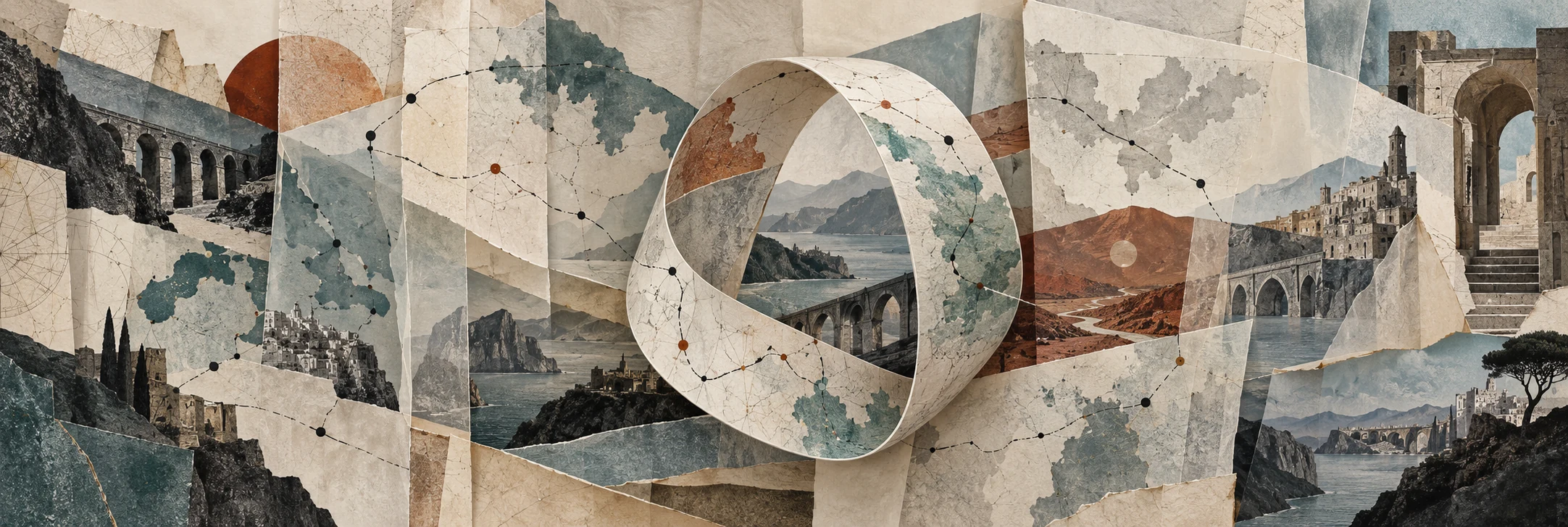
Our original banner is a visual essay in connected fragments: translucent map-like sheets, routes, architectural traces and interrupted layers. Its invented geography makes connections visible without pretending to document a particular migration. It illustrates a question raised by the concept; it is not a historical Altermodern artwork or a reproduction of the 2009 exhibition.
Start with the proposition
Bourriaud’s manifesto, published as a Tate Britain announcement in 2009, proposes that changing conditions of travel and cultural exchange call for different artistic forms. It presents the journey as something that can organize a work, not merely provide its subject. [1]
Translation, in this account, can involve movement between formats as well as languages. The manifesto describes an art of connected trajectories through place and time, and frames the exhibition as a discussion of an emerging altermodernity. Its claim about the end of postmodernism is an argument to assess, not a settled date in a timeline. [1]
Keep that distinction when using the term. A curatorial framework offers a way to relate different practices. It does not necessarily describe how every participating artist understands their own work, nor does it impose a shared technique.
Look for relationships, not a signature appearance
A work concerned with translation might connect a recorded voice to an image, a journey to a sculpture or an archival fragment to a newly made object. What matters is how one element changes the meaning of another. Bright colours or mixed materials alone tell us little.
Ask what travels, what remains local and what becomes unavailable in the transfer. A photograph of an object is not the object; a translated phrase may carry a different rhythm; a route on a map can hide the conditions of moving through the territory.
The banner uses overlapping sheets to suggest these changes. Some traces continue across a seam, while others stop. This is our interpretive device rather than a universal Altermodern motif. The seams are useful because they prevent the composition from pretending that connection is effortless.
A documented project to investigate
Nick Hornby’s account of The Ghost in the Machine identifies the project as a Visual Dialogues commission connected to the 2009 Tate Triennial. The artist’s page presents questions of interpretation, authorship and translation in relation to sculptural practice. It supplies a specific project to examine rather than an unsupported list of supposedly Altermodern celebrities. [2]
Study the project’s documentation before generalizing from it. Which relationships are visible in the objects, and which require the accompanying account? An exhibition photograph, an artist’s statement and a curator’s interpretation are related sources, but each tells you something different.
That distinction is valuable beyond this example. A work should not be reduced to a convenient illustration of a theory; the unexpected details may be where the work resists the theory most productively.
Questions the framework leaves open
Here is a critical reading to try: whose mobility does the image assume? The freedom to travel, circulate an object or translate a cultural reference is not equally available to everyone. A celebratory network diagram can make those differences difficult to see.
Similarly, combining references does not erase their histories. Name where material comes from, distinguish quotation from invention and consider what is lost when a local practice becomes a portable visual motif. Connection is a starting point for attention, not a substitute for it.
These are questions we bring to the framework, not claims that every associated artist answers them in the same way. They allow a viewer to test the usefulness and limits of the concept against a particular work.
An exercise in accountable translation
Choose one ordinary object you know well. Draw it, describe it in words, then use that description to make a second image without referring to the drawing. Place the stages together and annotate what survived, changed or disappeared.
An image model can participate in the second translation, provided its output is labelled and its inventions remain visible as inventions. Do not manufacture archival evidence or real migration histories to make the exercise seem important.
The result need not look cosmopolitan or technologically elaborate. A small, precisely documented change can reveal more about translation than a grand collage in which every origin has been erased.
A small poetic detour
Original words from the AOI studio.
Poetry
The route crosses the fold.
On the other side, its name changes.
The crease remains.
The prompt workshop
Original creative exercises. These prompts create new illustrations, not documentary evidence.
Start with a translation
Create an original conceptual collage from three representations of the same invented everyday object: a drawing, a paper silhouette and a sculptural interpretation. Make differences between translations visible. No text or historical claims.
Original AOI exercise; a generated image is not historical or documentary evidence.
Build connected layers
Compose a wide visual essay using translucent invented maps, architectural fragments and interrupted routes. Show seams and missing connections, varied scales and material textures. Do not use sacred motifs or pretend this is a real migration archive.
Original AOI exercise; a generated image is not historical or documentary evidence.
Test what disappears
Make a second interpretation of the first collage from a short written description only. Compare what changes. Label the generated stage and record which elements were invented.
Original AOI exercise; a generated image is not historical or documentary evidence.
People & works to explore
References discussed in this article. Consult the sources below for context.
Artists and practitioners
Nicolas Bourriaud — curator and theorist of the proposition
Nick Hornby — a documented project connected to the 2009 Triennial
Paintings and other works
Altermodern: Tate Triennial 2009 — exhibition and curatorial framework
The Ghost in the Machine (Nick Hornby, 2009)