
Art history · the Aesthetic Movement and the designed interior
Aestheticism gives unusual weight to the experience of art: colour, form, rhythm and sensuous arrangement need not justify themselves by delivering a moral lesson. In late-nineteenth-century Britain, that position connected painting and literature with furniture, ceramics, dress and interiors. It was more than a preference for pretty objects—and it is more specific than today’s broad use of the word “aesthetic.”
A visual introduction
Open any image to look closer, then browse the examples.
Creative toolbox · take this style further
Choose an input, adjust it, then open a tool. Search links pass your text to the destination. Copy & open copies it for you to paste into the generator; you start generation there.
ChatGPT
Copy your input and paste it into a ChatGPT conversation or image request.
Copy & open ChatGPT (new tab)Claude · Anthropic
Develop an image prompt or explore the style in a new Claude conversation.
Copy & open Claude · Anthropic (new tab)Midjourney
Paste your input into the Imagine bar on the Create page.
Copy & open Midjourney (new tab)Adobe Firefly
Copy your input, open Firefly, and paste it into the prompt field.
Copy & open Adobe Firefly (new tab)Leonardo.Ai
Copy your input, open Leonardo, and paste it into the generation field.
Copy & open Leonardo.Ai (new tab)Lexica
Search AI images and prompts using your selected input.
Search with this input Lexica (new tab)Pexels
Search the photo and video library. Short keywords often work best.
Search with this input Pexels (new tab)Pixabay
Search photos, illustrations and other images.
Search with this input Pixabay (new tab)Unsplash
Search photographs using the style name or your own keywords.
Search with this input Unsplash (new tab)Wikipedia
Search for background reading. A style may not have its own article.
Search with this input Wikipedia (new tab)WikiArt
Copy your input into WikiArt’s search to explore artists and artworks.
Copy & open WikiArt (new tab)Instagram hashtags
Search a hashtag made from your input: spaces and punctuation are removed. Instagram may require sign-in.
Search with this input Instagram hashtags (new tab)A closer look
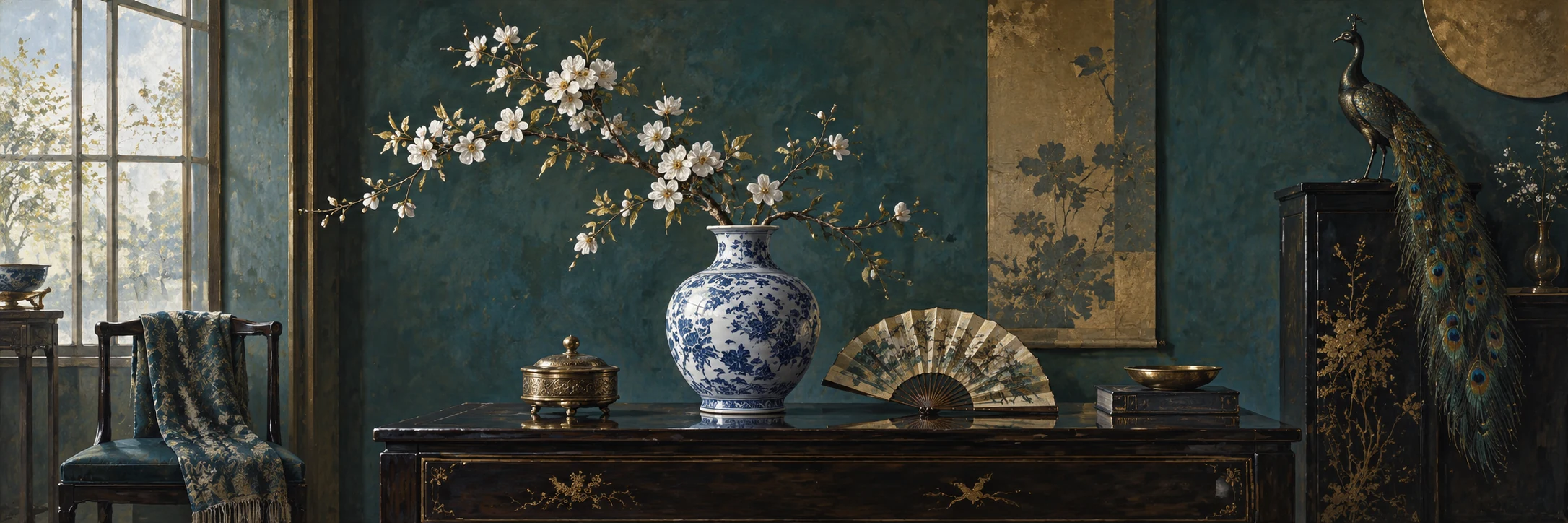
The banner imagines a quiet interior arranged around blue-and-white ceramics, a fan, a peacock-feather motif and a flowering branch. Restrained gold and deep blue-green connect the objects without making them identical. This is an original interpretation of design relationships, not a reconstruction of Whistler’s Peacock Room or an authenticated period interior.
Beauty as an argument
The V&A places the British Aesthetic Movement broadly between 1860 and 1900 and explains its challenge to expectations that art should tell an improving story. The familiar phrase “art for art’s sake” names that challenge. It does not establish that every associated artist held an identical philosophy or that a beautiful work has no social context. [1]
The old entry’s claim that the artist’s pleasure simply mattered more than the viewer’s is too crude. A more useful question concerns the grounds on which art is valued. Must it teach a lesson, illustrate a narrative or serve an external purpose to deserve serious attention?
Aestheticism makes the arrangement itself worth examining. An interval between objects, a restrained colour echo or a deliberately unresolved mood can become central to the experience rather than incidental decoration around a message.
The room becomes a composition
The V&A’s account of the aesthetic home describes a field of furnishings and popular motifs, including peacocks, fans and sunflowers. It also identifies Western interpretations of Japanese art among the influences on design. These are historically situated acts of selection and adaptation, not evidence of a single interchangeable “Eastern” style. [2]
Read an interior at several scales. First notice the dominant light and colour fields. Then examine the relation between furniture and wall. Finally look at an individual vessel or small motif. If these scales respond to one another, the room can feel composed rather than merely full.
In our banner, the pale ceramics interrupt darker surfaces while the branch introduces an uneven living rhythm. The fan and feather-like ornament offer flatter shapes. Their difference matters as much as their coordination. A collection of matching motifs alone would be a less interesting arrangement.
A documented example with a complicated history
The Smithsonian’s record dates James McNeill Whistler’s Harmony in Blue and Gold: The Peacock Room to 1876–1877. It explains that Thomas Jeckyll designed the dining room in Frederick Leyland’s London home before Whistler transformed its decoration. The work therefore has a history of collaboration, alteration and patronage, not simply the appearance of a timeless masterpiece. [3]
Study the museum images for repeated colour, shelves and ornamental fields. The title’s musical language invites attention to relationships across the room. Yet its harmonious appearance should not erase the practical and personal conflicts involved in making it.
A source-based account can hold both observations: the work offers an intense visual experience, and it emerged through particular people, objects and circumstances. Beauty need not become an excuse to stop asking historical questions.
Distinguish the movement from a mood board
A contemporary image can borrow a peacock palette or an elegant fan without becoming a historical Aesthetic Movement work. Identify it as an interpretation and explain the borrowed design problem. Likewise, a social-media “aesthetic” may be an informal cluster of tastes rather than an art-historical category.
For a present-day study, select three objects with different profiles and a limited palette. Arrange them so that a curve, a colour and a gap recur without exact repetition. Photograph or draw several alternatives. The task is to make the relationship rewarding, not to accumulate the largest number of period-looking accessories.
When using an image model, ask for coherent materials and deliberate spacing. Inspect the ceramic pattern, furniture joins and repeated ornament. Synthetic detail can multiply quickly; convincing arrangement requires subtraction as often as addition.
A small test of attention
Remove the most decorative object from your composition. Does the remaining arrangement still deserve a second look? If so, the image may be doing more than displaying attractive possessions.
Return the object only if it strengthens the whole. The pleasure of looking can be precise, demanding work—an argument made through how things are placed.
A small poetic detour
Original words from the AOI studio.
Poetry
The blue returns in porcelain.
A branch leans into the silence.
No moral arrives.
The prompt workshop
Original creative exercises. These prompts create new illustrations, not documentary evidence.
Start with an arrangement
Invent a still life with a pale ceramic vessel, a folded fan and a flowering branch against deep blue-green. Restrained gold accent, deliberate gaps and varied profiles. No copied historical design or lettering.
Original AOI exercise; a generated image is not historical or documentary evidence.
Build an interior
Create an original Aesthetic Movement-inspired room where wall colour, ceramic objects and furniture form a considered arrangement. Use subtle botanical ornament and quiet areas; do not reproduce the Peacock Room.
Original AOI exercise; a generated image is not historical or documentary evidence.
Test the relationship
Show the same invented interior with its most decorative object removed. Preserve lighting and viewpoint. Compare whether proportion, colour and spacing still carry the composition.
Original AOI exercise; a generated image is not historical or documentary evidence.
People & works to explore
References discussed in this article. Consult the sources below for context.
Artists and practitioners
James McNeill Whistler — painting and interior decoration
Thomas Jeckyll — architect of the room later transformed by Whistler
Paintings and other works
Harmony in Blue and Gold: The Peacock Room (1876–1877)
Sources and further exploration
[1] V&A — An introduction to the Aesthetic Movement
[2] V&A — Furnishing the aesthetic home
[3] Smithsonian National Museum of Asian Art — Harmony in Blue and Gold: The Peacock Room
Creative studies to try
Explore these collected prompts as creative interpretations. They are starting points for image-making, not reproductions of historical artworks or evidence about a tradition.
Visual cues: charged color, emotional contour, symbolic compression

Study 1 — Aestheticism
Ultra-wide panoramic banner, a human hand and a sleek robotic hand reaching toward each other, fingertips almost touching, a bright luminous spark of intelligence between them, a subtle world map behind them with global data network lines, symbolizing human-AI collaboration and digital transformation, rendered in Aestheticism style, with refined composition, distinctive materials, elegant lighting, high-detail artistic finish, high quality, high detail, balanced composition, no text, no logo, no watermark, exact aspect ratio 1584:396
Prompt source: 1001 Art Styles. Select the text to copy, then adapt the subject and composition.