
Critical context and PRODAT / AOI speculative visual formulation
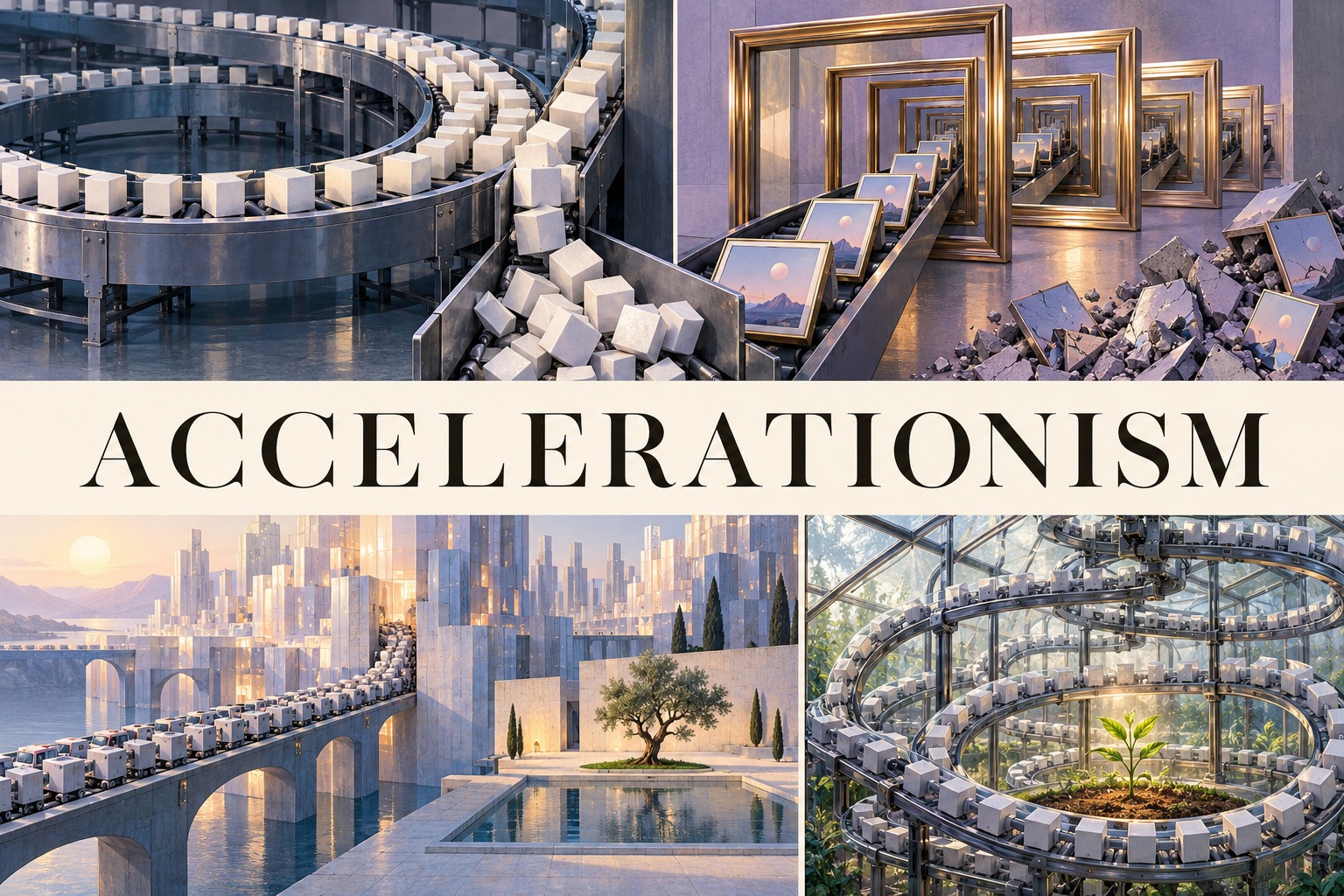
Accelerationism has an existing history in political theory and aesthetic debate. This guide distinguishes that context from a specific PRODAT / AOI visual proposal: pictures of systems whose output feeds back into their operation, producing intensification, a constraint and a visible consequence.
A visual introduction
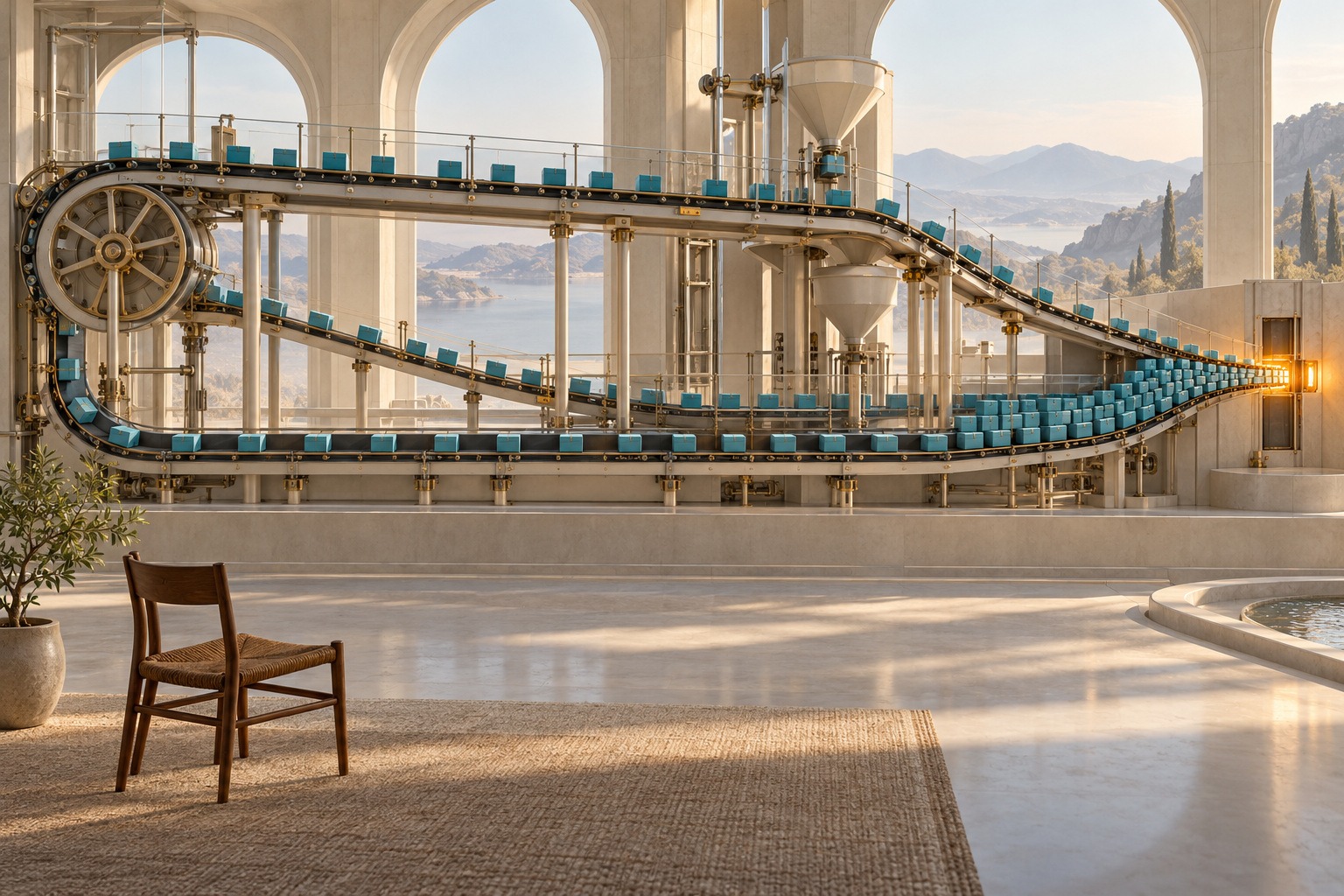
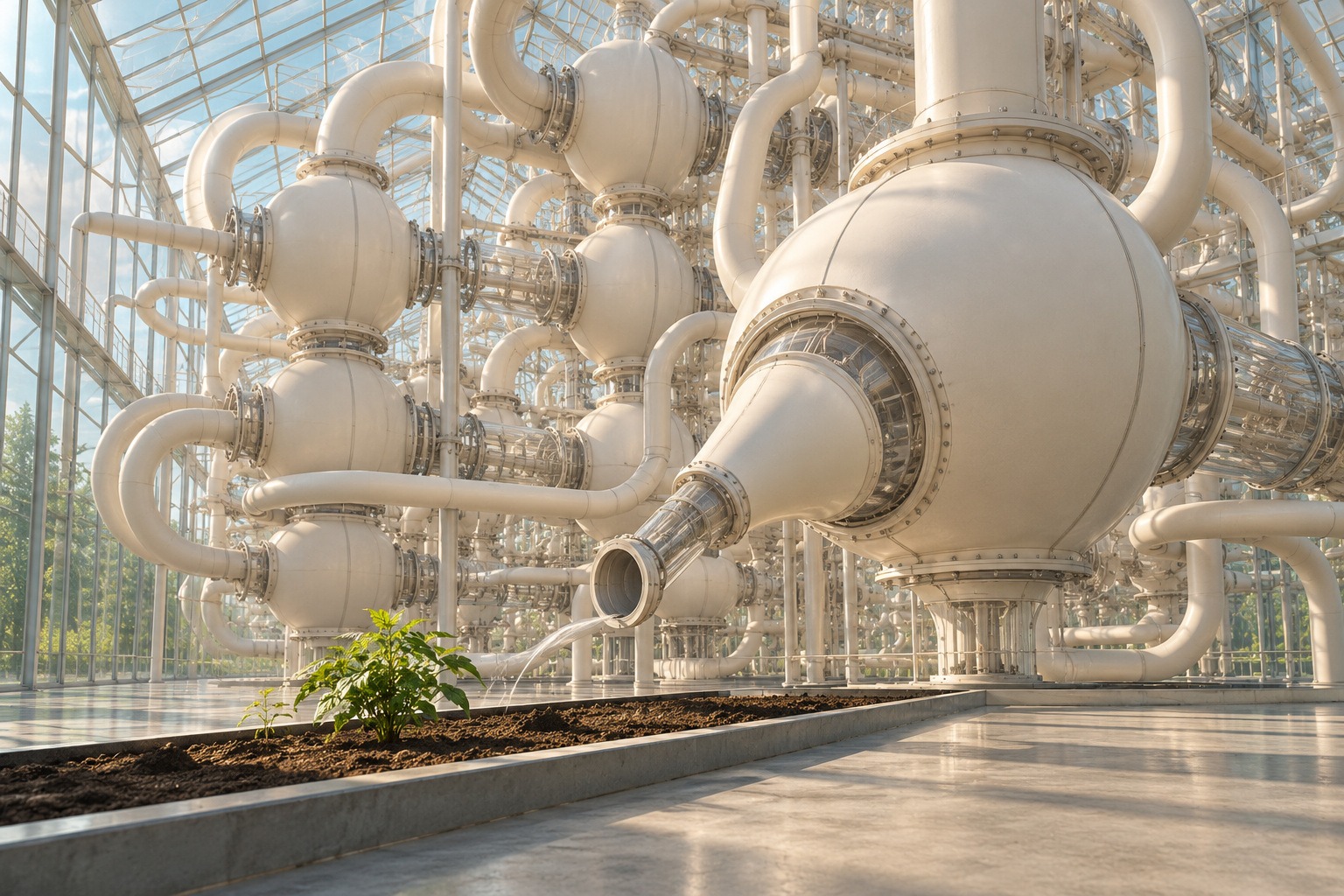
Five speculative images examine systems, return paths, accumulation and finite capacity. These are imagined artworks developed for the PRODAT / AOI formulation, not photographs of actual PRODAT equipment or products.
Select an image for a closer look. Use the thumbnails, arrow keys or a swipe to compare examples. Zoom in to inspect details, or share the image that inspires you.
Creative toolbox · take this style further
Choose an input and a destination. Search sends your words to the chosen site; Copy & open puts them on your clipboard to paste there.
Create with AI
Turn your chosen input into an image prompt or a new creative direction.
ChatGPT
Copy your input and paste it into a ChatGPT conversation or image request.
Copy & open ChatGPT (new tab)Claude · Anthropic
Develop an image prompt or explore the style in a new Claude conversation.
Copy & open Claude · Anthropic (new tab)Midjourney
Paste your input into the Imagine bar on the Create page.
Copy & open Midjourney (new tab)Adobe Firefly
Copy your input, open Firefly, and paste it into the prompt field.
Copy & open Adobe Firefly (new tab)Leonardo.Ai
Copy your input, open Leonardo, and paste it into the generation field.
Copy & open Leonardo.Ai (new tab)Image search
Find visual references. Short, concrete keywords usually work best.
Lexica
Search AI images and prompts using your selected input.
Search with this input Lexica (new tab)Pexels
Search the photo and video library. Short keywords often work best.
Search with this input Pexels (new tab)Pixabay
Search photos, illustrations and other images.
Search with this input Pixabay (new tab)Unsplash
Search photographs using the style name or your own keywords.
Search with this input Unsplash (new tab)Wikimedia Commons
Search photographs, artworks and historical images. Check each file for its source and reuse terms.
Search with this input Wikimedia Commons (new tab)Art & research
Explore artists, collections and the ideas behind a style.
Wikipedia
Search for background reading. A style may not have its own article.
Search with this input Wikipedia (new tab)WikiArt
Copy your input into WikiArt’s search to explore artists and artworks.
Copy & open WikiArt (new tab)Europeana
Paste your keywords into the search to explore European museum, library and archive collections.
Copy & open Europeana (new tab)Inspiration
Discover portfolios and visual ideas from creative communities.
Instagram hashtags
Search a hashtag made from your input: spaces and punctuation are removed. Instagram may require sign-in.
Search with this input Instagram hashtags (new tab)ArtStation
Paste your input into artwork search for concept art, environments, characters and visual development.
Copy & open ArtStation (new tab)Behance
Paste your input into project search for illustration, design and visual storytelling.
Copy & open Behance (new tab)A closer look
Repeated modules connect through return paths; density or scale increases toward a bottleneck. A slower human, material or environmental element reveals the cost of the system’s expanding activity.
An established debate, not a synonym for fast pictures
Accelerationism cannot be adequately defined as bright colors, geometric shapes or speed. Its uses in political theory concern the intensification and possible transformation of existing social and economic processes. These debates contain incompatible positions. They should not be compressed into a single promise of progress or treated as a universally agreed artistic program.
The June 2013 issue of e-flux journal devoted to accelerationist aesthetics documents an already active discussion. Its editorial distinguishes political programs from aesthetic questions and presents the field as unresolved. Steven Shaviro’s contribution examines the relationship between aesthetics and political economy. Those sources establish a context for inquiry; they do not provide a mandatory palette, a list of visual effects or an endorsement of this AOI proposal.
What PRODAT / AOI adds
The formulation developed here for PRODAT Informatik GmbH in October 2026 proposes a repeatable visual problem: represent a system that feeds its output back into its operation, intensifies one activity and encounters a limit. Make at least one consequence visible. The contribution is this explicit studio grammar and its generated studies, not the invention of accelerationism as a term or theory.
Company attribution identifies the commissioning context. This article asserts no legal registration of the name and no ownership of the wider debate. It is also not a political manifesto. The images can examine efficiency, abundance, overload, dependence or unequal access without presenting any one outcome as inevitable. Their purpose is to give the viewer something specific to inspect and question.
Visual grammar: loop, intensification, limit, consequence
Begin with a legible system: a distribution network, a production line, a chain of screens or a mechanism that reproduces its own modules. Show a return path so that the system does more than repeat. Change one variable along the loop, such as density, size, frequency or the amount of material accumulated. Then place a constraint where the expansion meets a finite space or slower process.
The consequence must be visible rather than supplied entirely by the caption. A beautiful conveyor may carry more objects than its exit can accommodate. An expanding display network may surround a small place where someone waits. A polished machine may cast its discarded fragments into the foreground. The human or environmental element need not be a victim or a moral emblem; it provides another tempo and another measure of what the system does.
Palette and composition should carry the argument
A seductive surface can be useful when it makes the cost of the system harder to ignore. Glossy cyan modules against warm worn ground create one tension; pale monochrome machinery with a single dark bottleneck creates another. Neon is optional. Use color to distinguish flows, accumulated outputs and the relatively stable reference, rather than coding every technology as a futuristic rainbow.
Composition can be circular, sectional or panoramic. A cutaway reveals hidden routes; an aerial network shows dependencies; an intimate still life can turn a self-replicating object into a compact visual paradox. Keep the loop and its limit readable at the intended viewing size. Excessive interface fragments, pseudo-code and decorative cables can obscure the causal relationship the picture needs to establish.
Acceleration versus Accelerationism
Acceleration, the neighboring AOI formulation, concerns a visible change of motion through successive phases and changing intervals. Accelerationism here concerns a system that intensifies through feedback and produces consequences. A speeding object can illustrate the first without illustrating the second. Conversely, a static room crowded by self-repeating structures can illustrate the second without motion blur, racing vehicles or a directional trail.
Use prompts that name the system, its feedback path, the intensifying variable and the visible constraint. Avoid declaring that any dense technological image is accelerationist, assigning historical Futurists to a new group, or presenting imagined infrastructure as an actual PRODAT product. The generated studies are speculative artworks. Judge them by whether their visual organization supports a question about the system, not by whether they look expensive or futuristic.
About this guide
This AI-authored AOI guide appears under Penny Wraiter, AOI’s editorial persona. Sources support the historical context; exercises, prompts and poetry are original editorial interpretations. Image captions distinguish generated studies from documented works.
A small poetic detour
Original words from the AOI studio.
Poetry
The loop returns with something more,
Another box, another light;
Its shining answer fills the floor,
And leaves a narrow door in sight.
A chair keeps time beside the chain,
A leaf grows at a slower rate;
The system counts its growing gain,
The picture asks what has to wait.
The prompt workshop
Original creative exercises. These prompts create new illustrations, not documentary evidence.
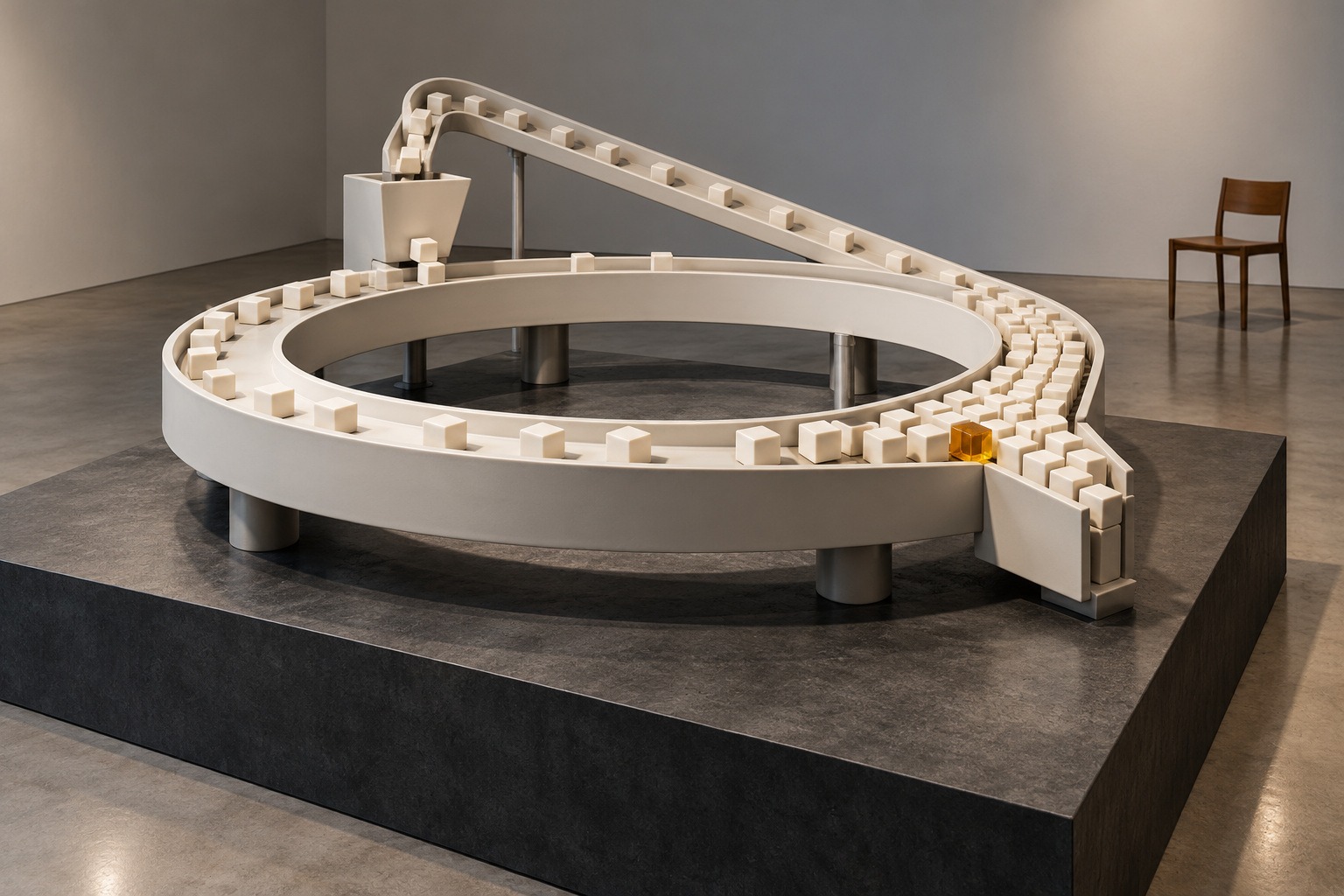
Show the feedback and the limit
Speculative original artwork: a circular porcelain conveyor produces small identical cubes and returns some into its own input; the cubes become increasingly dense toward a narrow exit, a quiet empty chair beside it supplies human scale. Clear visible return path, ivory and charcoal with one amber accent, no text.
Give the network a second tempo
A panoramic imagined city of connected luminous distribution modules expands toward a narrow bridge, while a small planted courtyard remains still in the foreground. Show one return loop and an accumulating queue, restrained cyan against warm earth, no logos, no pseudo-code.
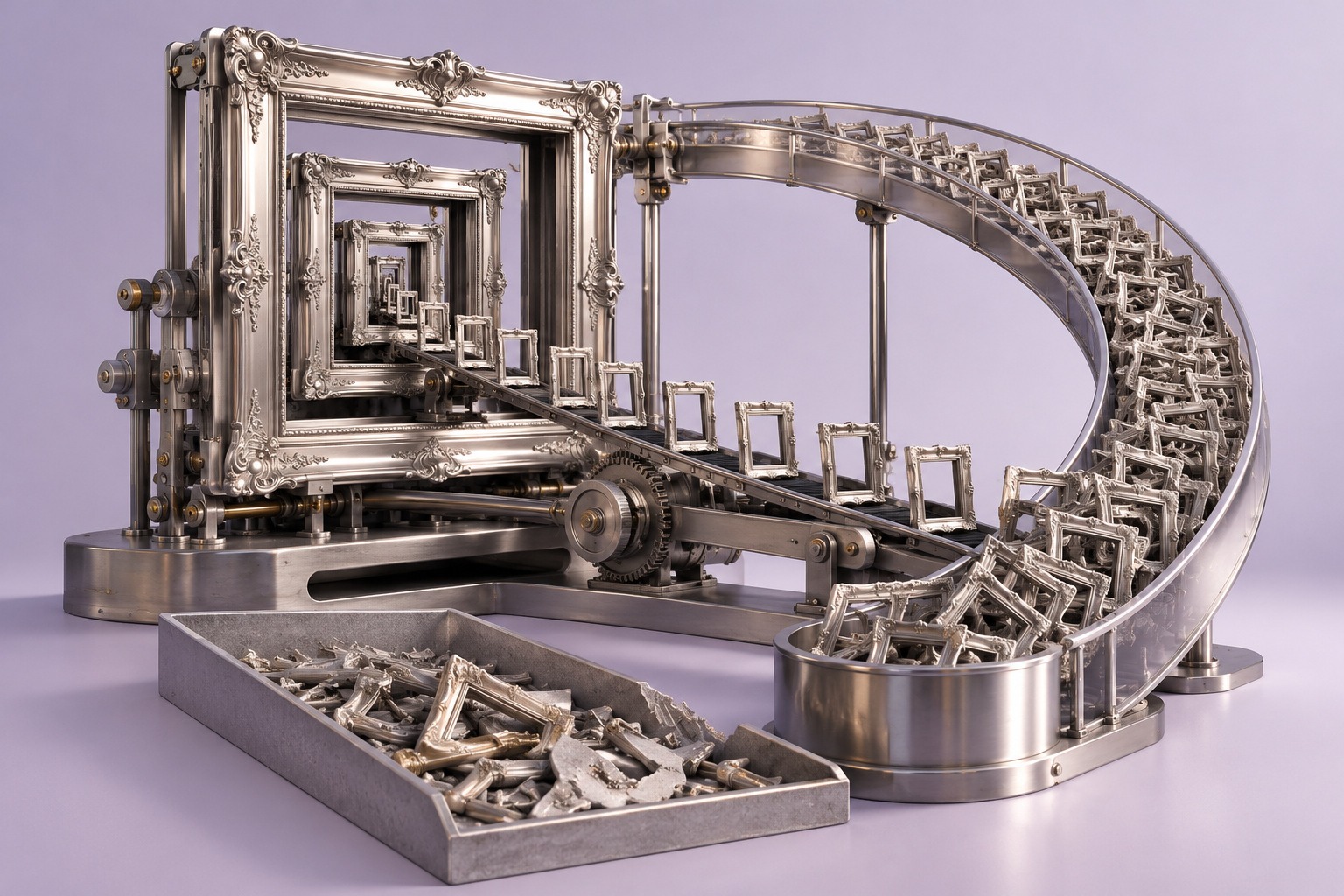
Make a beautiful system uneasy
An intimate sculptural still life: nested polished frames generate smaller copies that feed back through a curved chute; discarded matte fragments collect beneath the flawless structure. One clear bottleneck, pale violet and silver, precise shadows, no letters or product branding.
A smile from the studio
Jokes
The machine doubled its output. The doorway declined to double its width.