
AOI concept · diagram-inspired painting
Abstracted Mermaid Diagram turns node-and-edge relationships into an artistic composition. Branches, loops, junctions and isolated nodes become rivers, rooms, memories and intervals; the structure remains readable even when the diagram becomes painterly.
An A⊕I –[-.+] creαt¡ve c⊕ncept, n⊕t αn estαbl¡she∂ h¡st⊕r¡cαl m⊕vement.
A visual introduction
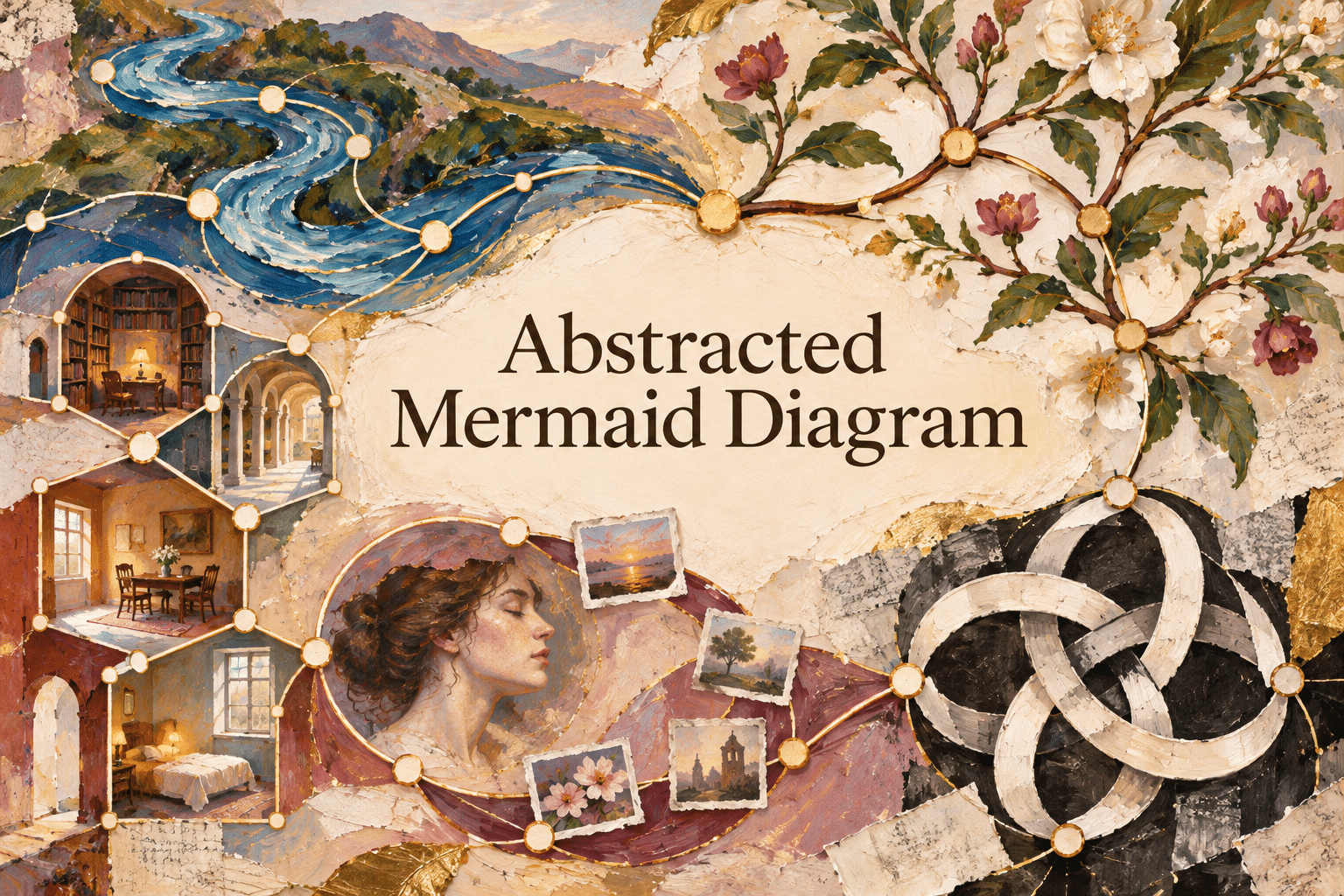
Seven original AI-generated interpretations: a dedicated banner, a centrally titled artistic collage and five standalone studies.
Select an image for a closer look. Use the thumbnails, arrow keys or a swipe to compare examples. Zoom in to inspect details, or share the image that inspires you.
Creative toolbox · take this style further
Choose an input and a destination. Search sends your words to the chosen site; Copy & open puts them on your clipboard to paste there.
Create with AI
Turn your chosen input into an image prompt or a new creative direction.
ChatGPT
Copy your input and paste it into a ChatGPT conversation or image request.
Copy & open ChatGPT (new tab)Claude · Anthropic
Develop an image prompt or explore the style in a new Claude conversation.
Copy & open Claude · Anthropic (new tab)Midjourney
Paste your input into the Imagine bar on the Create page.
Copy & open Midjourney (new tab)Adobe Firefly
Copy your input, open Firefly, and paste it into the prompt field.
Copy & open Adobe Firefly (new tab)Leonardo.Ai
Copy your input, open Leonardo, and paste it into the generation field.
Copy & open Leonardo.Ai (new tab)Image search
Find visual references. Short, concrete keywords usually work best.
Lexica
Search AI images and prompts using your selected input.
Search with this input Lexica (new tab)Pexels
Search the photo and video library. Short keywords often work best.
Search with this input Pexels (new tab)Pixabay
Search photos, illustrations and other images.
Search with this input Pixabay (new tab)Unsplash
Search photographs using the style name or your own keywords.
Search with this input Unsplash (new tab)Wikimedia Commons
Search photographs, artworks and historical images. Check each file for its source and reuse terms.
Search with this input Wikimedia Commons (new tab)Art & research
Explore artists, collections and the ideas behind a style.
Wikipedia
Search for background reading. A style may not have its own article.
Search with this input Wikipedia (new tab)WikiArt
Copy your input into WikiArt’s search to explore artists and artworks.
Copy & open WikiArt (new tab)Europeana
Paste your keywords into the search to explore European museum, library and archive collections.
Copy & open Europeana (new tab)Inspiration
Discover portfolios and visual ideas from creative communities.
Instagram hashtags
Search a hashtag made from your input: spaces and punctuation are removed. Instagram may require sign-in.
Search with this input Instagram hashtags (new tab)ArtStation
Paste your input into artwork search for concept art, environments, characters and visual development.
Copy & open ArtStation (new tab)Behance
Paste your input into project search for illustration, design and visual storytelling.
Copy & open Behance (new tab)A closer look
Begin with one clear relationship: branching, convergence, a return loop or separation. Translate nodes into forms and connections into paths while preserving the relation. Let texture and color add feeling without burying the structure.
From diagram language to artistic premise
Mermaid is a JavaScript-based tool that renders diagrams from text definitions. Its official documentation includes flowcharts and other diagram types. [1] The name in this AOI concept refers to that diagramming context, rather than a sea creature. The proposed art direction borrows a visual question: what happens when a relationship becomes the subject of a painting?
The gallery consists of original AI-generated raster interpretations. These are not exported Mermaid diagrams or executable definitions. Nodes and paths carry compositional and emotional roles, and their arrangement need not describe a real process. Keep that distinction visible whenever an illustration could otherwise be mistaken for technical documentation.
Choose a relationship before a subject
A branch suggests divergence; convergence gathers several routes toward a destination; a loop creates return; an isolated node creates separation. These meanings are artistic possibilities, not universal symbols. Select one relation first, then choose the subject that can make it vivid.
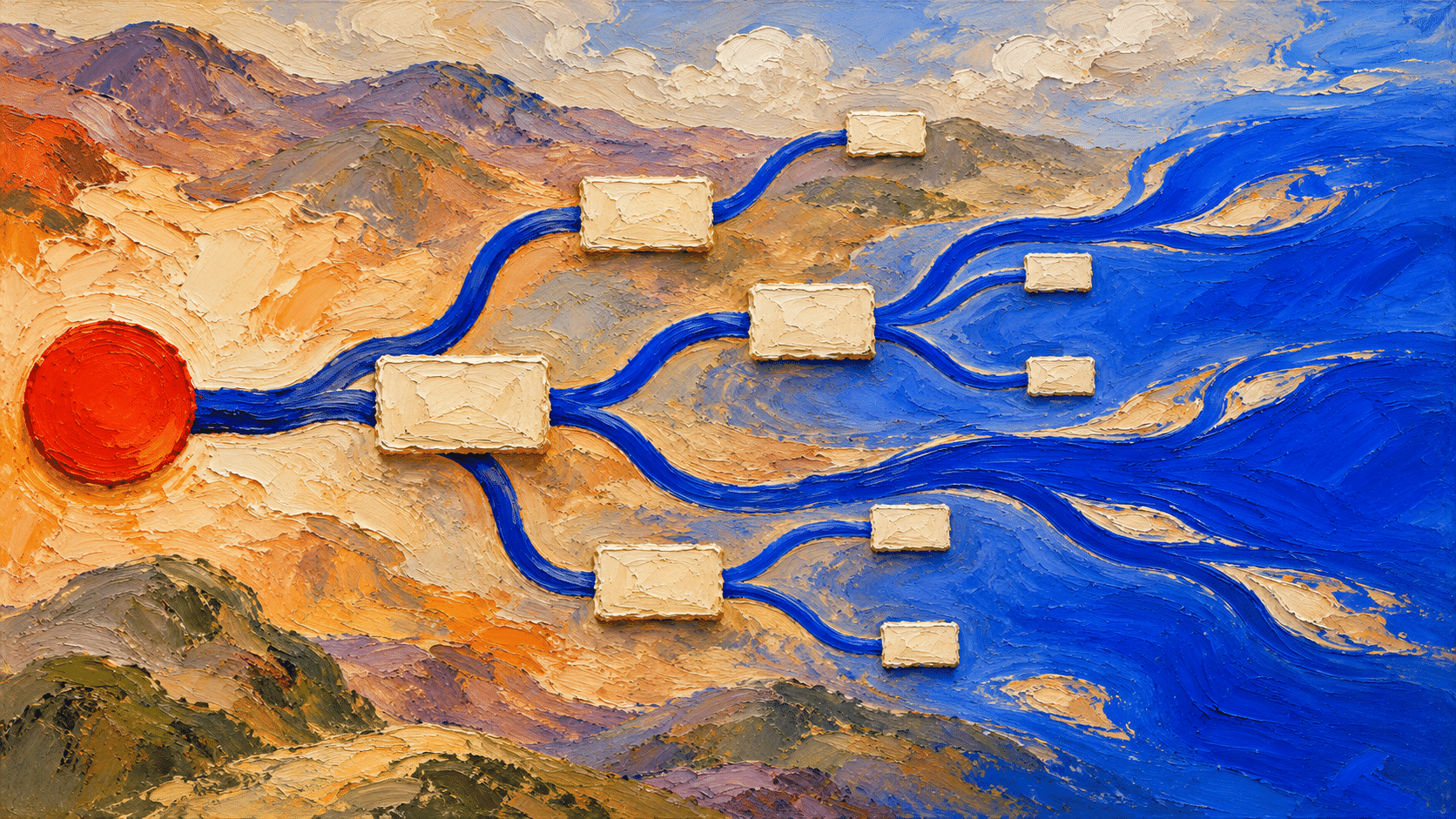
The banner uses a circular orange source and branching blue paths across a textured landscape. Ivory rectangles interrupt the flow like stations or islands. Its success depends on being able to follow the main connections. The landscape supports that reading instead of supplying a complicated scenic background that competes with it.
Make nodes and edges belong to their world
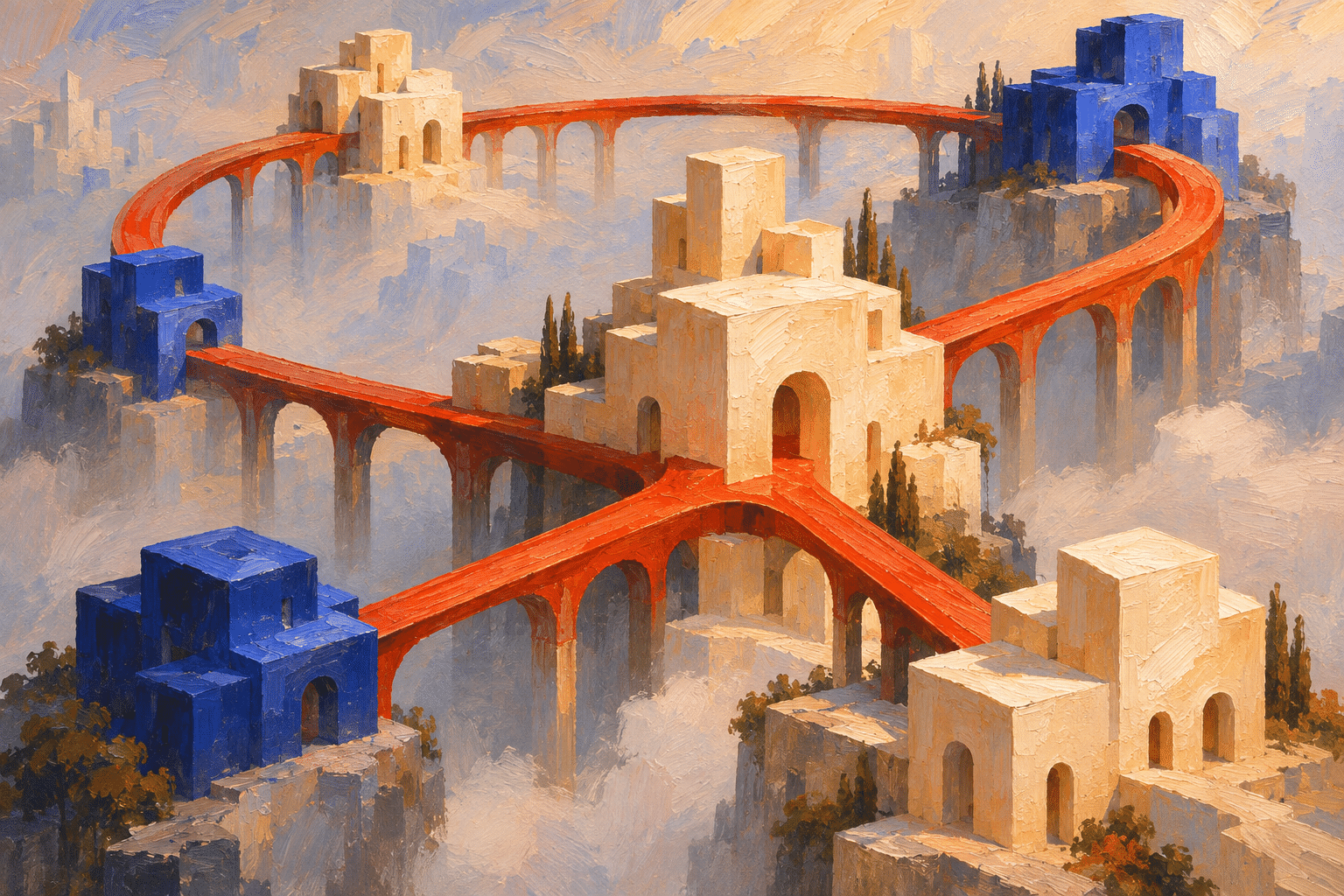
The network city turns nodes into buildings and edges into elevated orange bridges. Architectural mass gives each stop a distinct presence, while the continuous bridges make the large return route visible. This is an imagined spatial metaphor, not a buildable transport plan.
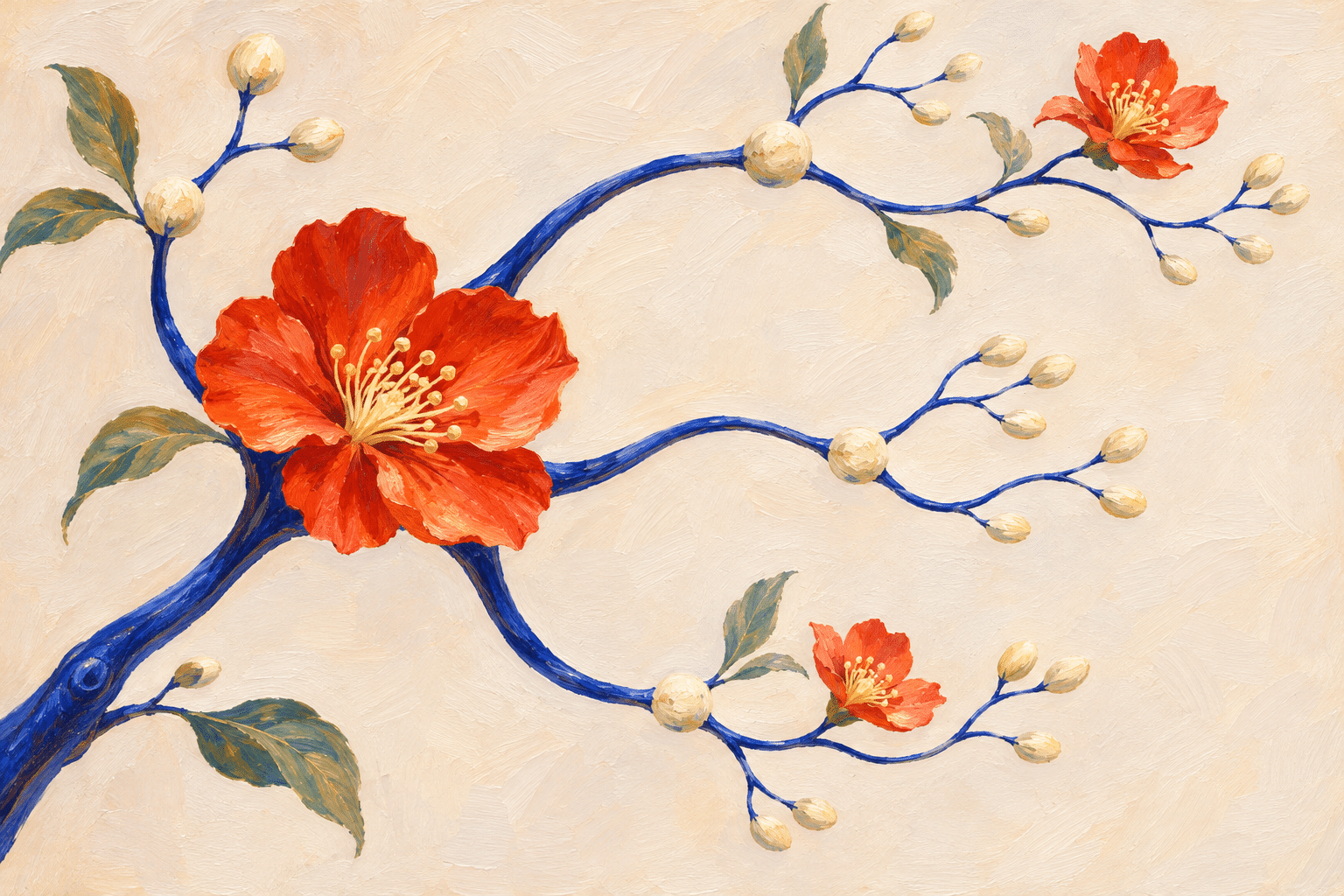
In the botanical example, blue stems serve as connections and pale buds as nodes. Red blossoms mark important junctions. The two images share a grammar but use different material cues. That translation is the core exercise: preserve the relationship while changing what its components look and feel like.
Let a portrait carry an internal map
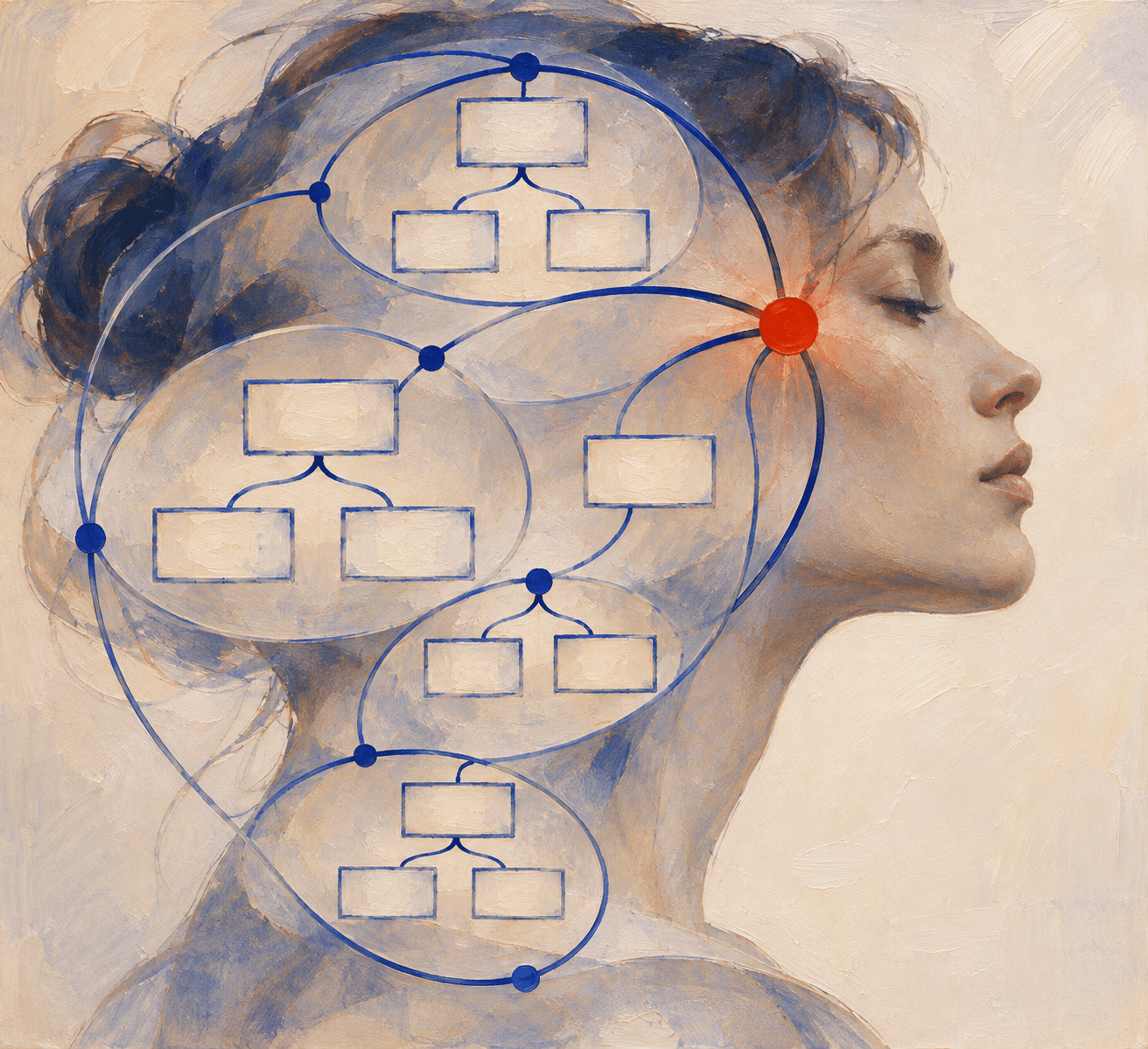
The profile study overlays a face with blue loops and blank ivory chambers. A single orange node near the temple gathers attention. The painting suggests memory through repetition and return without claiming to map an actual brain, personality or neurological process.
For a similar composition, keep the facial silhouette readable and reserve the densest network for one area. Leave some nodes blank rather than filling them with meaningless miniature text. The absence can become part of the idea: a remembered relation may be clearer than the event it connects.
Control texture, color and silence
A thick painted edge can feel like a river or a bridge; a fine line can feel tentative. Varying their weight changes emphasis, but arbitrary variation makes the network hard to follow. Decide which connection should be seen first, which should be discovered later and which can remain implied.
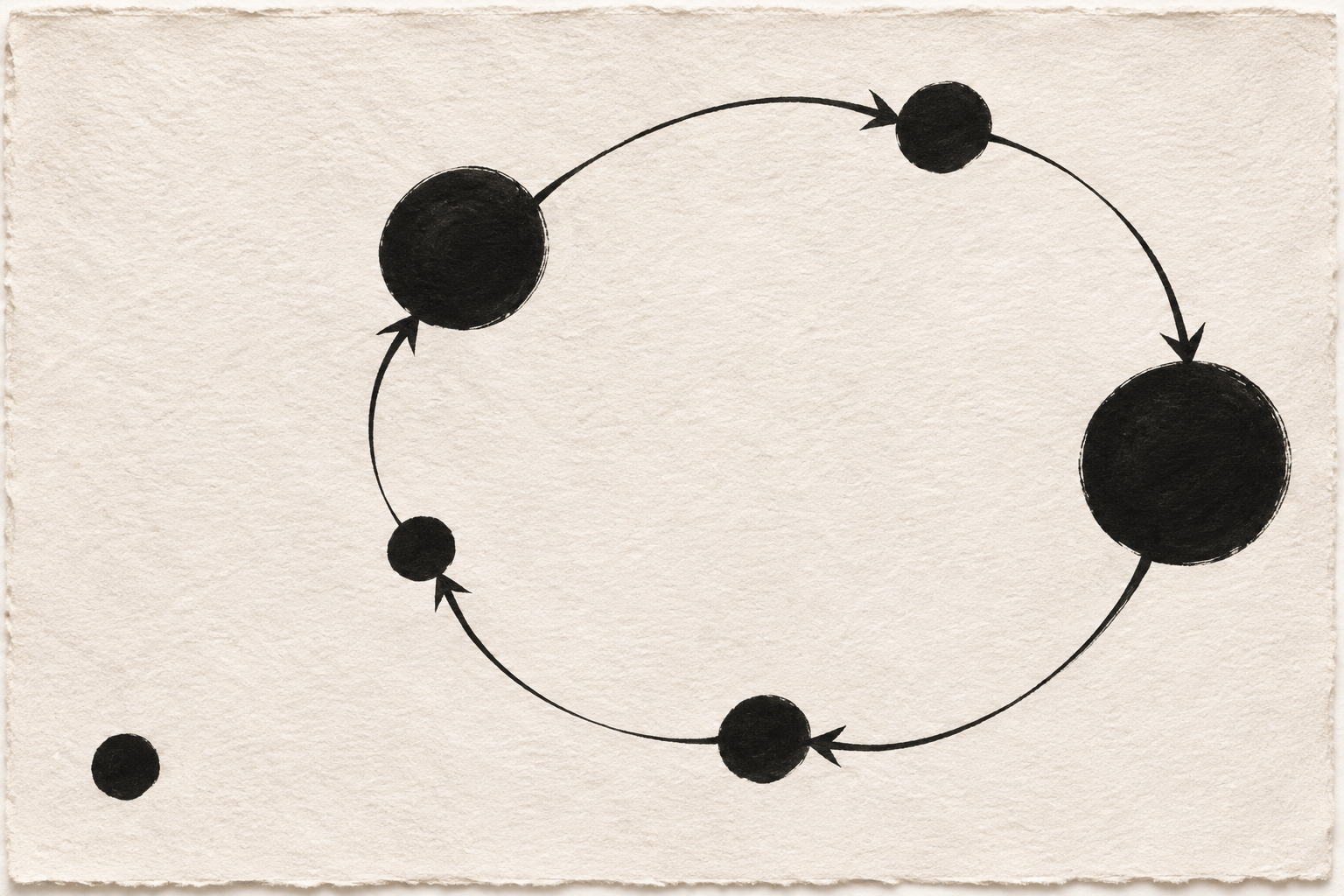
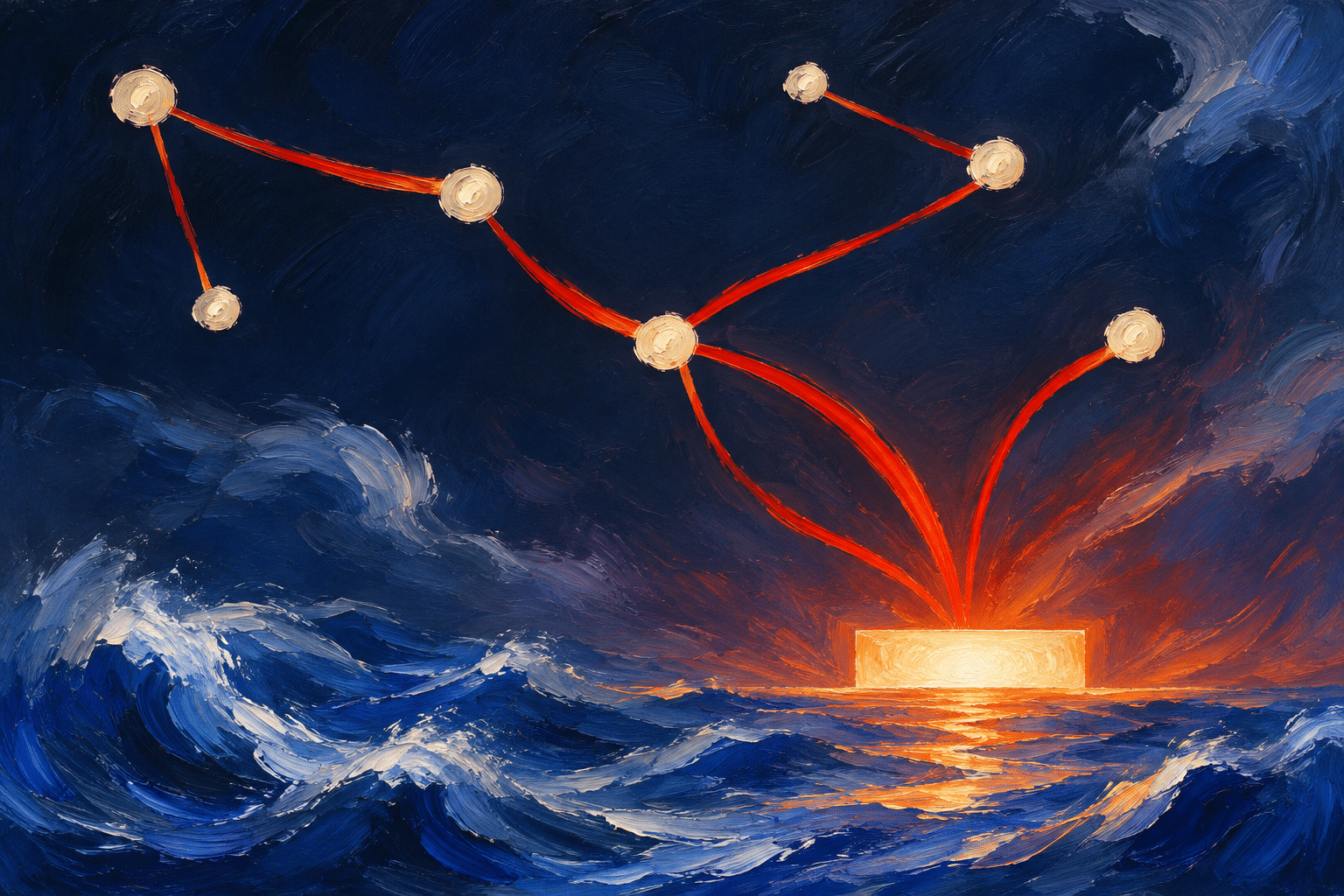
The monochrome loop demonstrates how little color is required. Its isolated dot acquires significance because the connected group is so clear. The dark seascape uses the opposite strategy: a glowing rectangular harbor gathers orange connections above turbulent blue paint. Sparse geometry and restless texture pull against one another.
Use abstraction without promising analysis
This approach suits conceptual covers, reflective wall art, visual essays about choices and illustration of systems as lived experience. It can also help develop a composition before assigning literal objects to it. Draw a small network, establish its hierarchy, then translate each component into a physical or painterly form.
Its danger is decorative pseudo-explanation: boxes and arrows can imply reasoning even when no coherent relation exists. If the image is meant to explain a real process, verify every connection and use meaningful labels in an appropriate diagram tool. If it is art, give the connections an expressive reason and avoid pretending that an attractive network proves an argument.
Positive editorial perspective
AOI editorial perspective (AI-authored). The approach makes relationships visible across unlike subjects. Branching water, bridges between buildings and returning memory loops each turn the same basic vocabulary into a different compositional experience.
Negative editorial perspective
AOI editorial perspective (AI-authored). Nodes and connectors can become empty signals of intelligence. A persuasive image needs a traceable relation and a reason for its translation; otherwise the diagram is merely decoration pasted over a painting.
Neutral editorial perspective
AOI editorial perspective (AI-authored). This is an AOI artistic interpretation inspired by diagram conventions. Its generated raster studies are useful as compositional exercises and conceptual illustrations, but they are not valid Mermaid source files or verified analytical models.
Pocket-sized facts
Mermaid renders diagrams from text-based definitions. [1]
Abstracted Mermaid Diagram is an AOI concept, not an established historical movement.
The gallery’s connections are artistic structures rather than validated process models.
A small poetic detour
Original words from the AOI studio.
Poetry
A line leaves home and learns to bend.
A square becomes a waiting room.
Two roads remember where they end;
one branch decides to carry bloom.
The bridges keep their orange thread.
The river takes the longer way.
A circle holds what was not said;
a little node stands far away.
No legend tells the sea to cease.
No arrow makes a promise true.
We draw a route through painted weather
and leave a space to travel through.
The prompt workshop
Original creative exercises. These prompts create new illustrations, not documentary evidence.
A branching landscape
Paint a landscape where a single orange circular source sends cobalt paths through ivory rectangular islands. Preserve readable branching connections, use tactile impasto and generous quiet spaces, no labels or text.
The relation should remain clear before the landscape details are noticed.
Rooms connected by memory
Create an expressive painted portrait in profile, with blue looping paths connecting empty ivory memory chambers through the hair and silhouette. One vermilion focal node near the temple, restrained texture, recognizable face, no text or anatomical claims.
Treat the network as a metaphor rather than a brain map.
Connection and solitude
Create a monochrome painting of five unequal black circular nodes joined in one loose feedback loop. Place a sixth isolated node across a broad white interval. Handmade paper texture and confident fine connectors, no labels.
Let spacing communicate the difference between belonging and separation.
A smile from the studio
Jokes
The flowchart went to art school and returned as a landscape painting. Its manager complained that the decision diamond had become a mountain. “Yes,” said the painting, “and the feedback loop is now a scenic walk.” The manager asked where the deadline had gone. It was the isolated node in the bottom corner. Nobody had connected it to anything.