AOI creative concept · Light and photographic experiments
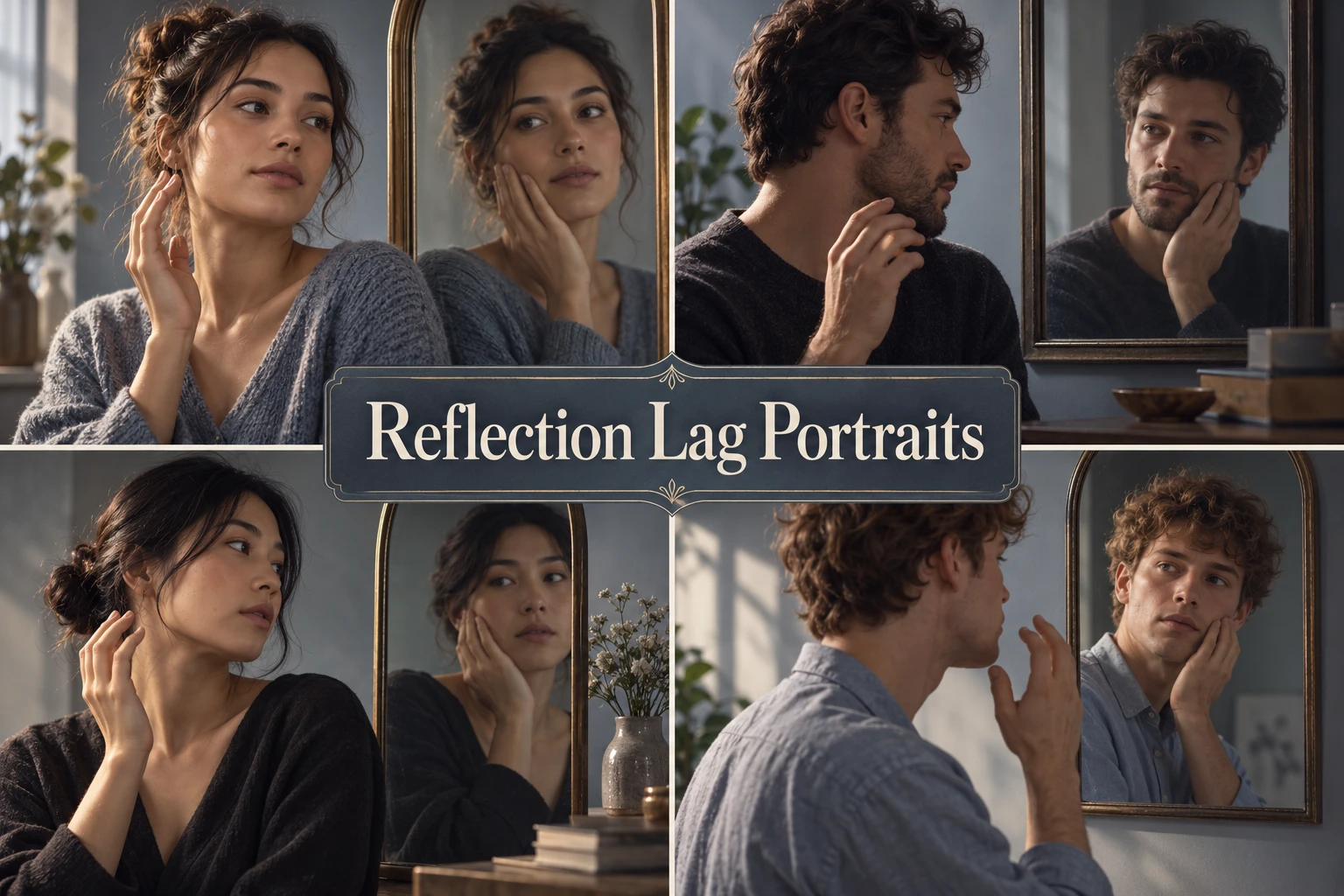
Create a fictional portrait in which a reflection lags behind one small gesture.
An AOI creative concept, not an established historical movement.
A closer look
Warm skin tones, muted gray and pale blue; naturalistic portrait lighting. The focal scene: a portrait whose mirror reflection retains one slightly earlier hand gesture.
Choose the intervention
Create a fictional portrait in which a reflection lags behind one small gesture. The person and reflected face should otherwise agree closely, concentrating the discrepancy in a hand, glance or slight turn rather than in an entirely different identity.
Construct the image
Show an adult beside a plain mirror with one hand just leaving the cheek. In the reflection, keep that hand touching the cheek while the head and clothing remain aligned. Use soft lateral light and an uncluttered background. Make the mirror edge visible so the two versions cannot be mistaken for separate people.
Keep the comparison clear
Too many differences turn a precise temporal idea into a generic uncanny double. Choose one gesture and keep the rest consistent. Label the result as a staged or generated fiction; it should never be offered as evidence of a real event or optical phenomenon.
Technique notes
Move the lag to a falling scarf, with the reflected scarf still resting on the shoulder while both faces remain still.
When prompting an image model, spell out the rule and visible relationships. The invented style name alone is not a reliable instruction. Compare outputs against the critique above and revise the specific failed relationship.
The prompt workshop
Original creative exercises. These prompts create new illustrations, not documentary evidence.
Start with the defining rule
Create an original illustration of a portrait whose mirror reflection retains one slightly earlier hand gesture. Create a fictional portrait in which a reflection lags behind one small gesture. The person and reflected face should otherwise agree closely, concentrating the discrepancy in a hand, glance or slight turn rather than in an entirely different identity. Use warm skin tones, muted gray and pale blue; naturalistic portrait lighting. Keep the composition readable, with a clear focal area and quiet surrounding space. No lettering, signatures or watermark.
Build the fuller composition
Create an original Reflection Lag Portraits composition. Show an adult beside a plain mirror with one hand just leaving the cheek. In the reflection, keep that hand touching the cheek while the head and clothing remain aligned. Use soft lateral light and an uncluttered background. Make the mirror edge visible so the two versions cannot be mistaken for separate people. Use warm skin tones, muted gray and pale blue; naturalistic portrait lighting. Preserve the defining constraint: Create a fictional portrait in which a reflection lags behind one small gesture. Avoid decorative clutter, readable text and watermarks.
Try a deliberate variation
Create an experimental illustration based on this rule: Create a fictional portrait in which a reflection lags behind one small gesture. The person and reflected face should otherwise agree closely, concentrating the discrepancy in a hand, glance or slight turn rather than in an entirely different identity. Variation: Move the lag to a falling scarf, with the reflected scarf still resting on the shoulder while both faces remain still. Use warm skin tones, muted gray and pale blue; naturalistic portrait lighting. Make the changed relationship unmistakable while keeping supporting details restrained. No captions, signatures or watermark.
Look closer
Explore the image gallery
Select an image to enlarge it. Browse with the arrows, and press Escape to return.
Your next inspiration
Discover another art style
Follow a visual thread to the next subject.