
Painting · abstract form and the illusion of shallow space
Abstract Illusionism combines nonrepresentational forms with devices that make those forms appear to project, hover or cast shadows. The intriguing contradiction is that a painted gesture can look like an object suspended above the painting that contains it. Instead of asking what familiar thing the image depicts, ask where its marks seem to exist.
A visual introduction
Open any image to look closer, then browse the examples.
Creative toolbox · take this style further
Choose an input, adjust it, then open a tool. Search links pass your text to the destination. Copy & open copies it for you to paste into the generator; you start generation there.
ChatGPT
Copy your input and paste it into a ChatGPT conversation or image request.
Copy & open ChatGPT (new tab)Claude · Anthropic
Develop an image prompt or explore the style in a new Claude conversation.
Copy & open Claude · Anthropic (new tab)Midjourney
Paste your input into the Imagine bar on the Create page.
Copy & open Midjourney (new tab)Adobe Firefly
Copy your input, open Firefly, and paste it into the prompt field.
Copy & open Adobe Firefly (new tab)Leonardo.Ai
Copy your input, open Leonardo, and paste it into the generation field.
Copy & open Leonardo.Ai (new tab)Lexica
Search AI images and prompts using your selected input.
Search with this input Lexica (new tab)Pexels
Search the photo and video library. Short keywords often work best.
Search with this input Pexels (new tab)Pixabay
Search photos, illustrations and other images.
Search with this input Pixabay (new tab)Unsplash
Search photographs using the style name or your own keywords.
Search with this input Unsplash (new tab)Wikipedia
Search for background reading. A style may not have its own article.
Search with this input Wikipedia (new tab)WikiArt
Copy your input into WikiArt’s search to explore artists and artworks.
Copy & open WikiArt (new tab)Instagram hashtags
Search a hashtag made from your input: spaces and punctuation are removed. Instagram may require sign-in.
Search with this input Instagram hashtags (new tab)A closer look
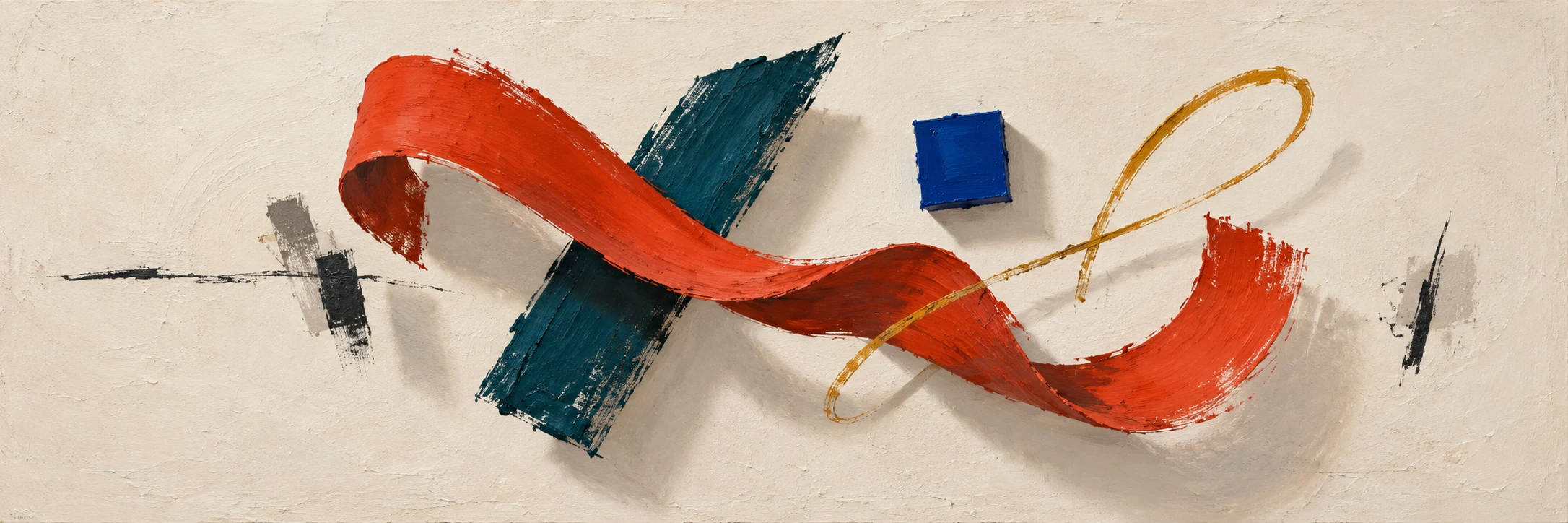
The original banner arranges coloured ribbons, broad strokes and small geometric fragments over a pale painted ground. Soft directional shadows suggest a narrow interval between each form and the surface. It is a synthetic illustration of pictorial depth, not a photograph of a historical painting or a claim that the forms physically project.
A particular use of illusion
The word abstraction does not require a painting to appear completely flat. Colour, overlap and scale can suggest space even without recognisable objects. Abstract Illusionism makes that spatial suggestion conspicuous: marks that belong to a painting begin to behave like things in front of it.
Jack Reilly’s official biography associates his early career with Abstract Illusionism and the travelling exhibition The Reality of Illusion, which opened at the Denver Art Museum. His account places this involvement around the late 1970s. It provides a documented connection to the movement; it does not support assigning its foundation to Kandinsky or Mondrian merely because both made abstract art. [1]
Keep the historical label distinct from the broader phrase “an abstract illusion.” Many works create ambiguous depth without belonging to this particular context. A contemporary digital render can explore a similar visual problem, but resemblance alone does not make it a historical example.
How the floating effect is built
Start with the ground. A reasonably stable surface gives the eye something against which to judge distance. If the background is too active, the shadows may read as unrelated shapes rather than evidence that a coloured mark hovers above it.
Next consider the shadow’s direction, offset and softness. A narrow dark interval can make a stroke seem close to the ground; a displaced, softer shadow may suggest more separation. These are pictorial cues rather than measurements. Their usefulness depends on how consistently the image asks us to interpret them.
Overlaps add another layer of persuasion. One ribbon passes in front of another; an edge disappears; a small highlight suggests a turn. Too many unrelated light directions can make the spatial claim collapse. A deliberate contradiction can be interesting, but it should feel chosen rather than overlooked.
The mark becomes a subject
A catalogue hosted by the George D. Green Art Institute discusses Green’s involvement with Abstract Illusionism and his use of trompe-l’œil and perspective. It describes an art in which abstract forms appear to separate from the picture surface. This places the visual device in an artist’s documented practice rather than treating every three-dimensional-looking abstraction as equivalent. [2]
The important subject can be the act of looking itself. At one moment we recognise a brushlike mark; at another we read a raised strip. The image holds these readings in tension. A successful example need not fool us permanently. It can reward our awareness of how readily the eye supplies depth.
Compare this with an optical pattern that vibrates or seems to move. Both may test perception, but their mechanisms differ. Here, the useful questions concern surface, objecthood and projected space. Simply labelling everything “Op Art” would conceal those distinctions.
Read the new banner as a construction
The pale ground creates breathing room around the saturated forms. Curves and angular fragments offer different speeds of movement, while their shared lighting makes them seem to occupy one shallow space. The small forms act as pauses between the larger gestures.
Notice the difference between a pleasing tangle and a legible sequence. Follow one ribbon from beginning to end. Does its thickness remain plausible? Does the shadow agree with its turns? When a form crosses another, is the order clear? These questions make a useful inspection routine for both painted and generated work.
The banner demonstrates a visual proposition, not the handling of real wet paint. A generated highlight may simulate texture without corresponding to any material process. Its caption should keep that distinction visible.
Make the illusion earn its place
Create a simple composition with three forms and one light direction. Make a second version without the shadows. Compare how the forms change from apparent objects to graphic marks. Then restore only the shadows that contribute to the spatial idea.
If the picture works only because everything looks expensive and three-dimensional, simplify it. The more interesting achievement is a small disturbance in seeing: the surface remains a surface, yet the mark seems unwilling to stay there.
A small poetic detour
Original words from the AOI studio.
Poetry
A painted shadow waits
under a painted stroke.
The wall has acquired a doubt.
The prompt workshop
Original creative exercises. These prompts create new illustrations, not documentary evidence.
Start with shallow space
Create an original abstract painted composition with three coloured strokes appearing to float above a quiet ivory ground. Consistent upper-left light, restrained soft cast shadows, visible paint-like edges, no lettering.
Original AOI exercise; a generated image is not historical or documentary evidence.
Build the contradiction
Combine a broad curved gesture, a thin angular line and a small flat square in shallow illusionistic space. Keep the ground visibly painted while the marks suggest objects. Avoid a copy of any existing artwork.
Original AOI exercise; a generated image is not historical or documentary evidence.
Remove the evidence
Create paired versions of the same original composition, one with directional shadows and one without. Preserve form, colour and placement. Compare which spatial cues change the reading.
Original AOI exercise; a generated image is not historical or documentary evidence.
People & works to explore
References discussed in this article. Consult the sources below for context.
Artists and practitioners
Jack Reilly — documented association with Abstract Illusionism
George D. Green — illusionistic abstract painting discussed in Visual Magic
Paintings and other works
The Reality of Illusion — travelling museum exhibition discussed in Reilly’s biography
Visual Magic (2015) — exhibition catalogue and comparative reference
Sources and further exploration
[1] Jack Reilly — official artist biography
[2] George D. Green Art Institute — Visual Magic exhibition catalogue (2015)