
Drawing · distortion, projection and the moving viewer
An anamorphic drawing is deliberately distorted so that its intended image becomes legible from a particular viewpoint or through an appropriate optical arrangement. The strange-looking surface and the resolved view belong to the same work. Change where you stand and you change what the drawing can tell you.
Creative toolbox · take this style further
Choose an input, adjust it, then open a tool. Search links pass your text to the destination. Copy & open copies it for you to paste into the generator; you start generation there.
ChatGPT
Copy your input and paste it into a ChatGPT conversation or image request.
Copy & open ChatGPT (new tab)Claude · Anthropic
Develop an image prompt or explore the style in a new Claude conversation.
Copy & open Claude · Anthropic (new tab)Midjourney
Paste your input into the Imagine bar on the Create page.
Copy & open Midjourney (new tab)Adobe Firefly
Copy your input, open Firefly, and paste it into the prompt field.
Copy & open Adobe Firefly (new tab)Leonardo.Ai
Copy your input, open Leonardo, and paste it into the generation field.
Copy & open Leonardo.Ai (new tab)Lexica
Search AI images and prompts using your selected input.
Search with this input Lexica (new tab)Pexels
Search the photo and video library. Short keywords often work best.
Search with this input Pexels (new tab)Pixabay
Search photos, illustrations and other images.
Search with this input Pixabay (new tab)Unsplash
Search photographs using the style name or your own keywords.
Search with this input Unsplash (new tab)Wikipedia
Search for background reading. A style may not have its own article.
Search with this input Wikipedia (new tab)WikiArt
Copy your input into WikiArt’s search to explore artists and artworks.
Copy & open WikiArt (new tab)Instagram hashtags
Search a hashtag made from your input: spaces and punctuation are removed. Instagram may require sign-in.
Search with this input Instagram hashtags (new tab)A closer look
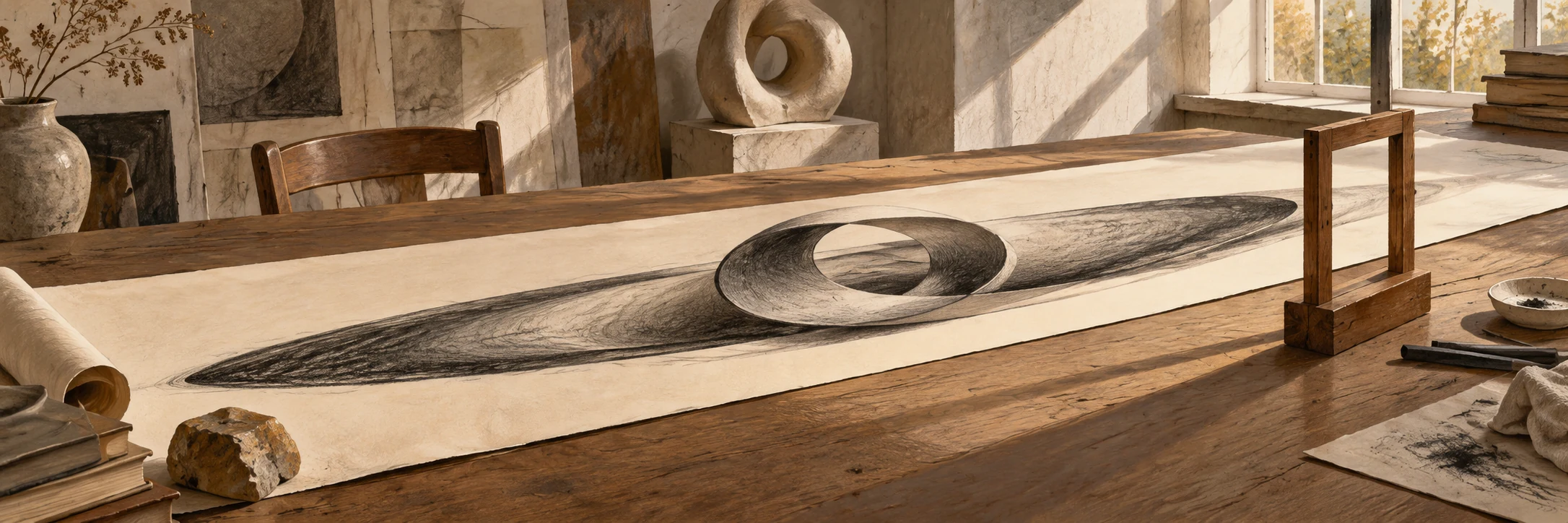
The banner imagines a studio experiment with an elongated drawing and a viewing frame. It is an AI-generated concept illustration, not a geometrically constructed anamorphosis. No claim is made that the depicted marks will resolve into a correct image when viewed from an angle.
A distortion with a specific purpose
In ordinary perspective drawing, an object is represented from a chosen position. Anamorphosis pushes the relationship between position and image into the foreground: the marks can look incoherent or stretched until the viewer occupies the intended place. The viewing conditions are therefore part of the design, not an optional finishing touch.
Hans Holbein the Younger’s The Ambassadors, dated 1533, offers a famous example. The elongated form near the figures’ feet becomes a skull when seen obliquely. The National Gallery discusses both the optical effect and the skull’s place within the painting’s larger meanings. [1]
The work does more than deliver a surprise. It makes the viewer move between incompatible readings of one surface. For your own study, ask why that movement matters: does it reveal something, conceal something or force a reconsideration of the first impression?
Choose the viewing system before the picture
A fixed oblique viewpoint and a cylindrical mirror require different constructions. Stretching a picture by eye is not a universal solution for either. Decide which system you are using, identify the viewing position and keep the support surface stable while you test the result.
For a first physical experiment, use a simple target such as a circle or block letter. A camera fixed at the intended viewpoint can help you compare the projected appearance with that target. Adjust a construction grid or a digital perspective transform and test again; do not begin with an elaborate portrait that hides basic errors.
Record the setup as well as the successful view. A useful presentation shows the distorted surface from elsewhere and the resolved image from its intended position. Those two views make the construction understandable and prevent a single flattering photograph from doing all the persuasive work.
The surface, the photograph and the illusion differ
A photograph of an anamorphic installation is a flat image of one encounter with it. On a phone, the viewer cannot necessarily reproduce the original bodily experience by tilting the device. Screen scaling, cropping and the camera position may change the conditions that made the physical work function.
Likewise, anamorphic drawing is not interchangeable with an anamorphic cinema lens. The shared idea of altered proportions does not make the equipment or artistic purpose identical. State whether you mean perspective-based drawing, mirror anamorphosis or a filmmaking process.
Our banner deliberately illustrates the idea of a studio experiment rather than pretending to be a working puzzle. The long paper, distorted mark and viewing frame are narrative clues. Their appearance alone cannot verify a mathematically correct projection.
Use AI for proposals; test the actual geometry
An image model can help imagine a setting, material treatment or theme for an installation. It may also produce a convincing picture of a supposed optical effect that would fail in a real room. Treat that output as a concept and build the projection separately using a reproducible construction.
Keep the final test simple: fix the camera, compare the target outline, check several edges and document the distance and height. If the drawing is intended for people moving through a space, consider how they will find the viewpoint without the explanatory caption solving the experience for them.
The strongest result is not merely distorted. It has a reason for being seen twice. Let the ordinary view establish a question and let the resolved view change the question, rather than offering an unrelated trick.
A small poetic detour
Original words from the AOI studio.
Poetry
The line waits for a footstep;
the room supplies another eye.
The prompt workshop
Original creative exercises. These prompts create new illustrations, not documentary evidence.
Imagine a studio experiment
Editorial concept illustration of elongated charcoal marks on a long studio sheet beside a small viewing frame, oblique daylight; a proposal about anamorphic drawing, not a working optical demonstration.
Original AOI exercise; a generated image is not historical or documentary evidence.
Design the encounter
Concept art for a temporary anamorphic installation on a plain floor, one clearly suggested viewing station and visitors approaching it, restrained materials and light; label the image a proposal and construct the projection separately.
Original AOI exercise; a generated image is not historical or documentary evidence.
Plan the evidence
Create a visual mood study for presenting an anamorphic drawing with two separately captured views: the distorted surface and its intended viewpoint. Do not claim generated images prove the optical geometry.
Original AOI exercise; a generated image is not historical or documentary evidence.
People & works to explore
References discussed in this article. Consult the sources below for context.
Artists and practitioners
Hans Holbein the Younger
Paintings and other works
Hans Holbein the Younger, The Ambassadors, 1533