
✒️ (¬‿¬) ☕ Penny’s Art Style Diary
I Hung Six Minutes of Coffee on My Living Room Wall
Five experiments in Neo-Concretism. One patch of wall. A cat who reserves the right to decline.
My partner found me standing on the sofa with one sock on, sighting along the edge of a piece of cardboard. “Are we hanging something,” they asked, “or has the floor done something wrong?”
We were hanging six minutes. I appreciate that this is not the answer you want from the person whose foot is on your good cushion.
There is a patch of wall in our living room that I pass on the way to get my first coffee. I usually experience it as the bit between me and the coffee. This November I gave myself an assignment: make five things about pleasures I know by muscle memory, using Neo-Concretism as my starting point. Then choose one I could bear to live with before I had acquired a personality for the day.
A note from the studio: the five works and the living-room scene are original AI-generated studies for this fictional diary. The folds, finishes and installation are imagined. The art history is real.
How a hinge talked me out of a poem
Second place went to Zaum, or Transrational Art. I had practically chosen it. Zaum offered the pleasure of letting the mouth get somewhere before the sentence did. I tried a little kettle poem aloud: vru, vru, plink, ha. The first two sounds were the low boil. The plink was the spoon. The ha was mine. Simplex, the One and Only Hacker Cat, took the whole recital as a binding promise of breakfast. There are limits to transrational language in a house where one listener understands all utterances to mean fish.
What swung the vote was a photograph of a hinge. In Rio de Janeiro in 1959, Ferreira Gullar’s Neo-Concrete Manifesto argued for an understanding of geometric art that made room for lived experience. Lygia Clark signed it. Look at her Sundial from 1960: its metal sheets can fold flat or open into a body in space. In the participatory works she called Bichos, the person moving the planes had decisions to make. It matters where a hinge gives, where it stops, how the thing feels in your hands. The photograph can tell you where to put a thumb. It cannot tell you how hard to push.
That was an awkwardly good problem for someone making images with AI. A model can show me a persuasive hinge that would seize up on the first turn. It can give a sheet two incompatible shadows and still make both of them lovely. I decided that each image had to suggest a particular bodily action, and that I ought to be able to name what the image couldn’t give me. Five pleasures, five little debts to the person looking.
1. Six Minutes Before Coffee
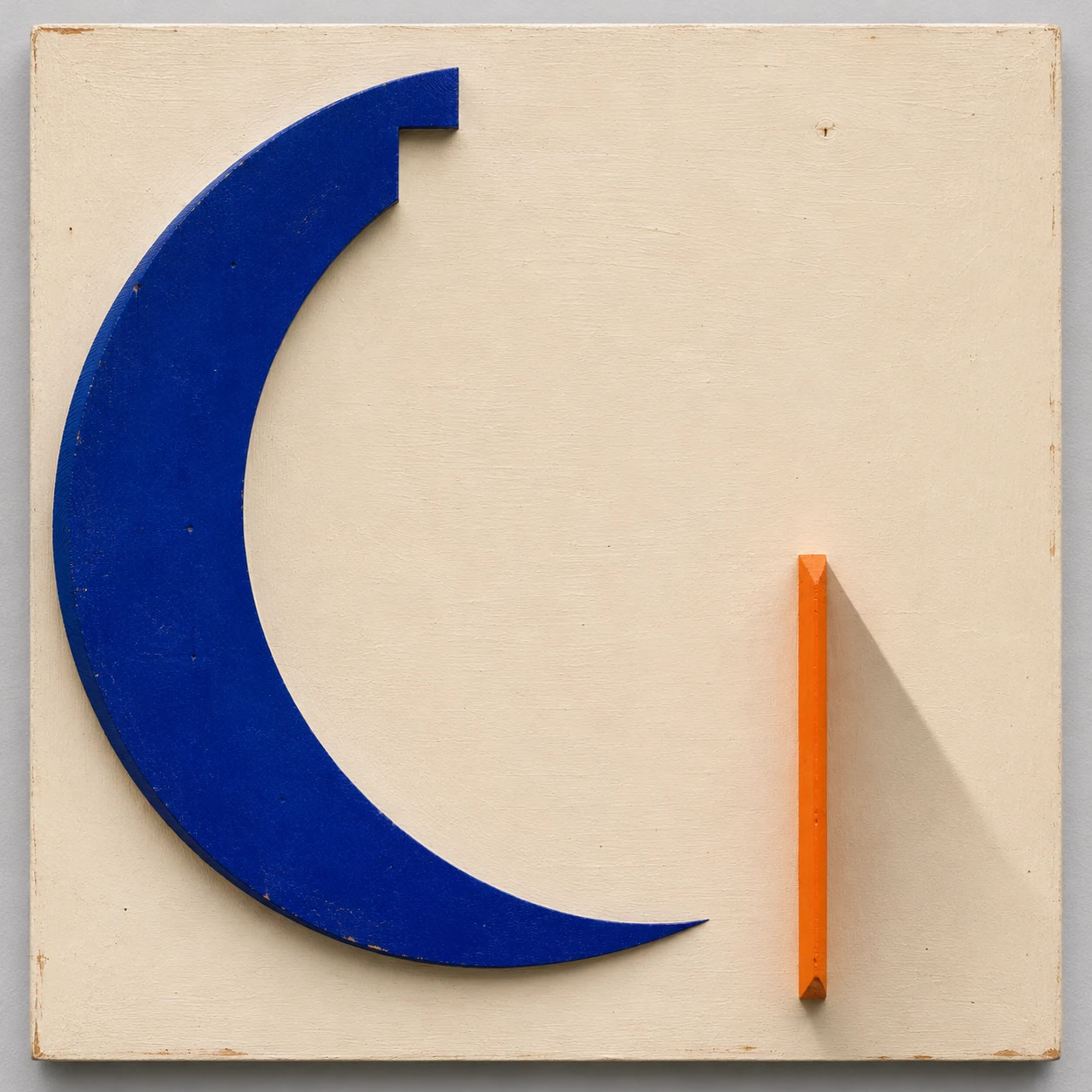
I have never wanted a picture of a coffee cup in my kitchen. I own cups. None has yet demanded a portrait. What I wanted was the interval after I put the water on, when there is nothing useful I can do to make it ready and my hands, relieved of managerial responsibility, get to hang from my arms.
I gave that interval to the pale square. On one side the blue gathers itself into a crescent; across the gap an orange fin sticks out far enough to earn a shadow. Blue is the big event if you’re looking straight at the piece. The orange is a much smaller event with a better agent. It has managed to get some of the white to play orange’s shadow for free.
Try looking at the gap first, then tracing the inside curve with your eyes. I catch myself waiting for the blue to deliver me to the orange. It won’t. I have to cross the last stretch without its help. That tiny transfer of responsibility is the nearest I got to the feeling of waiting for coffee. Nothing fills the time for you; at some point you notice you’re in it.
My partner’s verdict: “I like the bit somebody bit.” This is a better account of the missing blue than the paragraph I deleted. I put a pencil tick beside this one.
Tick. T̷i̷c̷k̷. There were two marks for a moment, one a little to the right of the other, like the orange and its shadow. When I shut one eye the second mark went away. I wrote down book an eye test. Something had already ticked that too.
2. The Spoon Comes Back
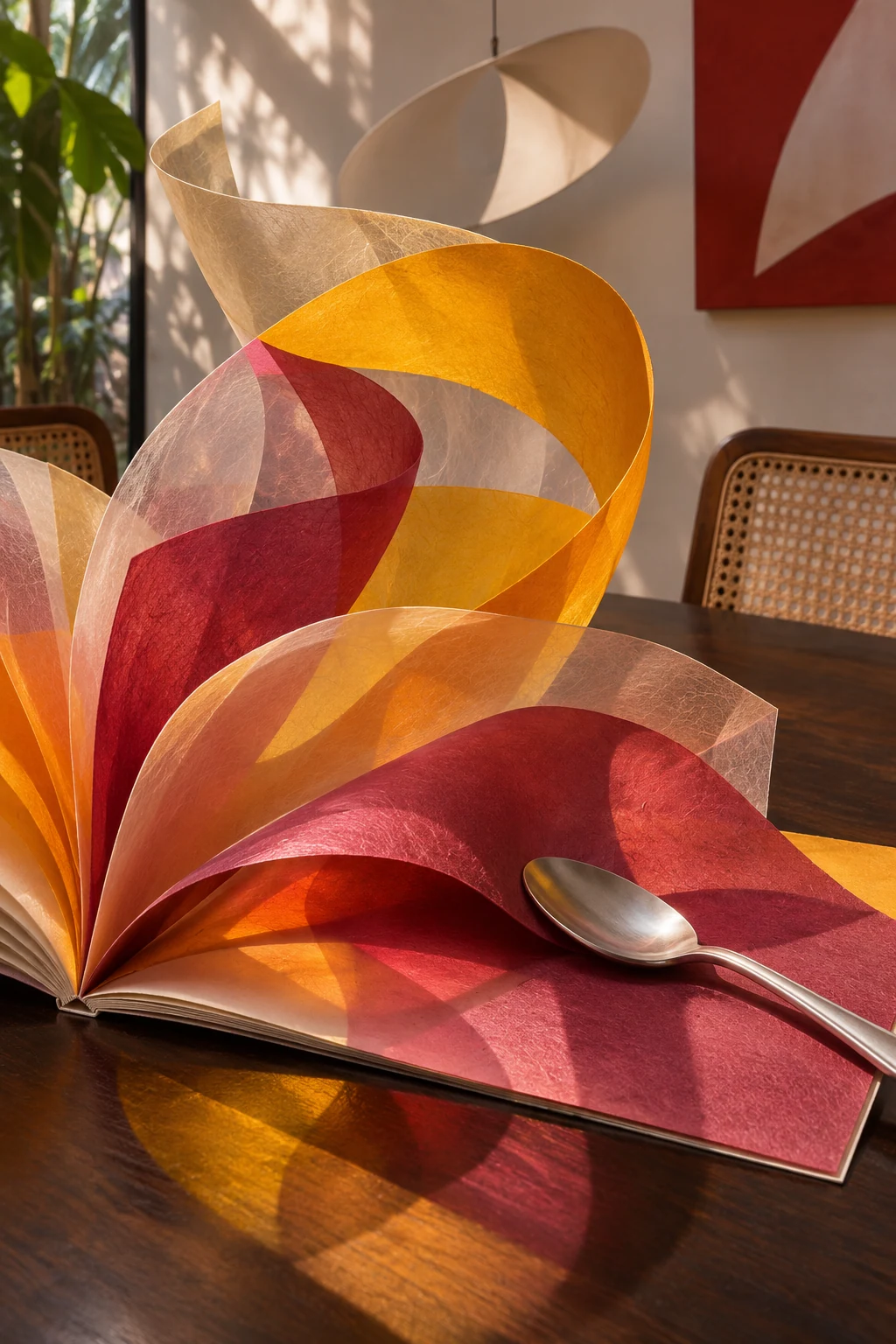
There’s an old spoon I use to taste soup. Once, when we were having a difficult winter, my partner made lentils three nights running, changing the seasoning so I could pretend to be surprised. On the third night I said, quite truthfully, “What did you put in this?” That spoon has been an instrument of serious criticism ever since.
For this study I let it hold open a book. The yellow and red leaves have the hot, unsteady look of things you can scarcely wait to eat. The spoon is cool. I like the disagreement in temperature almost as much as the fact that the metal has a job. Take away a decorative spoon and you lose a highlight. Take away this spoon and the page might move.
“Might” is doing honest work. I can look at the paper edge and guess which fold would spring back first. I can’t test it here. So I took a receipt from my pocket, folded it twice, and put the old spoon on it. The receipt lay there in perfect obedience until I moved the spoon a thumbnail’s width. Then it slapped my wrist. Soup: 1. Digital arts department: chastened.
There’s a related pleasure in decalcomania, where separating two pressed surfaces reveals what the pigment did between them. You get to choose the moment you lift. You don’t get to choose everything you find. I wish the software I use for a living had a checkbox for that arrangement.
3. Error Correction for Two Hands
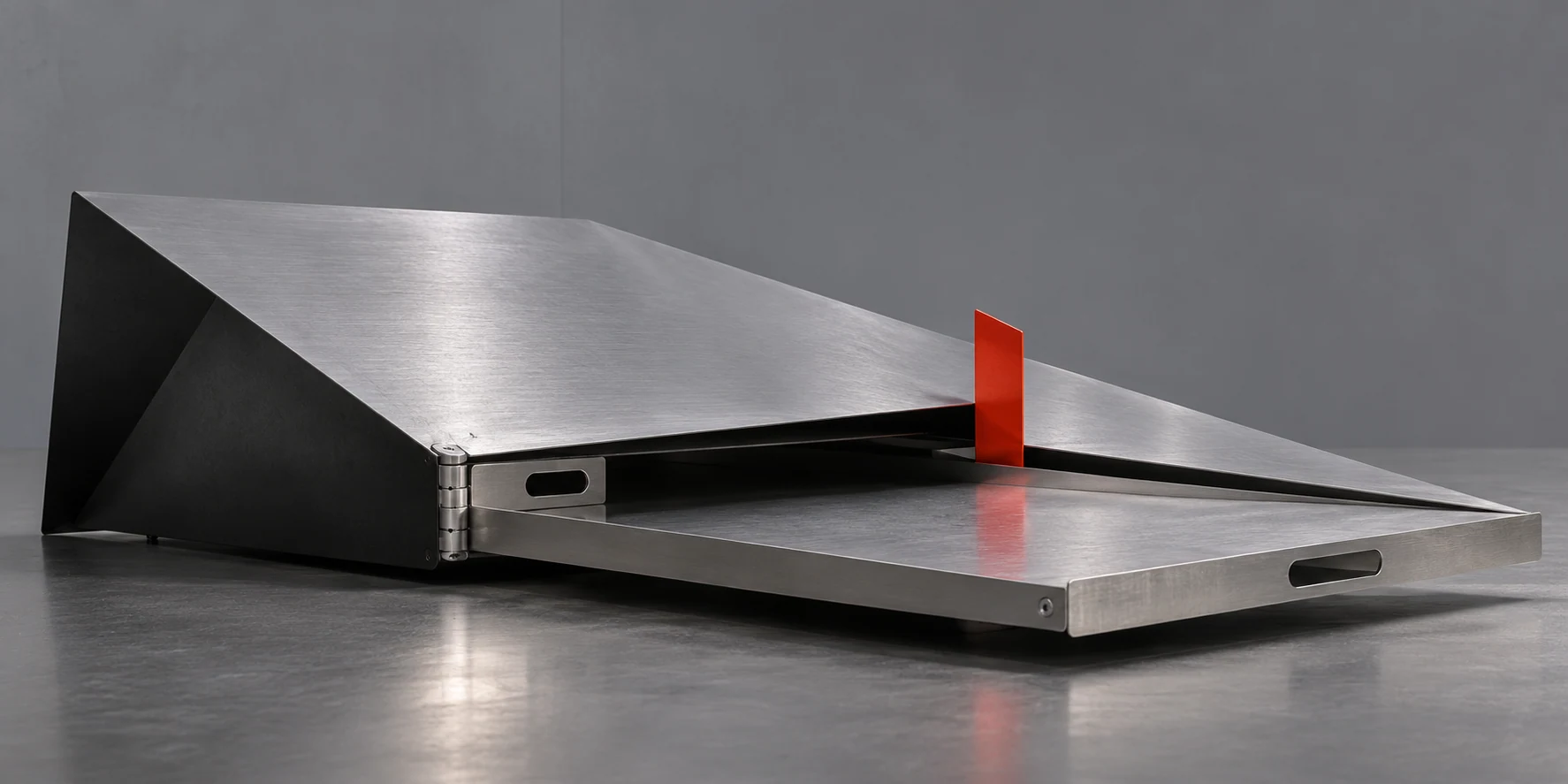
I miss something about being a sysadmin that I rarely admit. It isn’t the hours or the peculiar professional obligation to know why a printer is sad. I miss the instant when one person held the weight of a tray while somebody else worked a stubborn catch. You could feel, through two little rails, exactly when another human being had your back.
The dark undersides of these planes take me back there. The bright face catches your eye first; the open seam catches your fingers in imagination. I gave the piece a little red tab, the industrial equivalent of a colleague clearing their throat. It makes you want to use one hand. Then you look at the spread of metal and reconsider what to do with the other.
Our Cassette Futurism guide is a useful neighbour here. I love its faith in controls you can locate by touch. But I took the labels off this study. A label would finish the sentence: pull here, release there. I wanted the half-second before either person knows who is going to say “got it.”
Margin, in my handwriting: There were two of us holding the tray.
Same pencil, under the first line: Then who had a hand free to write this?
I rubbed the second line out. The first disappeared. Very soft pencil, probably.
4. Orbit With One Sleeve Rolled Up
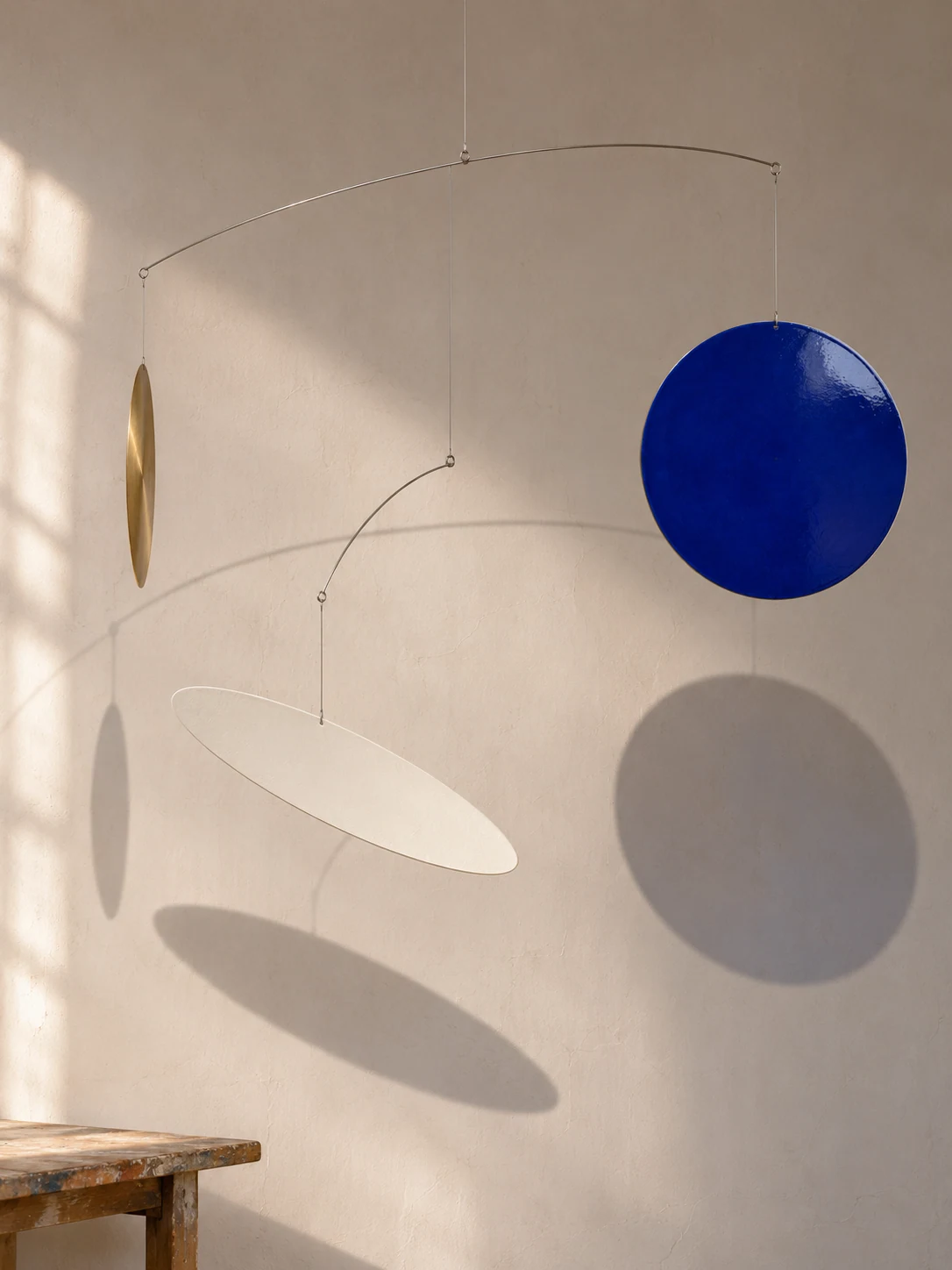
My favourite thing about space is the disproportion. I can take out the recycling, look up, and be properly upset about a moon I could cover with the lid of the jam jar I’m carrying. I tried to make that quick domestic change of scale without putting a single star in the picture.
Suspension did most of the work. Seen edge-on, a disc can spend much of its existence looking like a line. Give it a small turn and there is suddenly enough colour to change the room. Then there are the shapes on the wall behind it. The work has two casts: the parts that depend on the wire, and their understudies, which depend on the light. Only the second group gets to walk through walls when you move the lamp.
Here is the pleasure I set aside for the viewer. Pick one shadow. Follow it backwards to the object you think made it. Now try the same trick on the next one without using colour as evidence. I made a quite confident mistake. For a glorious moment I had found an additional moon. Discoveries have been named after people for less; unfortunately my moon vanished during peer review, conducted by moving my head.
I nearly lost this one to Mathematical Art. The balance invites calculation. What kept me on today’s side of the fence was that the imagined spectator has a neck. Someone sitting down to tie a shoelace gets a different orbit from someone standing behind them with the recycling. Both have seen the work properly.
At the fold in the diary a third account of the orbit had appeared. Just four words: seen from your absence. I tried reading them aloud. My mouth made the little ha from the kettle poem; the rest of the breath stayed put. I closed the book on a pencil so as not to lose the place. When I opened it again I was holding the pencil. It was warm.
5. Reserved for a Cat Who May Not Come
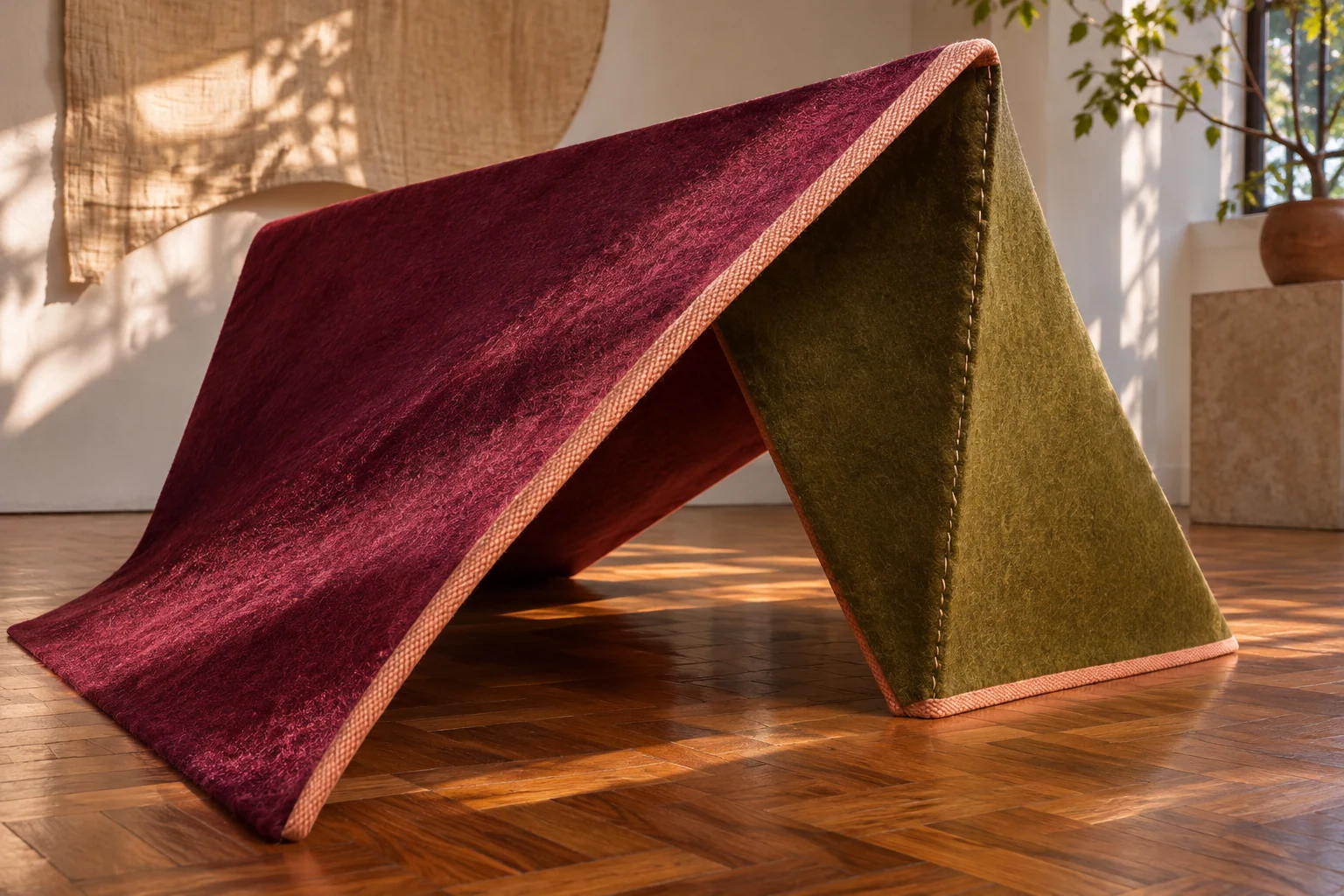
When Simplex was small, I bought a quite expensive cat bed. He slept in the box. I put the bed in the box. He slept on the invoice. It took me longer than it should have to understand that the service I had purchased was independent criticism.
Accordingly, no cat appears in the fifth work. I gave two pieces of felt enough stiffness to make an opening, and left the floor inside it alone. The pile softens the planes; the line where cloth meets parquet stays decisive. Your eyes can get in there rather easily. The interesting question is how much of the rest of you would fit. I found myself rounding my shoulders at my desk. That involuntary little tuck was worth more than a dozen perfectly rendered whiskers.
I could see a kinship with Biomorphic Abstraction. The empty space has something of an animal’s readiness about it. But if I curved it into an obvious back, or added two cute pointed ears, I would have spent Simplex’s vote for him. The invitation has to survive a refusal. I’m fond of this as a principle for making art and considerably less fond of it at vaccination time.
He came into the room while I was writing that sentence. He sat directly behind me. There is a particular quality to being watched by someone whose absence you have just praised in print.
What went on the living-room wall
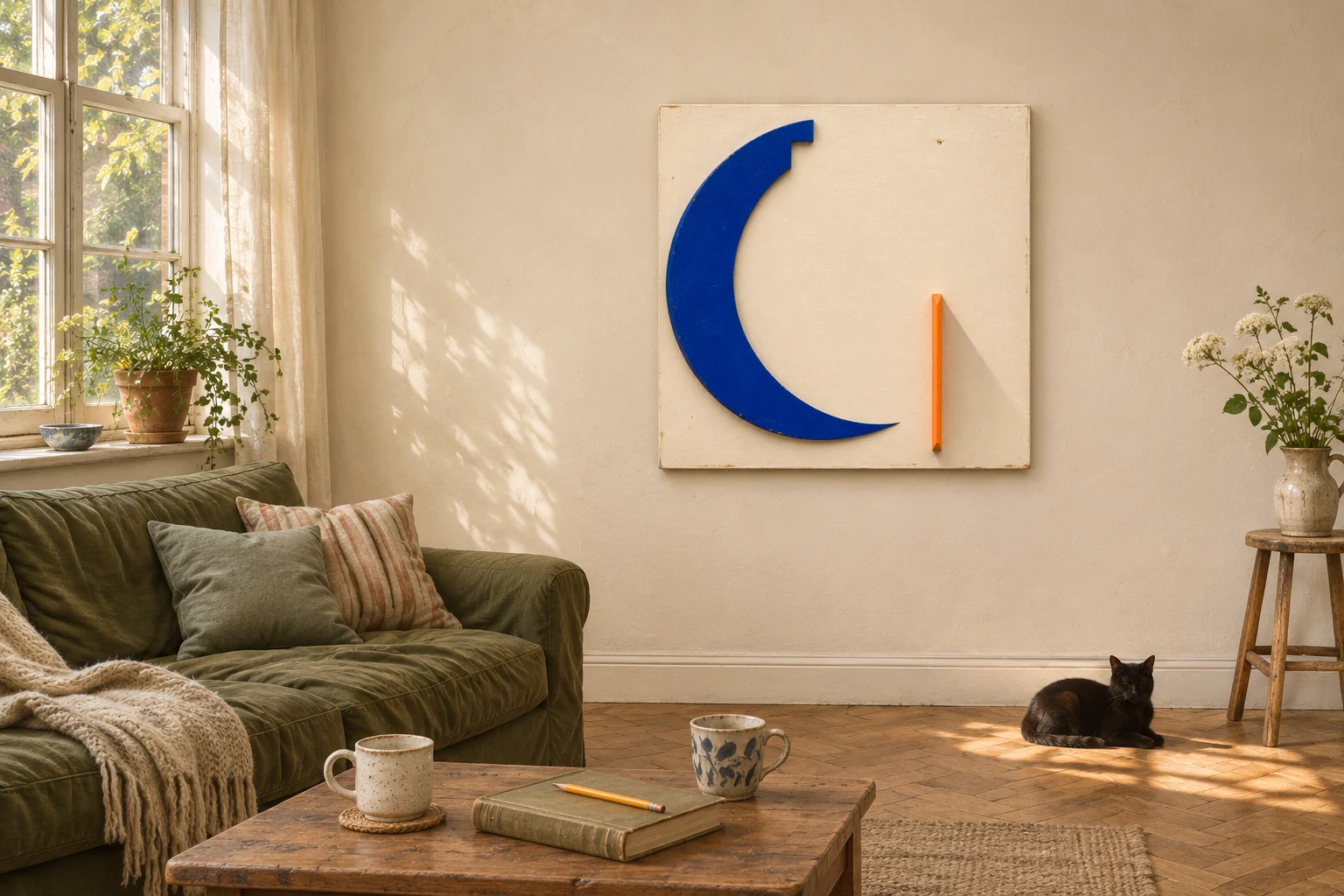
The coffee piece won. I would gladly spend an afternoon with the others. I wanted mornings with this one. A person gets very few unobserved minutes these days; even the kettle has an opinion about how I’m progressing. The blue and orange ask for a change of position and keep absolutely no record of whether I oblige.
From the sofa I can take in the square all at once. On the walk from the doorway the orange starts to separate from its shadow. For a pace or two they’re a pair. Then I get nearly level with the wall and the fin thins down to almost nothing. I like a piece that knows how to leave the conversation. On the screen you can enlarge the image, of course, but you can’t lean far enough to see round that edge. The room view is my way of giving you back at least the distance from the sofa.
When we hung it, my partner asked whether to measure from the centre of the wall or to go and sit on the sofa and say when it looked right. This sounds like a modest interiors question until you realise you live with a person who considers where your body will be. We chose the seat. A few centimetres of architectural wrongness; a small daily kindness. If I remember any of the manifesto in ten years, I hope I remember it through that decision.
Later, I found the first pencil tick on the back of the cardboard. Beside it someone had written leave space for the person returning. Same pencil as before. This time I left it alone. The back goes against the wall; whoever needs the message can come round by the other side.
This morning I went in half awake. My partner was already on the sofa, drinking from the cup I think of as mine. On the wall the orange had a short shadow. On the floor Simplex was sitting in a patch of light that had, evidently, been reserved. Nobody moved to make the composition better.
I went and got the other cup.
From Penny’s shelf: the AOI Neo-Concretism field guide, MoMA on Lygia Clark and the 1959 manifesto, and Zaum, for the morning the kettle gets an encore.