
Chinese commercial calendar-poster tradition
A calendar could stay on a wall for a year. Yuefenpai made that useful object carry a picture of desirable life, combining decoration, advertising and the promise of modern things. Their soft faces, patterned clothes and elaborate frames deserve close attention, along with the businesses and social ideals behind them.
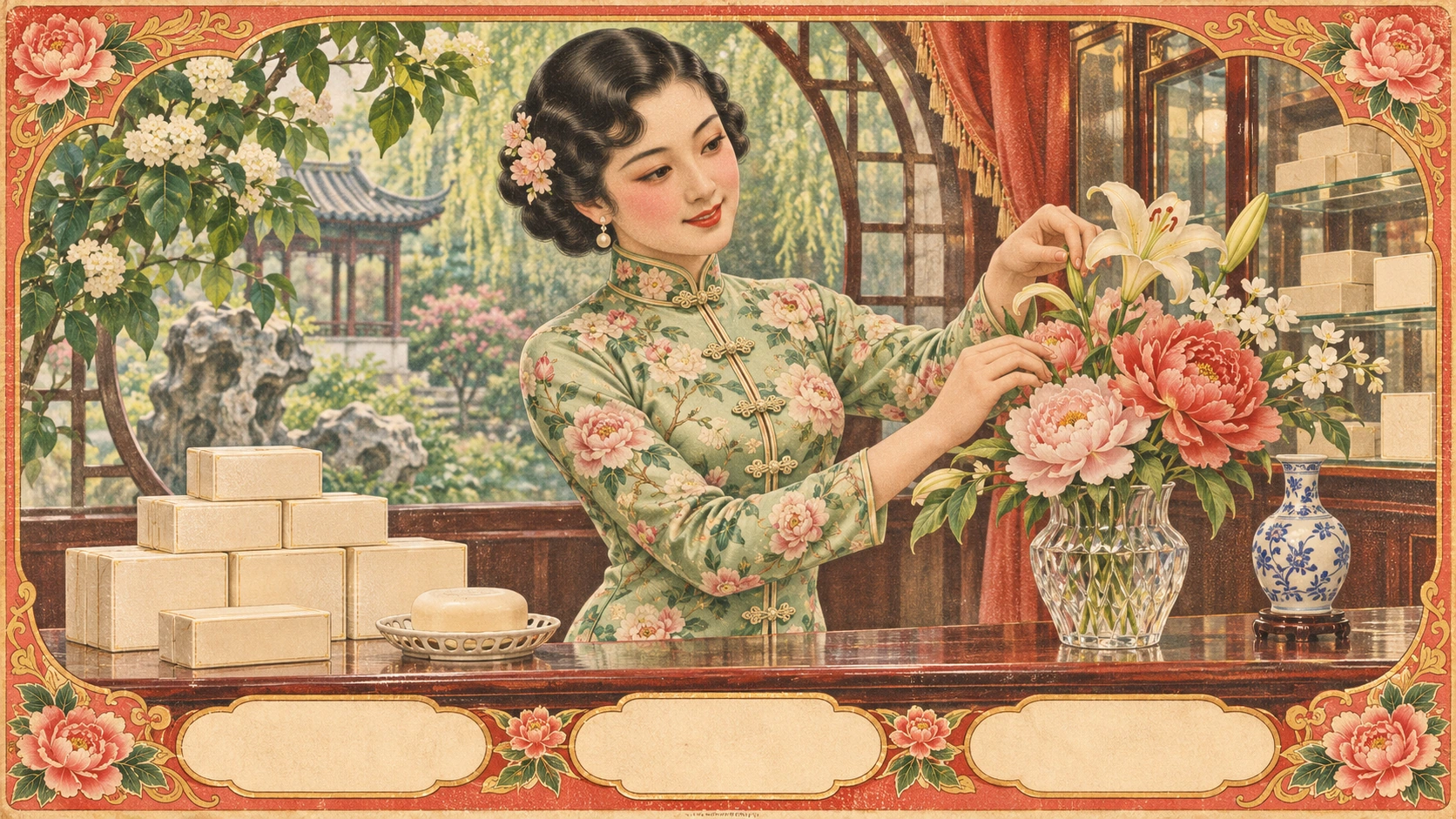
A visual introduction
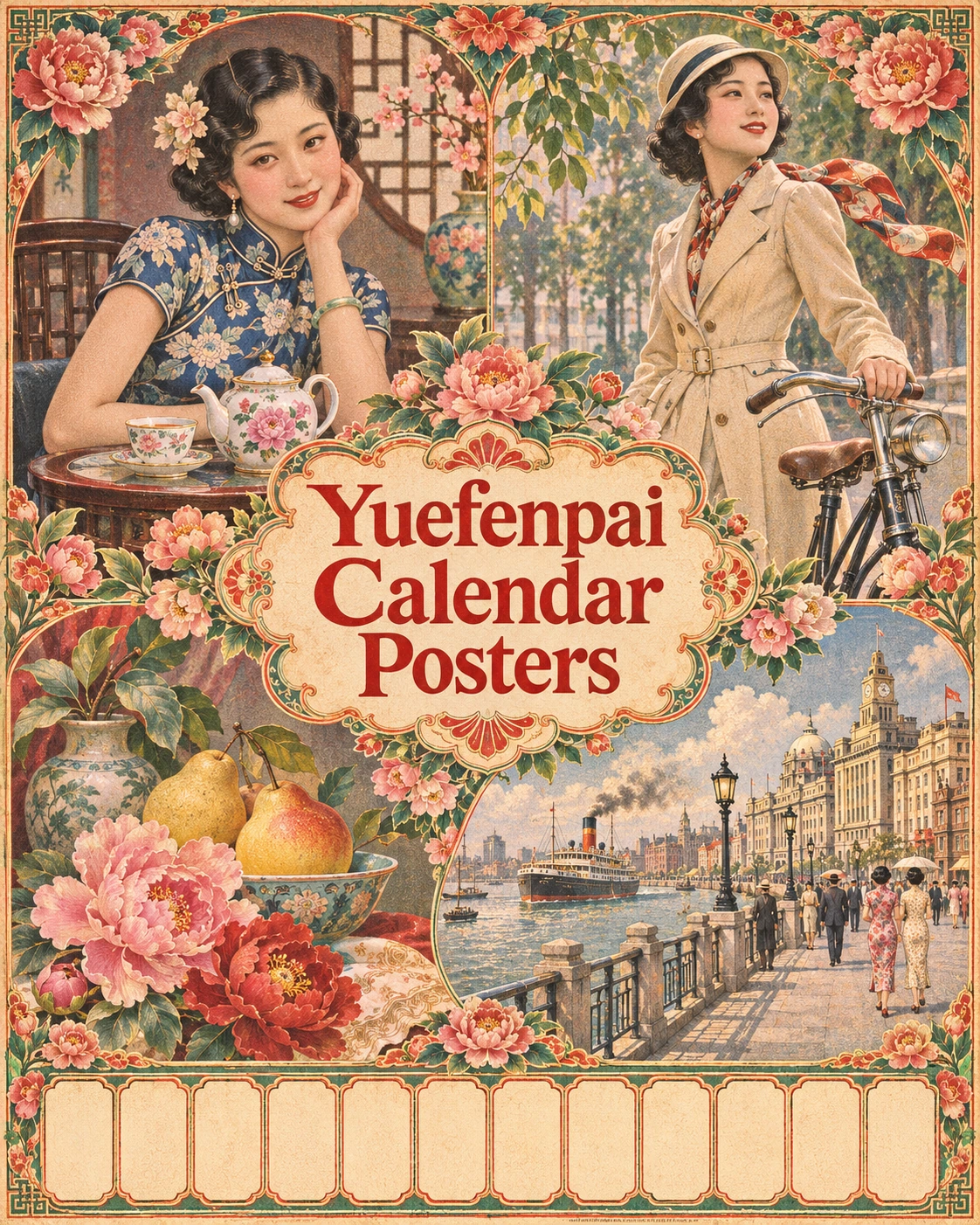
Five original AI-generated interpretations explore calendar-poster composition. Blank cartouches suggest spaces for dates or advertising. The images are contemporary design studies, and the linked museum records provide the documentary examples.
Select an image for a closer look. Use the thumbnails, arrow keys or a swipe to compare examples. Zoom in to inspect details, or share the image that inspires you.
Creative toolbox · take this style further
Choose an input and a destination. Search sends your words to the chosen site; Copy & open puts them on your clipboard to paste there.
Create with AI
Turn your chosen input into an image prompt or a new creative direction.
ChatGPT
Copy your input and paste it into a ChatGPT conversation or image request.
Copy & open ChatGPT (new tab)Claude · Anthropic
Develop an image prompt or explore the style in a new Claude conversation.
Copy & open Claude · Anthropic (new tab)Midjourney
Paste your input into the Imagine bar on the Create page.
Copy & open Midjourney (new tab)Adobe Firefly
Copy your input, open Firefly, and paste it into the prompt field.
Copy & open Adobe Firefly (new tab)Leonardo.Ai
Copy your input, open Leonardo, and paste it into the generation field.
Copy & open Leonardo.Ai (new tab)Image search
Find visual references. Short, concrete keywords usually work best.
Lexica
Search AI images and prompts using your selected input.
Search with this input Lexica (new tab)Pexels
Search the photo and video library. Short keywords often work best.
Search with this input Pexels (new tab)Pixabay
Search photos, illustrations and other images.
Search with this input Pixabay (new tab)Unsplash
Search photographs using the style name or your own keywords.
Search with this input Unsplash (new tab)Wikimedia Commons
Search photographs, artworks and historical images. Check each file for its source and reuse terms.
Search with this input Wikimedia Commons (new tab)Art & research
Explore artists, collections and the ideas behind a style.
Wikipedia
Search for background reading. A style may not have its own article.
Search with this input Wikipedia (new tab)WikiArt
Copy your input into WikiArt’s search to explore artists and artworks.
Copy & open WikiArt (new tab)Europeana
Paste your keywords into the search to explore European museum, library and archive collections.
Copy & open Europeana (new tab)Inspiration
Discover portfolios and visual ideas from creative communities.
Instagram hashtags
Search a hashtag made from your input: spaces and punctuation are removed. Instagram may require sign-in.
Search with this input Instagram hashtags (new tab)ArtStation
Paste your input into artwork search for concept art, environments, characters and visual development.
Copy & open ArtStation (new tab)Behance
Paste your input into project search for illustration, design and visual storytelling.
Copy & open Behance (new tab)A closer look
Look for a dominant figure or scene, softly modelled skin, sharply described fabrics and objects, ornamental framing and spaces for calendars or advertising. The visual balance joins pictorial pleasure with the practical structure of a printed gift.
An image that stayed in the home
Yuefenpai, 月份牌, refers to calendar posters associated with Chinese popular and commercial visual culture. Shanghai became an important centre, with production and circulation also connected to other cities. This guide asks how an ornamental household image became a durable advertisement. The broader Advertisement guide follows persuasion across more media and periods.
Fukuoka Asian Art Museum describes companies giving customers practical promotional pictures that combined elements of New Year imagery with advertising and calendar functions. Its record also notes examples with and without calendars. The format allowed the image, company and household routine to remain in repeated contact.
The history reaches beyond the best-known fashionable female portraits. Berlin's Ethnologisches Museum holds a Shanghai calendar poster acquired in 1899, depicting a general and attendants with auspicious figures below. That documented object provides an earlier point of comparison. It helps keep the full category's narrative and decorative range in view.
Artists, studios and the printed object
Fukuoka attributes Calendar Poster for China Printing Co. to Zheng Mantuo and dates its offset-on-paper example broadly to the 1910s–1930s. The collection's exhibition checklist also names Hu Boxiang, Hang Zhiying / Zhiying Studio, Xie Zhiguang, Jin Meisheng and Li Mubai. The studio credit matters because commercial images emerged through organized production and reproduction.
The same checklist identifies Hu Boxiang's Calendar Poster for British American Tobacco Co. as 1930, and Hang Zhiying / Zhiying Studio's Lady with Pink Scarf as a work of the 1930s. These are specific records a reader can inspect. A painted design, a printed edition and a later reproduction may require different descriptions and dates.
A poster's company lettering, product package and date panels help identify its commercial purpose. Preserve those details when studying an original. For a new composition, decide where the advertising and calendar information would sit before filling the picture with ornament. The frame has work to do.
Why the faces appear so softly modelled
Francesca Dal Lago's study describes a technique associated with Zheng Mantuo in which charcoal powder is rubbed, shaded and lifted to model a face, then combined with pale watercolour washes. This cabi shuicai or cabi dancai approach helps explain the gentle skin transitions and blush associated with many familiar calendar portraits. It is a useful technique reference for the look explored here.
Set that soft modelling beside crisp cloth patterns, a glossy tea vessel or a sharply bounded border. The contrast gives different materials different visual behaviour. If every surface receives the same hazy treatment, the figure loses weight and the product becomes difficult to recognize.
In a contemporary digital study, describe the desired appearance in material terms. Ask for powder-soft facial shading, delicate colour washes, precise floral fabric and a restrained printed-paper texture. Keep the eyes and hands structurally clear. Artificial yellowing is optional, and an unaged palette can reveal the design with greater clarity.
Read the promise in the pose
Dal Lago examines the tensions between images of modern women, consumer culture and gendered display. Fashionable clothes and confident poses could make modernity visible while the advertising still offered a carefully managed image for consumption. Those tensions deserve attention alongside the colour and decorative charm.
Ask what the person is allowed to do within the picture. Does she pour, choose, travel, read or merely occupy an expensive room? Follow her gaze and the direction of her hands. Notice how a product, flower or furnishing supplies a second subject. These are questions a viewer can test against a particular poster.
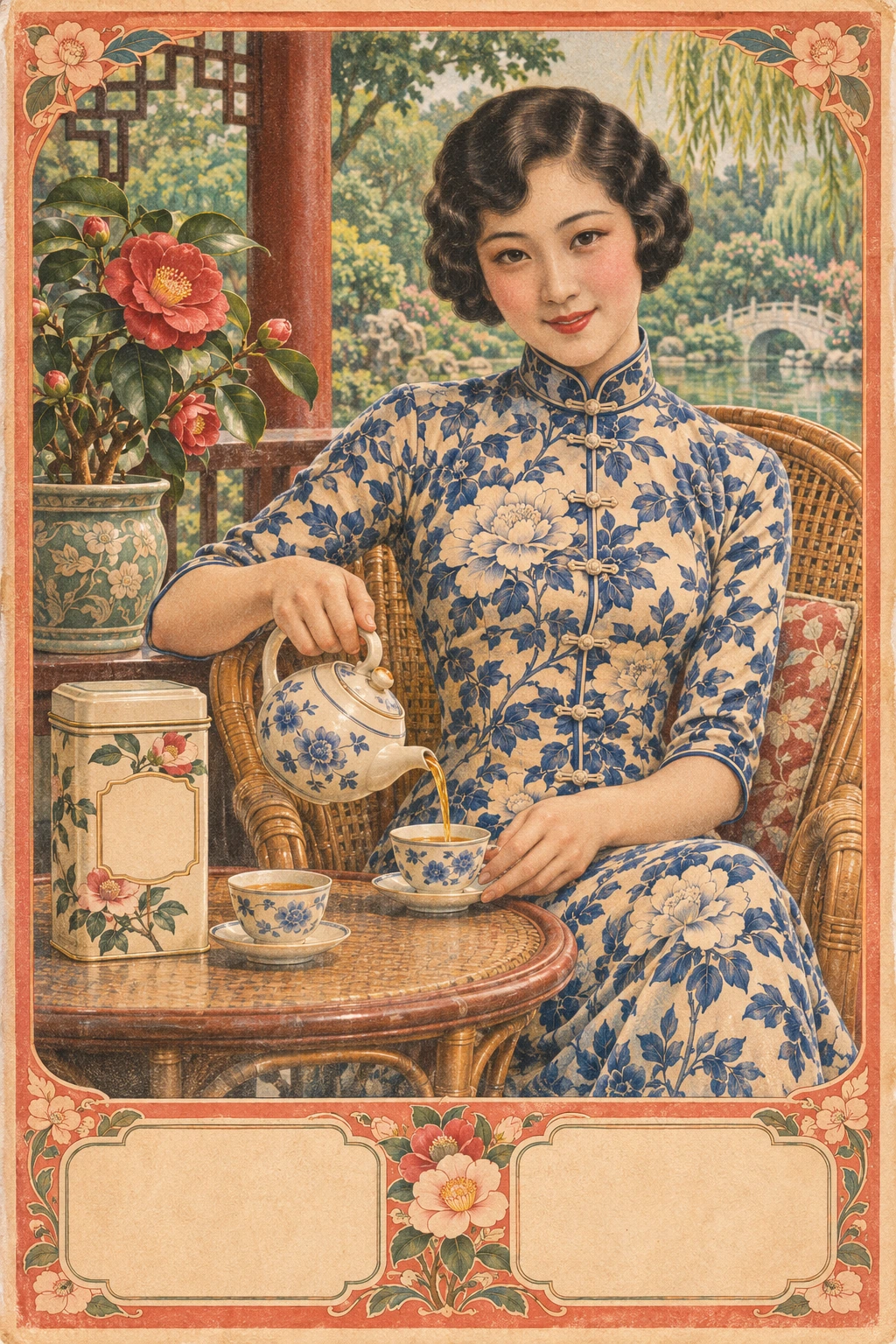
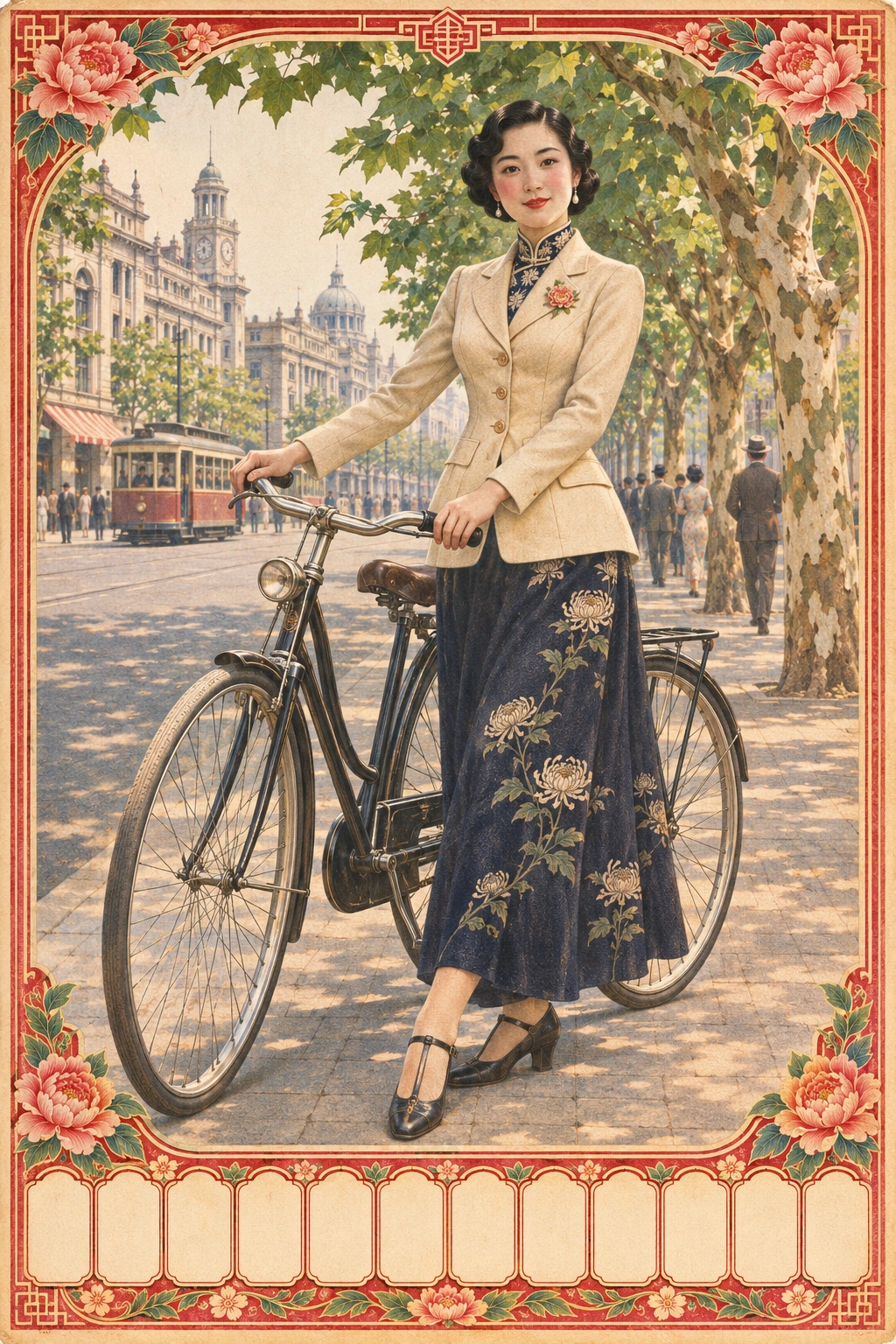
The newly generated tea and bicycle studies make different choices about activity. One builds a small domestic action around an object. The other gives its figure a means of movement and an outdoor setting. Their scenes are invented editorial interpretations. Historical conclusions should come from the credited collection objects and scholarship.
Build a poster from its hierarchy
Begin with the main figure or object, then reserve the lower or side zones for calendar and advertising information. Place the strongest contrast around the face or product. Let flowers and border motifs return the eye toward that focal point. A richly patterned sleeve can remain readable if the space beside it is quieter.
Use colour relationships across the whole sheet. A vermilion border can answer a small accent inside the scene. Jade foliage can cool the warm cream paper. Deep hair or dark furniture supplies a stable anchor for delicate modelling. The result needs a clear large-scale structure before fine ornament will reward attention.
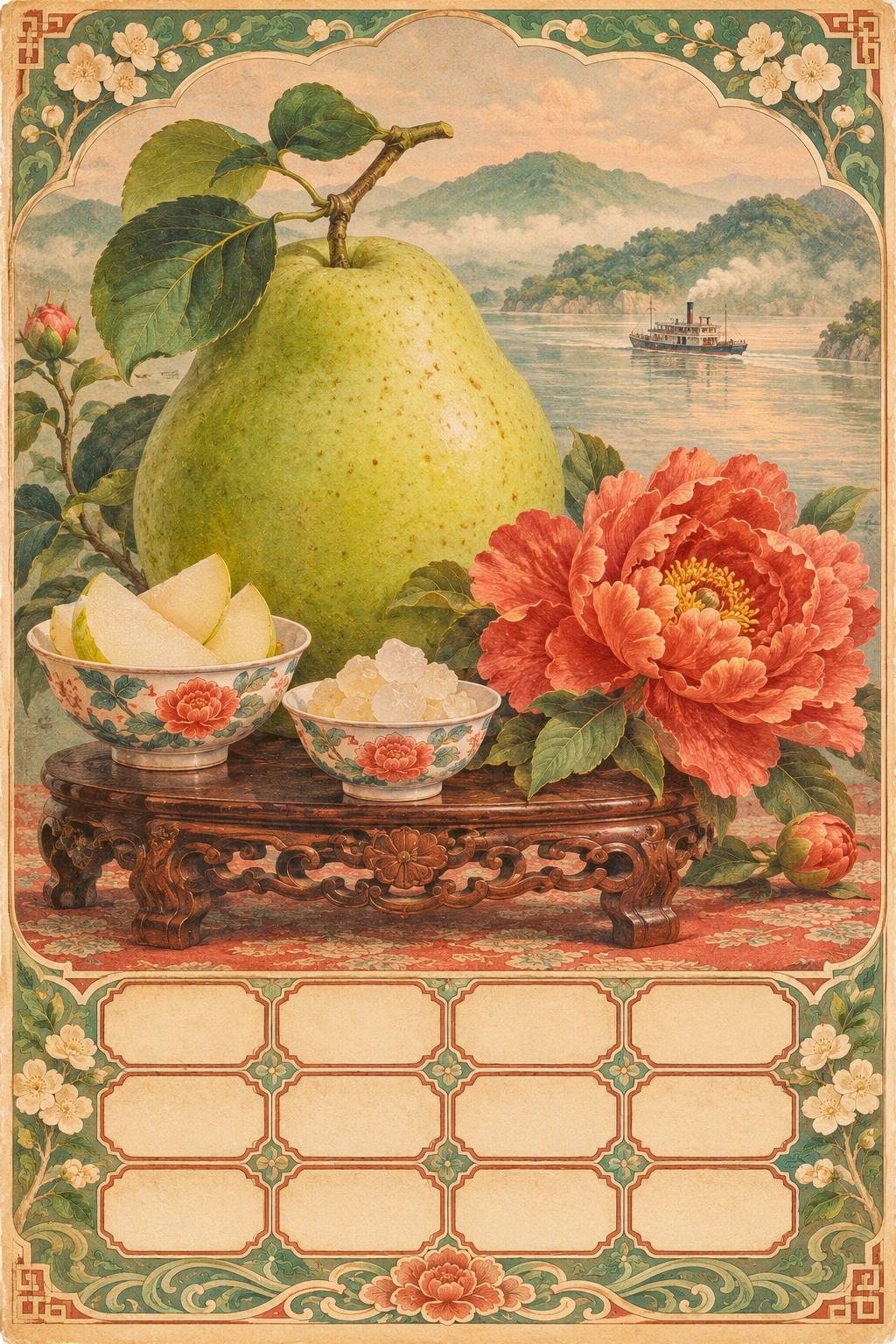
The pear study explores a contemporary extension through a still life. It borrows the dominant motif, ornamental frame and reserved panels while giving the fruit an exaggerated scale. The gallery's empty cartouches are intentional design spaces. A usable calendar would require separately checked dates, language and typography.
Study with enough specificity to learn
Useful comparisons include the period and place, artist or studio, advertiser, printing process and intended setting. Shanghai School Painting offers another local history of image-making, with its own practices and institutions. Comparing those contexts can reveal shared urban conditions while preserving the commercial poster's particular function.
For prompt development, specify the subject's action, garment structure, face treatment, decorative border and reserved information zones. Review the results for coherent hands, plausible bicycles and meaningful spatial relationships. Invented script can overwhelm a well-composed image, so plan actual lettering as an editorial task.
Contemporary uses include cultural interpretation, packaging studies, exhibition graphics and calendars. The most thoughtful adaptations retain the format's relationship between daily life and persuasion. A beautiful frame alone tells us very little about what its image wants us to desire.
A small poetic detour
Original words from the AOI studio.
Poetry
A year hangs by a thread of red.
The painted sleeve forgets to fade.
A cup is lifted, spring returns,
and every month a promise made.
Beyond the border, traffic grows.
Inside, one perfect peony blows.
The prompt workshop
Original creative exercises. These prompts create new illustrations, not documentary evidence.
A figure, an object and a quiet action
Create an original vertical yuefenpai-inspired calendar-poster study of an adult Chinese woman pouring tea on a veranda. Use softly rubbed charcoal-like facial shading with pale colour washes, a precise blue floral qipao, a tea tin with an empty label and a restrained ornamental border. Reserve two blank calendar panels below. Coherent hands and tea service, no invented writing.
Put the figure in the city
Compose an original calendar-poster interpretation of a fully clothed adult woman beside a bicycle on a tree-lined Shanghai-inspired promenade. Show a purposeful stance, tailored cream jacket, long navy skirt, softly modelled skin and crisp fabric. Use jade foliage, vermilion framing and empty calendar compartments. Treat the setting as an invented historical interpretation.
Let a still life carry the promise
Design a contemporary yuefenpai-inspired poster around an enormous pale-green pear, porcelain bowls and a coral peony. Use a dominant central motif, layered river scenery, delicate print texture and an ornamental cream-and-jade frame. Reserve blank panels for a calendar that will be typeset separately. No brand or pseudo-script.
Your next inspiration
Discover another art style
Follow a visual thread to the next subject.

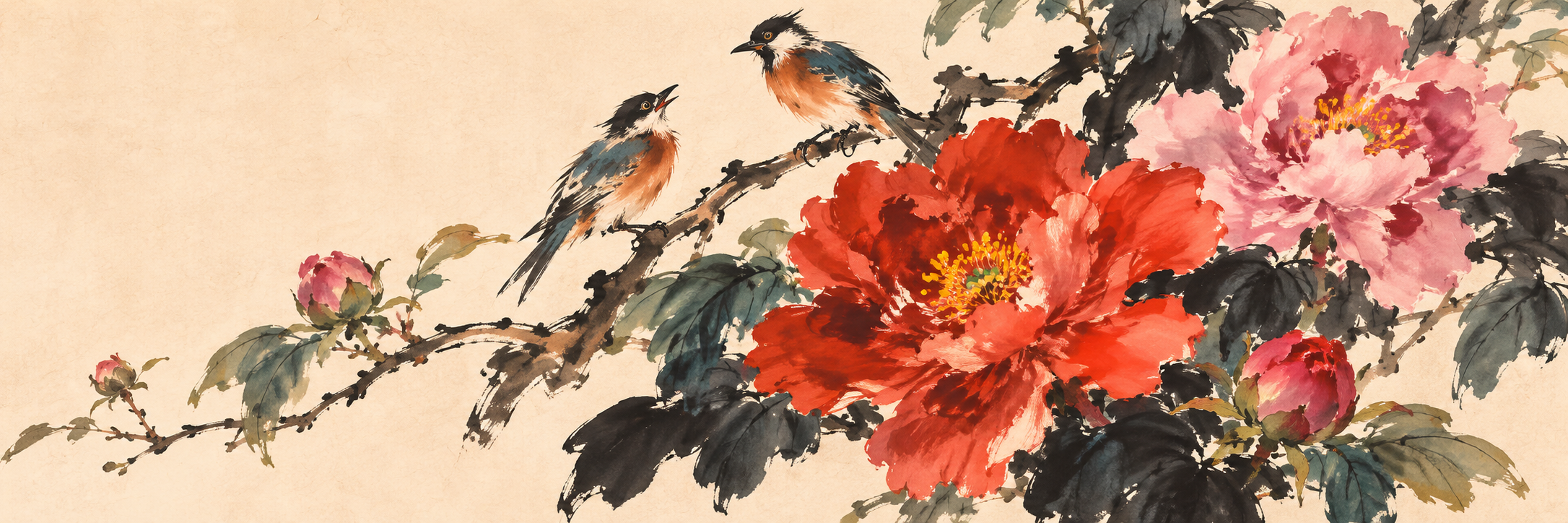
Shanghai School Painting
Compare Shanghai's painting traditions with the city's commercial poster culture.
People & works to explore
References discussed in this article. Consult the sources below for context.
Artists and practitioners
Zheng Mantuo — Calendar Poster for China Printing Co., Fukuoka Asian Art Museum
Hu Boxiang — Calendar Poster for British American Tobacco Co., Fukuoka Asian Art Museum
Hang Zhiying / Zhiying Studio — calendar posters listed by Fukuoka Asian Art Museum
Jin Meisheng — Calendar Poster: Lady with Blue Scarf, Fukuoka Asian Art Museum
Paintings and other works
Zheng Mantuo, Calendar Poster for China Printing Co. (1910s–1930s), offset on paper
Hu Boxiang, Calendar Poster for British American Tobacco Co. (1930), offset on paper
Hang Zhiying / Zhiying Studio, Calendar Poster: Lady with Pink Scarf (1930s), offset on paper
A smile from the studio
Jokes
The calendar promised twelve orderly months. The peonies, having no appointments, took most of the page.