
Historical Chinese painting context
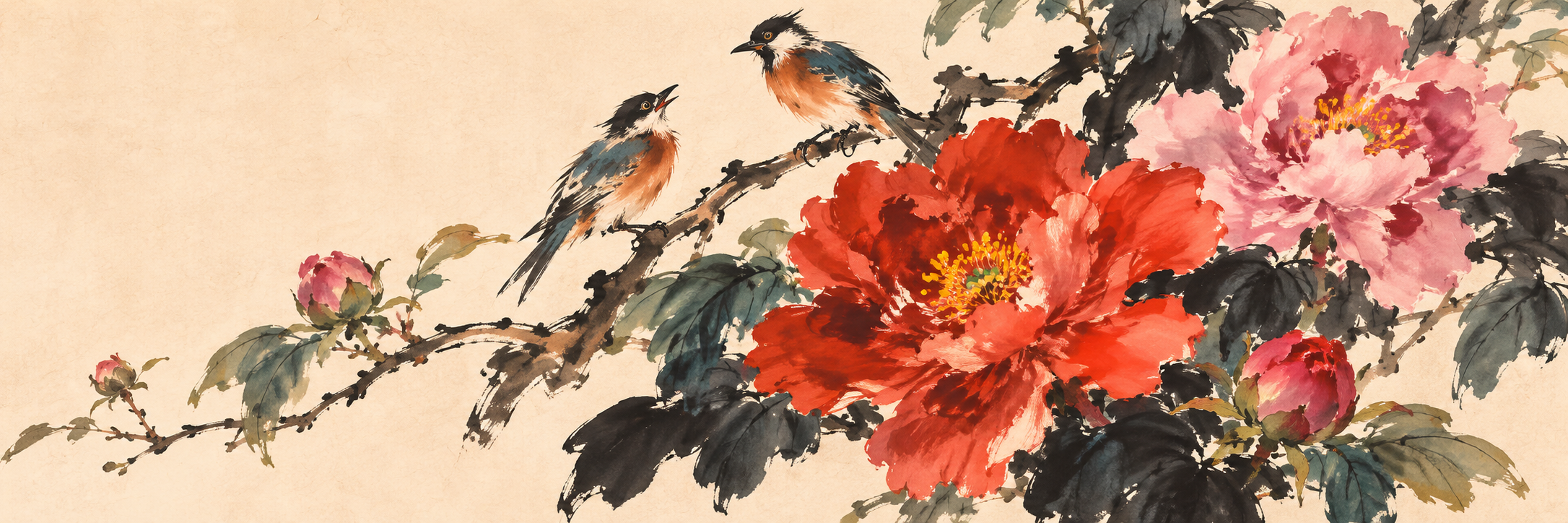
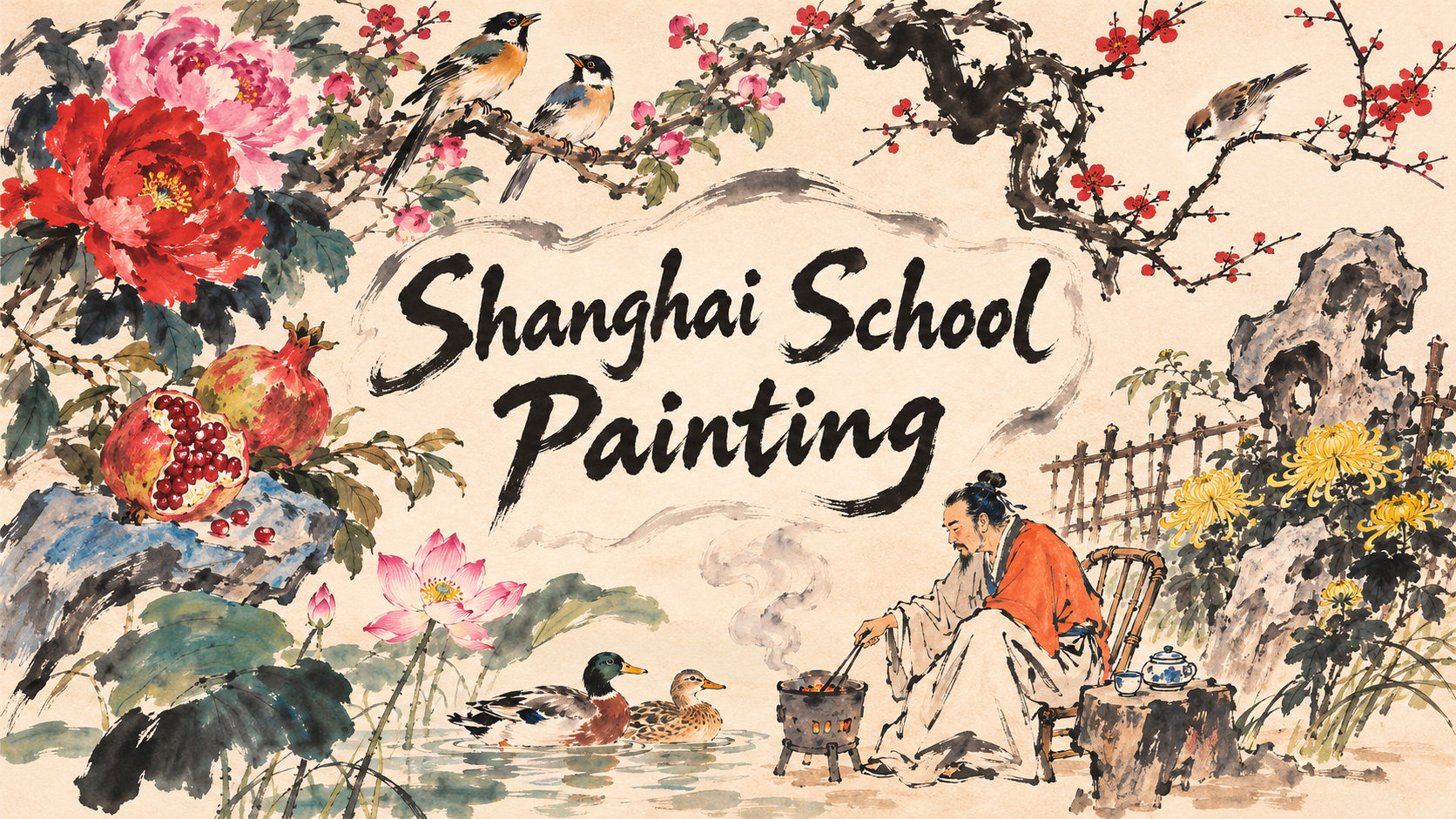
Shanghai School Painting brings forceful ink, selective bright color and expressive composition into a historical Chinese painting context that reaches from the nineteenth into the early twentieth century.
A visual introduction
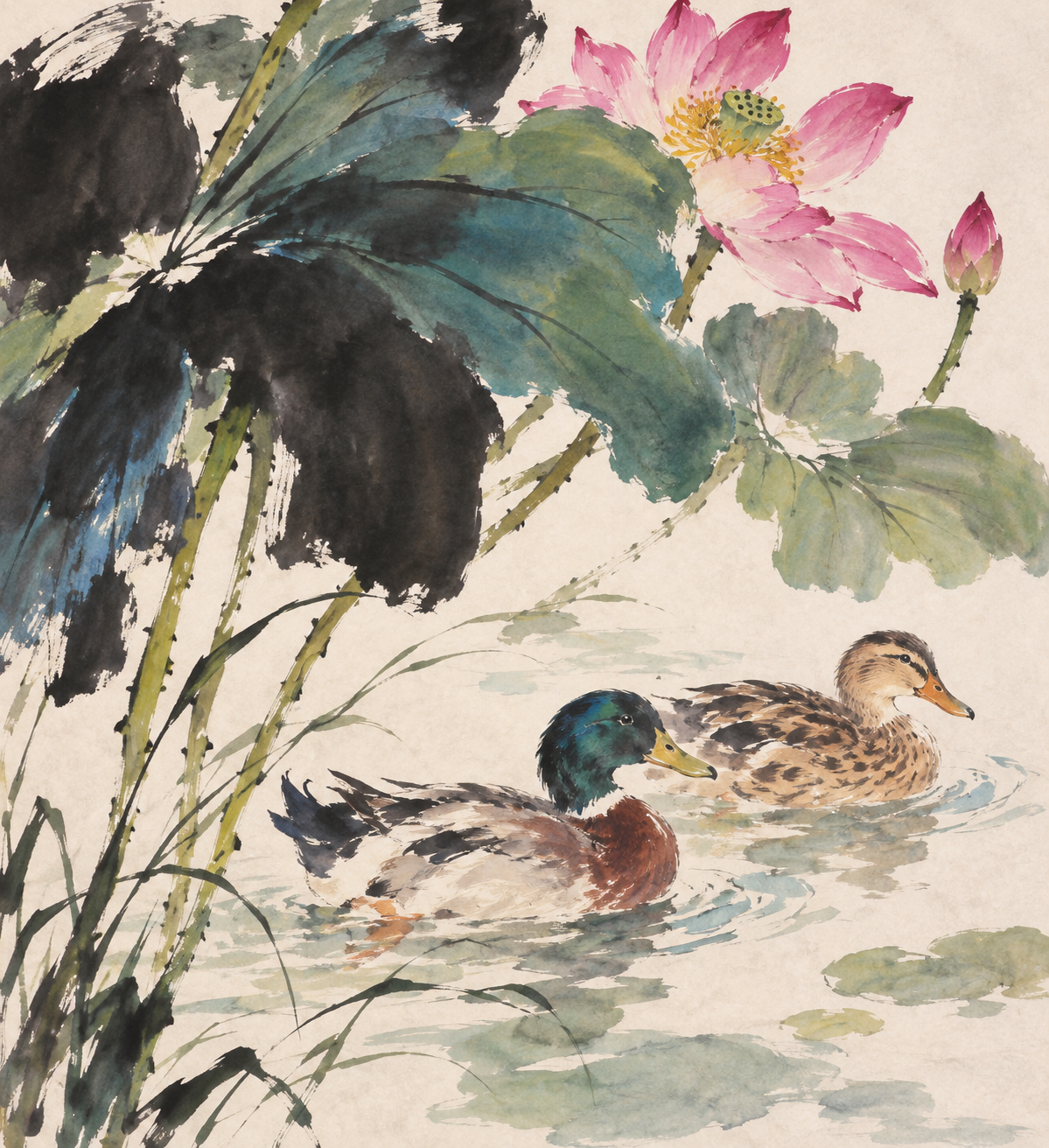
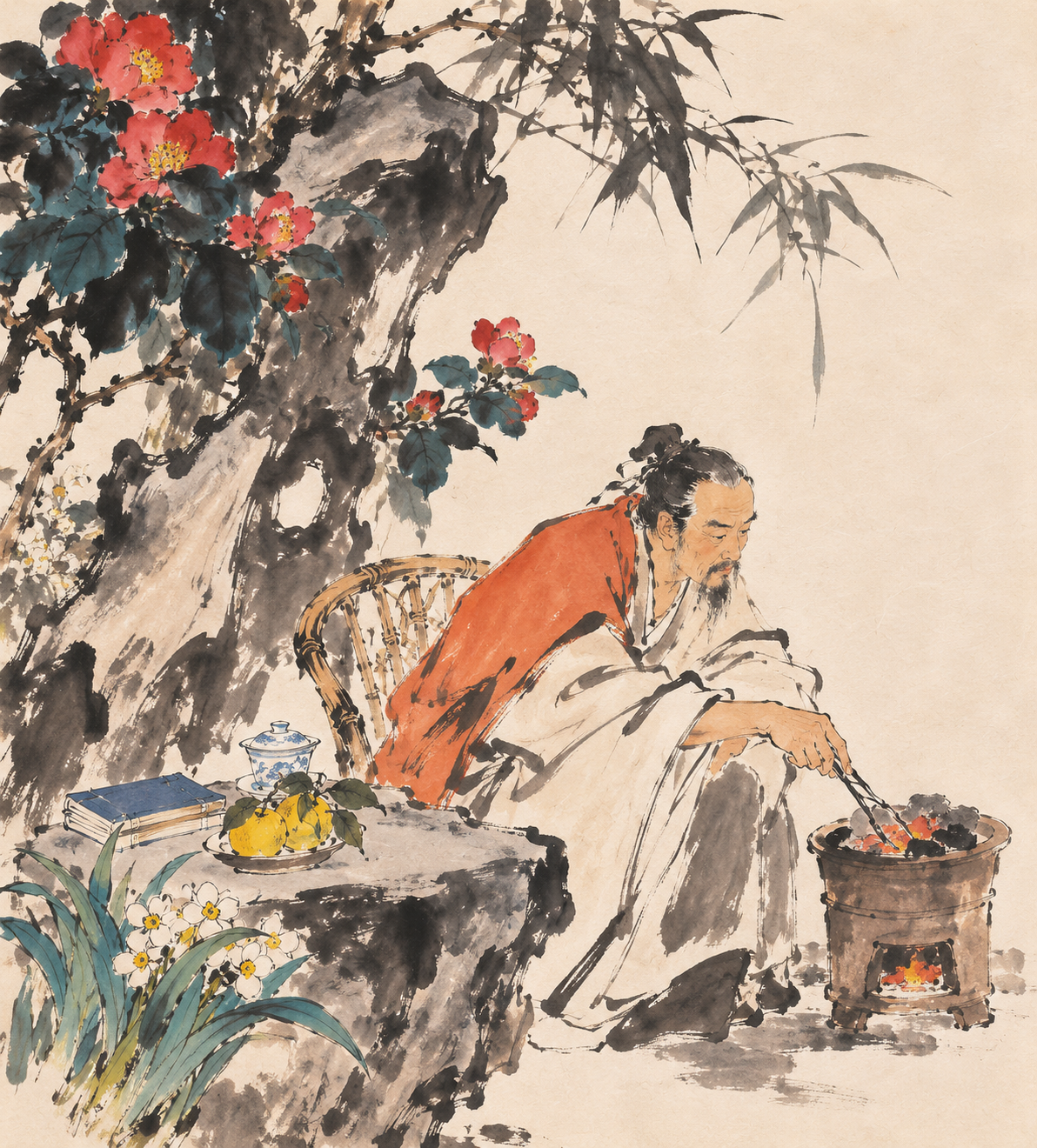
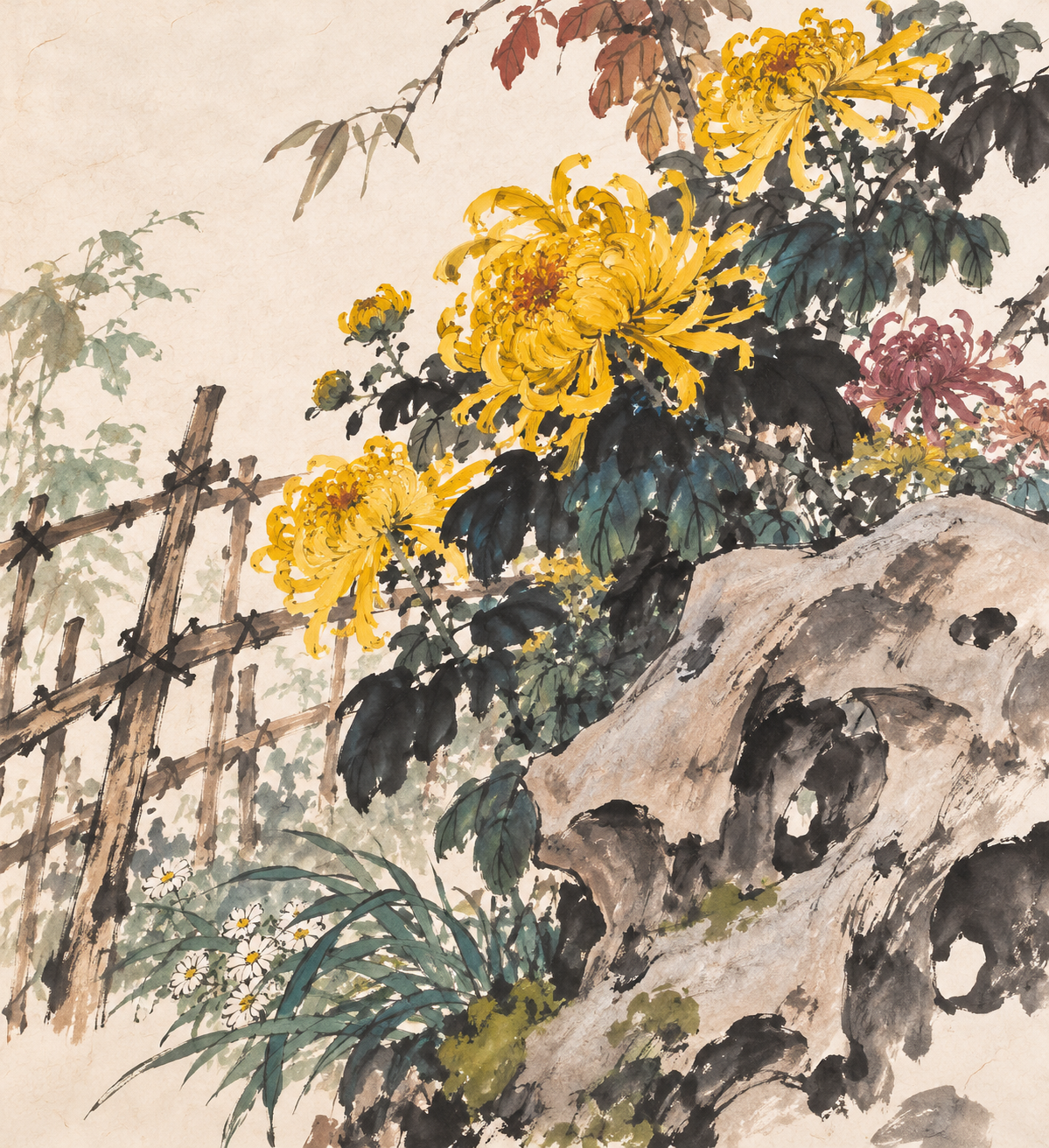
Select an image for a closer look. Use the thumbnails, arrow keys or a swipe to compare examples. Zoom in to inspect details, or share the image that inspires you.
Creative toolbox · take this style further
Choose an input and a destination. Search sends your words to the chosen site; Copy & open puts them on your clipboard to paste there.
Create with AI
Turn your chosen input into an image prompt or a new creative direction.
ChatGPT
Copy your input and paste it into a ChatGPT conversation or image request.
Copy & open ChatGPT (new tab)Claude · Anthropic
Develop an image prompt or explore the style in a new Claude conversation.
Copy & open Claude · Anthropic (new tab)Midjourney
Paste your input into the Imagine bar on the Create page.
Copy & open Midjourney (new tab)Adobe Firefly
Copy your input, open Firefly, and paste it into the prompt field.
Copy & open Adobe Firefly (new tab)Leonardo.Ai
Copy your input, open Leonardo, and paste it into the generation field.
Copy & open Leonardo.Ai (new tab)Image search
Find visual references. Short, concrete keywords usually work best.
Lexica
Search AI images and prompts using your selected input.
Search with this input Lexica (new tab)Pexels
Search the photo and video library. Short keywords often work best.
Search with this input Pexels (new tab)Pixabay
Search photos, illustrations and other images.
Search with this input Pixabay (new tab)Unsplash
Search photographs using the style name or your own keywords.
Search with this input Unsplash (new tab)Wikimedia Commons
Search photographs, artworks and historical images. Check each file for its source and reuse terms.
Search with this input Wikimedia Commons (new tab)Art & research
Explore artists, collections and the ideas behind a style.
Wikipedia
Search for background reading. A style may not have its own article.
Search with this input Wikipedia (new tab)WikiArt
Copy your input into WikiArt’s search to explore artists and artworks.
Copy & open WikiArt (new tab)Europeana
Paste your keywords into the search to explore European museum, library and archive collections.
Copy & open Europeana (new tab)Inspiration
Discover portfolios and visual ideas from creative communities.
Instagram hashtags
Search a hashtag made from your input: spaces and punctuation are removed. Instagram may require sign-in.
Search with this input Instagram hashtags (new tab)ArtStation
Paste your input into artwork search for concept art, environments, characters and visual development.
Copy & open ArtStation (new tab)Behance
Paste your input into project search for illustration, design and visual storytelling.
Copy & open Behance (new tab)A closer look
Calligraphic branches and stems carry the structure; saturated ink masses meet vivid flower or fruit accents, while open paper gives energetic brushwork room to breathe.
History without a single recipe
The Shanghai School names a historical painting context, not a standardized pattern library or every painting made in Shanghai. The Met describes Wu Changshuo as a leading figure whose work transformed historical precedents through bright color and saturated ink and pigment. His dated 1922 hanging scroll Dew-Moistened Pearls, with its tangled wisteria and cascading blossoms, is a useful concrete reference. It also prevents a misleading restriction of the subject to the Qing dynasty alone.
For a contemporary study, the useful question is how an inherited brush language can become assertive and immediate. Do not equate the whole school with one artist’s manner. The exercises here select a limited vocabulary of vigorous structure, concentrated color and asymmetry; they are interpretive studies rather than a survey of every associated painter.
Make the stroke carry the form
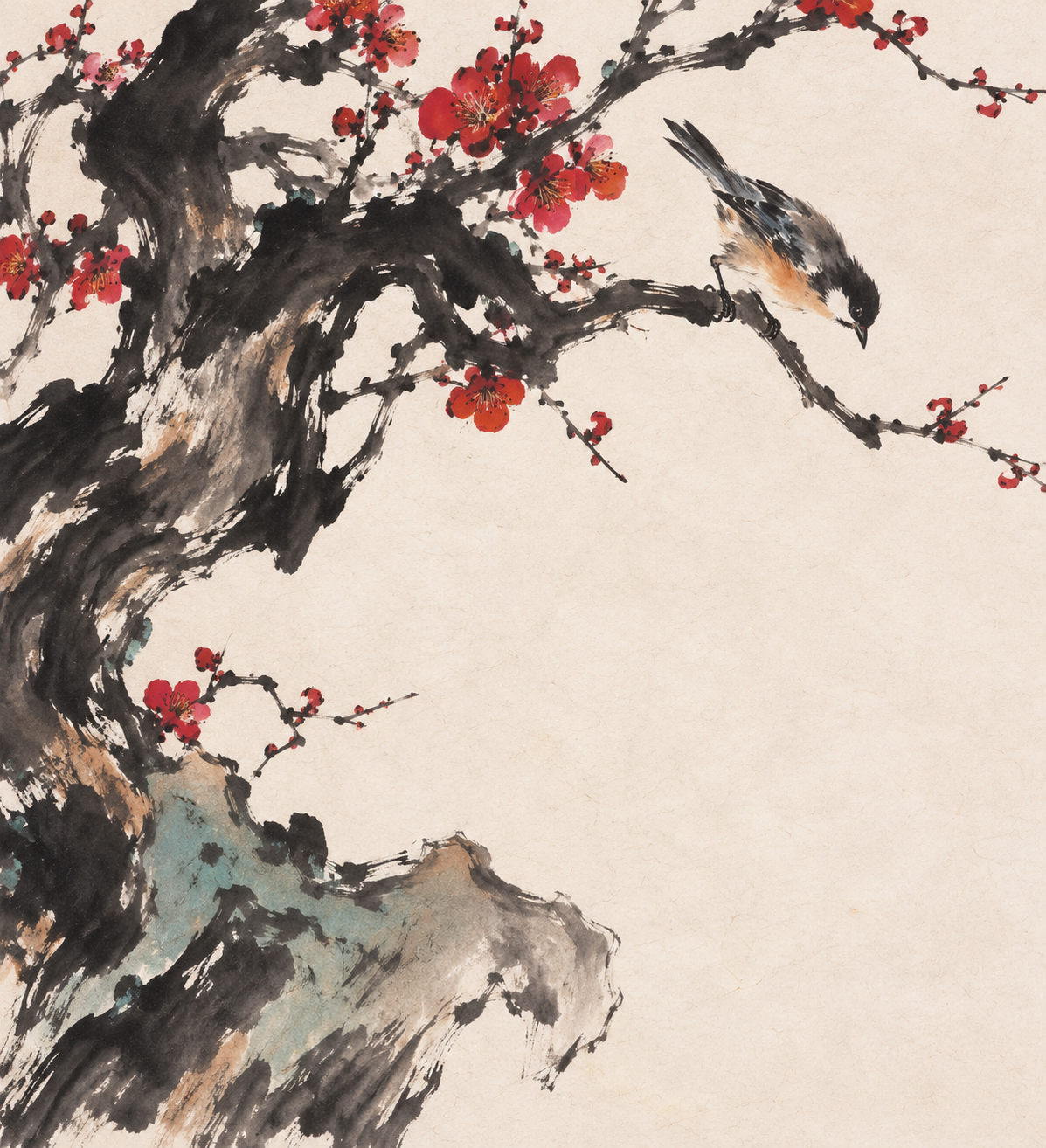
Think of a branch as a sequence of pressure changes, turns and interruptions. A mechanically even outline may identify the plant, yet lose the energy of the gesture. Let a heavier bend anchor the composition and a thinner extension turn toward empty paper. Dark foliage can act as a counterweight to a flower without describing every leaf.
Wet and dry marks should have different jobs. A saturated patch can gather weight; a broken stroke can expose the surface and suggest speed. Adding a uniform grain overlay to a smooth digital painting does not produce these relationships. The shape of each mark, and the way it meets its neighbors, matter more than an overall texture.
Color, interval and scale
Place color where it changes the reading of the image. A red blossom near a dark fork can become a pivot; a group of pale petals can interrupt an otherwise heavy mass. Bright color need not occupy most of the sheet. Compare a concentrated accent with an evenly distributed palette to see how the eye’s route changes.
Avoid filling open paper simply because it feels unfinished. The interval between a bird and a branch can suggest alertness; the gap between two fruit forms can stop a still life from becoming a pile. Crop deliberately. A stem entering from outside the sheet can imply continuation, but a crop through the focal flower may weaken the entire arrangement.
Applications and responsible interpretation
The approach can support flower-and-bird studies, fruit still lifes and expressive figures. Begin with a subject whose structure you understand, then simplify its anatomy into meaningful gestures. The planned studies vary blossoms, pomegranates, ducks, a seated figure and a garden corner so that the same principles face different compositional problems.
A seal, signature or inscription is not a generic authenticity stamp. Include writing only when it has been composed and checked; otherwise let the image stand without it. Generated examples should be described as contemporary interpretations. They cannot establish physical materials, an artist’s authorship or the cultural provenance of an object.
Positive editorial perspective
AOI editorial perspective (AI-authored). The selected vocabulary combines immediate graphic impact with close attention to individual marks. A forceful dark branch and a small bright blossom can establish an entire visual argument. Its strongest compositions allow color, brush pressure and empty paper to cooperate, rather than using detail as the only measure of richness.
Negative editorial perspective
AOI editorial perspective (AI-authored). The approach becomes formulaic when every image contains the same red flower, black branch and decorative seal. Excess saturation can flatten the hierarchy, while imitation brush textures conceal weak structure. Broaden the subjects and remove unnecessary accents; a convincing gesture should remain readable before surface effects are added.
Neutral editorial perspective
AOI editorial perspective (AI-authored). This entry presents a focused introduction to Shanghai School painting through one documented work and a set of contemporary exercises. It does not assign a single formula to all associated artists. The exercises address composition and mark behavior, while historical attribution and material identification require separate evidence.
A small poetic detour
Original words from the AOI studio.
Poetry
A branch arrives before the blossom does,
its dark arm turning sharply through the air.
One red note catches on a knot of ink;
the empty paper holds it waiting there.
The leaves collect the weather in their folds.
A bird leans out beyond the crowded stem.
The brush has left a broken road behind;
the eye must cross the spaces after them.
No petal needs to occupy the sky.
No stroke must prove the whole tree understood.
A little color interrupts the weight,
and light returns through gaps in painted wood.
The prompt workshop
Original creative exercises. These prompts create new illustrations, not documentary evidence.
Start with a branch
An original contemporary Shanghai-school-informed ink-and-color study: a gnarled plum branch entering diagonally, sparse red blossoms, one small bird leaning toward open paper, vigorous pressure-sensitive strokes, saturated dark accents, no signatures, seals or invented writing.
Use the dark branch to establish direction; reserve the brightest red for a few blossoms.
Build a fruit still life
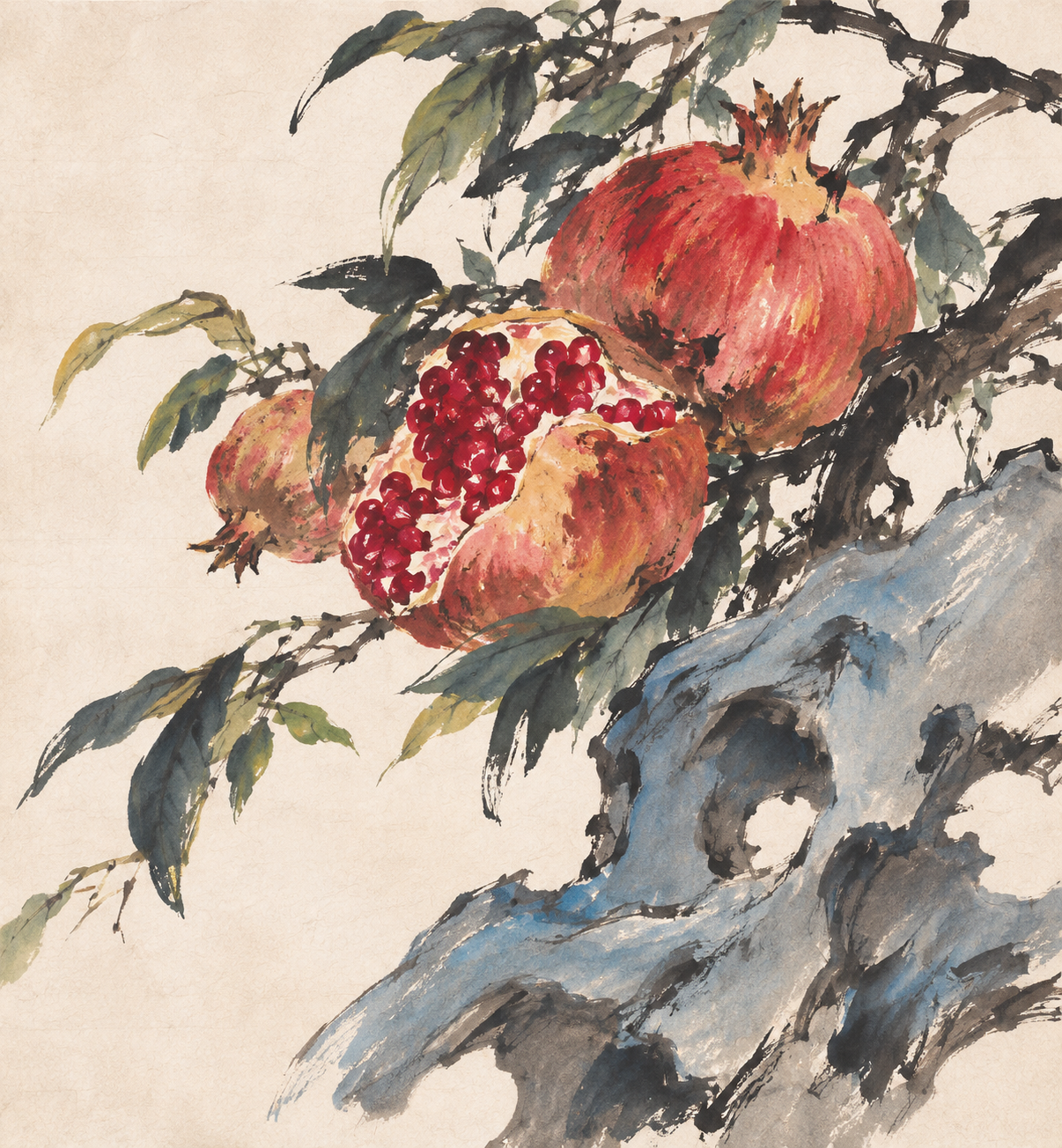
Three pomegranates with one split fruit, a blue-gray rock and loose leaves, original ink-and-color study informed by Shanghai School painting, forceful asymmetric structure, selective vermilion seeds, wet and dry marks, generous paper reserves, no text.
Keep the split fruit legible without giving every seed equal contrast.
Test figure and gesture
An original seated figure tending a small brazier, concise expressive ink contours, one warm garment accent, weight carried by broad and fine brush-like marks, spare paper ground, contemporary study of Shanghai-school-informed visual principles, no inscriptions.
Check anatomy and posture before judging decorative texture.
A smile from the studio
Jokes
Penny gave every blossom a highlight, every leaf a vein and every twig a dramatic backstory. The result looked less like a flowering branch than a committee meeting. She removed half the leaves. Suddenly the red blossom had something to say. Simplex supplied a paw print in the empty corner. Penny called it an unauthorized contribution; the composition called it a second focal point.
Sources and further exploration
The Met — Wu Changshuo’s Dew-Moistened Pearls, dated 1922; a specific Shanghai School reference