
Printmaking · Relief processes
Learn to read a woodcut through prints by Dürer, Hokusai and Kirchner. See how carved space, ink, paper and colour registration shape an impression.
A visual introduction
Four museum works and an original AOI collage. Open each image to compare the details. Credits identify the artist, medium and collection for each historical work.
Select an image for a closer look. Use the thumbnails, arrow keys or a swipe to compare examples. Zoom in to inspect details, or share the image that inspires you.
Creative toolbox · take this style further
Choose an input and a destination. Search sends your words to the chosen site; Copy & open puts them on your clipboard to paste there.
Create with AI
Turn your chosen input into an image prompt or a new creative direction.
ChatGPT
Copy your input and paste it into a ChatGPT conversation or image request.
Copy & open ChatGPT (new tab)Claude · Anthropic
Develop an image prompt or explore the style in a new Claude conversation.
Copy & open Claude · Anthropic (new tab)Midjourney
Paste your input into the Imagine bar on the Create page.
Copy & open Midjourney (new tab)Adobe Firefly
Copy your input, open Firefly, and paste it into the prompt field.
Copy & open Adobe Firefly (new tab)Leonardo.Ai
Copy your input, open Leonardo, and paste it into the generation field.
Copy & open Leonardo.Ai (new tab)Image search
Find visual references. Short, concrete keywords usually work best.
Lexica
Search AI images and prompts using your selected input.
Search with this input Lexica (new tab)Pexels
Search the photo and video library. Short keywords often work best.
Search with this input Pexels (new tab)Pixabay
Search photos, illustrations and other images.
Search with this input Pixabay (new tab)Unsplash
Search photographs using the style name or your own keywords.
Search with this input Unsplash (new tab)Wikimedia Commons
Search photographs, artworks and historical images. Check each file for its source and reuse terms.
Search with this input Wikimedia Commons (new tab)Art & research
Explore artists, collections and the ideas behind a style.
Wikipedia
Search for background reading. A style may not have its own article.
Search with this input Wikipedia (new tab)WikiArt
Copy your input into WikiArt’s search to explore artists and artworks.
Copy & open WikiArt (new tab)Europeana
Paste your keywords into the search to explore European museum, library and archive collections.
Copy & open Europeana (new tab)Inspiration
Discover portfolios and visual ideas from creative communities.
Instagram hashtags
Search a hashtag made from your input: spaces and punctuation are removed. Instagram may require sign-in.
Search with this input Instagram hashtags (new tab)ArtStation
Paste your input into artwork search for concept art, environments, characters and visual development.
Copy & open ArtStation (new tab)Behance
Paste your input into project search for illustration, design and visual storytelling.
Copy & open Behance (new tab)A closer look
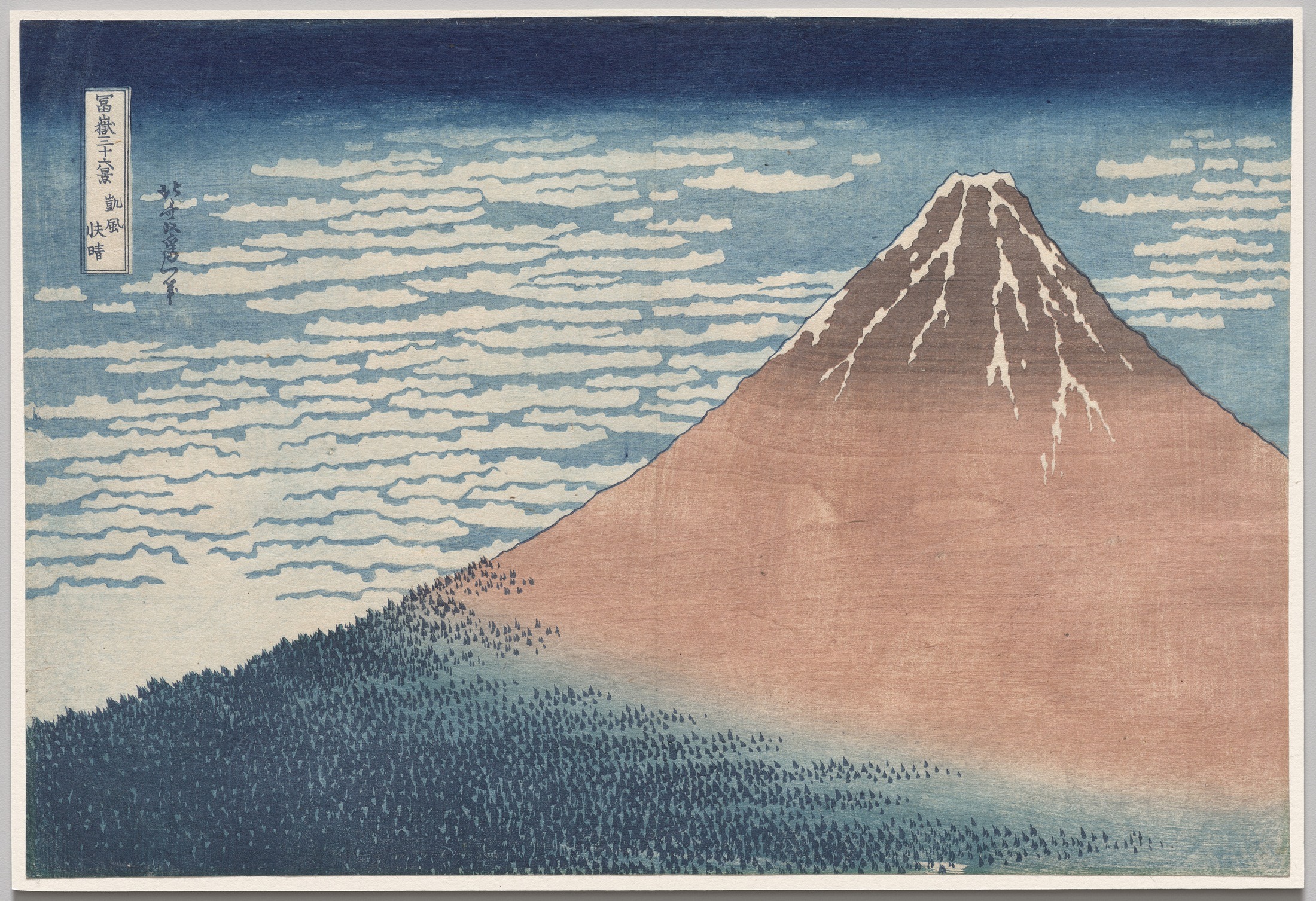
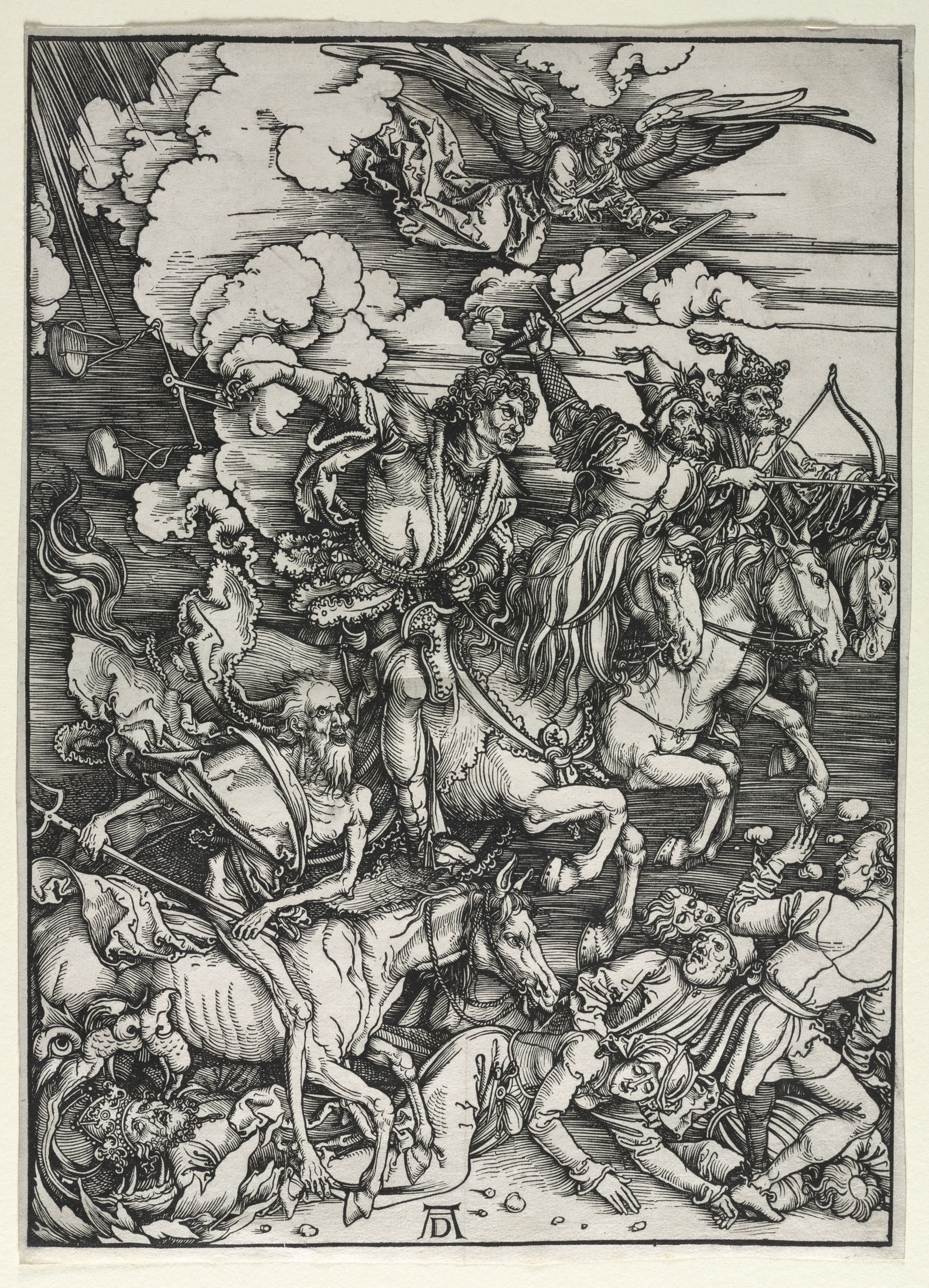
Hokusai gives Mount Fuji one immense red flank. Dürer builds an entire charge from black strokes narrow enough to disappear at arm’s length. Both depend on the same question. Which parts of the block will touch the paper?
Read the paper first
Take a white passage in Dürer’s Four Horsemen and follow it until it narrows to a point. On a conventional black-line woodcut that bright wedge corresponds to wood cut away. The adjacent black line required a thin ridge to survive the cutting on both sides. An apparently effortless stroke on paper may therefore represent quite patient work on the block.
Woodcut is a relief process. The printer inks the raised surface, places the paper against it and transfers the image under pressure. The impression reverses the arrangement on the block. That reversal matters to text, a raised hand or the direction in which a rider appears to charge. It also explains why a useful design exercise is to flip a thumbnail before committing to its shadows.
A scroll, a book and a print series
The Chinese Diamond Sutra scroll dated 868 gives a firm early point of reference. Its makers printed sections from woodblocks and joined the paper sheets into a scroll with an illustrated frontispiece. In fifteenth-century Europe relief blocks could be printed with movable type, making woodcuts particularly useful in illustrated books. These objects had distinct readerships, formats and functions. A single European starting date would erase centuries of printmaking.
Dürer’s Four Horsemen belongs to his Apocalypse series. In the gallery impression, the riders overlap so closely that their bodies become a single advancing front. The intervals of white separating the weapons are as important as the outlines of the horses. Start at the page edge and see which lines cut across it. The sensation of an event continuing beyond the sheet begins there.
How colour holds together
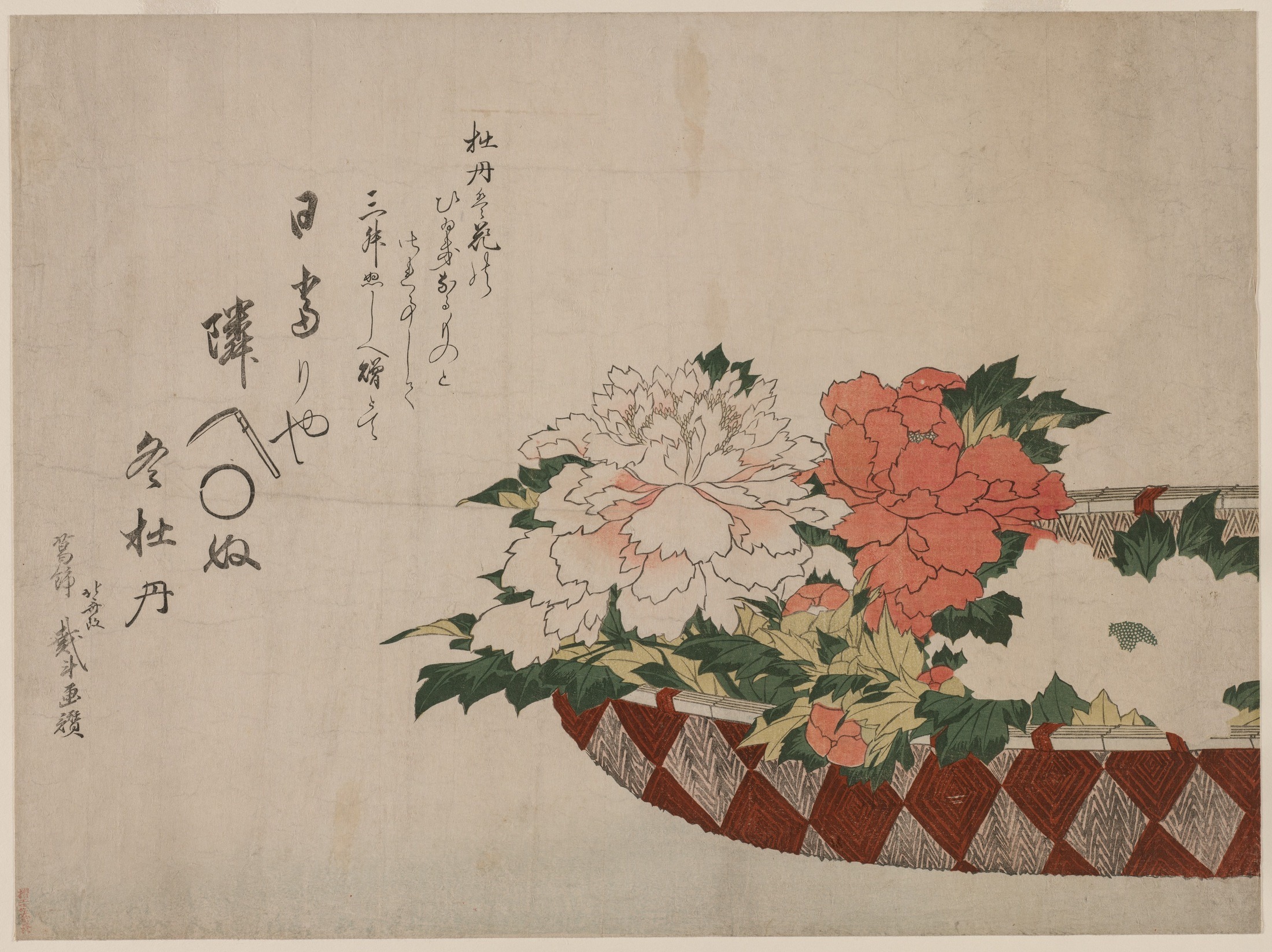
Compare two Hokusai impressions in the gallery. In South Wind, Clear Sky the mountain can be recognised from its outer edge alone. Small marks at its foot let a band of forest dissolve into the red slope. In Basket of Peonies the stem, petals, leaves, patterned container and calligraphy divide a much quieter field. Much of the paper stays open. The flower heads gain weight from that generous interval beside them.
Separate colour blocks require registration, a repeatable way to position the sheet against each block. Think through the sequence using two paper cutouts. If the blue shifts a little, does it simply change the edge of the water, or does it detach a flower from its stem? Place the most exacting joins where they matter. Hokusai’s print also offers a reminder that colour woodblock printing can produce subtle gradations.
Let the cut change direction
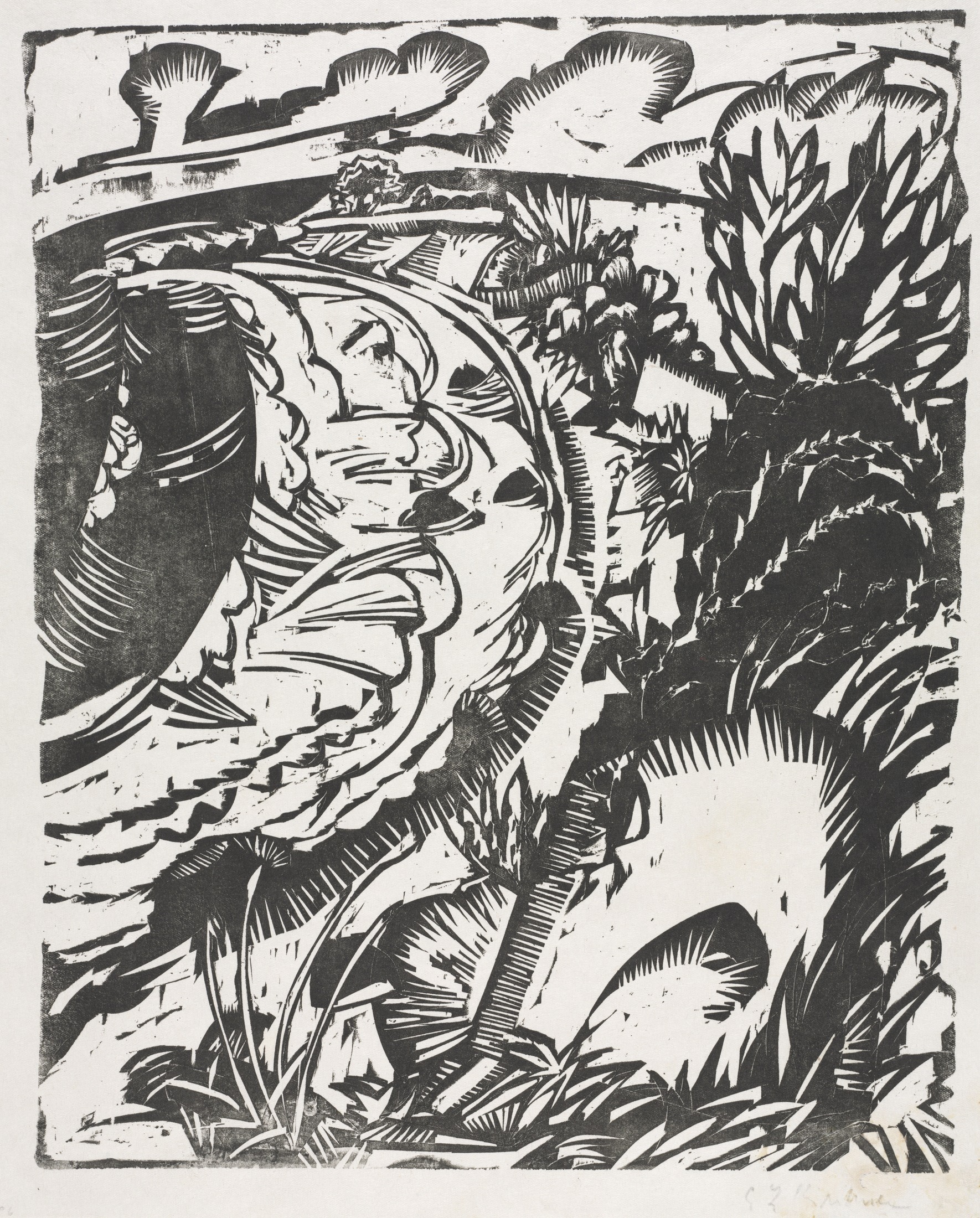
Kirchner’s Dune Landscape with a Curving Bay sets black masses against white channels that swell, turn and taper. Compare the marks in the foliage with the arc of the coast. A change of direction identifies the material before an individual leaf or wave has to be drawn. The relatively broad cuts make a useful counterpoint to Dürer’s fine network. Both ask the eye to construct a continuous surface from interrupted marks.
Plan a print on a small piece of paper
Make a two-value drawing the size of a postcard. Fill one connected dark shape and leave one large area of paper open. Now cut five white paths into the drawing with a white pencil. Give each a job, such as separating an elbow from a coat or bending a current around a stone. Reduce the drawing to thumbnail size. Any detail that disappears needs either a wider interval or a less crowded neighbour.
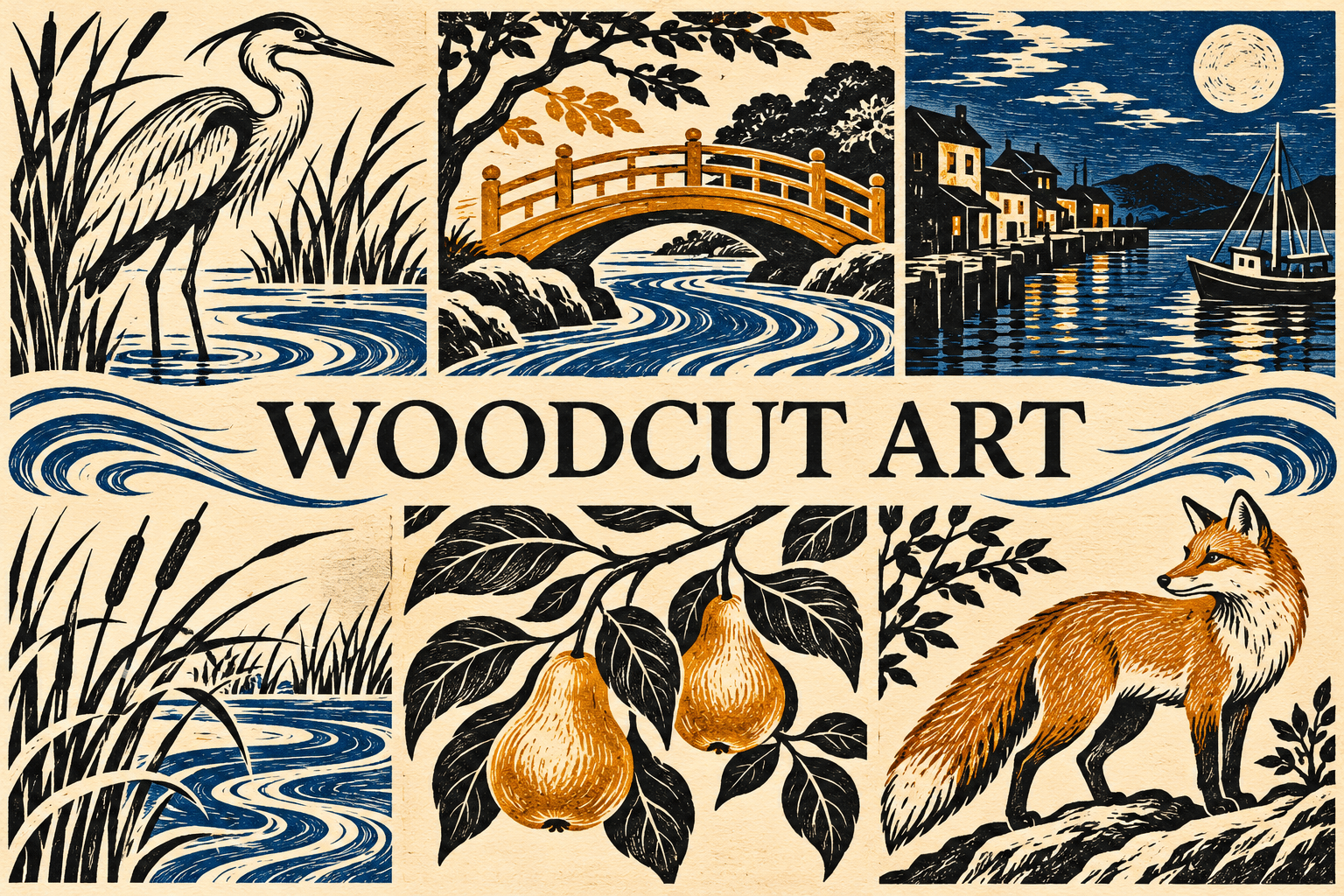
In the AOI collage the white breast of the heron and the pale space under its beak carry much of the bird’s silhouette. The water takes a different rhythm of long horizontal cuts. Use those decisions to describe a digital relief-style study. For an actual print, record the block, paper, ink and edition details alongside the impression.
A small poetic detour
Original words from the AOI studio.
Poetry
I spare a ridge the width of thread.
The river falls away around it.
One pull of paper lifts the reed,
and leaves the river where I found it.
The block looks left. The heron flies
across the sheet toward sunrise.
The prompt workshop
Original creative exercises. These prompts create new illustrations, not documentary evidence.
A single ink
Design a one-ink woodcut study of a bird beside a weir. Reserve the breast and one long strip of foam as paper white. Change cutting direction where water meets rock. Keep the bird readable at postcard size.
Two blocks at the quay
Imagine a two-colour relief print of an ochre ferry entering a blue harbour. Plan the shape of each block separately and let a small overlap make the darkest accent. Preserve paper between the mast and the waterfront.
One pear, three cuts
Arrange three small original relief studies of a pear on the same ground. Give the first a solid silhouette, the second tapered white cuts around its volume, and the third a flat second colour. Keep the contour fixed so the marks explain the change.
People & works to explore
References discussed in this article. Consult the sources below for context.
Artists and practitioners
Katsushika Hokusai
Albrecht Dürer
Ernst Ludwig Kirchner
Paintings and other works
Katsushika Hokusai, South Wind, Clear Sky, from Thirty-Six Views of Mount Fuji, early 1830s
Albrecht Dürer, The Four Horsemen, from The Apocalypse, c. 1498
Ernst Ludwig Kirchner, Dune Landscape with a Curving Bay, 1913
Katsushika Hokusai, Basket of Peonies, 1810 or 1814
A smile from the studio
Jokes
The printer signed the block before taking a proof. The mirror became the first satisfied reader.