
Vietnamese printmaking reference · contemporary interpretation
A carved line can make a wall, a branch and a river speak with different rhythms. This guide approaches Vietnamese modernist woodcut through relief-print construction and documented Vietnamese practice, while treating the label as a broad editorial reference rather than one uniform national style.
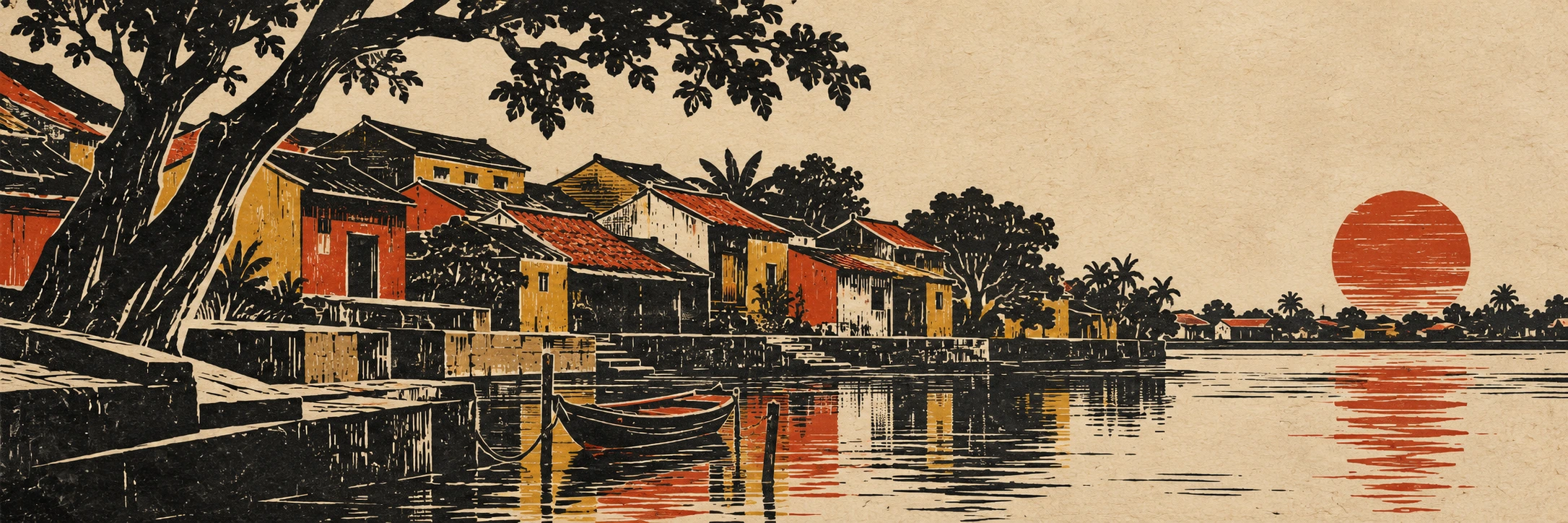
A visual introduction
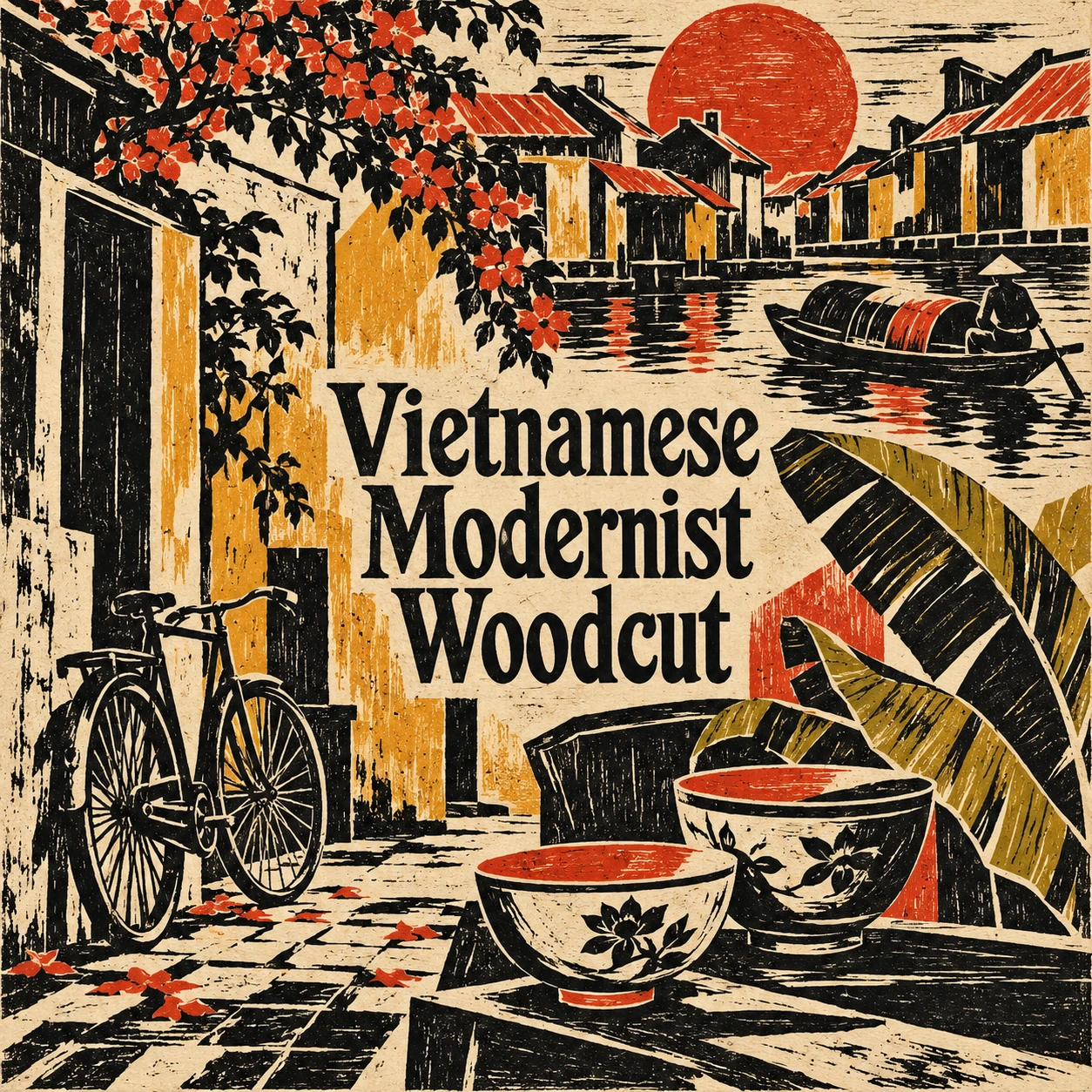
Seven original AI-generated interpretations: a dedicated banner, a centrally titled collage and five standalone studies. These are contemporary illustrations, not historical objects or proof of a physical printing process.
Select an image for a closer look. Use the thumbnails, arrow keys or a swipe to compare examples. Zoom in to inspect details, or share the image that inspires you.
Creative toolbox · take this style further
Choose an input and a destination. Search sends your words to the chosen site; Copy & open puts them on your clipboard to paste there.
Create with AI
Turn your chosen input into an image prompt or a new creative direction.
ChatGPT
Copy your input and paste it into a ChatGPT conversation or image request.
Copy & open ChatGPT (new tab)Claude · Anthropic
Develop an image prompt or explore the style in a new Claude conversation.
Copy & open Claude · Anthropic (new tab)Midjourney
Paste your input into the Imagine bar on the Create page.
Copy & open Midjourney (new tab)Adobe Firefly
Copy your input, open Firefly, and paste it into the prompt field.
Copy & open Adobe Firefly (new tab)Leonardo.Ai
Copy your input, open Leonardo, and paste it into the generation field.
Copy & open Leonardo.Ai (new tab)Image search
Find visual references. Short, concrete keywords usually work best.
Lexica
Search AI images and prompts using your selected input.
Search with this input Lexica (new tab)Pexels
Search the photo and video library. Short keywords often work best.
Search with this input Pexels (new tab)Pixabay
Search photos, illustrations and other images.
Search with this input Pixabay (new tab)Unsplash
Search photographs using the style name or your own keywords.
Search with this input Unsplash (new tab)Wikimedia Commons
Search photographs, artworks and historical images. Check each file for its source and reuse terms.
Search with this input Wikimedia Commons (new tab)Art & research
Explore artists, collections and the ideas behind a style.
Wikipedia
Search for background reading. A style may not have its own article.
Search with this input Wikipedia (new tab)WikiArt
Copy your input into WikiArt’s search to explore artists and artworks.
Copy & open WikiArt (new tab)Europeana
Paste your keywords into the search to explore European museum, library and archive collections.
Copy & open Europeana (new tab)Inspiration
Discover portfolios and visual ideas from creative communities.
Instagram hashtags
Search a hashtag made from your input: spaces and punctuation are removed. Instagram may require sign-in.
Search with this input Instagram hashtags (new tab)ArtStation
Paste your input into artwork search for concept art, environments, characters and visual development.
Copy & open ArtStation (new tab)Behance
Paste your input into project search for illustration, design and visual storytelling.
Copy & open Behance (new tab)A closer look
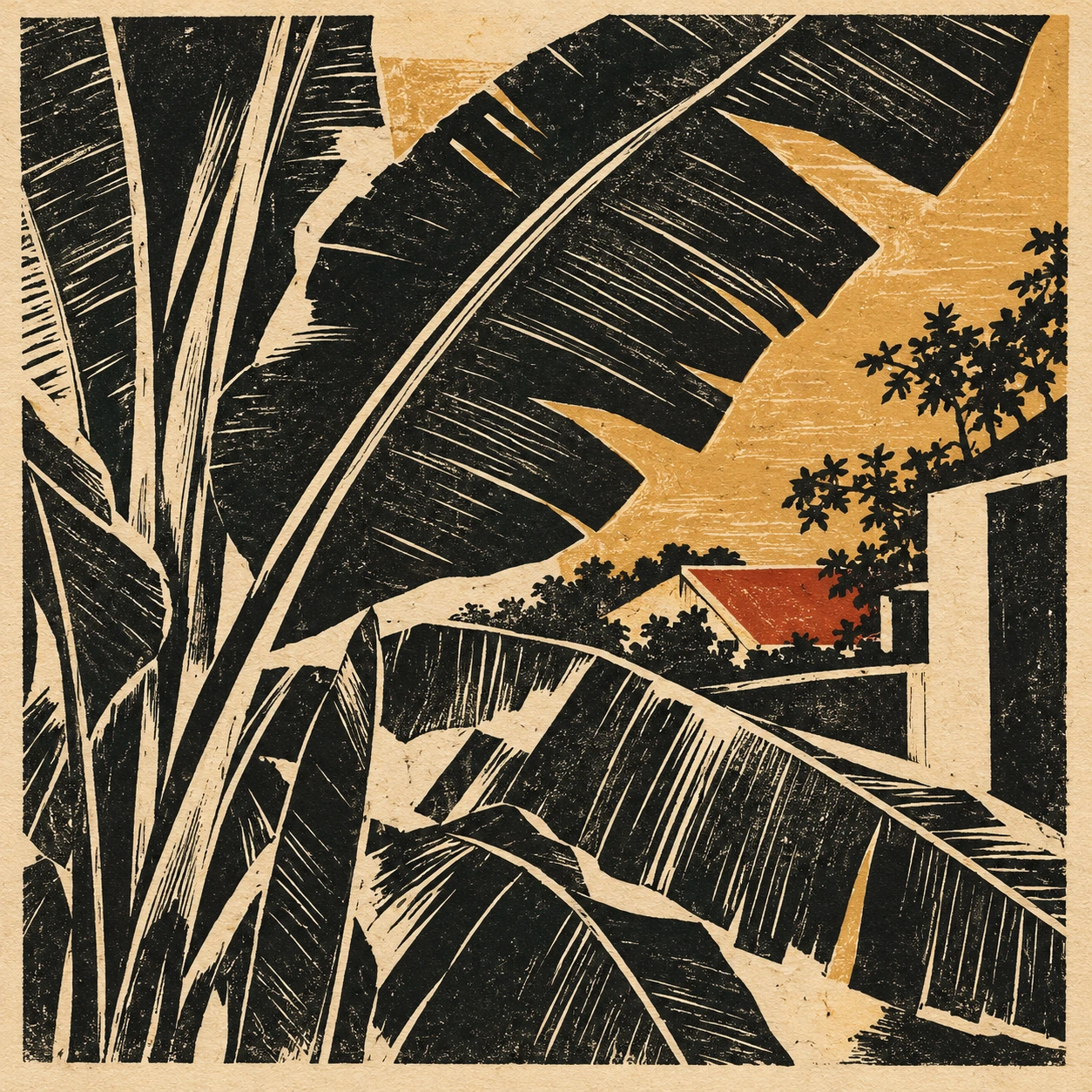
Strong black key shapes, decisive white cuts, compressed space, interlocking everyday forms, economical colour blocks and directional carved marks on warm paper.
A useful label with limits
Vietnamese Modernist Woodcut is used here as a descriptive heading for studying modern approaches to woodcut in a Vietnamese context. It is not presented as the name of a single school with one manifesto, palette or founder. Vietnamese printmakers have worked across different periods, subjects and purposes. A national label should invite closer looking, not excuse a collection of interchangeable cultural symbols.
Hanoi’s cultural authority documents Trần Nguyên Đán’s woodcut practice through subjects including scenery, rural life, craft villages and architecture, and records a 2016 exhibition at the Vietnam Fine Arts Museum. This is a concrete point of reference for the breadth of the medium. The AOI studies are newly generated compositions; none is attributed to him or offered as a reproduction of his work.
Relief construction before decoration
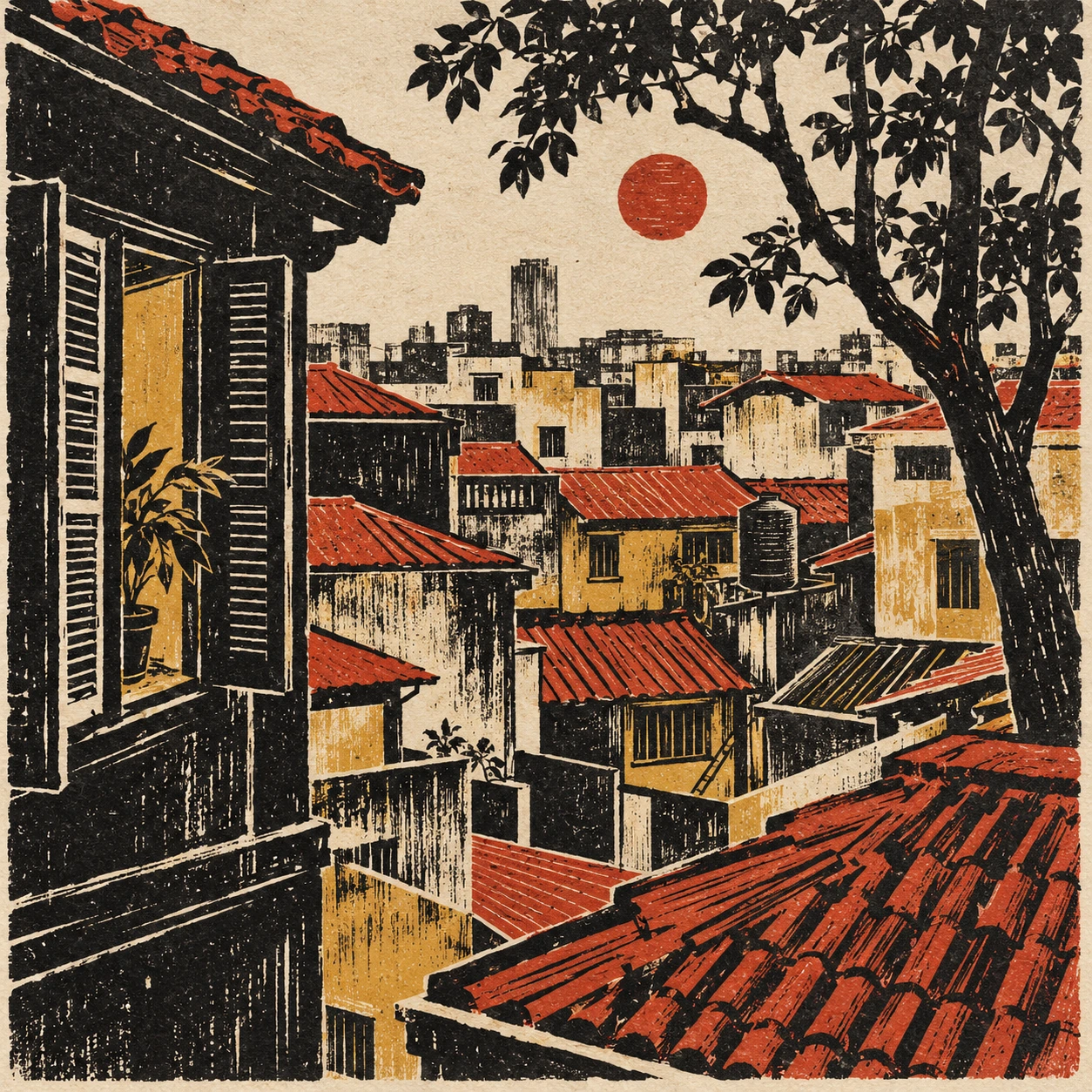
In a woodcut, the relationship between retained printing surface and cut-away space gives the image its structure. For an illustrative interpretation, think first in connected masses. A black wall can support a white window; a branch can divide a pale sky; a row of roofs can compress depth into a readable rhythm. The strongest cut is often the one that explains several things at once.
Draw a small two-value version before choosing additional colours. If the bicycle merges into its wall, separate the shapes through placement or value. If the river looks like striped fabric, make its directional cuts respond to the bank and boat. Carved-looking marks are persuasive when they describe a particular surface, not when they are sprinkled over everything equally.
Modern simplification and observed subjects
Modernist simplification can be explored through flattened planes, shifted viewpoints and an emphatic arrangement of shapes. Here it is an editorial way of discussing form, not a claim that every Vietnamese woodcut shares these features. Everyday subjects are enough: a courtyard, stacked bowls, leaves, a landing or an open window can carry a demanding composition without additional spectacle.
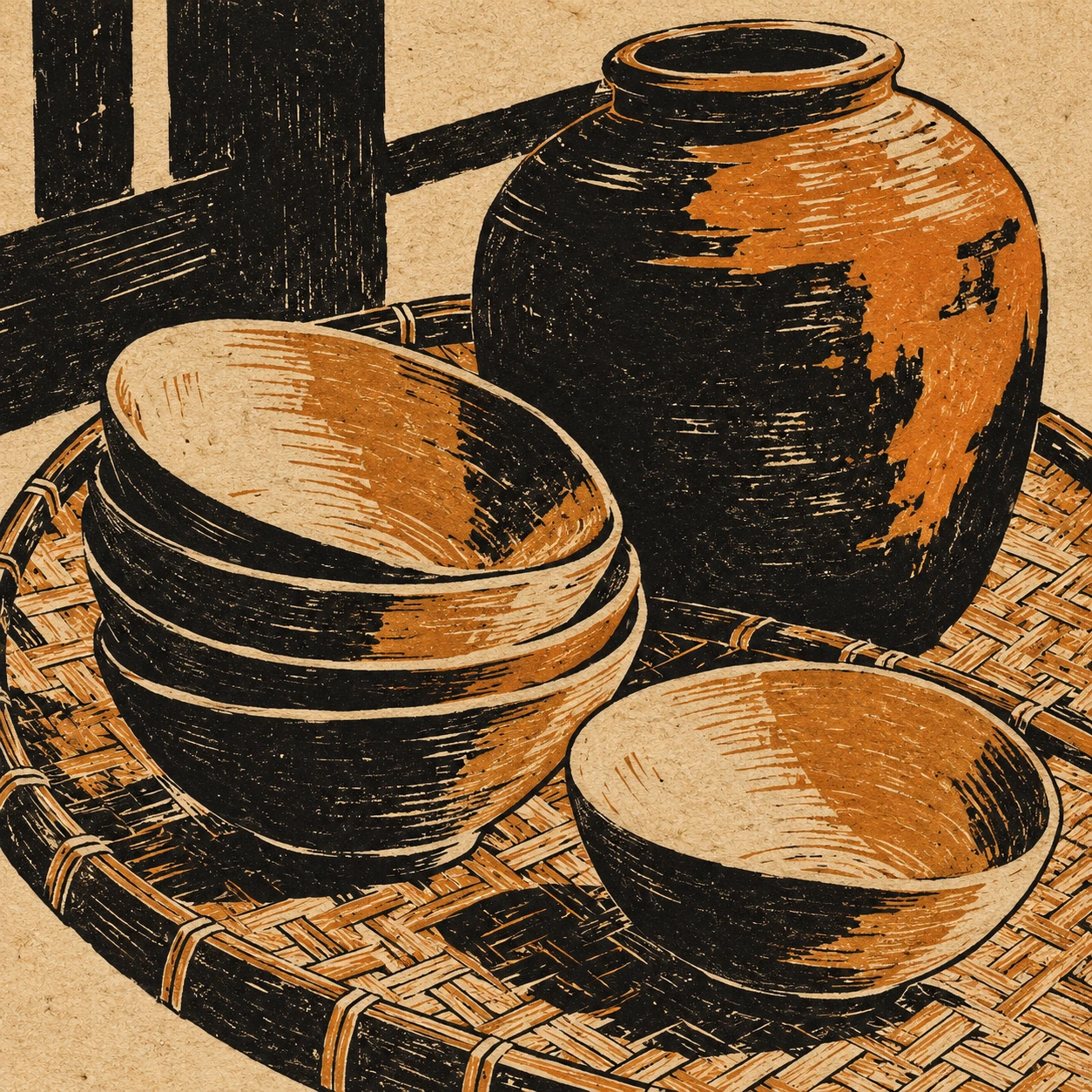
Avoid making locality depend on one repeated hat, temple or ornamental border. Ask instead how a roof meets another roof, how a vessel sits on a mat, or how water divides an urban space. Specific observation creates a stronger image than a checklist of national signs. When a location or building is invented, say so rather than borrowing the authority of an actual site.
A restrained colour structure
The gallery explores black with ochre or vermilion on warm paper as one workable palette, not as a definition of Vietnamese art. Give each colour a job. Black may establish structural weight; a red plane may pull the eye toward a roof; the paper can remain the light. If every object receives a separate bright colour, the composition loses its shared rhythm.
Small variations at an edge can suggest hand printing, but aggressive misregistration is not a requirement of woodcut. Keep the key shapes aligned where clarity matters. Likewise, exposed wood grain is optional and should not overpower the cuts. It is better to have three purposeful marks than fifty generic scratches pretending to be craftsmanship.
Five ways to test the language
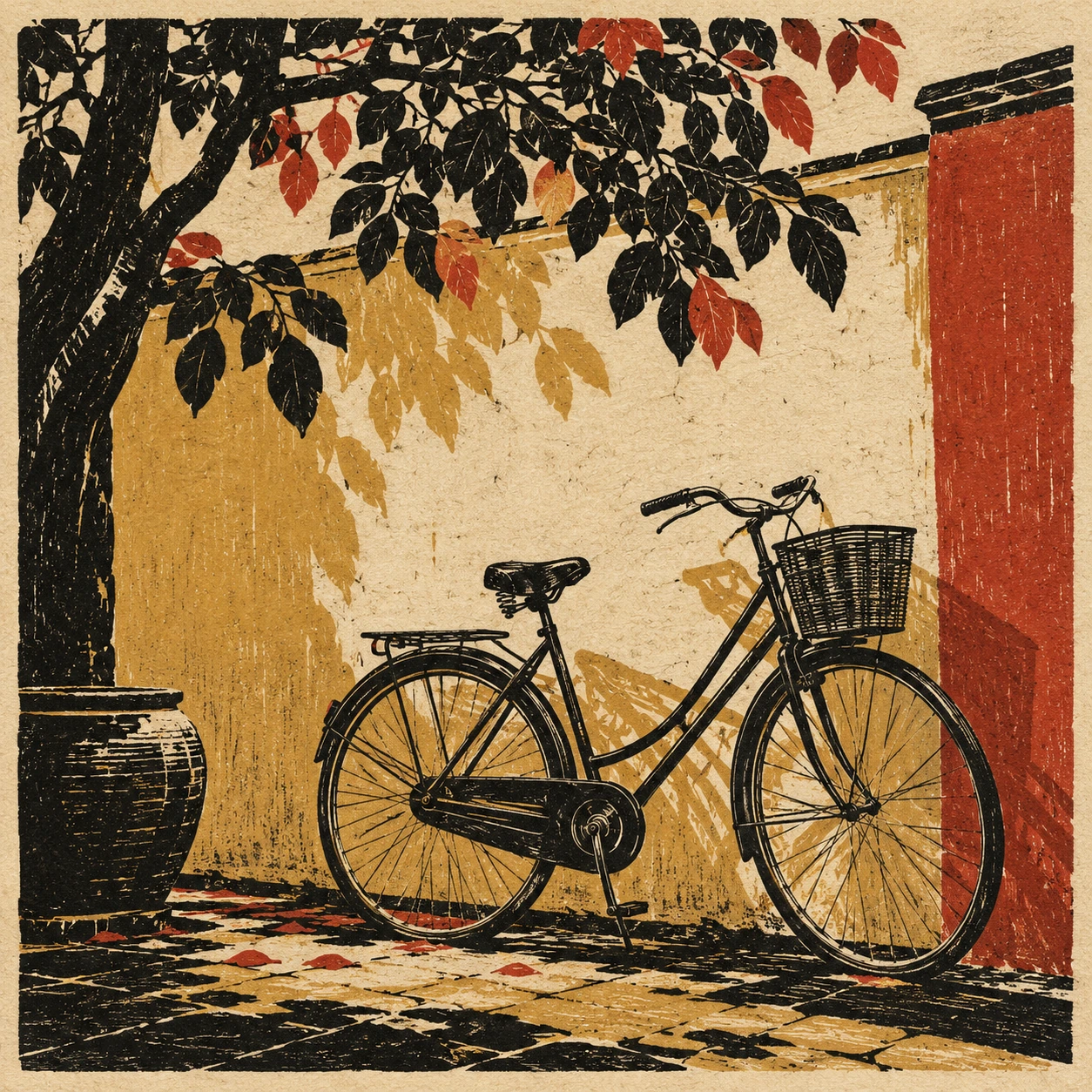
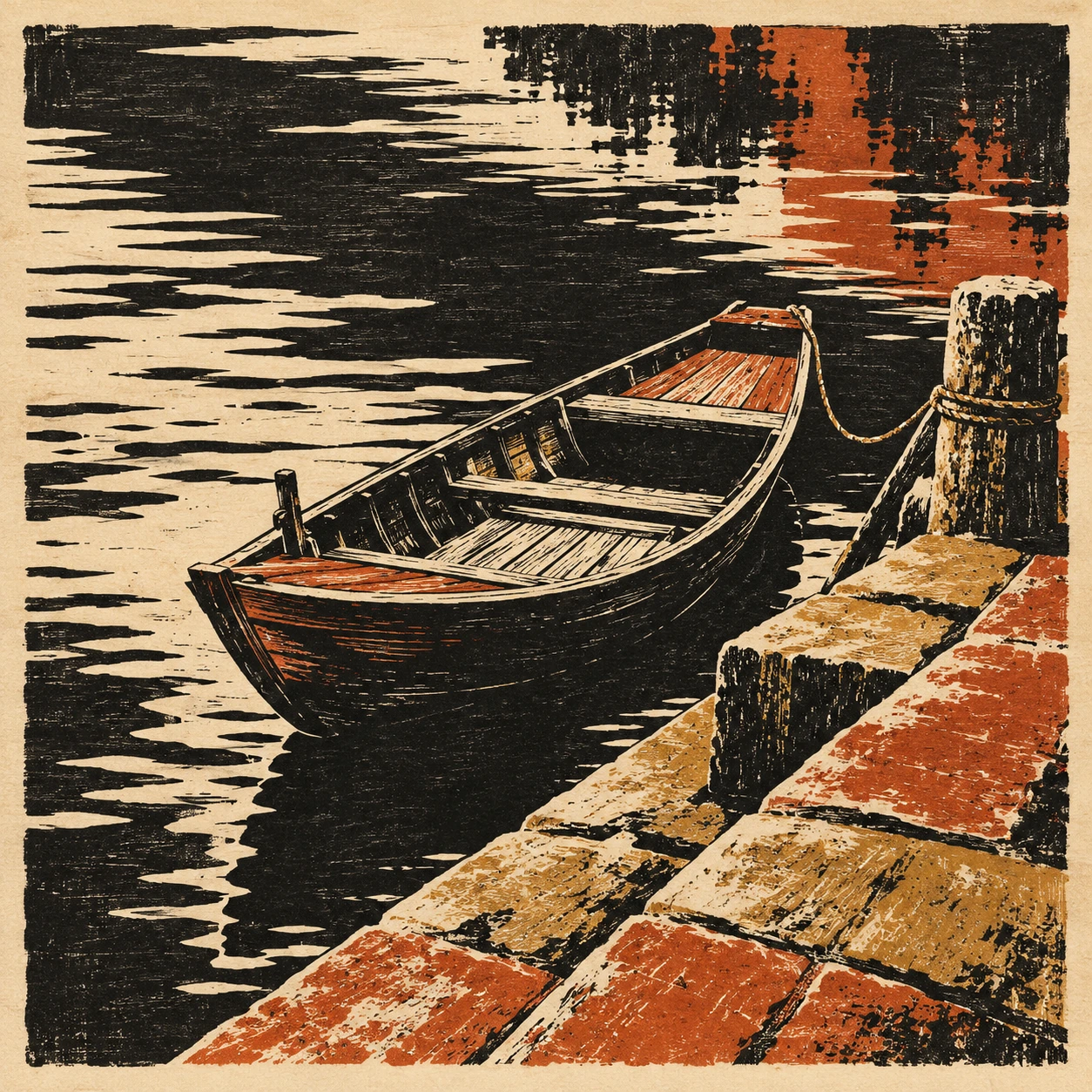
The bicycle courtyard tests recognizable geometry and shadow. The ceramic still life tests nested ovals and differences between vessel and background. The banana leaves test directional cutting. The moored boat tests diagonal movement across a largely horizontal field. The rooftops test compressed depth without relying on atmospheric blur. Together they ask whether the visual grammar can travel between subjects.
Look closely at joints, rims and intersections. A bicycle needs plausible wheels and a coherent frame even in a simplified picture. A boat needs a credible relation to water. Stylization allows omission, but it does not make accidental structural contradictions useful. Remove an uncertain detail or redesign the silhouette rather than disguising it under texture.
Use, attribution and further study
This treatment can support a printmaking study, an editorial composition or an original poster concept. For historical discussion, move from the broad label to a named artist, dated work and reliable collection record. Do not infer a print’s date or cultural provenance from its palette. Do not turn an AI illustration into a fictitious museum object by adding an edition number or signature.
Duy Tan University’s account of Nguyễn Tiến Việt supplies another contemporary example of sustained engagement with woodcut. Read such sources as evidence of particular practitioners rather than a recipe for an entire culture. The practical lesson is to join formal analysis with attribution: know what a mark does, and know whose actual work is being discussed.
Positive editorial assessment · AI-authored
The approach is strongest when bold masses and white cuts make ordinary things newly visible. A wheel, leaf or roof can become a carefully measured rhythm without losing its identity. The gallery’s varied subjects encourage attention to construction rather than decorative shorthand. Restrained colour makes relationships between forms especially clear and gives the paper a substantial role.
Negative editorial assessment · AI-authored
A broad cultural heading can become misleading if it turns into a formula of red pigment, rough texture and familiar symbols. That would flatten diverse practices into a costume. Improve the work by naming actual references, clarifying invented settings and making every cut describe form. Cultural specificity requires research; a generic “woodcut” filter cannot supply it.
Neutral editorial assessment · AI-authored
This article offers a contemporary visual study informed by Vietnamese printmaking references. It is useful for discussing relief structure, simplification and editorial composition. It is not a comprehensive history, an authentication guide or a claim that the generated works belong to a Vietnamese artistic lineage. Historical analysis should proceed through identified works and practitioners.
Pocket-sized facts
This heading is a broad descriptive reference, not one uniform national school.
All gallery images are original AI interpretations rather than Vietnamese-made historical prints.
A small poetic detour
Original words from the AOI studio.
Poetry
Where the Cut Lets Light Through
The branch is dark; the space around it sings.
A window opens where the block gives way.
The river gathers short and broken wings
of white that carry one small boat through day.
A bowl repeats the roof’s unhurried curve.
A wheel leans into shadow by a wall.
The knife-shaped line has nothing spare to serve;
it makes a place by choosing what to call.
I follow where the quiet paper shows,
between the leaf and what the leaf conceals.
The city does not need a hundred rows
of detail when one patient cut reveals.
The prompt workshop
Original creative exercises. These prompts create new illustrations, not documentary evidence.
Start simple: a courtyard bicycle
Create an original woodcut-inspired composition of a bicycle against a plain courtyard wall in a Vietnamese urban setting. Use coherent bicycle geometry, a strong black silhouette, decisive white cuts and one restrained vermilion plane. Avoid writing, signatures and tourist-symbol decoration.
Treat place thoughtfully; do not claim a historical artist made the result.
Build a riverbank rhythm
Compose an original modern relief-print interpretation of a moored boat, diagonal landing and layered urban roofs. Flatten depth into connected black, ochre and warm-paper shapes. Make water cuts follow the river’s direction.
Judge the large black-and-white pattern before adding grain.
Experiment: leaves as structure
Make a close woodcut-inspired study of banana leaves with white directional gouges inside black masses. Include only one small distant roof plane. Use the leaves to divide the frame asymmetrically.
The limited palette is a chosen exercise, not a national rule.
Your next inspiration
Discover another art style
Follow a visual thread to the next subject.
A smile from the studio
Jokes
The undo department
The designer brought a woodcut proof to a meeting and asked whether the window could move slightly to the left.
“Certainly,” said the printmaker. “In the next block.”
The designer asked for three versions, each with a different roofline, then suggested a small adjustment to every leaf.
The printmaker placed a fresh piece of wood on the table. “Here is our revision history. It is unusually solid.”
After a thoughtful silence, the designer decided that the original window had excellent compositional integrity.
The printmaker agreed, and quietly moved the tea away from the cutting tools.
An original studio joke about relief-print revisions, not a traditional story or a quotation from a practitioner.