
Artist reference · Edo-period ukiyo-e and figure design
Utagawa Kunisada makes a gesture feel theatrical before a story is explained. Expressive faces, patterned robes and carefully divided spaces turn figures into a tightly organized visual performance.
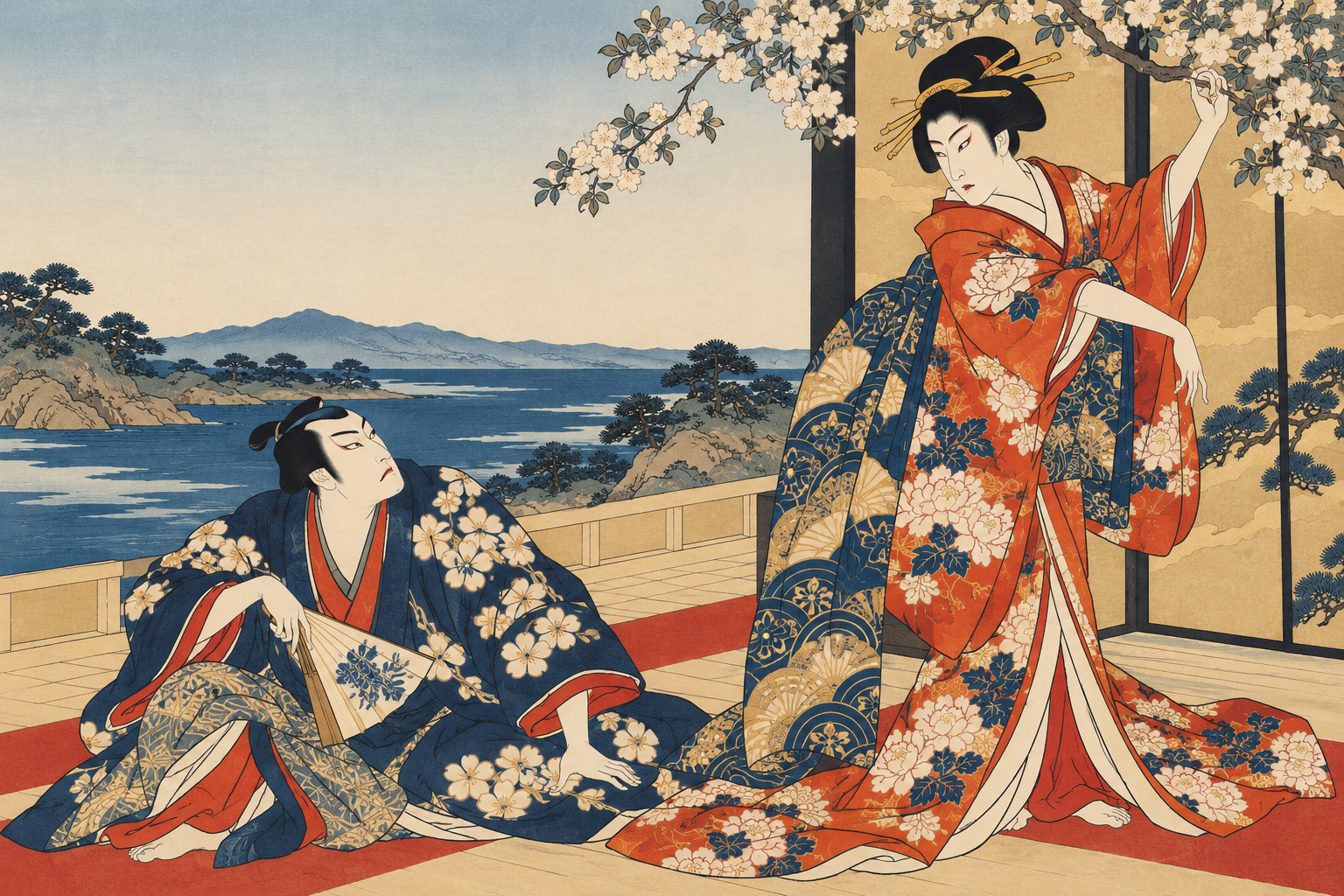
A visual introduction
Five original AI-generated AOI interpretations: a dedicated banner, a centrally titled collage and three standalone studies. These are new illustrations, not historical objects or works by the referenced artist.
Select an image for a closer look. Use the thumbnails, arrow keys or a swipe to compare examples. Zoom in to inspect details, or share the image that inspires you.

Creative toolbox · take this style further
Choose an input and a destination. Search sends your words to the chosen site; Copy & open puts them on your clipboard to paste there.
Create with AI
Turn your chosen input into an image prompt or a new creative direction.
ChatGPT
Copy your input and paste it into a ChatGPT conversation or image request.
Copy & open ChatGPT (new tab)Claude · Anthropic
Develop an image prompt or explore the style in a new Claude conversation.
Copy & open Claude · Anthropic (new tab)Midjourney
Paste your input into the Imagine bar on the Create page.
Copy & open Midjourney (new tab)Adobe Firefly
Copy your input, open Firefly, and paste it into the prompt field.
Copy & open Adobe Firefly (new tab)Leonardo.Ai
Copy your input, open Leonardo, and paste it into the generation field.
Copy & open Leonardo.Ai (new tab)Image search
Find visual references. Short, concrete keywords usually work best.
Lexica
Search AI images and prompts using your selected input.
Search with this input Lexica (new tab)Pexels
Search the photo and video library. Short keywords often work best.
Search with this input Pexels (new tab)Pixabay
Search photos, illustrations and other images.
Search with this input Pixabay (new tab)Unsplash
Search photographs using the style name or your own keywords.
Search with this input Unsplash (new tab)Wikimedia Commons
Search photographs, artworks and historical images. Check each file for its source and reuse terms.
Search with this input Wikimedia Commons (new tab)Art & research
Explore artists, collections and the ideas behind a style.
Wikipedia
Search for background reading. A style may not have its own article.
Search with this input Wikipedia (new tab)WikiArt
Copy your input into WikiArt’s search to explore artists and artworks.
Copy & open WikiArt (new tab)Europeana
Paste your keywords into the search to explore European museum, library and archive collections.
Copy & open Europeana (new tab)Inspiration
Discover portfolios and visual ideas from creative communities.
Instagram hashtags
Search a hashtag made from your input: spaces and punctuation are removed. Instagram may require sign-in.
Search with this input Instagram hashtags (new tab)ArtStation
Paste your input into artwork search for concept art, environments, characters and visual development.
Copy & open ArtStation (new tab)Behance
Paste your input into project search for illustration, design and visual storytelling.
Copy & open Behance (new tab)A closer look
Assertive contours separate flat color areas. Elaborate textiles contrast with pale faces and quiet backgrounds; fans, sleeves and screens direct the eye through shallow, layered space.
An artist, not a generic Japanese filter
Kunisada was a major nineteenth-century ukiyo-e designer associated with the Utagawa school and also known as Toyokuni III. His subjects include kabuki actors and women in everyday or literary settings. The National Gallery of Art's Kabuki Actor with a Fan and Cleveland's Woman with a Fan in her Left Hand Combing her Hair provide specific collection references. They are better starting points than a collection of unspecified Japanese-looking motifs.
This guide concentrates on figure design and spatial organization. It does not claim that every print by Kunisada shares one palette, or that a generated image reproduces the knowledge of designers, carvers, printers and publishers. The illustrations are new AOI interpretations, not historical prints or attributed works.
Gesture carries the composition
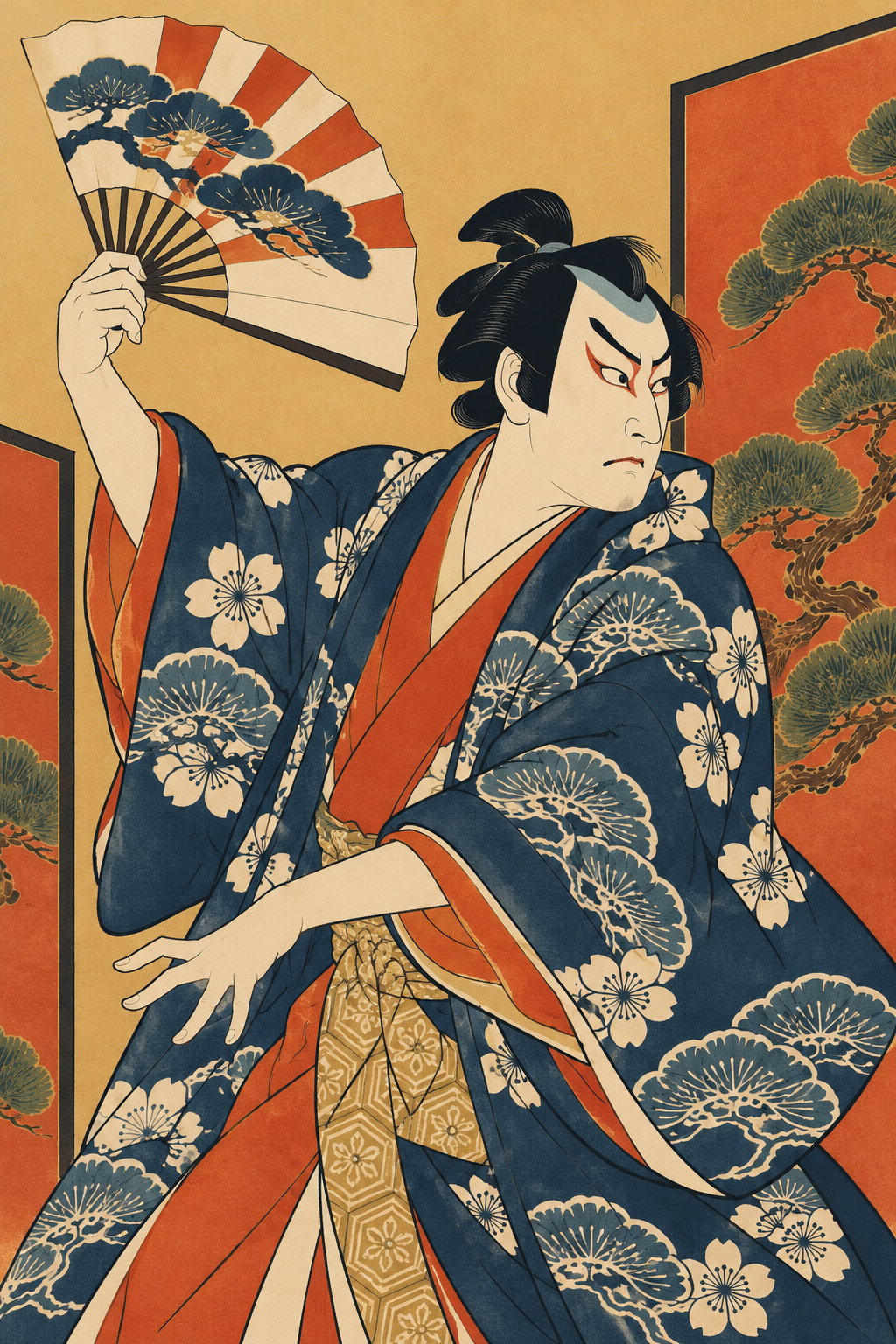
Begin with the angle of the head, the direction of the gaze and one principal arm movement. A raised fan creates a diagonal; a hanging sleeve supplies a counterweight. Check the figure as a dark silhouette before adding a single textile motif. If the pose is unclear without decoration, ornament will only make the confusion more elaborate.
Give the face a quieter surface than the robe. Small changes in brow, mouth and neck angle can carry more expression than heavily modeled skin. In an original study, invent the performer and the scene rather than attaching an unverified historical actor's name to a generated face.
Pattern and space work together
Treat a robe as a set of folded planes. Repeat a floral or geometric motif across those planes, allowing the folds to interrupt it. A perfectly tiled pattern floating over the figure feels pasted on; a pattern that changes randomly at every fold loses its organizing rhythm. Keep a few dark seams readable through the ornament.
Screens, railings and branches can divide the image without requiring deep photographic perspective. Overlap a foreground object with a distant view and leave a pale interval between them. Compare warm vermilion with indigo, but remember that this is one practical palette rather than a universal definition of the artist.
Build an interpretation carefully
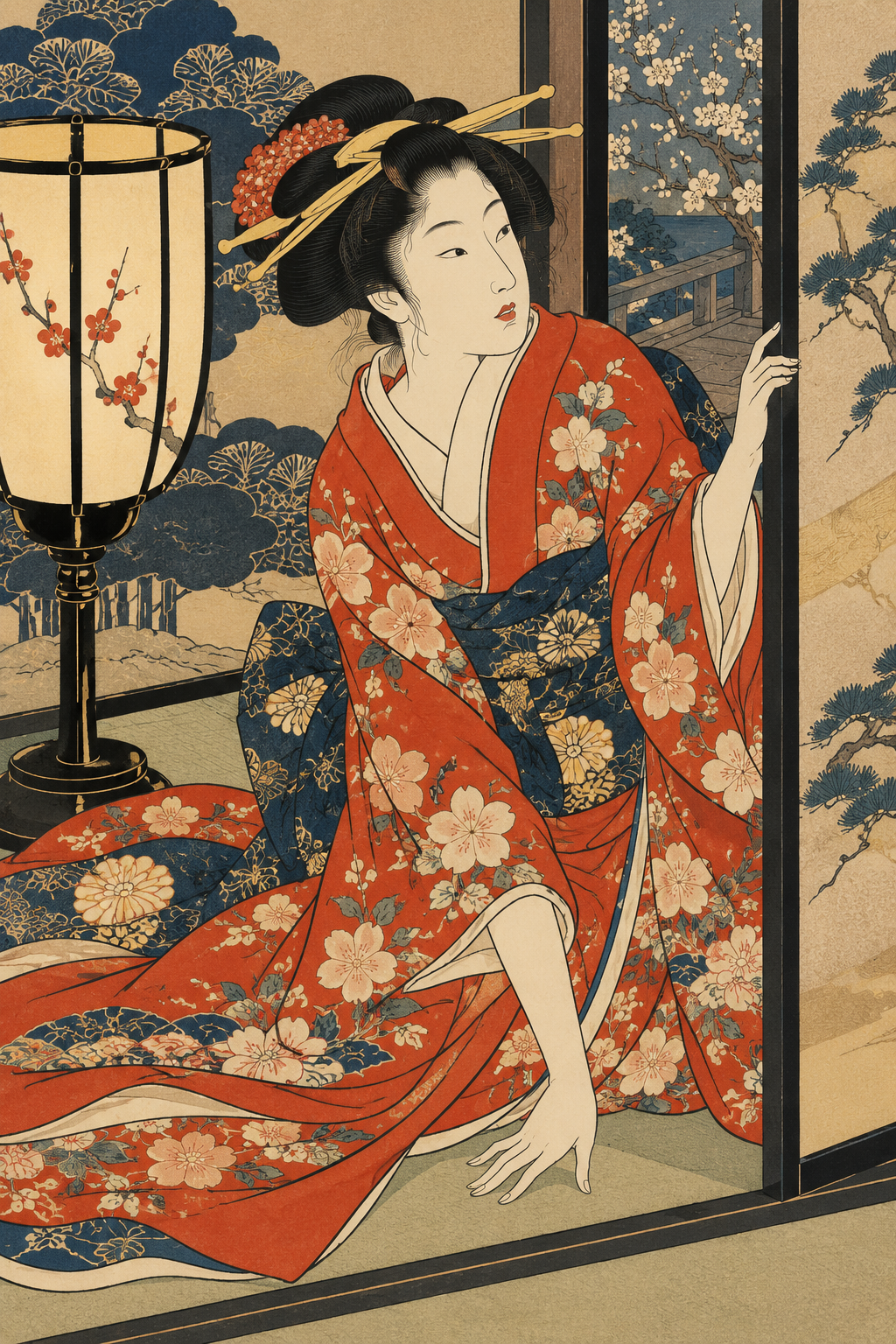
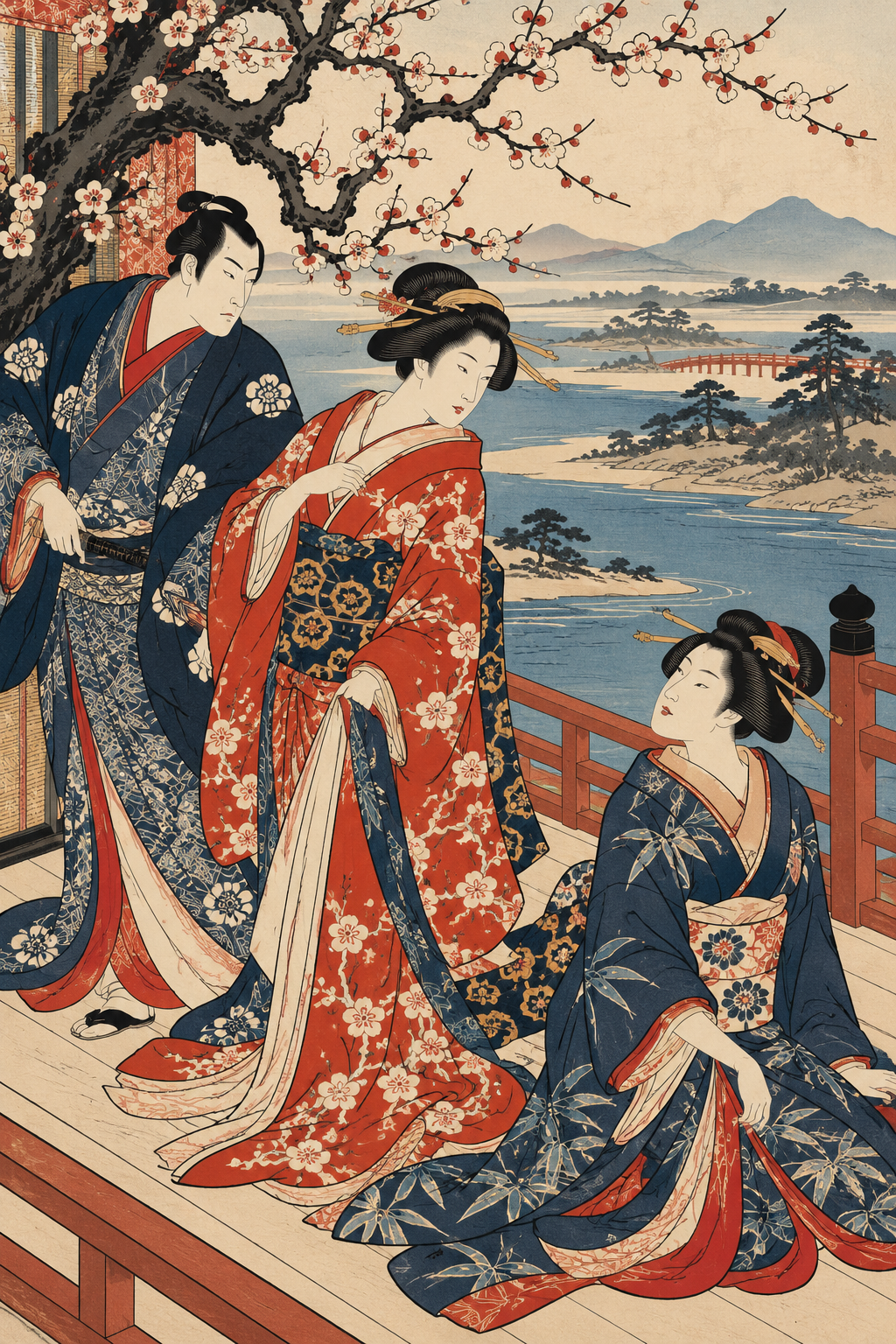
Try three exercises: an actor with a fan, a figure beside a lantern, and a small group beneath flowering branches. Keep the contour language consistent while changing the spatial problem. In the group scene, assign each figure a clear silhouette and avoid merging hands into neighboring sleeves.
Inspect fingers, fan ribs, robe closures and the continuity of screens. Omit invented signatures, pseudo-Japanese inscriptions and seals that might imply authenticity. A paper texture can support the image, but uniformly distressed edges are not evidence of age. Use museum records for historical works and label the generated study for what it is.
A small poetic detour
Original words from the AOI studio.
Poetry
Before the curtain
A sleeve describes the turning air;
a fan divides the afternoon.
The face remains a quiet square
of paper under painted bloom.
Behind a screen, a river bends.
Before it, one small gesture stays.
The distant blue recedes and lends
a pause to all the patterned ways.
The actor waits. The lines begin.
A whole performance gathers in.
The prompt workshop
Original creative exercises. These prompts create new illustrations, not documentary evidence.
Start with a theatrical silhouette
Create an original ukiyo-e-inspired portrait of an invented adult performer raising a folding fan. Use indigo, vermilion and pale paper, clear contours and a patterned robe. No inscriptions or seals.
Judge the pose before the textile detail.
Divide space with a screen
Place an invented adult figure beside a lantern and a partly opened screen. Use flat color, overlapping planes and one quiet distant view.
Keep object overlaps and hands readable.
Coordinate a small group
Design three invented figures beneath flowering branches beside a river, with clear silhouettes, varied gestures and repeated textile rhythms.
Avoid copied compositions and false historical attribution.
Your next inspiration
Discover another art style
Follow a visual thread to the next subject.
A smile from the studio
Jokes
The costume designer asked whether the robe had enough pattern. The performer said he could no longer find his elbow. They removed one flower, found the elbow, and discovered that it was delivering the strongest performance in the scene. The fan requested a separate dressing room.