
Historical mosaic traditions · contemporary material studies
A Byzantine mosaic turns separate pieces of stone or glass into a surface that can seem both solid and alive with light. Its power comes from the arrangement of those pieces, the scale of the image and the setting around it. Gold is one possibility; it is not the whole subject.
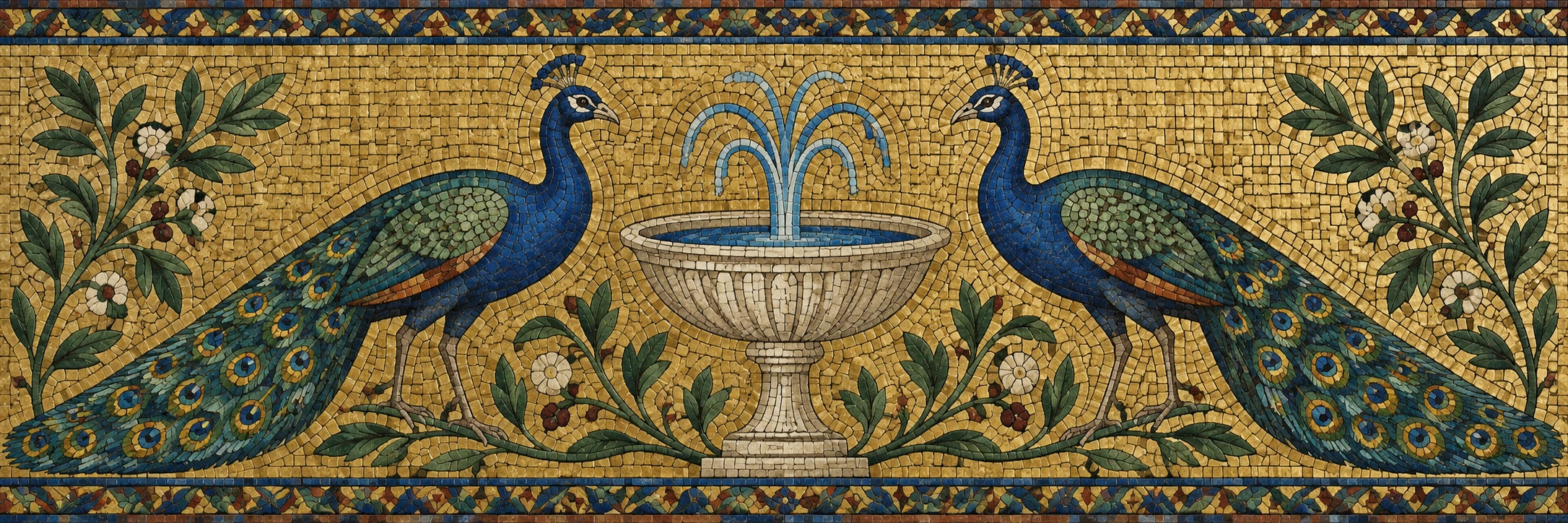
A visual introduction
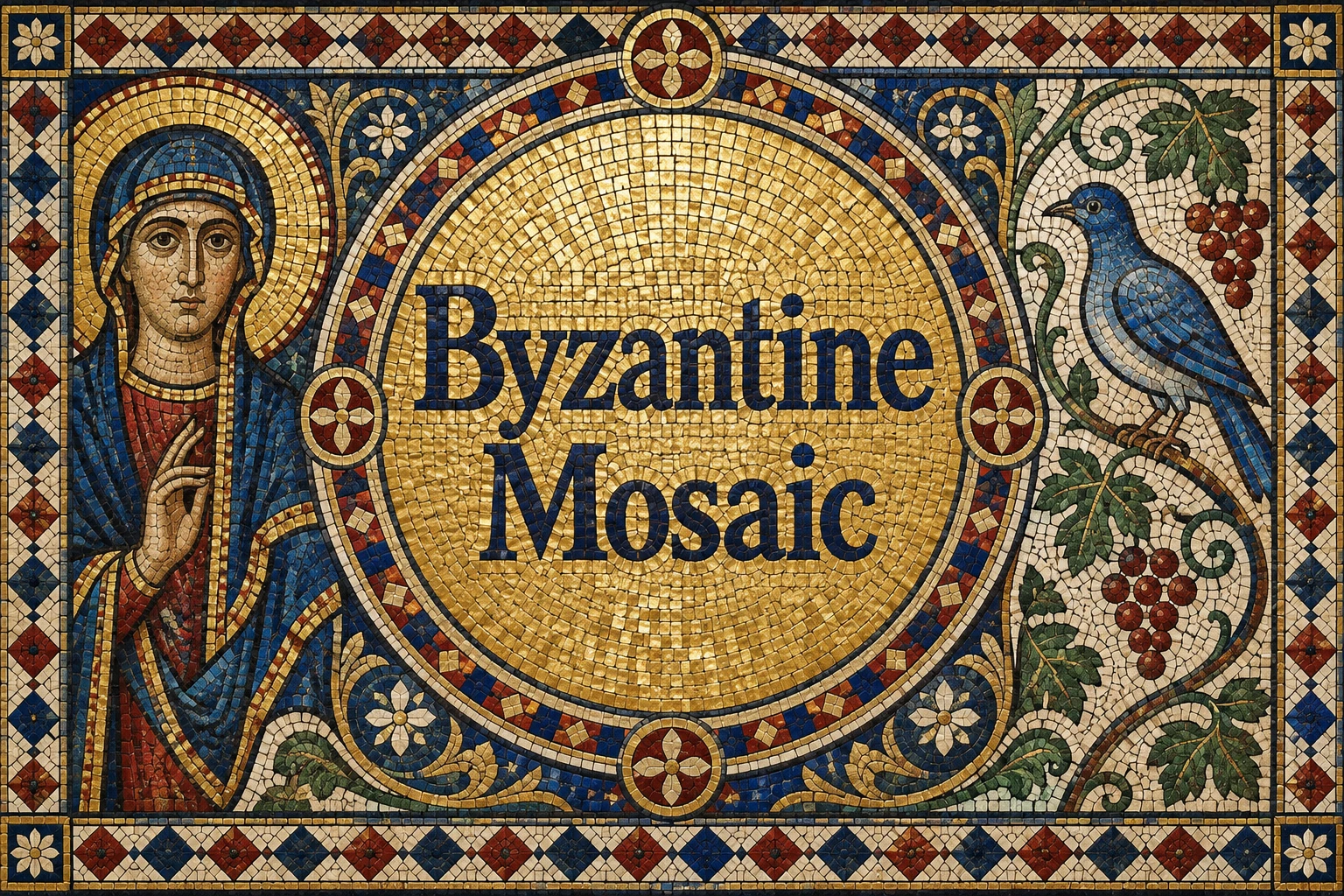
Seven original AI-generated interpretations: a dedicated banner, a centrally titled collage and five standalone studies. Captions identify the subject and distinguish these illustrations from historical or practitioner-made works.
Select an image for a closer look. Use the thumbnails, arrow keys or a swipe to compare examples. Zoom in to inspect details, or share the image that inspires you.
Creative toolbox · take this style further
Choose an input and a destination. Search sends your words to the chosen site; Copy & open puts them on your clipboard to paste there.
Create with AI
Turn your chosen input into an image prompt or a new creative direction.
ChatGPT
Copy your input and paste it into a ChatGPT conversation or image request.
Copy & open ChatGPT (new tab)Claude · Anthropic
Develop an image prompt or explore the style in a new Claude conversation.
Copy & open Claude · Anthropic (new tab)Midjourney
Paste your input into the Imagine bar on the Create page.
Copy & open Midjourney (new tab)Adobe Firefly
Copy your input, open Firefly, and paste it into the prompt field.
Copy & open Adobe Firefly (new tab)Leonardo.Ai
Copy your input, open Leonardo, and paste it into the generation field.
Copy & open Leonardo.Ai (new tab)Image search
Find visual references. Short, concrete keywords usually work best.
Lexica
Search AI images and prompts using your selected input.
Search with this input Lexica (new tab)Pexels
Search the photo and video library. Short keywords often work best.
Search with this input Pexels (new tab)Pixabay
Search photos, illustrations and other images.
Search with this input Pixabay (new tab)Unsplash
Search photographs using the style name or your own keywords.
Search with this input Unsplash (new tab)Wikimedia Commons
Search photographs, artworks and historical images. Check each file for its source and reuse terms.
Search with this input Wikimedia Commons (new tab)Art & research
Explore artists, collections and the ideas behind a style.
Wikipedia
Search for background reading. A style may not have its own article.
Search with this input Wikipedia (new tab)WikiArt
Copy your input into WikiArt’s search to explore artists and artworks.
Copy & open WikiArt (new tab)Europeana
Paste your keywords into the search to explore European museum, library and archive collections.
Copy & open Europeana (new tab)Inspiration
Discover portfolios and visual ideas from creative communities.
Instagram hashtags
Search a hashtag made from your input: spaces and punctuation are removed. Instagram may require sign-in.
Search with this input Instagram hashtags (new tab)ArtStation
Paste your input into artwork search for concept art, environments, characters and visual development.
Copy & open ArtStation (new tab)Behance
Paste your input into project search for illustration, design and visual storytelling.
Copy & open Behance (new tab)A closer look
Individually readable tesserae, contour-following rows, strong outlines and measured colour groups; stone can remain matte while glass and gold catch light, with compositions ranging from floor ornament to monumental figures and architectural surfaces.
Begin with a medium, then ask where it belongs
Byzantine mosaic belongs to a long and varied history of making images from small pieces, usually called tesserae. The label encompasses different periods, places, materials and functions. A patterned floor, a monumental wall image and a small devotional object do not ask the same things of a viewer. Treating them all as a gold filter over a frontal face misses both the craft and the setting. First ask whether the image belongs underfoot, across a wall or within an architectural curve.
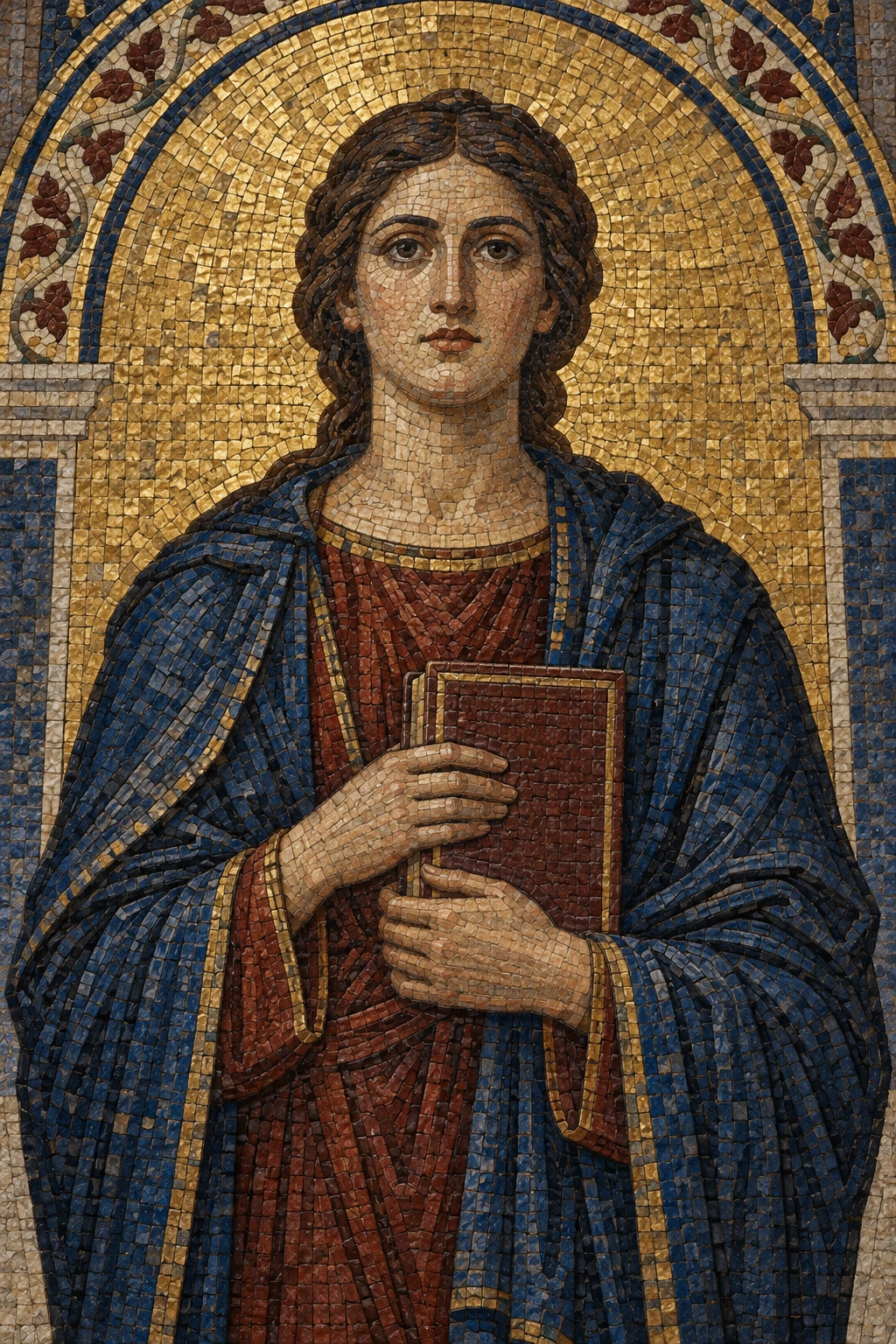
The AOI gallery offers contemporary interpretations of those visual problems. Its robed figure is fictional, its architectural study is not a reconstruction of a named building, and its decorative panels are newly generated designs. They are useful for discussing material and composition, not for documenting a lost monument. Where the article refers to an actual object or place, the source is identified separately.
Two references that prevent an overly narrow picture
UNESCO’s account of Ravenna’s Early Christian Monuments places its eight buildings in the fifth and sixth centuries and describes the meeting of different artistic traditions. San Vitale belongs within that architectural context. The lesson for looking is to keep the image and the building together: a mosaic’s position, surrounding surfaces and viewing distance shape the encounter. Ravenna is an important reference, but it is not a shorthand for every work made across the Byzantine world.
The Met’s Fragment of a Floor Mosaic with a Personification of Ktisis, dated about 500–550, uses marble and glass. Ktisis personifies the generous act of foundation. The object record also identifies modern restoration, which matters when reading its present appearance. This floor fragment broadens the discussion beyond golden church walls. A separate Met record for Byzantine mosaic tesserae identifies glass and gold leaf, providing a direct material reference for the luminous effects associated with some mosaics.
The small pieces must describe the large form
Look for the direction of the rows. Around an eye, a border or a curling leaf, the placement of pieces can reinforce the shape. Background rows can answer those contours or establish a different rhythm. In a convincing contemporary study, the tesserae are not a random grid pasted over a finished painting. Their edges participate in the drawing. A useful test is to imagine removing the colour: would the arrangement of joints still help you understand the form?
Vary the size of the pieces where the subject requires it. A face needs different articulation from a broad field behind it; a bird’s beak needs a decisive junction rather than a cloud of equally small fragments. Keep the mortar intervals plausible and broadly consistent within each passage. Excessively deep black cracks can make a surface look shattered, while absent joints turn it into a smooth illustration wearing a few decorative squares.
Gold, glass, stone and the work of light
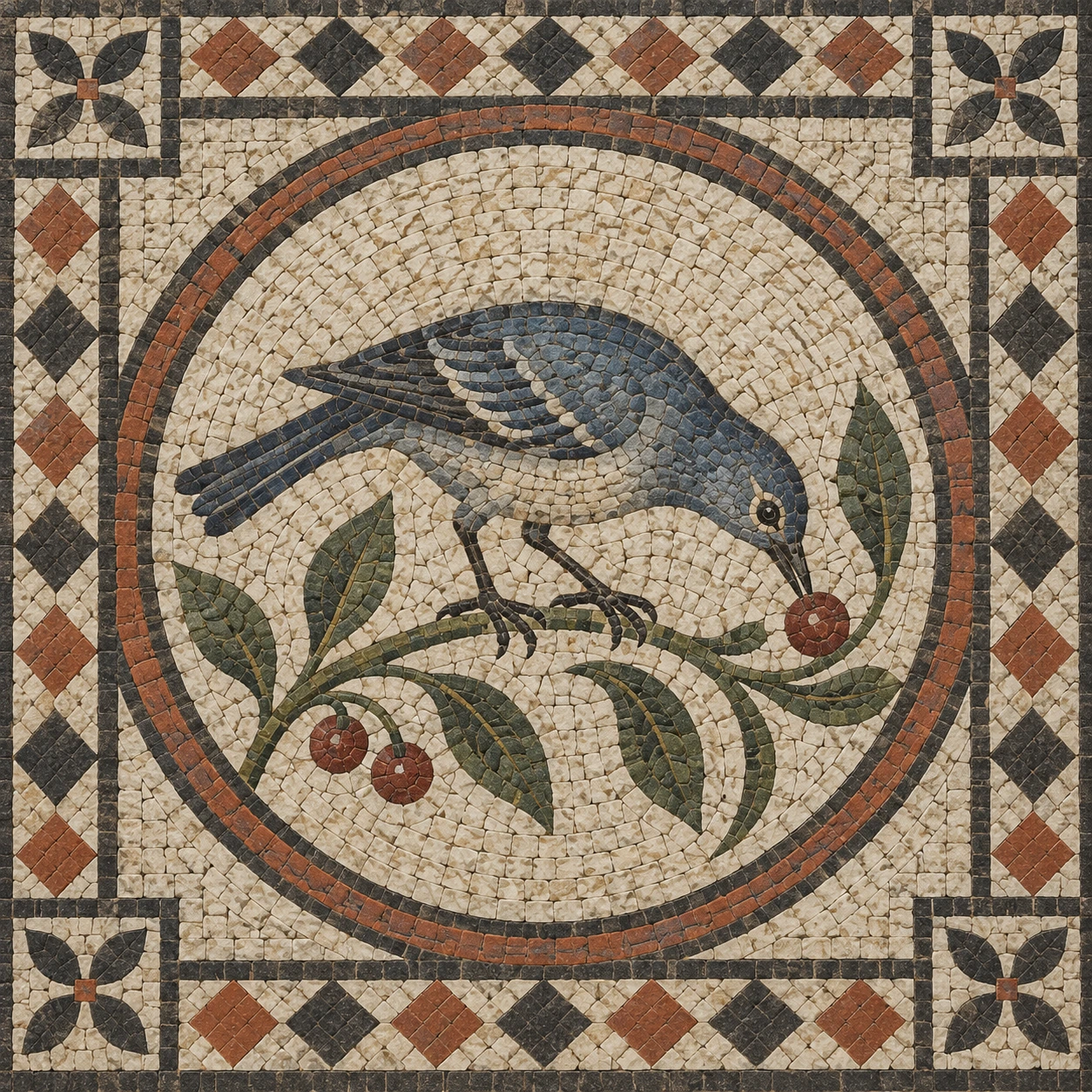
For an interpretive image, decide which material dominates. A matte stone medallion can use cream, terracotta and charcoal to establish a quiet surface. A wall-like glass panel can use blue and green pieces with sharper local reflections. Gold should remain a field made from separate units; a single uniform metallic gradient loses that construction. Give highlights a direction and a reason, rather than making every piece flash with equal intensity.
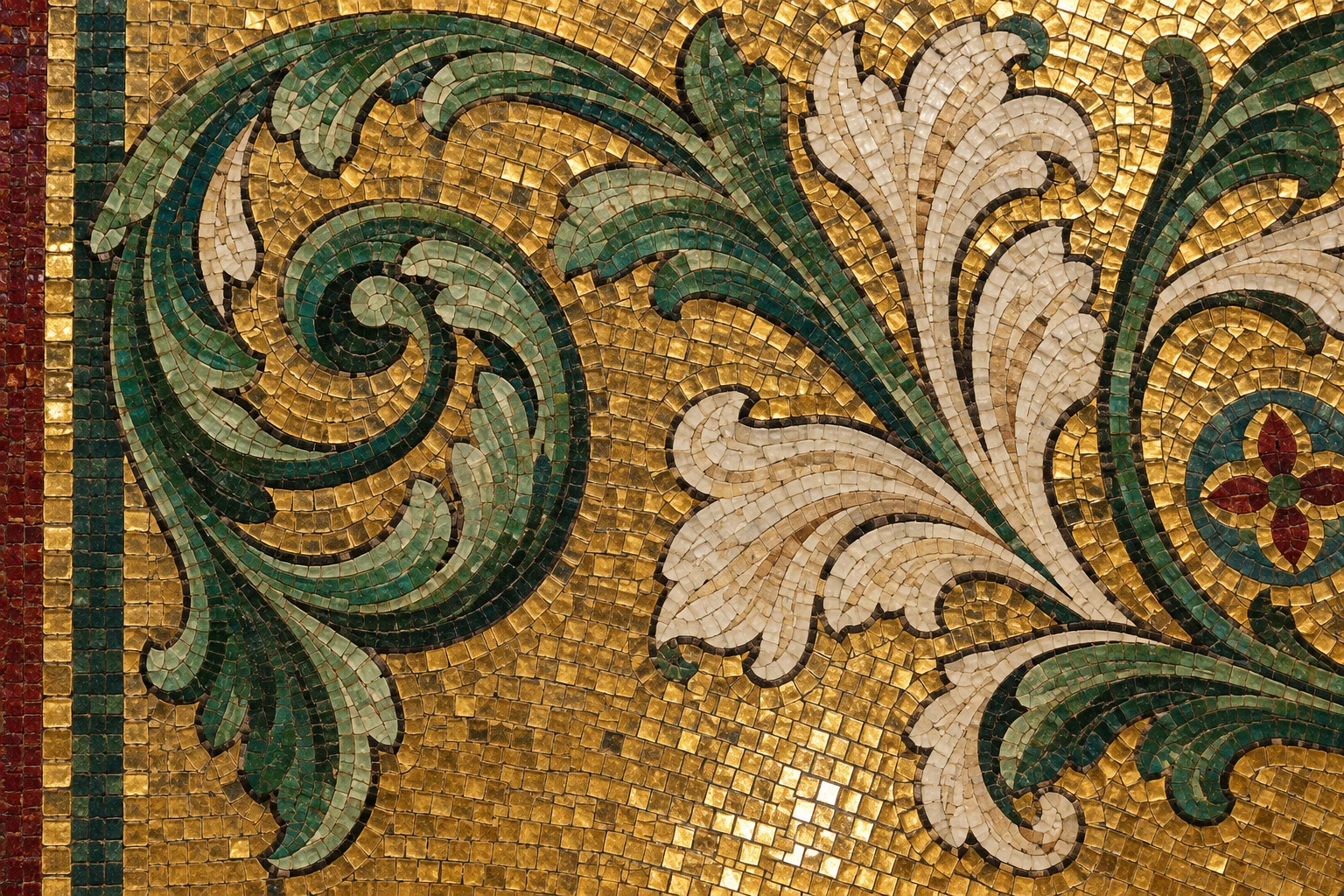
The vine study explores this distinction through light across a close surface. The bird medallion instead emphasizes stone and a restrained geometric border. These are creative comparisons, not recipes for conserving or manufacturing historic mosaics. An AI image can suggest small differences in angle and reflectivity, but it cannot establish the composition of glass or the construction of a gold-leaf layer. Material claims about a real object require its documentation.
Monumental composition and the meaning of the setting
A frontal figure can establish a strong encounter with the viewer, especially when its outline and surrounding space are carefully organized. Keep the face, hands, book and folds readable before enriching the background. The fictional figure in this set uses a closed book and an architectural arch to focus attention. It is not identified as a historical ruler or saint. A halo, gesture or inscription in an actual work can carry specific meaning; it should not be treated as interchangeable ornament.
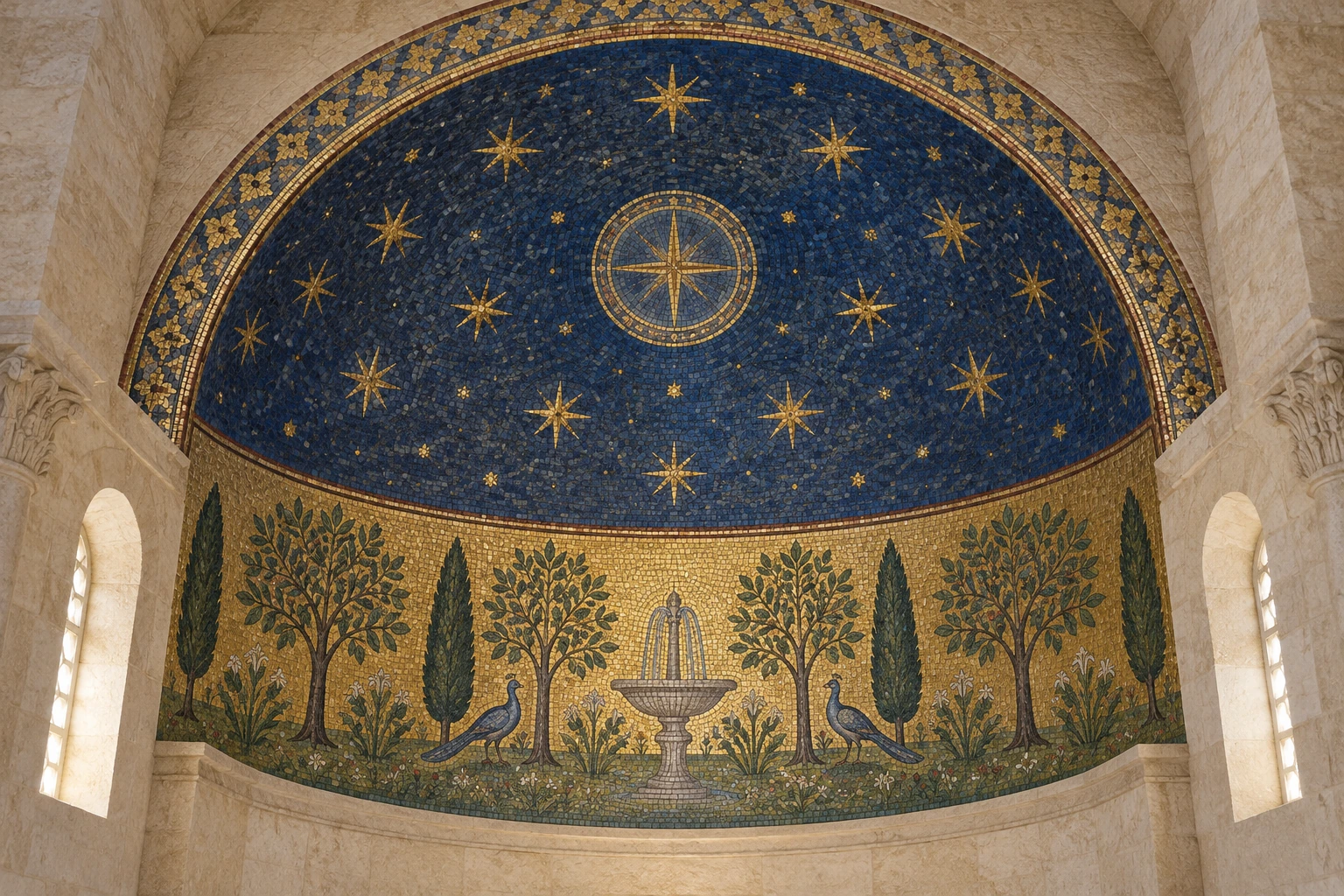
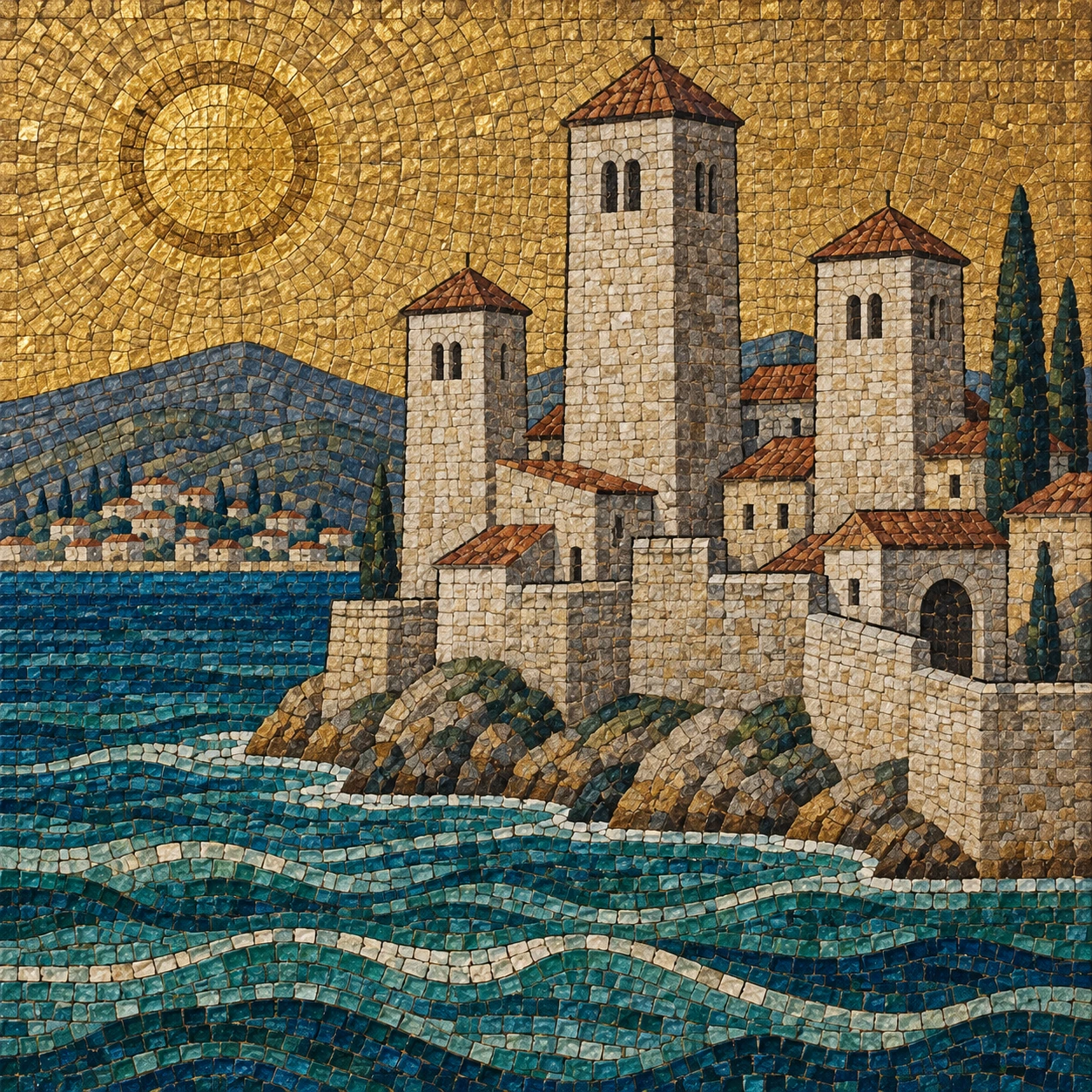
The apse study asks a different question: how does a design remain legible across a curved surface? Its broad blue upper field and garden-like lower zone can be understood before the individual pieces are inspected. The coastal city study compresses architecture and water into a decorative arrangement. These exercises show why simply increasing the density of ornament often weakens a mosaic-inspired image. Large shapes need to organize the smaller ones.
Using the visual language without flattening the history
This approach can support material studies, editorial illustration, architectural concept work and comparisons between different kinds of image construction. Specify the intended surface and viewpoint in the prompt. A floor panel seen from above and a wall panel seen in raking light should not behave like the same photograph. For a historically specific commission, research the named place, period, iconography and surviving evidence before generating details.
Common failures include gem-like protrusions, uniform square pixels, painted faces that ignore the joints, and invented lettering presented as meaningful Greek. Repair the brief by naming a material, a row direction, a value hierarchy and a single focal subject. Keep generated inscriptions out unless the text has been supplied and can be checked. The goal is an image whose beauty comes from organized pieces and considered light, with enough context to distinguish invention from evidence.
Positive editorial assessment · AI-authored
Mosaic’s strongest visual achievement is the cooperation between the small piece and the large image. The vine study makes that cooperation explicit: rows turn with the foliage while the gold background establishes a different rhythm of light. The stone bird medallion offers a quieter success, showing that material restraint can be as persuasive as brilliance. A good mosaic-inspired composition rewards two distances of looking, with a clear whole and an engaging surface rather than one concealing the absence of the other.
Negative editorial assessment · AI-authored
The common failure is expensive-looking noise: gold everywhere, jewel tones everywhere, and no hierarchy. Another is a smooth painted image with a uniform tile filter, where the joints have no relationship to the subject. Such images borrow the prestige of a historical label without studying its construction. Improve them by choosing a specific surface, reducing competing highlights and directing the rows around meaningful forms. Historical names, halos and inscriptions also need context; ornament cannot supply that context by itself.
Neutral editorial assessment · AI-authored
Byzantine mosaic is a broad historical reference, not a single palette or compositional formula. Contemporary studies can investigate tessera placement, material contrast and architectural scale, but they do not establish the history of a real object. The AOI set moves between a fictional figure, stone ornament, a glass-like surface, an invented apse and a coastal design. Its value is comparative and exploratory; the museum and monument sources remain the route to documented works.
Pocket-sized facts
Tesserae are the small pieces from which a mosaic is assembled.
The Met’s Ktisis floor fragment is catalogued as marble and glass, about 500–550, with modern restoration.
Gold is one material strategy within a much broader mosaic tradition.
Examples worth exploring
The Met, Fragment of a Floor Mosaic with a Personification of Ktisis — a documented floor image rather than a generic gold-ground icon.
Ravenna’s Early Christian Monuments — a source for studying mosaics together with their architectural setting.
A small poetic detour
Original words from the AOI studio.
Poetry
Ode to the Slightly Turned Tessera
One square inclines towards the window,
another keeps its portion dark.
Between them runs a thread of mortar,
small silence sharpening the mark.
The robe is blue in broken measures.
The leaf returns by curves of stone.
A thousand edges learn a figure
that none could carry on its own.
I move; the wall returns an answer.
A little gold becomes a flame.
The pieces have not left their places,
but nothing shines quite the same.
Let distance gather what was scattered;
let nearness show the patient seams.
The light will finish, for a moment,
what every separate fragment means.
The prompt workshop
Original creative exercises. These prompts create new illustrations, not documentary evidence.
Start simple: a stone bird medallion
Create an original Byzantine-inspired floor-mosaic study of one blue-grey bird and a green vine inside a cream stone medallion. Use irregular matte tesserae, fine mortar joints and rows that follow the bird’s contour. Add a restrained terracotta-and-charcoal border. No gold glitter or inscriptions.
Focus on stone and row direction before adding complexity.
Compose a monumental fictional figure
Create a contemporary Byzantine-inspired mosaic of a fictional frontal adult figure with a closed book, blue cloak and oxblood tunic beneath a simple arch. Use coherent hands and face, contour-following tesserae and a restrained gold-glass background. No named saint, ruler or invented lettering.
A compositional interpretation, not a reconstruction of a historical icon.
Experiment: light across a mosaic surface
Create a close decorative panel of a curling green vine and ivory leaves against gold-glass tesserae. Show small differences in tile angle under light from one side. Keep mortar joints legible and the overall vine readable. Avoid uniform glitter, gemstones and smooth painted areas.
Compare the behaviour of the background pieces with the contour rows.
Your next inspiration
Discover another art style
Follow a visual thread to the next subject.
A smile from the studio
Jokes
The revision request
A patron admired the new mosaic and asked whether the expression could be made “a little more approachable.”
The mosaicist moved two tesserae near the mouth.
“Excellent. Now perhaps more authoritative.”
The two tesserae went back.
“Could we see both versions side by side?”
“Certainly,” said the mosaicist. “We will need another wall.”
The patron suggested an undo button. The apprentice brought a small chisel.
Finally they agreed to inspect the face again in the afternoon light. The expression changed beautifully, nobody moved a stone, and the mosaicist added “consultation with the sun” to the invoice.
An original imagined workshop scene, not a historical anecdote.
Sources and further exploration
The Met, Mosaic Tesserae — a direct collection record identifying glass and gold leaf.