
Mixed
Trianglism is a name used in distinct artist practices built around the triangle. This entry distinguishes documented uses by Howard Schoor and Richard “Dick” Seed, then offers original AOI studies of triangular composition: how three-sided forms can direct attention, suggest volume and organize a whole picture.
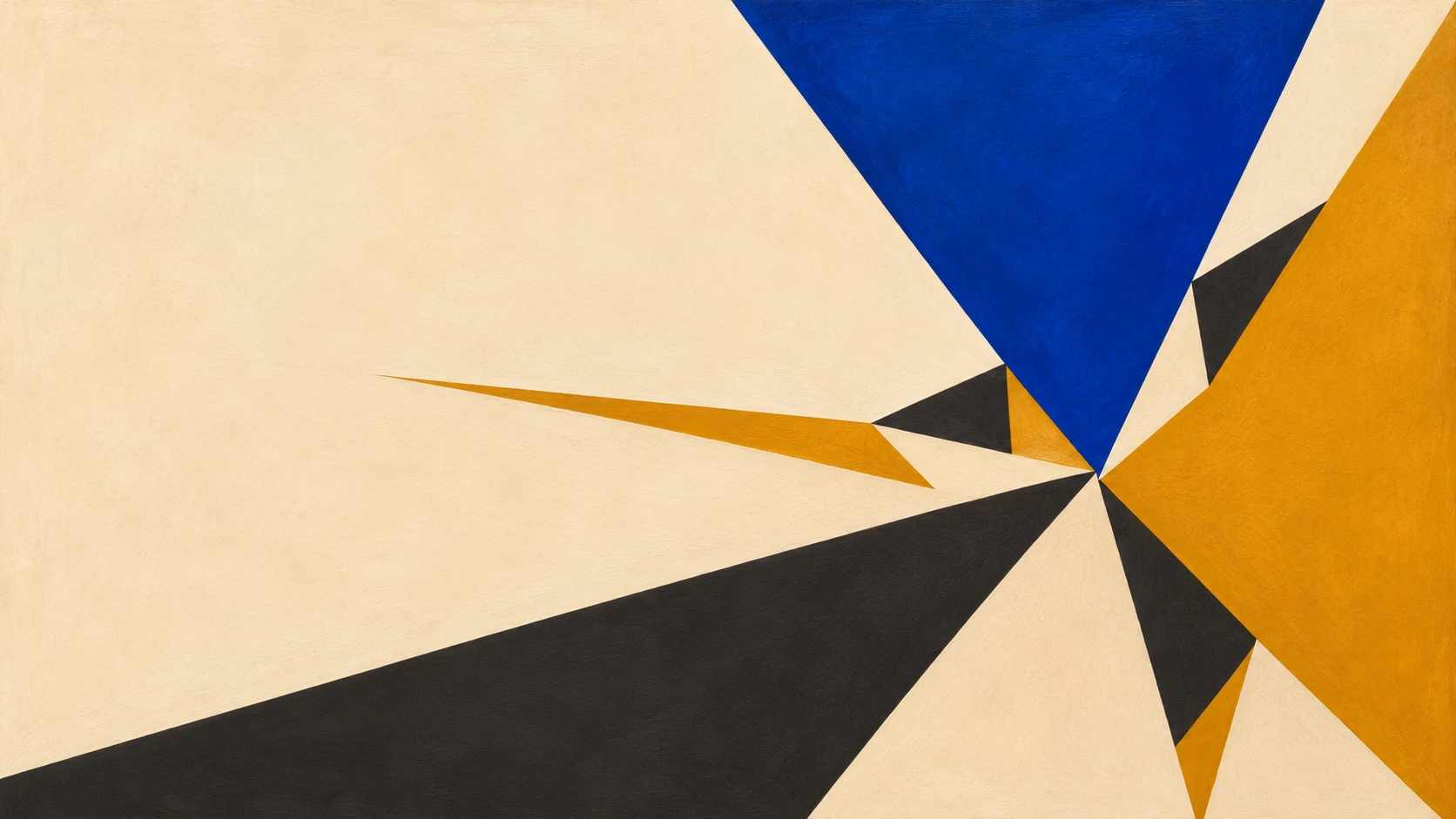
A visual introduction
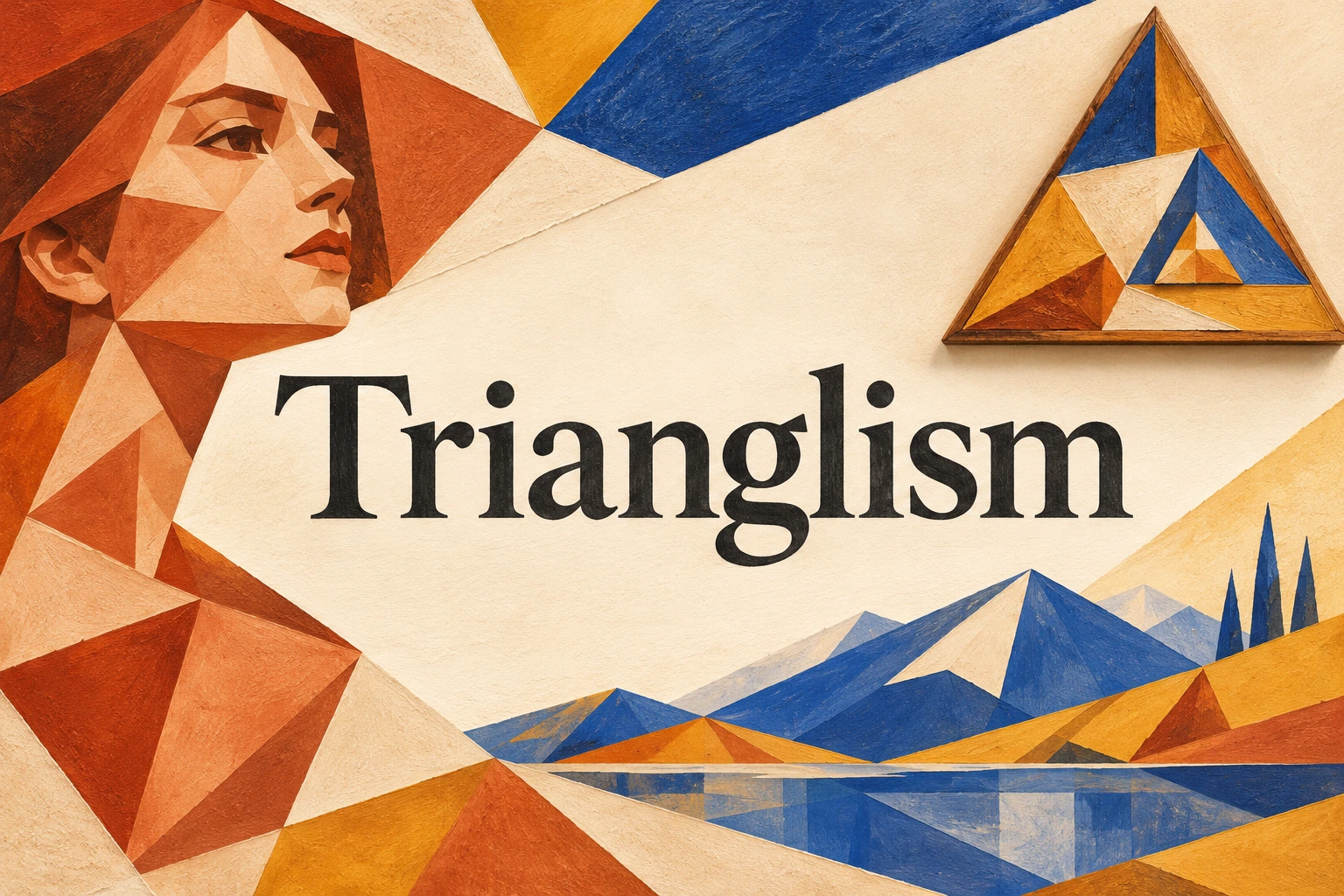
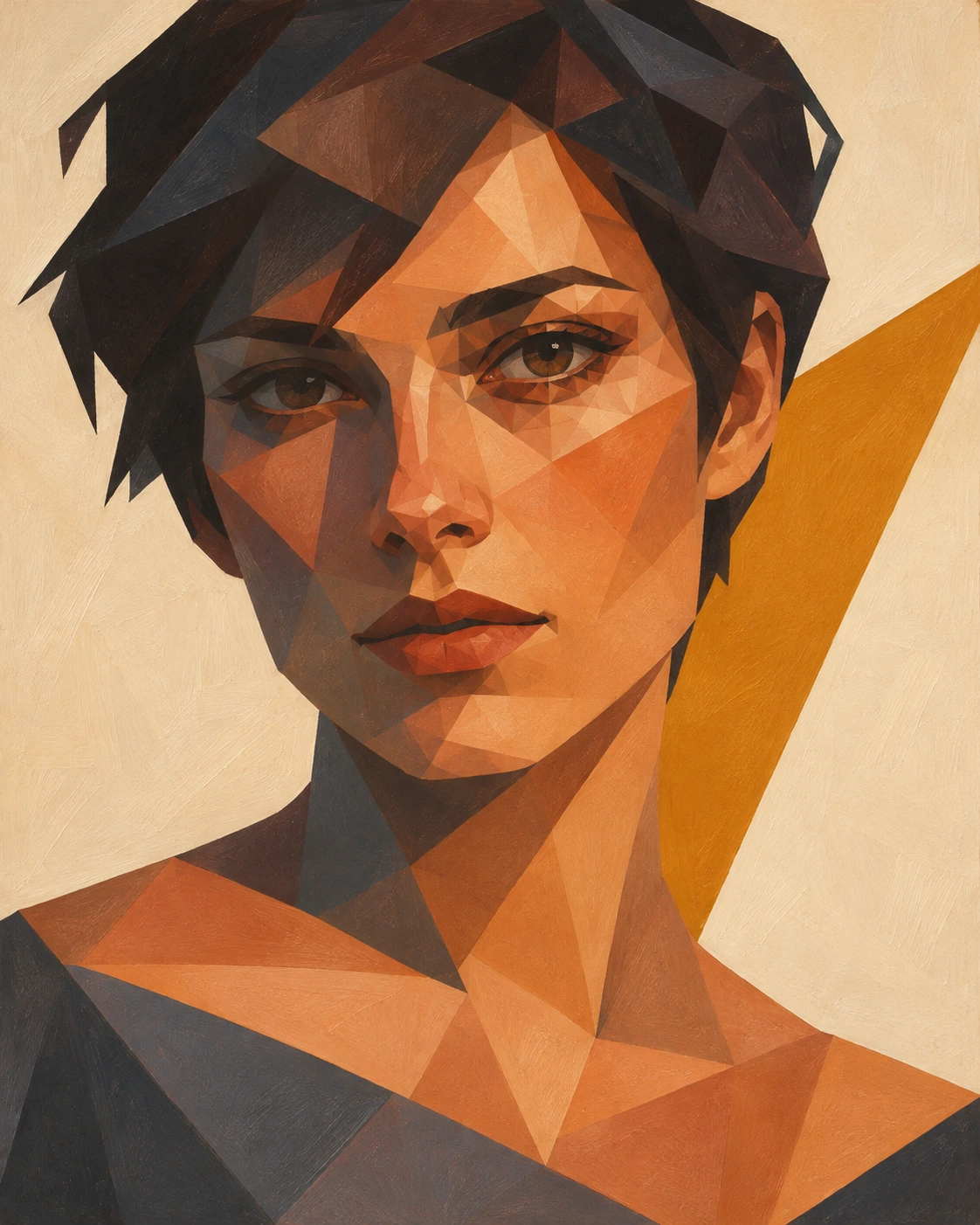
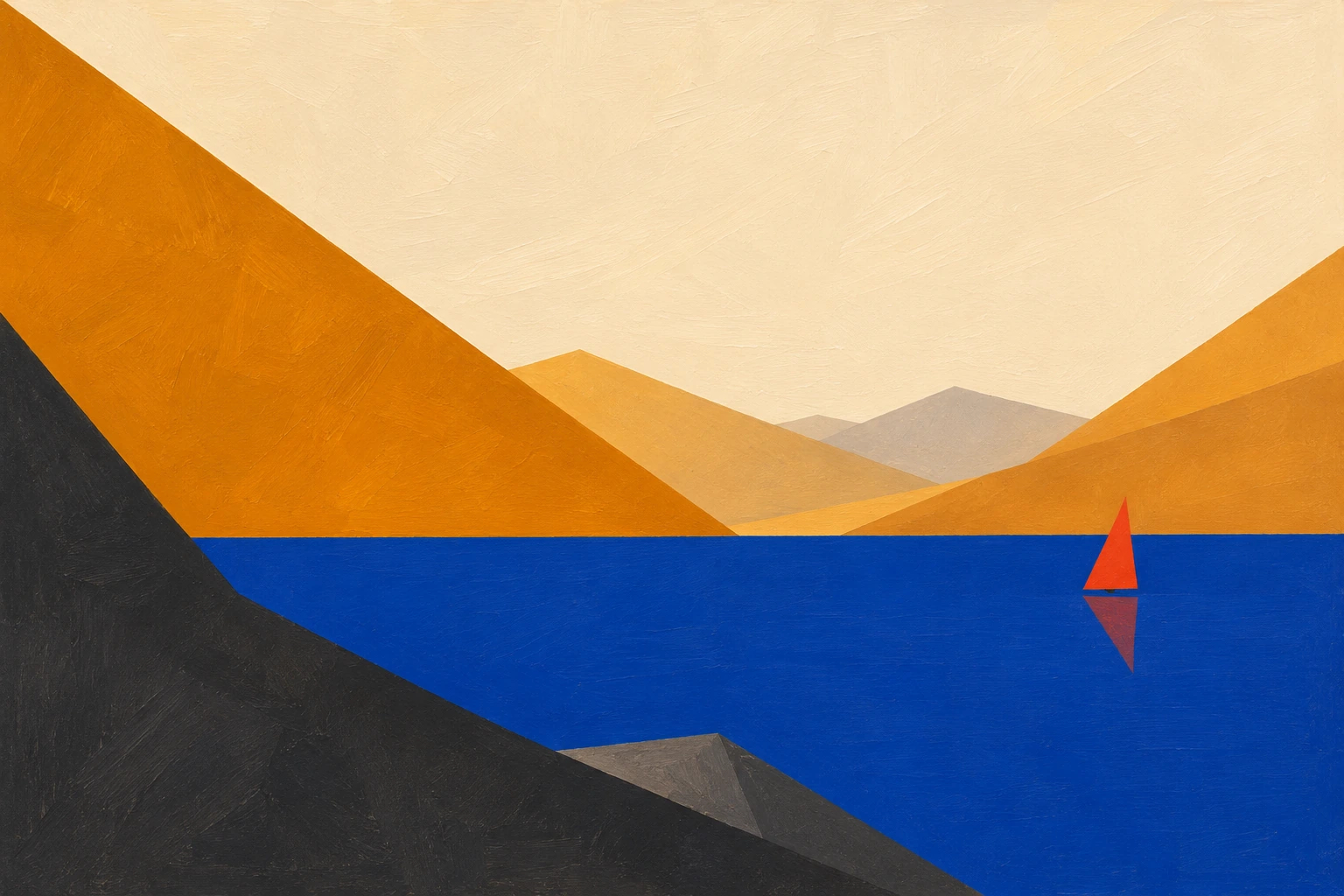
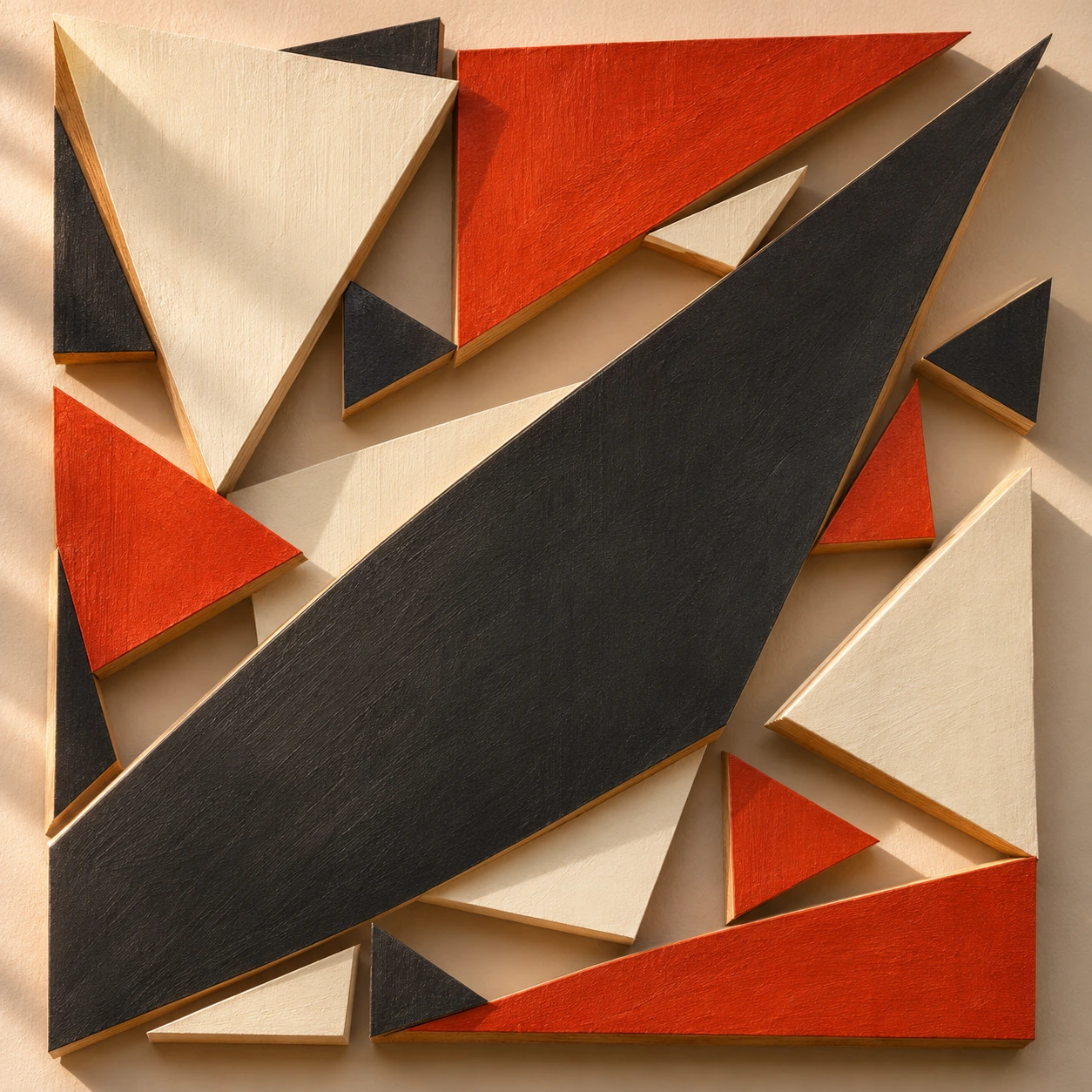
Five original AI-generated AOI studies of triangular composition: banner, titled collage, portrait, landscape and imagined relief. These are not artworks by the artists discussed in the research.
Select an image for a closer look. Use the thumbnails, arrow keys or a swipe to compare examples. Zoom in to inspect details, or share the image that inspires you.
Creative toolbox · take this style further
Choose an input and a destination. Search sends your words to the chosen site; Copy & open puts them on your clipboard to paste there.
Create with AI
Turn your chosen input into an image prompt or a new creative direction.
ChatGPT
Copy your input and paste it into a ChatGPT conversation or image request.
Copy & open ChatGPT (new tab)Claude · Anthropic
Develop an image prompt or explore the style in a new Claude conversation.
Copy & open Claude · Anthropic (new tab)Midjourney
Paste your input into the Imagine bar on the Create page.
Copy & open Midjourney (new tab)Adobe Firefly
Copy your input, open Firefly, and paste it into the prompt field.
Copy & open Adobe Firefly (new tab)Leonardo.Ai
Copy your input, open Leonardo, and paste it into the generation field.
Copy & open Leonardo.Ai (new tab)Image search
Find visual references. Short, concrete keywords usually work best.
Lexica
Search AI images and prompts using your selected input.
Search with this input Lexica (new tab)Pexels
Search the photo and video library. Short keywords often work best.
Search with this input Pexels (new tab)Pixabay
Search photos, illustrations and other images.
Search with this input Pixabay (new tab)Unsplash
Search photographs using the style name or your own keywords.
Search with this input Unsplash (new tab)Wikimedia Commons
Search photographs, artworks and historical images. Check each file for its source and reuse terms.
Search with this input Wikimedia Commons (new tab)Art & research
Explore artists, collections and the ideas behind a style.
Wikipedia
Search for background reading. A style may not have its own article.
Search with this input Wikipedia (new tab)WikiArt
Copy your input into WikiArt’s search to explore artists and artworks.
Copy & open WikiArt (new tab)Europeana
Paste your keywords into the search to explore European museum, library and archive collections.
Copy & open Europeana (new tab)Inspiration
Discover portfolios and visual ideas from creative communities.
Instagram hashtags
Search a hashtag made from your input: spaces and punctuation are removed. Instagram may require sign-in.
Search with this input Instagram hashtags (new tab)ArtStation
Paste your input into artwork search for concept art, environments, characters and visual development.
Copy & open ArtStation (new tab)Behance
Paste your input into project search for illustration, design and visual storytelling.
Copy & open Behance (new tab)A closer look
Triangles act as structural decisions: pointed directions, broad bases, unequal scales, shared edges and deliberate gaps. The image may remain flat and abstract or describe a recognizable subject through angular planes; a triangular texture alone is not the whole idea.
One word, more than one practice
In a February 2018 press release supplied by Howard Schoor, the artist describes his work as Trianglism and connects its recurring triangle to his earlier engineering life. The release presents the name as part of his professional artistic identity. It is a useful primary account of his own practice, not an independent verdict on who invented triangular art.
The ArtBrake! profile of Richard “Dick” Seed also uses Trianglism, describing his move toward the triangle as a basic form and attributing a founder claim to the North Chatham Bugle. The profile places this discussion alongside his wood and metal work. These separate accounts establish multiple uses of the word; they do not establish a single organized movement, agreed founder or universal manifesto.
What this entry means by triangular composition
AOI uses the visual exercises below to explore the triangle as a governing form. The generated images are original studies, not works by Schoor or Seed, and they do not claim to reproduce either artist's complete method. A triangle might be the dominant silhouette, an internal division or the interval left between other shapes.
Choose which of those jobs matters. In a flat composition, a large triangle can gather smaller ones toward a point. In a portrait, angled planes can describe the turn of a cheek without covering every feature in an equally dense mesh. In a landscape, broad triangular masses can organize depth before smaller fragments describe terrain.
Direction, weight and the space between
A broad base can make a shape feel planted; a narrow tip can pull attention toward a distant corner. Rotate a few forms against the main direction to create tension, then decide whether they interrupt the rhythm or destroy it. Repeated orientation supplies coherence, while one carefully placed exception creates an event.
Scale does much of the work. Use a small family of large, medium and small triangles rather than a uniform carpet of shards. Leave an area with fewer divisions so the eye can rest. Negative space can be triangular too, but it need not repeat the same proportion as the colored forms around it.
Flat color, volume and material
For flat abstraction, give neighboring planes colors with a deliberate value relationship. A limited palette of ivory, charcoal, ochre and one saturated hue can reveal the structure more clearly than a different color for every cell. Thin outlines are optional; shared edges and contrast can separate the forms.
For suggested volume, make planes turn consistently from light to shadow. For a material study, describe whether the pieces resemble painted wood, cut paper or translucent glass. Those choices change edge thickness, reflection and shadow. A generated material effect remains an illustration, not a verified fabrication plan.
Trianglism, Cubism and triangulation
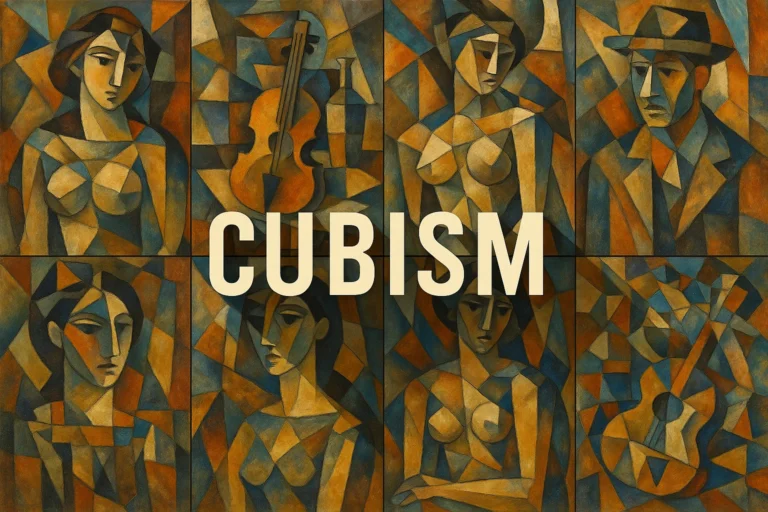
The Metropolitan Museum's account of Cubism describes fractured forms, shallow pictorial space and multiple or contrasting viewpoints. Cubism is therefore not simply a picture made from cubes, and changing the number of sides does not create a historical successor by arithmetic.
Likewise, a digital triangulated mesh is a construction method, while Trianglism is an artist-used label whose meaning depends on context. The two can overlap visually. Ask whether triangles merely cover an existing photograph or actually change its composition, rhythm and interpretation. Both can produce attractive images, but they solve different problems.
A useful working sequence
Start with three large masses and a focal point. Divide only where a division clarifies a turn, redirects the gaze or creates a useful interruption. Test the design without color, then introduce a restrained palette and a material character. At thumbnail size, the main relationship should survive.
This approach can serve paintings, editorial illustrations, surface patterns and spatial concepts. Its common weakness is automatic fragmentation: every surface receives the same treatment, and the subject loses hierarchy. Keep some broad shapes intact. Precision is valuable when it supports a decision, not when it merely increases the number of edges.
A small poetic detour
Original words from the AOI studio.
Poetry
Three edges meet and make a place;
A point persuades the eye to turn.
The quiet gap completes the space,
While colored planes refuse to blur.
No angle proves a picture wise—
Its meaning waits between the sides.
The prompt workshop
Original creative exercises. These prompts create new illustrations, not documentary evidence.
Three scales, one direction
Make an original triangular abstract painting: three large interlocking masses, a few medium counterpoints and tiny accents, ivory negative space, charcoal and ochre with one cobalt plane. Clear directional tension, subtle painted surface, no text.
A face built from decisions
Compose an invented adult portrait from broad triangular painted planes. Preserve a coherent gaze and facial silhouette, use smaller facets only near the focal eye, warm terracotta light and cool slate shadow, quiet background. No uniform polygon filter, no writing.
Triangles become objects
Imagine a wall relief of triangular painted wood pieces in charcoal, ivory and vermilion. Vary thickness and scale, leave deliberate gaps, use raking light to reveal edges. One dominant diagonal, restrained composition, original design, no labels.
A smile from the studio
Jokes
The triangle arrived at the exhibition with three excellent points. The curator asked for an artist statement. It added seventeen pages and immediately lost its compositional economy.