
Artist study · food, color and unstable still-life space
Tracy Miller’s still lifes combine recognizable food and everyday abundance with restless abstract painting. Dense color, shifting scale and uncertain space make the familiar table feel inviting, excessive and slightly unsettled.
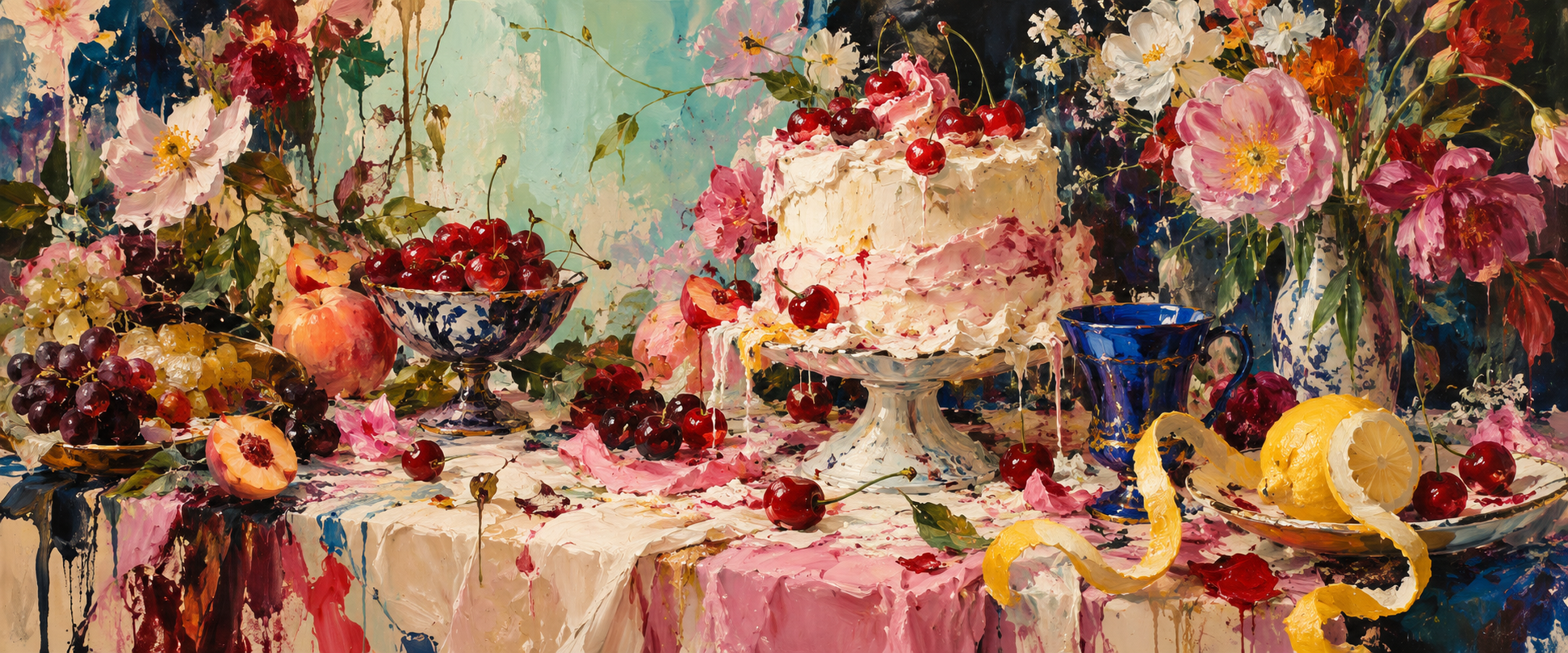
A visual introduction
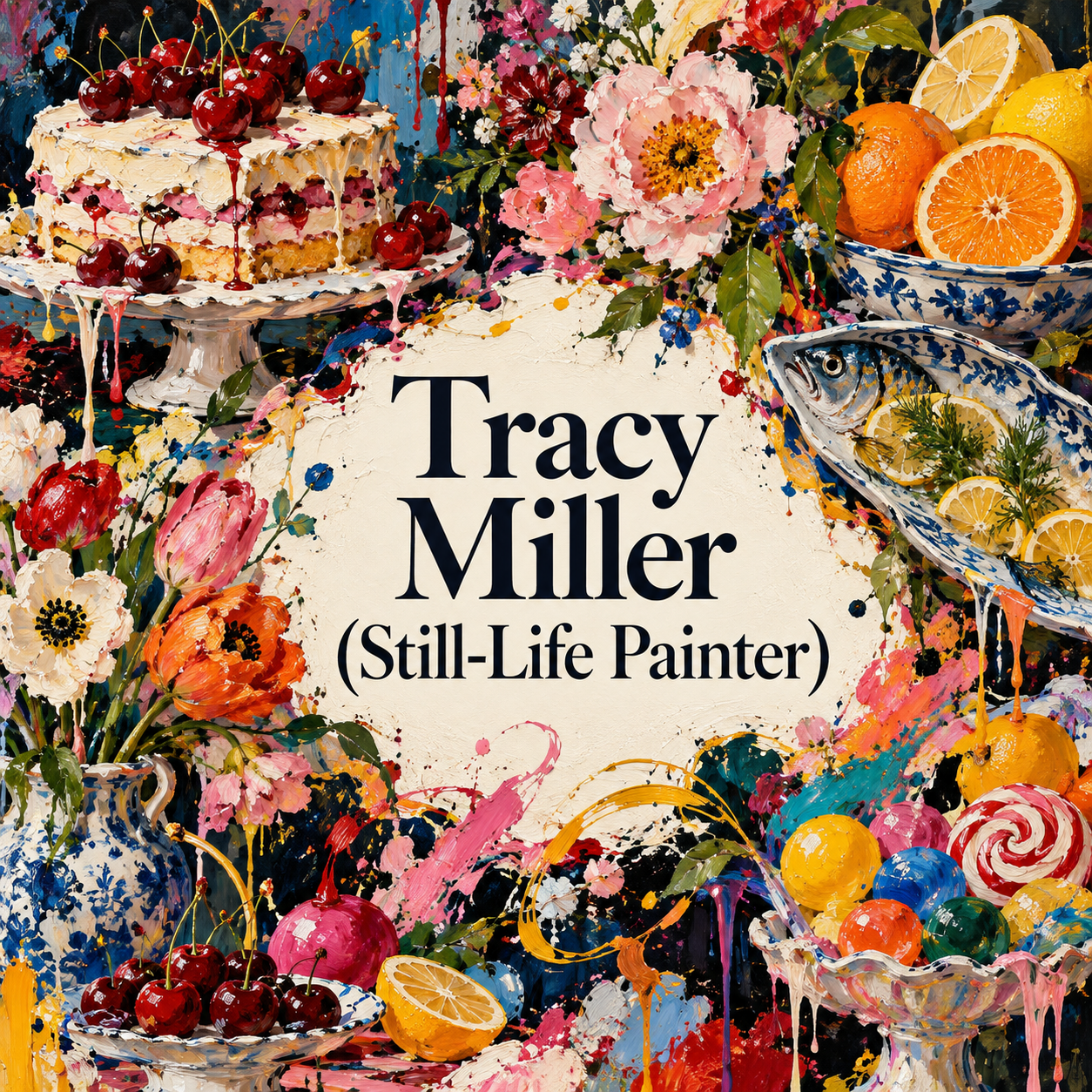
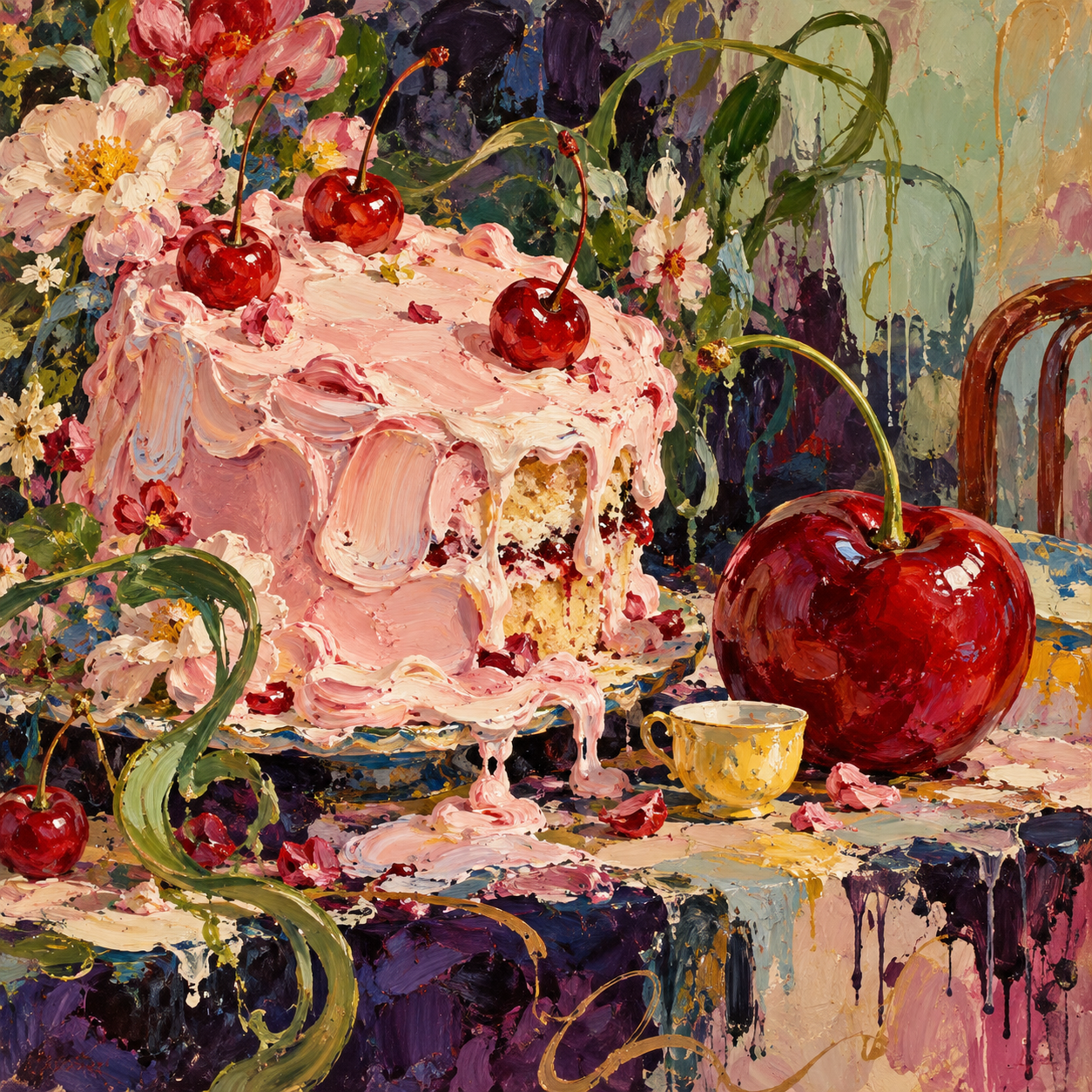
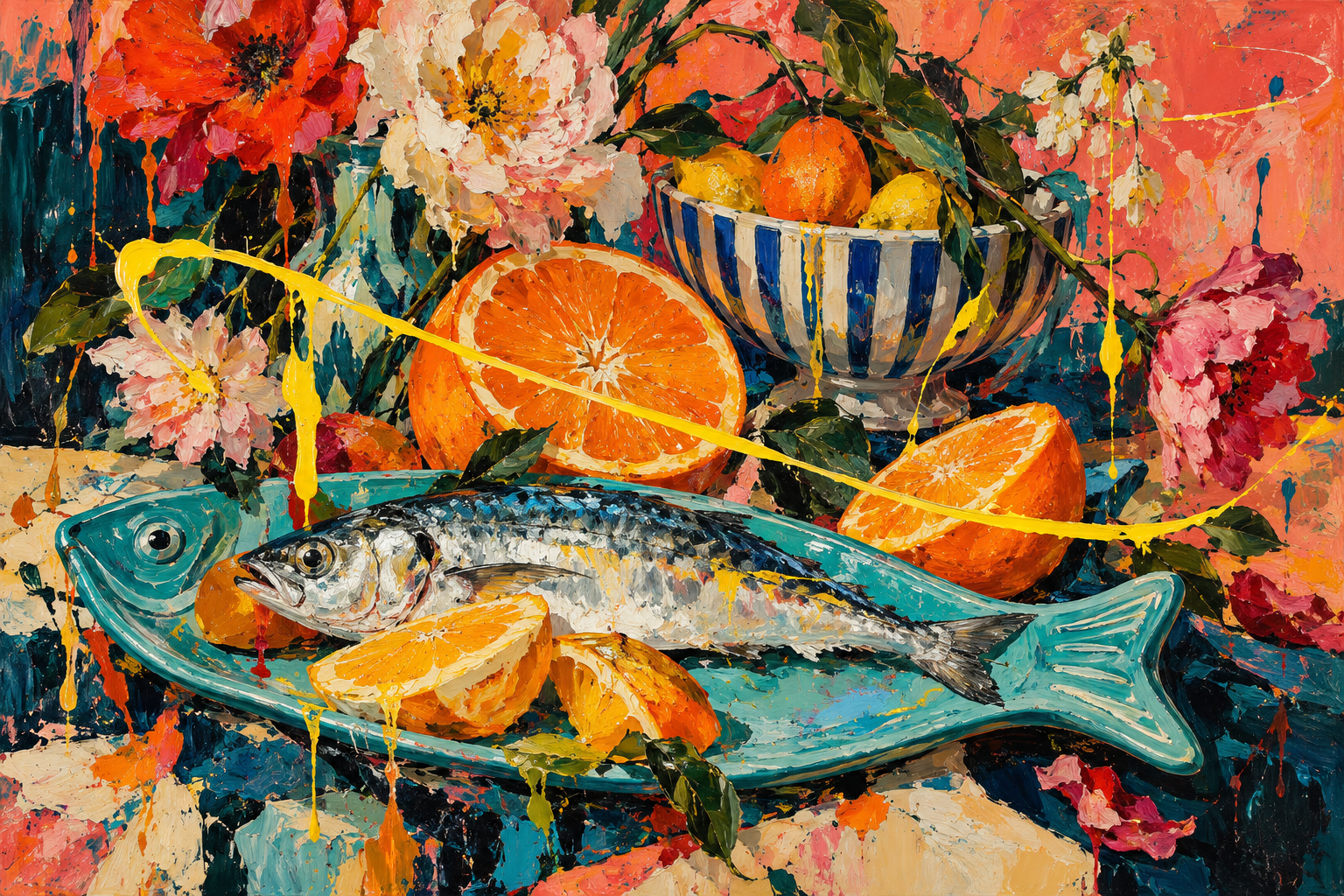
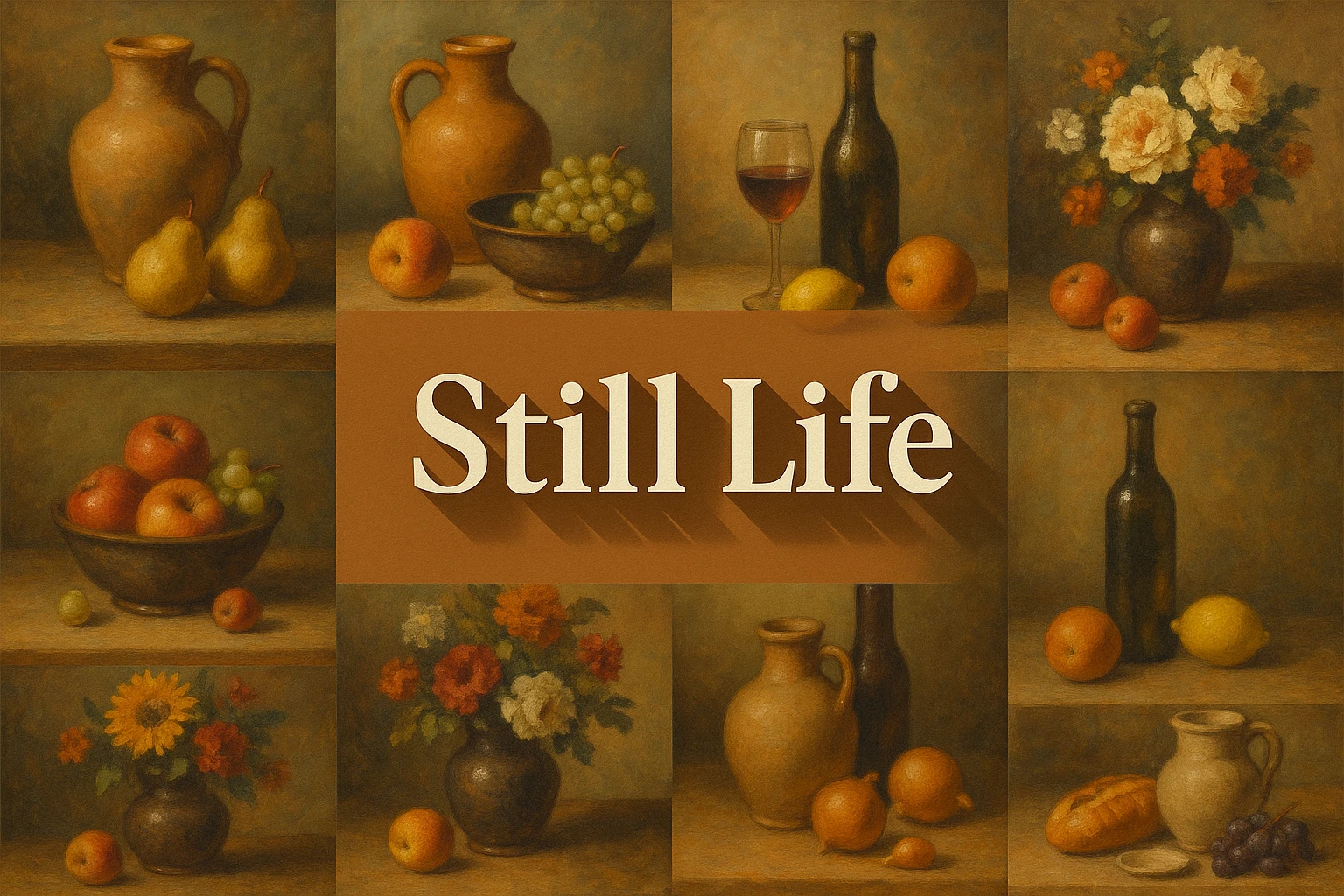
Five original AI-generated AOI studies: a dedicated banner, a centrally titled collage and three standalone examples. These are contemporary interpretations of the visual principles discussed here.
Select an image for a closer look. Use the thumbnails, arrow keys or a swipe to compare examples. Zoom in to inspect details, or share the image that inspires you.
Creative toolbox · take this style further
Choose an input and a destination. Search sends your words to the chosen site; Copy & open puts them on your clipboard to paste there.
Create with AI
Turn your chosen input into an image prompt or a new creative direction.
ChatGPT
Copy your input and paste it into a ChatGPT conversation or image request.
Copy & open ChatGPT (new tab)Claude · Anthropic
Develop an image prompt or explore the style in a new Claude conversation.
Copy & open Claude · Anthropic (new tab)Midjourney
Paste your input into the Imagine bar on the Create page.
Copy & open Midjourney (new tab)Adobe Firefly
Copy your input, open Firefly, and paste it into the prompt field.
Copy & open Adobe Firefly (new tab)Leonardo.Ai
Copy your input, open Leonardo, and paste it into the generation field.
Copy & open Leonardo.Ai (new tab)Image search
Find visual references. Short, concrete keywords usually work best.
Lexica
Search AI images and prompts using your selected input.
Search with this input Lexica (new tab)Pexels
Search the photo and video library. Short keywords often work best.
Search with this input Pexels (new tab)Pixabay
Search photos, illustrations and other images.
Search with this input Pixabay (new tab)Unsplash
Search photographs using the style name or your own keywords.
Search with this input Unsplash (new tab)Wikimedia Commons
Search photographs, artworks and historical images. Check each file for its source and reuse terms.
Search with this input Wikimedia Commons (new tab)Art & research
Explore artists, collections and the ideas behind a style.
Wikipedia
Search for background reading. A style may not have its own article.
Search with this input Wikipedia (new tab)WikiArt
Copy your input into WikiArt’s search to explore artists and artworks.
Copy & open WikiArt (new tab)Europeana
Paste your keywords into the search to explore European museum, library and archive collections.
Copy & open Europeana (new tab)Inspiration
Discover portfolios and visual ideas from creative communities.
Instagram hashtags
Search a hashtag made from your input: spaces and punctuation are removed. Instagram may require sign-in.
Search with this input Instagram hashtags (new tab)ArtStation
Paste your input into artwork search for concept art, environments, characters and visual development.
Copy & open ArtStation (new tab)Behance
Paste your input into project search for illustration, design and visual storytelling.
Copy & open Behance (new tab)A closer look
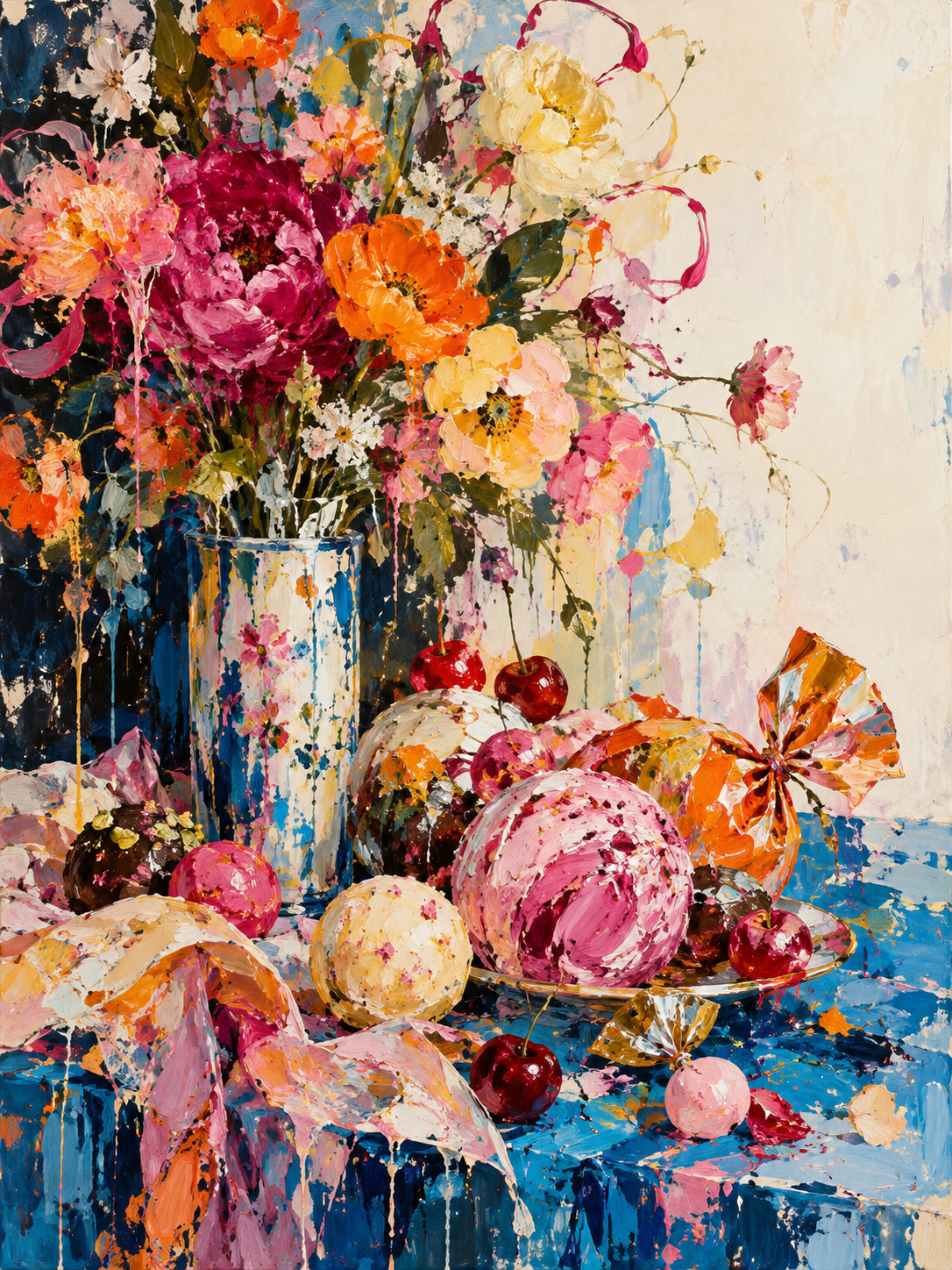
Confections, fruit, flowers and containers mingle with thick paint, loops, drips and patches of saturated color. Objects remain recognizable while their scale, weight and setting refuse to settle into a tidy tabletop.
Which Tracy Miller?
This entry concerns the Brooklyn-based painter Tracy Miller, known for food-centered still lifes and abstract compositions. The artist's official site is tracymillerpaintings.com. She is distinct from the wildlife painter of the same name, whose work receives its own AOI entry.
The Sharpe-Walentas Studio Program identifies Miller as born in Storm Lake, Iowa, in 1966, with a BFA from the University of Iowa and an MFA from the University of California, Berkeley. More useful than a long list of credentials is the painting's central tension: familiar things remain recognizable while the surrounding paint refuses to behave like a stable room.
Abundance with an uneasy aftertaste
The American University Museum's 2013 exhibition, Big Paintings, 1997–2013, describes food and flowers operating simultaneously as recognizable objects and abstract forms. Its examples include Tart and Donuts from 1997, Salt Water Taffy from 2001, and Ambrosia from 2006, all recorded as oil on canvas. Those titles point toward a vocabulary of food without reducing the paintings to illustrations of a menu.
The artist's own account connects the work to visual abundance, consumer imagery and the domestic associations of food. The Sharpe-Walentas profile also identifies overconsumption and feminist critique among its concerns. A painting can attract the eye with sweetness while making that attraction feel excessive. The critical force is part of the work's sensory appeal, rather than a separate message pasted onto it.
Let the object and the paint disagree
A cake can suggest icing and also function as a broad pale mass. A cherry can be a fruit, a red dot, a weight at the edge of a shape, or a route into another part of the canvas. Reading both identities at once makes a still life active. The object need not disappear for abstraction to take hold.
For an original exercise, select a small group of foods with different silhouettes. Pair a compact round object with something stretched, folded or stacked. Establish them clearly, then let neighboring marks interrupt their edges. Keep enough recognition for the interruption to matter; a canvas of unrelated splashes poses a different problem.
Use the brushwork to alter the pace. A carefully bounded rim can sit beside a loose smear, while a dense passage of paint meets a thinner open field. If every object receives the same level of finish, the image can become a neat collection of icons instead of a restless painted environment.
Make scale and space slightly unreliable
Ordinary still-life depth gives the viewer a stable table, a background and objects arranged between them. Here, the study becomes more interesting when some of those assurances loosen. An unexpectedly large fruit can compete with a much smaller vessel; a flower can hover between the front and back of the image.
Choose one or two disruptions and keep other relationships clear. A repeated curve can connect objects that do not share a plausible scale. A warm color can jump across the composition, while a dark patch creates an apparent depth that the next mark contradicts. The eye should have something to follow even when the room does not quite add up.
Avoid using random size changes as a substitute for composition. Ask which object deserves emphasis and which element carries the viewer toward it. A large motif near an edge needs a counterweight; a crowded center may need an opening through which the painting can breathe.
Color should attract and complicate
A strongly saturated palette can make food seem enticing before its arrangement begins to feel unstable. Compare sweet pinks and warm yellows with darker, murkier or cooler passages. The difference creates pressure. Keeping everything equally bright removes that tension and can make the image behave like cheerful packaging.
Repeated colors should create a route rather than a checklist. A small red accent can answer a larger red form across the canvas. Leave some passages less resolved so the viewer alternates between naming an object and simply seeing paint. Surface, shape and subject can take turns leading.
For digital or AI studies, describe paint behavior as well as ingredients. Specify uneven edge handling, visible layering, contrasting densities and an uncertain tabletop. A prompt that lists only cake, candy and flowers is likely to produce a decorated still life without the more interesting conflict between representation and abstraction.
Three studies, without impersonating an original work
The AOI gallery explores a confection-centered arrangement, a citrus-and-fish still life, and a combination of flowers and candy-like forms. A wide banquet-like banner and a titled collage introduce the series. These are newly generated studies of visual principles, not paintings by Miller or reproductions of the museum examples.
Use the first study to control a dominant shape, the second to test competing scales, and the third to experiment with the boundary between a recognizable object and a painted mark. Keep one compositional question in view. Excess becomes expressive when there is something for it to press against.
The main risk is comfortable imitation of abundance: many objects, many colors, no tension. Remove one attractive detail and see whether the image becomes more alive. A useful still-life experiment can be luscious and awkward at the same time, allowing the pleasure of looking to remain unresolved.
A small poetic detour
Original words from the AOI studio.
Poetry
The table will not keep still
A cherry finds a sky inside the plate;
the icing rises higher than the vase.
A yellow streak arrives a little late
and interrupts the room's unfinished phrase.
The flowers lean toward somewhere off the cloth.
A cup forgets the shadow it should wear.
I came to name the things and wandered off
where pink becomes a kind of weather there.
The feast stays bright, the appetite unsure.
One brushmark opens what the fruits obscure.
The prompt workshop
Original creative exercises. These prompts create new illustrations, not documentary evidence.
Build a restless confection still life
Paint an original food still life with one pale cake, cherries and a small cup, combining recognizable forms with thick oil-like marks, uneven edges and saturated patches of color. Let one object shift scale and one edge dissolve into the surrounding paint. Keep a deliberate focal mass.
Study the tension between an object and its painted shape.
Give the table competing scales
Create an original exuberant still life of citrus, a fish-shaped platter and flowers in an uncertain shallow space. Use looping brushwork, dense and open passages, warm sweet color against cool dark areas, and two purposeful scale shifts. No lettering or copied composition.
Keep a route for the eye while loosening the room’s perspective.
Let flowers become marks
Create a painterly still life in which flowers, folded candy wrappers and rounded sweets alternate between recognizable objects and abstract color shapes. Vary edge sharpness, paint density and scale; leave one quiet opening among the abundance.
The opening should make the crowded passages more active.
Your next inspiration
Discover another art style
Follow a visual thread to the next subject.
People & works to explore
References discussed in this article. Consult the sources below for context.
Artists and practitioners
Tracy Miller (still-life painter)
Paintings and other works
Tart (1997)
Donuts (1997)
Salt Water Taffy (2001)
Ambrosia (2006)
A smile from the studio
Jokes
The still-life class was told to paint what they saw. One student painted a cake, three cherries and a perfectly respectable cup. Then she enlarged a cherry until it could rent the cup as an apartment, moved the cake behind a pink cloud and let the table slide out of the picture. “Where is the perspective?” asked her neighbor. “At the buffet,” she said. “It went back for seconds.”
Sources and further exploration
Tracy Miller — official artist statement and visual vocabulary
Tracy Miller — official exhibition history, including food-painting shows
American University Museum — Big Paintings, 1997–2013, with identified works and media
Sharpe-Walentas Studio Program — artist profile, education and themes