
Artistic genre
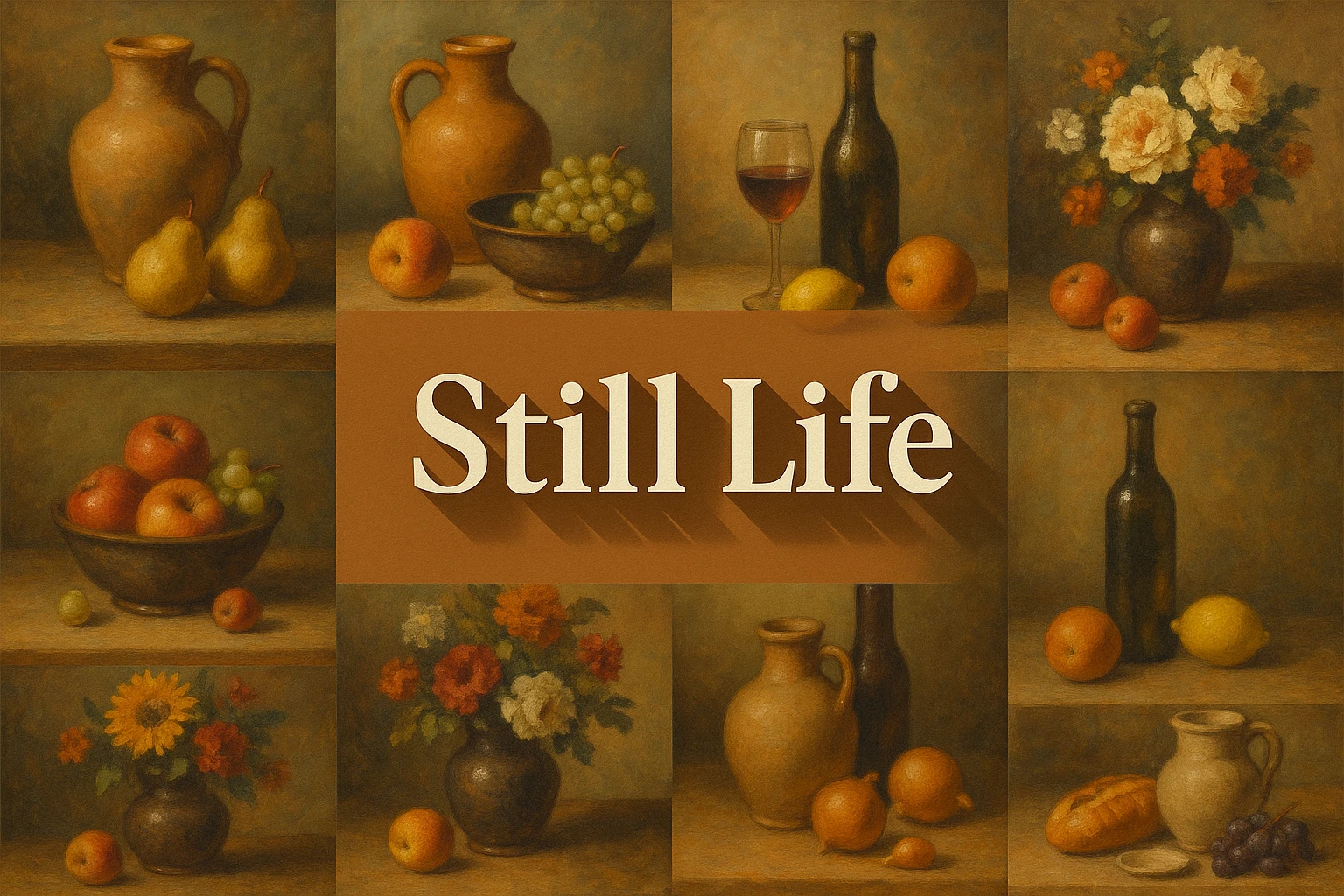
Still life takes objects as its main subjects. It can study light and material, construct a formal experiment, suggest a human presence or examine how things acquire meaning; it is not limited to fruit and flowers.
A visual introduction
Select an image for a closer look. Use the thumbnails, arrow keys or a swipe to compare examples. Zoom in to inspect details, or share the image that inspires you.
Creative toolbox · take this style further
Choose an input and a destination. Search sends your words to the chosen site; Copy & open puts them on your clipboard to paste there.
Create with AI
Turn your chosen input into an image prompt or a new creative direction.
ChatGPT
Copy your input and paste it into a ChatGPT conversation or image request.
Copy & open ChatGPT (new tab)Claude · Anthropic
Develop an image prompt or explore the style in a new Claude conversation.
Copy & open Claude · Anthropic (new tab)Midjourney
Paste your input into the Imagine bar on the Create page.
Copy & open Midjourney (new tab)Adobe Firefly
Copy your input, open Firefly, and paste it into the prompt field.
Copy & open Adobe Firefly (new tab)Leonardo.Ai
Copy your input, open Leonardo, and paste it into the generation field.
Copy & open Leonardo.Ai (new tab)Image search
Find visual references. Short, concrete keywords usually work best.
Lexica
Search AI images and prompts using your selected input.
Search with this input Lexica (new tab)Pexels
Search the photo and video library. Short keywords often work best.
Search with this input Pexels (new tab)Pixabay
Search photos, illustrations and other images.
Search with this input Pixabay (new tab)Unsplash
Search photographs using the style name or your own keywords.
Search with this input Unsplash (new tab)Wikimedia Commons
Search photographs, artworks and historical images. Check each file for its source and reuse terms.
Search with this input Wikimedia Commons (new tab)Art & research
Explore artists, collections and the ideas behind a style.
Wikipedia
Search for background reading. A style may not have its own article.
Search with this input Wikipedia (new tab)WikiArt
Copy your input into WikiArt’s search to explore artists and artworks.
Copy & open WikiArt (new tab)Europeana
Paste your keywords into the search to explore European museum, library and archive collections.
Copy & open Europeana (new tab)Inspiration
Discover portfolios and visual ideas from creative communities.
Instagram hashtags
Search a hashtag made from your input: spaces and punctuation are removed. Instagram may require sign-in.
Search with this input Instagram hashtags (new tab)ArtStation
Paste your input into artwork search for concept art, environments, characters and visual development.
Copy & open ArtStation (new tab)Behance
Paste your input into project search for illustration, design and visual storytelling.
Copy & open Behance (new tab)A closer look
Object scale, overlap, negative space, surface and lighting work together; the arrangement should remain readable before individual textures become elaborate.
Objects create relationships
The National Gallery of Art's collection overview demonstrates the variety of still-life arrangements and handling. The Met's Matisse example shows how ordinary objects can become an experiment in color planes and rhythm rather than an exercise in illusion alone.
Start with a reason for bringing the objects together. They might share a task, contrast in material or form a deliberate visual sequence. A random accumulation can be interesting, but it still needs a compositional relationship that rewards attention.
Arrange before rendering
Try several quick silhouettes. A tall object can anchor the group; a low horizontal can connect it to the table; a small gap can keep adjacent shapes distinct. Check the negative spaces as carefully as the objects themselves.
The table edge and viewpoint matter. A high viewpoint reveals surfaces and arrangement, while a lower one emphasizes profiles and overlap. Do not combine incompatible ellipses or perspective cues unless that disruption is a deliberate part of the work.
Let light distinguish materials
Glass, cloth, ceramic and metal respond differently. Identify each material's main behavior instead of adding the same highlight to every surface. Reflections should relate to the environment, and cast shadows should help place the objects on the support.
Limit detail until the large value pattern works. One well-placed highlight can be enough to describe a polished surface. Too many equally bright accents can scatter attention and make the arrangement feel less coherent.
Meaning is specific, not automatic
Objects can suggest use, memory, consumption or absence. Avoid treating every flower as a fixed symbol or every skull-free arrangement as meaningless. Historical interpretations require evidence about the particular painting and its context.
For a contemporary study, an unfinished repair, a packed lunch or a set of worn tools can provide a clear subject. Decide whether the image emphasizes material observation or an implied human story. A generated example should preserve plausible object relationships and remain an original arrangement rather than a disguised reproduction of a museum work.
The prompt workshop
Original creative exercises. These prompts create new illustrations, not documentary evidence.
Three materials
Original still life of a ceramic cup, folded cloth and clear bottle, distinct material responses to one window light and a balanced triangular arrangement.
An absent task
Original still life of a partly repaired wooden toy and a few worn tools, clear overlaps and an implied human activity, no decorative clutter.
Color as structure
Original modern still life with ordinary kitchen objects organized into broad color planes, rhythmic edges and deliberately simplified depth.
Sources and further exploration
National Gallery of Art — the breadth of still-life subjects
The Met — Matisse’s still life as a color and spatial construction