
Printing technology · contemporary visual interpretation
A receipt is a very small stage with an unusually strict lighting budget. Black dots, pale paper and a narrow path can turn a cup, a fern or a city into an image that feels both immediate and temporary. Thermal Receipt explores that visual economy without confusing a generated illustration with a working printer file.
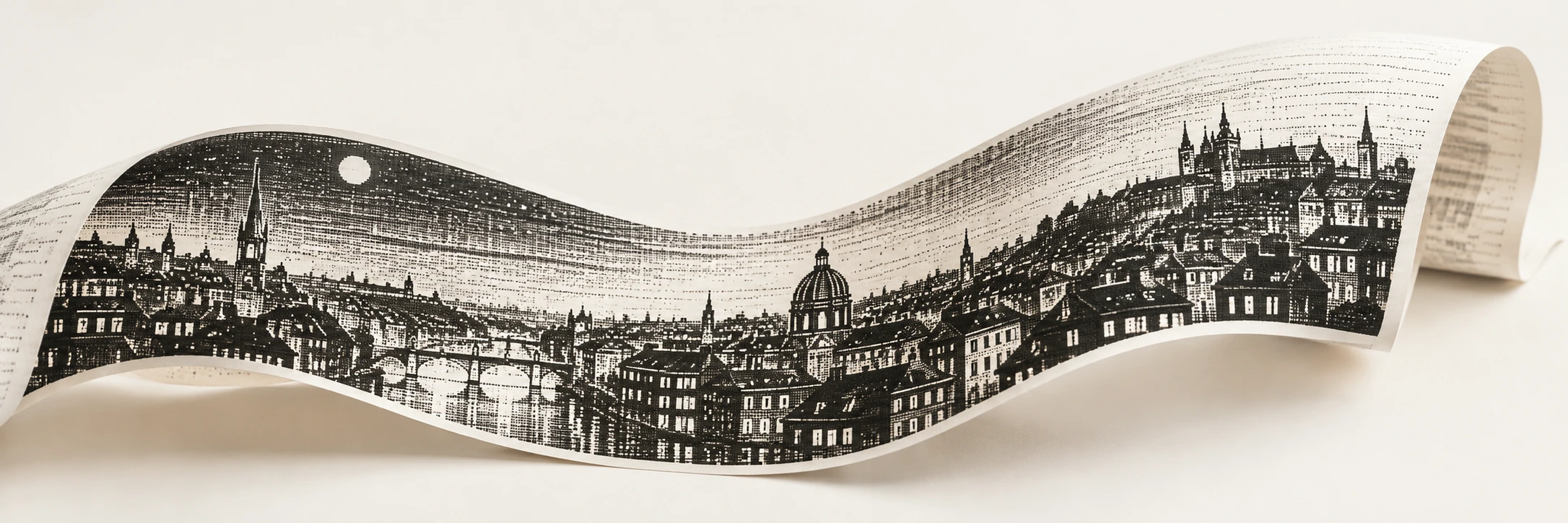
A visual introduction
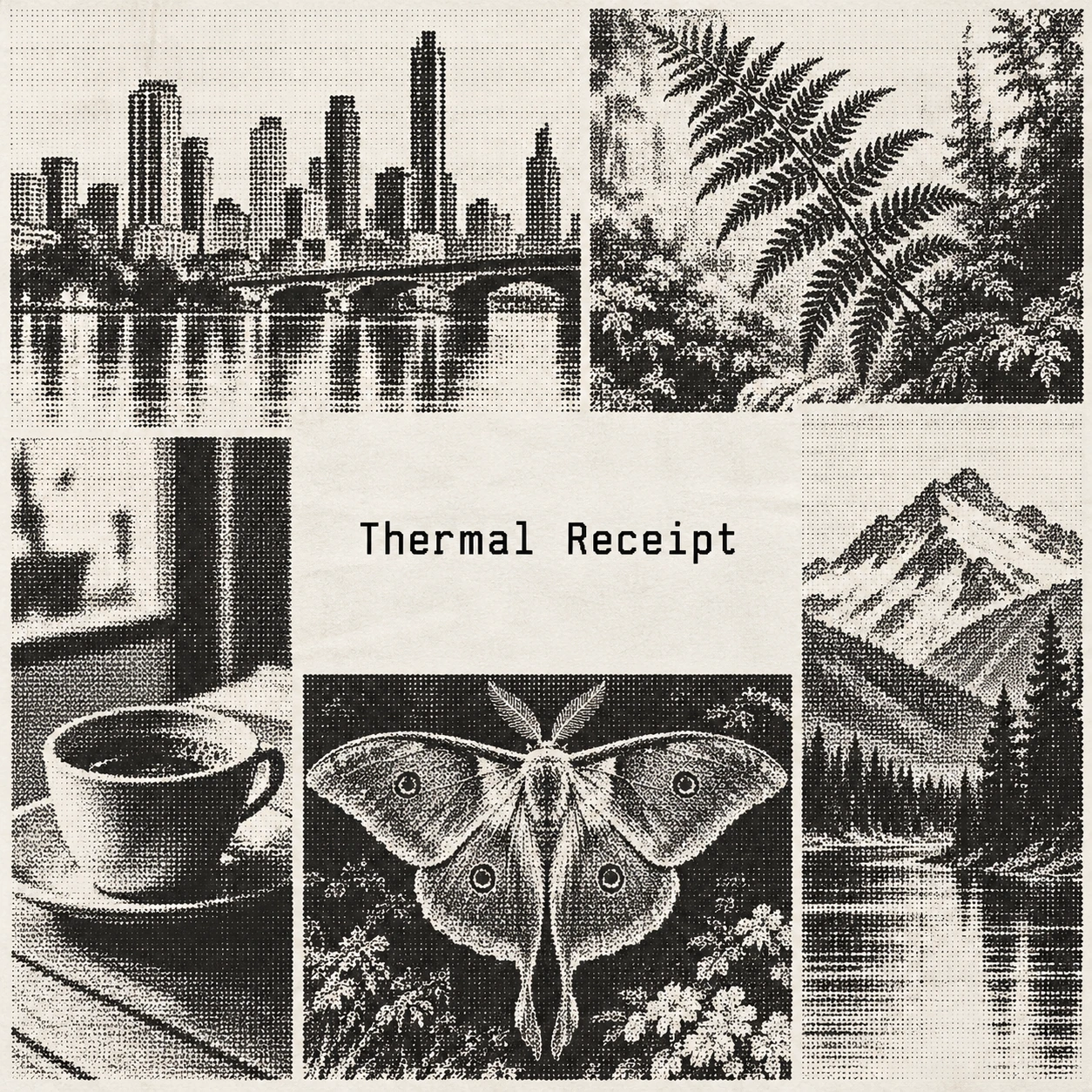
Seven original AI-generated interpretations: a dedicated banner, a centrally titled collage and five standalone studies. These are contemporary illustrations, not historical objects or proof of a physical printing process.
Select an image for a closer look. Use the thumbnails, arrow keys or a swipe to compare examples. Zoom in to inspect details, or share the image that inspires you.
Creative toolbox · take this style further
Choose an input and a destination. Search sends your words to the chosen site; Copy & open puts them on your clipboard to paste there.
Create with AI
Turn your chosen input into an image prompt or a new creative direction.
ChatGPT
Copy your input and paste it into a ChatGPT conversation or image request.
Copy & open ChatGPT (new tab)Claude · Anthropic
Develop an image prompt or explore the style in a new Claude conversation.
Copy & open Claude · Anthropic (new tab)Midjourney
Paste your input into the Imagine bar on the Create page.
Copy & open Midjourney (new tab)Adobe Firefly
Copy your input, open Firefly, and paste it into the prompt field.
Copy & open Adobe Firefly (new tab)Leonardo.Ai
Copy your input, open Leonardo, and paste it into the generation field.
Copy & open Leonardo.Ai (new tab)Image search
Find visual references. Short, concrete keywords usually work best.
Lexica
Search AI images and prompts using your selected input.
Search with this input Lexica (new tab)Pexels
Search the photo and video library. Short keywords often work best.
Search with this input Pexels (new tab)Pixabay
Search photos, illustrations and other images.
Search with this input Pixabay (new tab)Unsplash
Search photographs using the style name or your own keywords.
Search with this input Unsplash (new tab)Wikimedia Commons
Search photographs, artworks and historical images. Check each file for its source and reuse terms.
Search with this input Wikimedia Commons (new tab)Art & research
Explore artists, collections and the ideas behind a style.
Wikipedia
Search for background reading. A style may not have its own article.
Search with this input Wikipedia (new tab)WikiArt
Copy your input into WikiArt’s search to explore artists and artworks.
Copy & open WikiArt (new tab)Europeana
Paste your keywords into the search to explore European museum, library and archive collections.
Copy & open Europeana (new tab)Inspiration
Discover portfolios and visual ideas from creative communities.
Instagram hashtags
Search a hashtag made from your input: spaces and punctuation are removed. Instagram may require sign-in.
Search with this input Instagram hashtags (new tab)ArtStation
Paste your input into artwork search for concept art, environments, characters and visual development.
Copy & open ArtStation (new tab)Behance
Paste your input into project search for illustration, design and visual storytelling.
Copy & open Behance (new tab)A closer look
Monochrome raster marks, narrow strip proportions, abrupt black silhouettes, dithered tones, feed-direction rhythms and occasional paper curls; open paper is an active compositional material.
A process becomes a visual reference
Thermal Receipt names an AOI visual treatment drawn from direct-thermal receipt printing. It is not a historical art movement. The reference is useful because it imposes a set of visible decisions: a restricted tonal language, a narrow support and a sequence of marks that appears to arrive line by line. A good image makes those decisions legible rather than merely placing a generic photograph on a crumpled strip.
Zebra distinguishes direct thermal printing, which darkens a heat-sensitive coating, from thermal transfer, which uses a heated ribbon. Ordinary monochrome receipt imagery belongs to the former reference here. It does not require ink or toner in the printing mechanism. The black in our illustrations is therefore a depiction of a thermal mark, even though the published artwork is an ordinary digital image.
Design for the strip
Start by deciding what the narrow format can do. A column of steam, a fern frond or a stack of roofs can travel vertically without feeling squeezed. A broad panorama needs a different solution: divide its depth into a few stacked bands, or allow the paper to turn across the composition. Keep one visual anchor intact. If every edge competes at the same density, the strip becomes a grey queue of information.
Use three value families before adding texture: untouched paper, a sparse dot field and solid black. A pale window can puncture a dark shop front; a dark cup can support a light plume of steam. These relationships remain visible when the artwork is reduced to a thumbnail. Tiny decorative dots should support a form, not stand in for a missing composition.
Dots are structure
Dithering suggests intermediate tones by distributing black marks over white space. In an illustrative treatment, those marks can be organized into regular rasters or carefully varied clusters. Follow the subject: a leaf edge needs a continuous route, while a night sky can tolerate a looser field. Put the finest detail beside an area of rest so the viewer can actually notice it.
Avoid mixing a crisp raster with smoothly airbrushed greys unless the contrast is intentional and clearly presented as a hybrid. Also separate image grain from paper material. A faint paper texture can describe the support; it should not erase the printed silhouette. A dramatic curl is useful only when the printed marks follow the same surface convincingly.
Time, wear and the tempting fake archive
Zebra notes that direct-thermal output responds to environmental conditions, including heat and light. Such exposure can affect readability; a uniformly picturesque fade is not a universal physical outcome. The aesthetic can suggest transience without claiming a predictable lifespan. We do not present a generated stain as evidence of an actual aged receipt.
An imagined receipt is also not a real transaction. Keep invented purchase details, merchant identities and scannable codes out of an image unless the project specifically needs clearly fictional typography. The studies here use visual subjects rather than fabricated accounting. Their modest paper format supplies enough narrative: something small has briefly become worth keeping.
Read the five studies
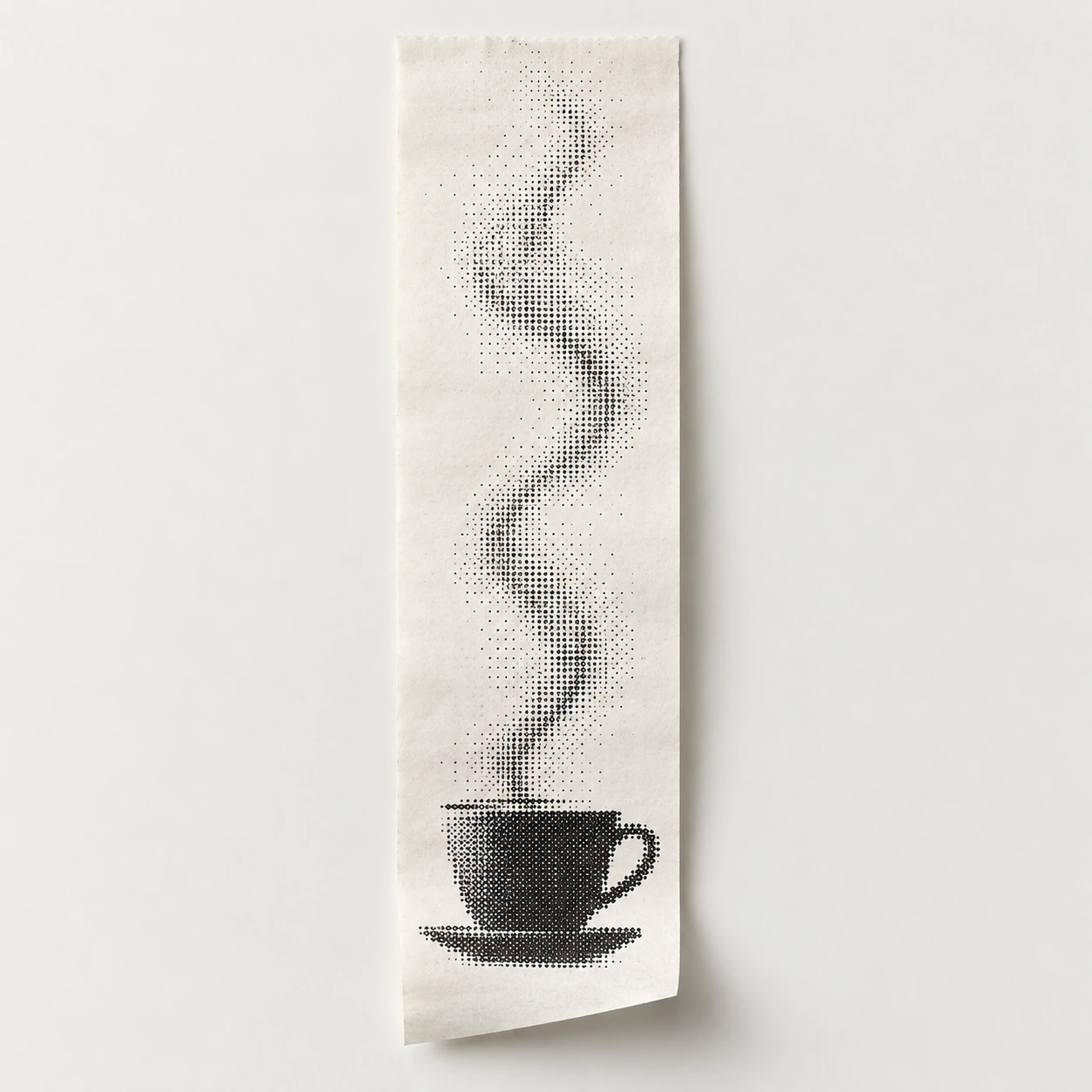
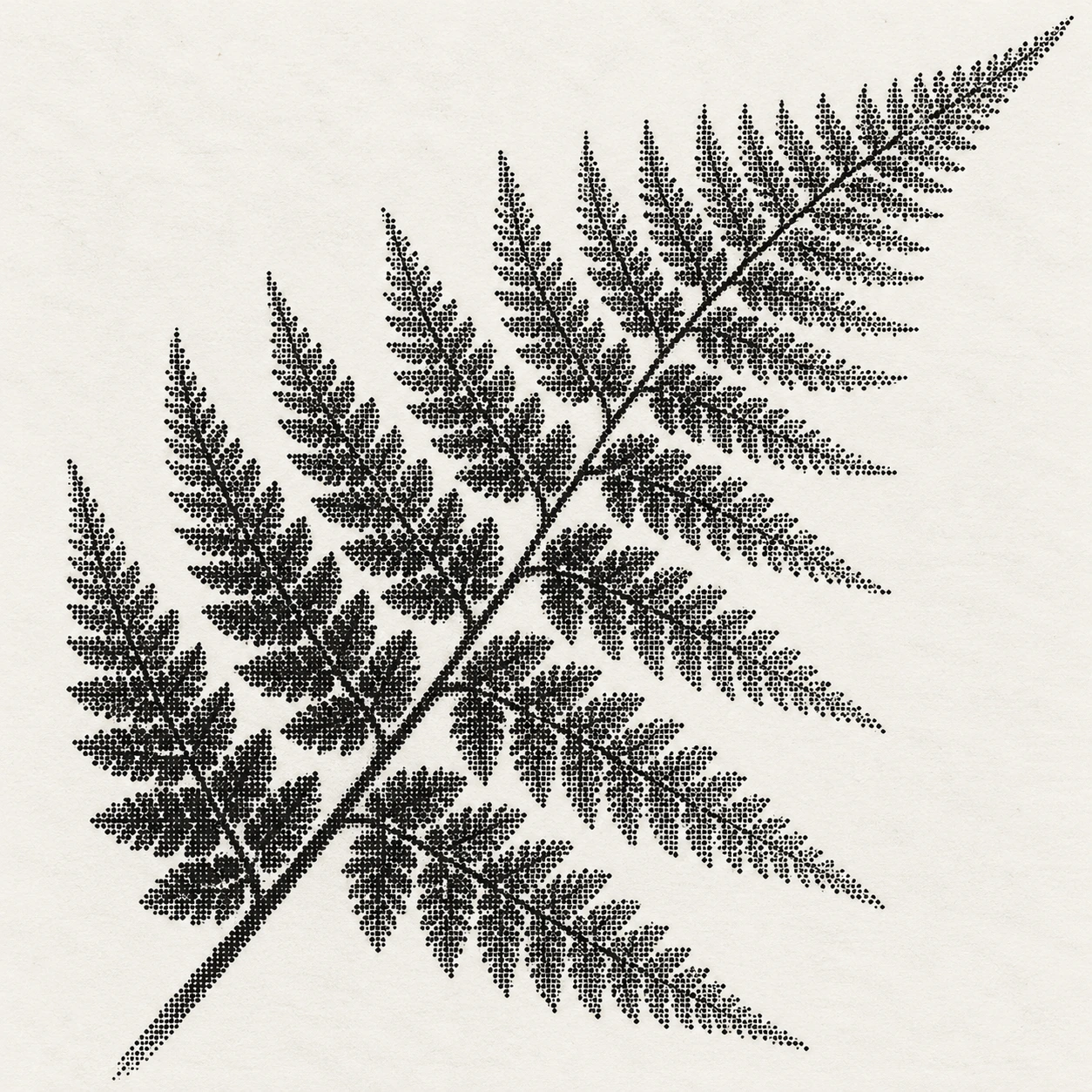
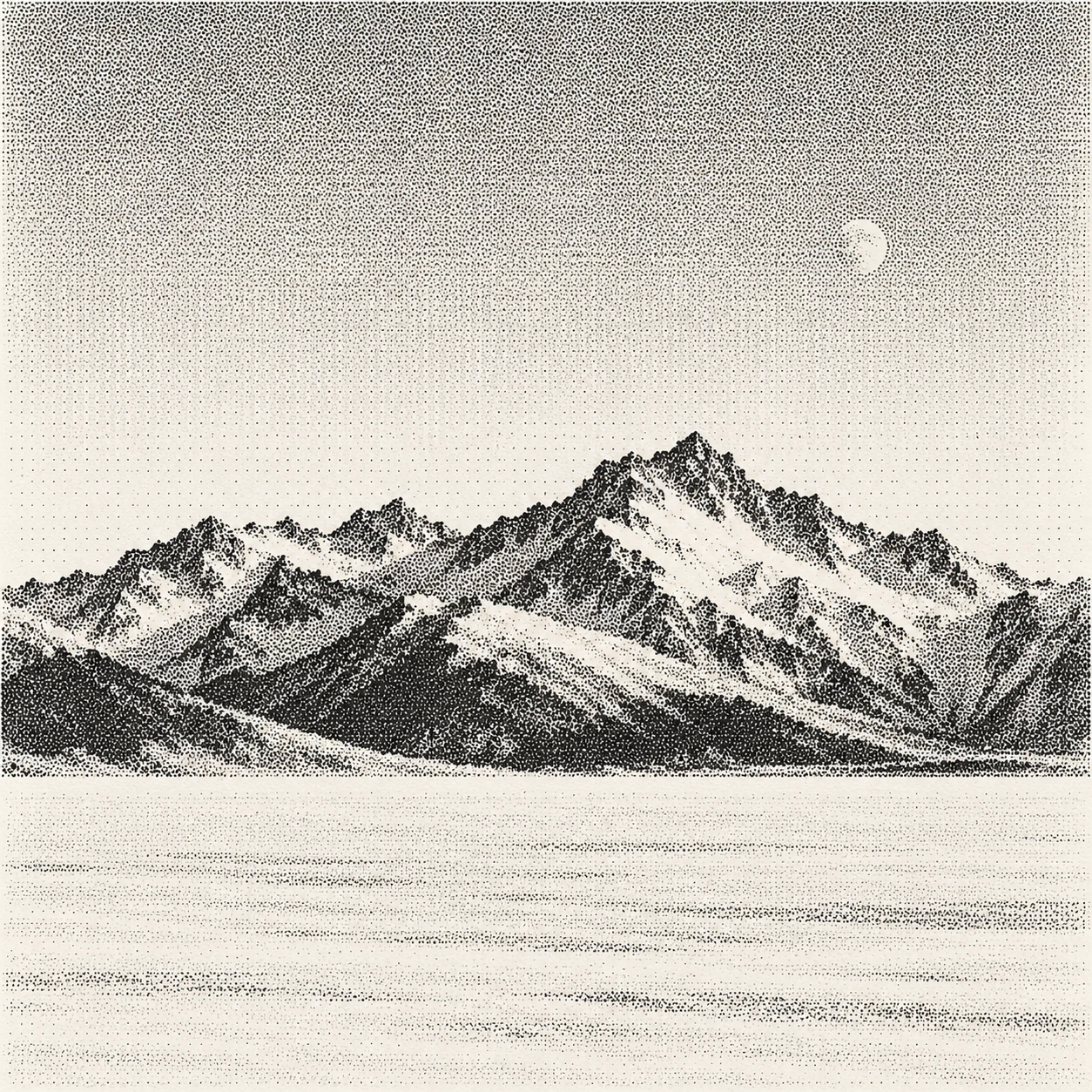
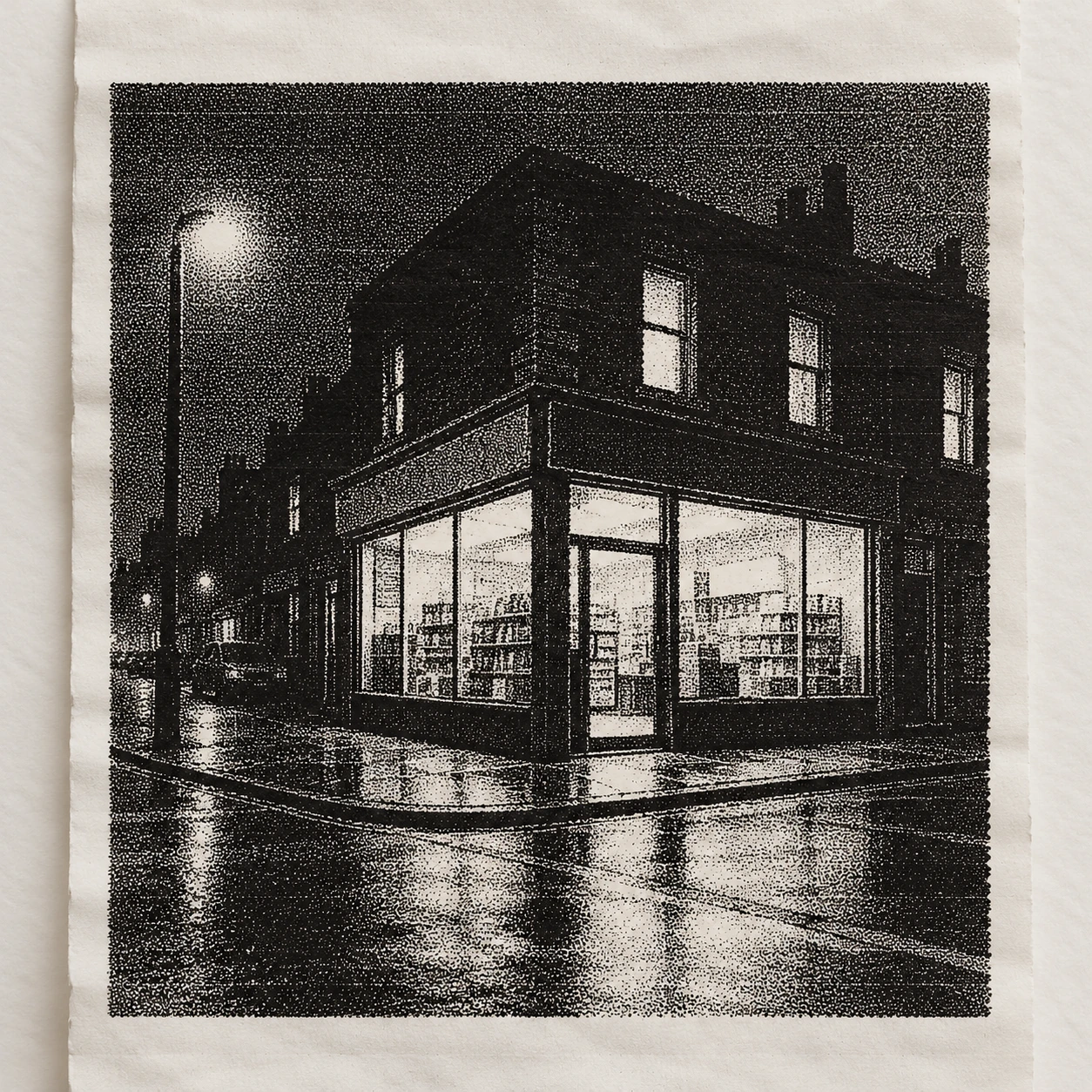
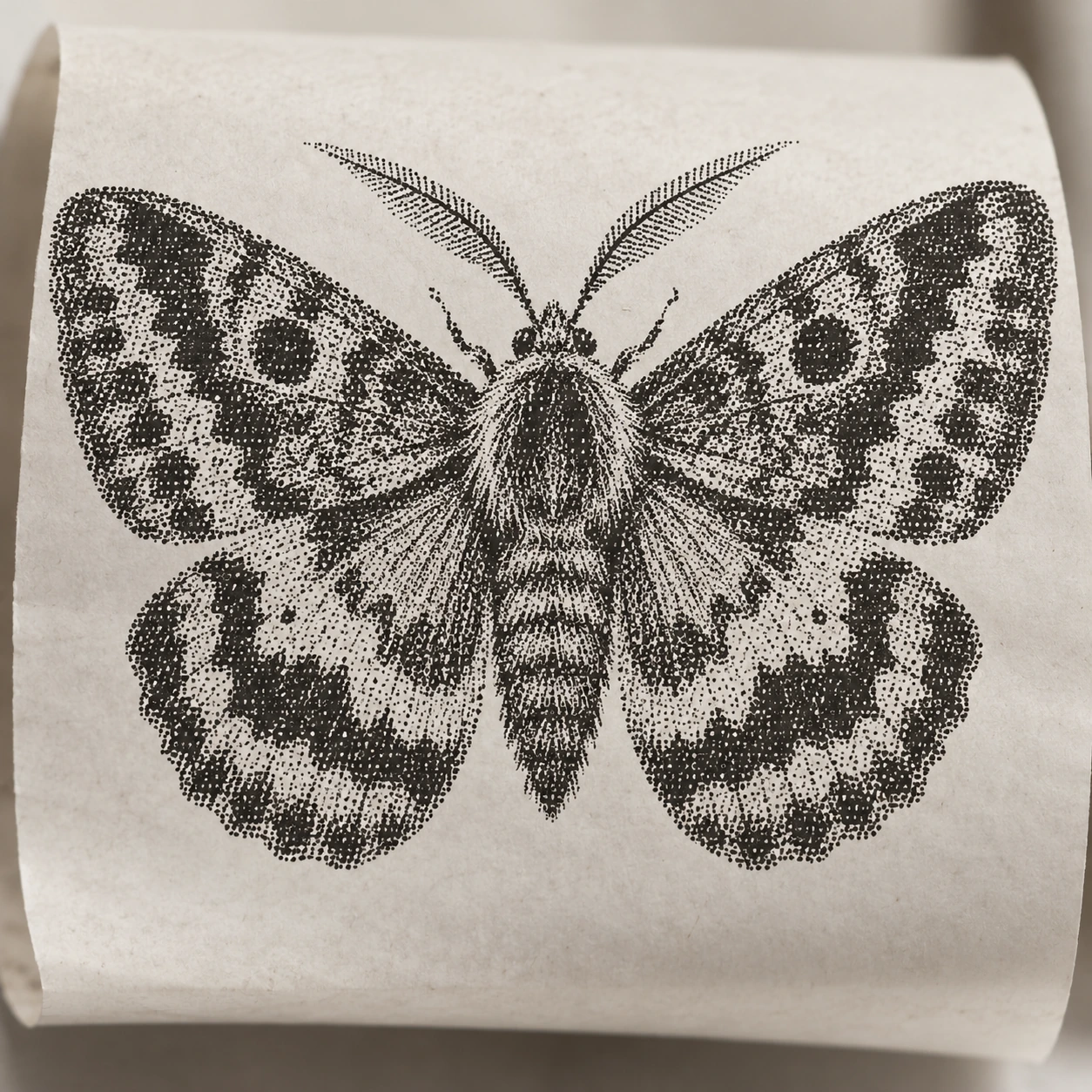
The cup tests a strong silhouette against rising fine marks. The fern tests whether a delicate branching structure survives a restricted palette. The mountain tests broad atmospheric bands. The night shop tests bright windows against a heavy dark mass. The moth tests bilateral structure and intricate pattern without filling every available gap. These are different compositional problems, not five versions of a noise filter.
For an actual printer project, prepare the image for the particular device and paper width, then inspect a physical proof. A generated picture of thermal paper is not printer-ready data. For editorial illustration, zines or a memory-themed cover, the simulated support may be the intended result; label it accordingly and judge it as an image.
A practical revision pass
Shrink the composition until the subject occupies only a few centimetres on screen. If the cup, leaf or shop disappears, simplify the largest shapes first. Then examine the full-size dots for accidental moiré, broken contours and grey sludge. Preserve a clear path through the image. A receipt is already narrow; it should not also be difficult to read.
Finally ask whether the paper contributes something essential. If the image would say exactly the same thing on a large glossy poster, the material reference may be ornamental. Strong Thermal Receipt work makes scale, fragility and concentrated attention part of the meaning. The limitation becomes a compositional tool rather than a costume.
Positive editorial assessment · AI-authored
The strongest Thermal Receipt images make severe limits feel generous. A clean silhouette and a few tonal bands can give a tiny paper strip surprising spatial depth. The cup and fern approaches are especially useful because their vertical rhythms cooperate with the support. Unprinted paper does real descriptive work, allowing a modest image to retain clarity and intimacy.
Negative editorial assessment · AI-authored
The approach becomes a novelty when every subject receives the same scratches, curl and illegible pseudo-text. Excessive noise destroys the very economy that makes the reference interesting. Simplify the value structure, make raster marks follow the depicted surface, and remove transaction-like filler. A convincing image still needs an identifiable subject and a reason for this narrow material.
Neutral editorial assessment · AI-authored
Thermal Receipt is a contemporary illustration treatment informed by a printing technology. It can support small editorial pictures, paper-themed experiments and discussions of temporary records. The generated studies demonstrate visual possibilities; they do not establish device compatibility, material durability or authentic printing history. Physical production requires a separate preparation and proofing workflow.
Pocket-sized facts
Direct thermal and thermal transfer are different processes.
The AOI gallery contains digital interpretations, not physical receipts.
A small poetic detour
Original words from the AOI studio.
Poetry
A Small Receipt for Evening
The cup is black; its steam is mostly space.
A row of dots remembers how to rise.
The paper curls, concealing half a place
too small to need a map, too bright for size.
A window opens in a block of night.
The mountain spends its darkness on a seam.
Between two marks the sheet supplies the light;
the fern borrows the shape of leaving room.
I keep this narrow weather in a book,
no total, no account of what it cost.
It asks for just a second, and a look,
before the little evidence is lost.
The prompt workshop
Original creative exercises. These prompts create new illustrations, not documentary evidence.
Start simple: cup and steam
Create a monochrome thermal-receipt-inspired illustration of one black coffee cup on a narrow warm-white paper strip. Let steam rise as sparse ordered raster dots. Use a clean silhouette, large unprinted margins and one slight paper curl. No purchase text, logos or barcode.
Judge the cup at thumbnail size before admiring the dots.
Build a tiny night street
Design a black-and-white receipt-paper artwork of an imagined corner shop at night. Use pale windows inside a strong black building mass, a few dithered pavement reflections and a narrow vertical composition. Keep the raster marks consistent with the paper surface.
A fictional illustration, not a document of a real transaction.
Experiment: detail without grey
Render a fern frond using only black marks and white paper. Vary dot density to describe overlapping leaves while preserving their silhouettes. Present it as a thermal-print-inspired strip with quiet margins.
For a real device, export and proof separately at its supported resolution.
Your next inspiration
Discover another art style
Follow a visual thread to the next subject.

A smile from the studio
Jokes
The printer’s exhibition proposal
The receipt printer submitted a landscape to the gallery. The curator admired the mountain but asked for a wider horizon.
“I can offer a longer horizon,” said the printer. “Width is a matter for management.”
The curator requested a statement about permanence. The printer suggested they discuss it away from the sunny window.
They finally agreed on a solo exhibition. Every picture would be the same width, visitors could take their time, and the catalogue would be unusually easy to roll up.
At the opening, someone asked whether the work was priceless. The printer replied, “I deliberately left off the total.”
An original fictional studio joke.
Sources and further exploration
Zebra — direct thermal versus thermal transfer; explains the mechanism and environmental limits