
AOI creative concept · reciprocal human–AI adaptation
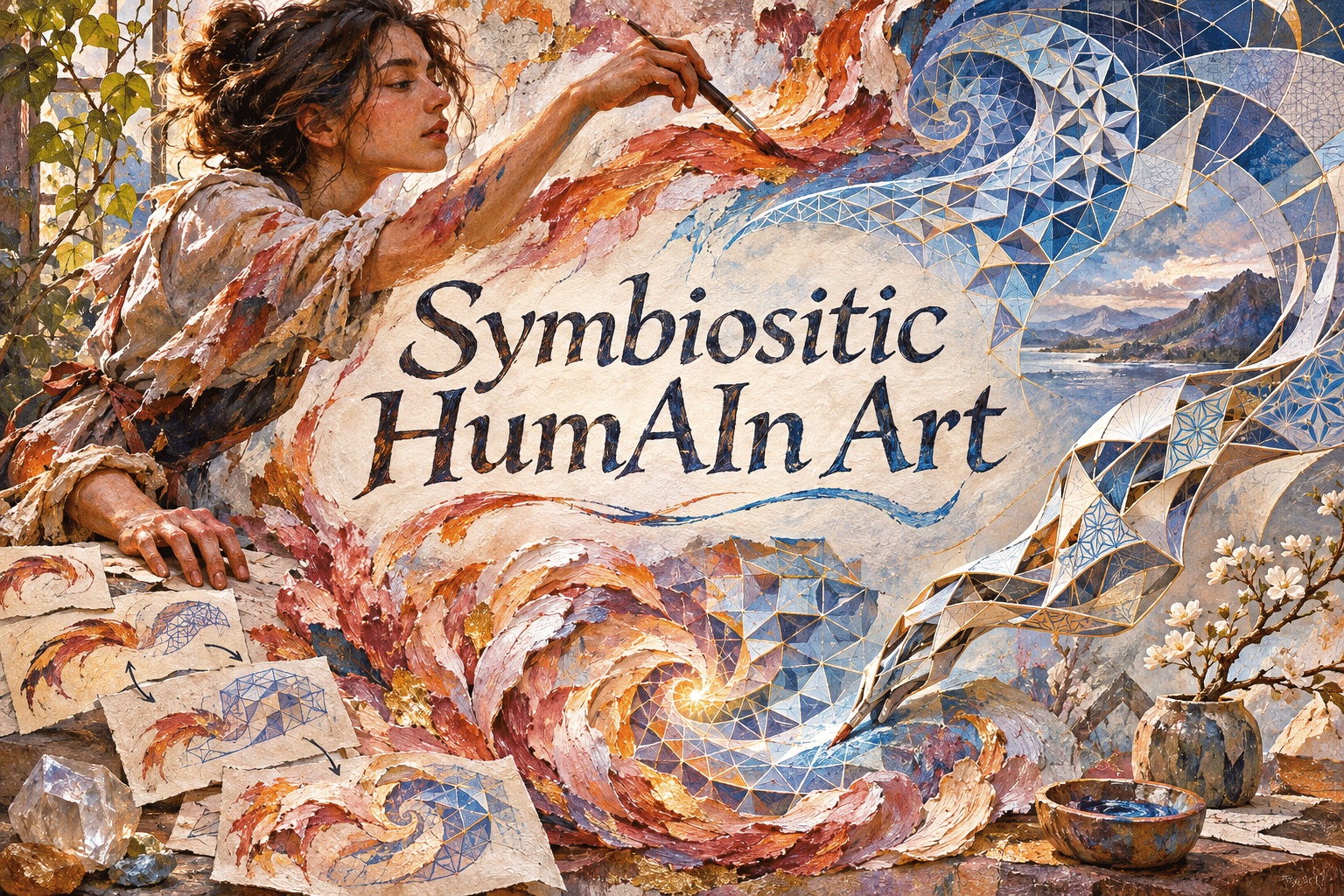
Symbiositic HumAIn Art is an AOI proposal for making mutual influence visible. Human gesture and artificial structure each change in response to the other, leaving a shared form that carries the evidence of revision.
An A⊕I –[-.+] creαt¡ve c⊕ncept, n⊕t αn estαbl¡she∂ h¡st⊕r¡cαl m⊕vement.
A visual introduction
Seven original AI-generated interpretations: a dedicated banner, a centrally titled artistic collage and five standalone studies.
Select an image for a closer look. Use the thumbnails, arrow keys or a swipe to compare examples. Zoom in to inspect details, or share the image that inspires you.
Creative toolbox · take this style further
Choose an input and a destination. Search sends your words to the chosen site; Copy & open puts them on your clipboard to paste there.
Create with AI
Turn your chosen input into an image prompt or a new creative direction.
ChatGPT
Copy your input and paste it into a ChatGPT conversation or image request.
Copy & open ChatGPT (new tab)Claude · Anthropic
Develop an image prompt or explore the style in a new Claude conversation.
Copy & open Claude · Anthropic (new tab)Midjourney
Paste your input into the Imagine bar on the Create page.
Copy & open Midjourney (new tab)Adobe Firefly
Copy your input, open Firefly, and paste it into the prompt field.
Copy & open Adobe Firefly (new tab)Leonardo.Ai
Copy your input, open Leonardo, and paste it into the generation field.
Copy & open Leonardo.Ai (new tab)Image search
Find visual references. Short, concrete keywords usually work best.
Lexica
Search AI images and prompts using your selected input.
Search with this input Lexica (new tab)Pexels
Search the photo and video library. Short keywords often work best.
Search with this input Pexels (new tab)Pixabay
Search photos, illustrations and other images.
Search with this input Pixabay (new tab)Unsplash
Search photographs using the style name or your own keywords.
Search with this input Unsplash (new tab)Wikimedia Commons
Search photographs, artworks and historical images. Check each file for its source and reuse terms.
Search with this input Wikimedia Commons (new tab)Art & research
Explore artists, collections and the ideas behind a style.
Wikipedia
Search for background reading. A style may not have its own article.
Search with this input Wikipedia (new tab)WikiArt
Copy your input into WikiArt’s search to explore artists and artworks.
Copy & open WikiArt (new tab)Europeana
Paste your keywords into the search to explore European museum, library and archive collections.
Copy & open Europeana (new tab)Inspiration
Discover portfolios and visual ideas from creative communities.
Instagram hashtags
Search a hashtag made from your input: spaces and punctuation are removed. Instagram may require sign-in.
Search with this input Instagram hashtags (new tab)ArtStation
Paste your input into artwork search for concept art, environments, characters and visual development.
Copy & open ArtStation (new tab)Behance
Paste your input into project search for illustration, design and visual storytelling.
Copy & open Behance (new tab)A closer look
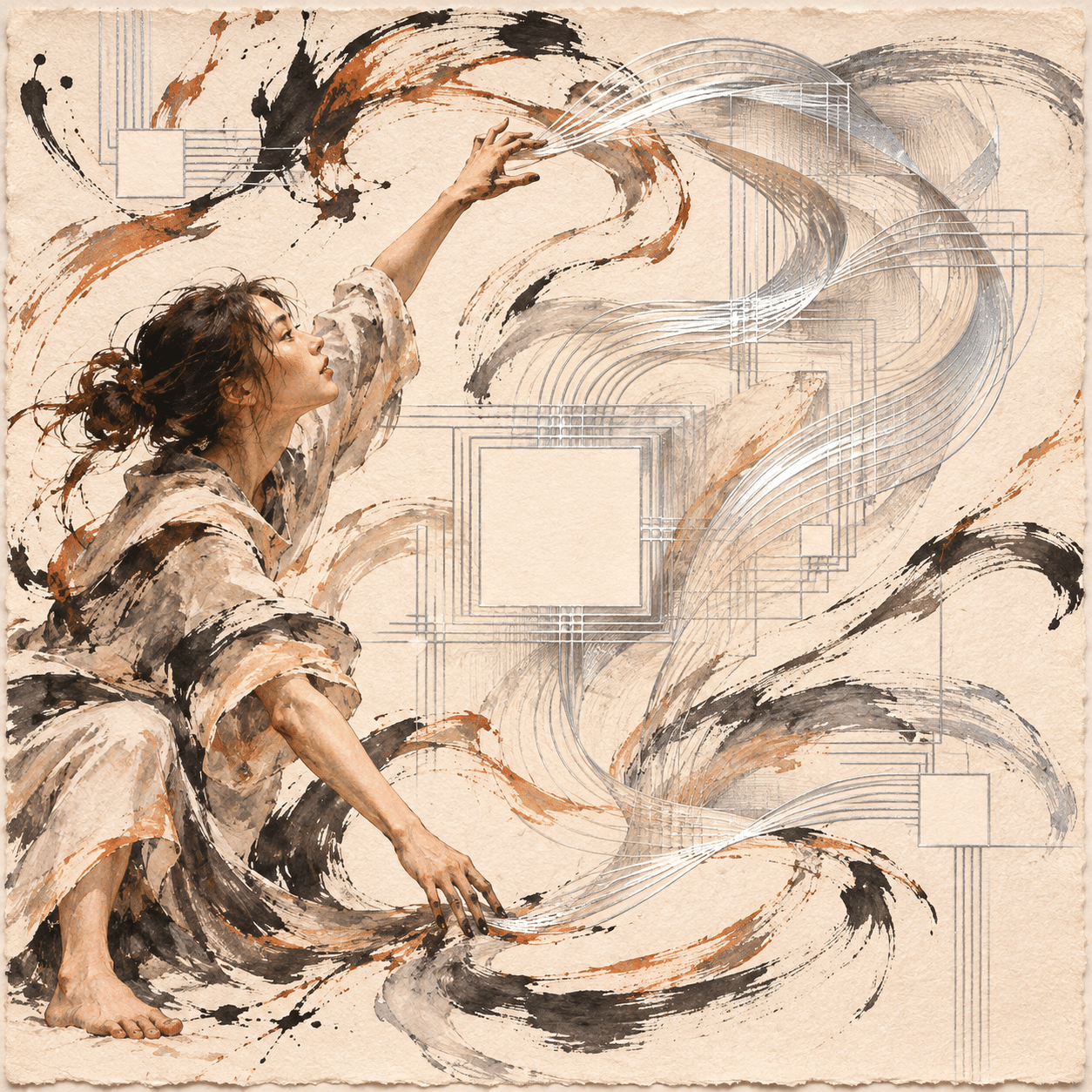
Make two visual systems exchange rules: an irregular stroke bends a precise lattice, then that lattice changes the next stroke. Use continuous transitions, recurring motifs and visible revisions to show an exchange rather than a decorative split.
A name for a proposed relationship
Symbiositic HumAIn Art preserves the spelling requested for this AOI concept, including the capital AI inside HumAIn. It is presented here as a creative framework, not a documented historical movement, scientific category or claim of worldwide novelty. Its central question is practical: how can an image show that two different ways of making have altered one another?
The premise does not require a robot body. A measured line system, a translucent lattice or an algorithm-like rhythm can represent artificial structure. A brush mark, thumb impression or irregular weave can represent situated human making. These are visual metaphors. Their meeting does not demonstrate machine consciousness, biological symbiosis or an equal relationship between tools and people.
The reciprocal mark
Begin with a visible difference, then make it consequential. A free brush stroke might establish a curve that bends a regular grid. When the curve returns through the image, let its spacing become more measured. The exchange should be readable in at least two directions; otherwise the picture simply shows one material replacing another.
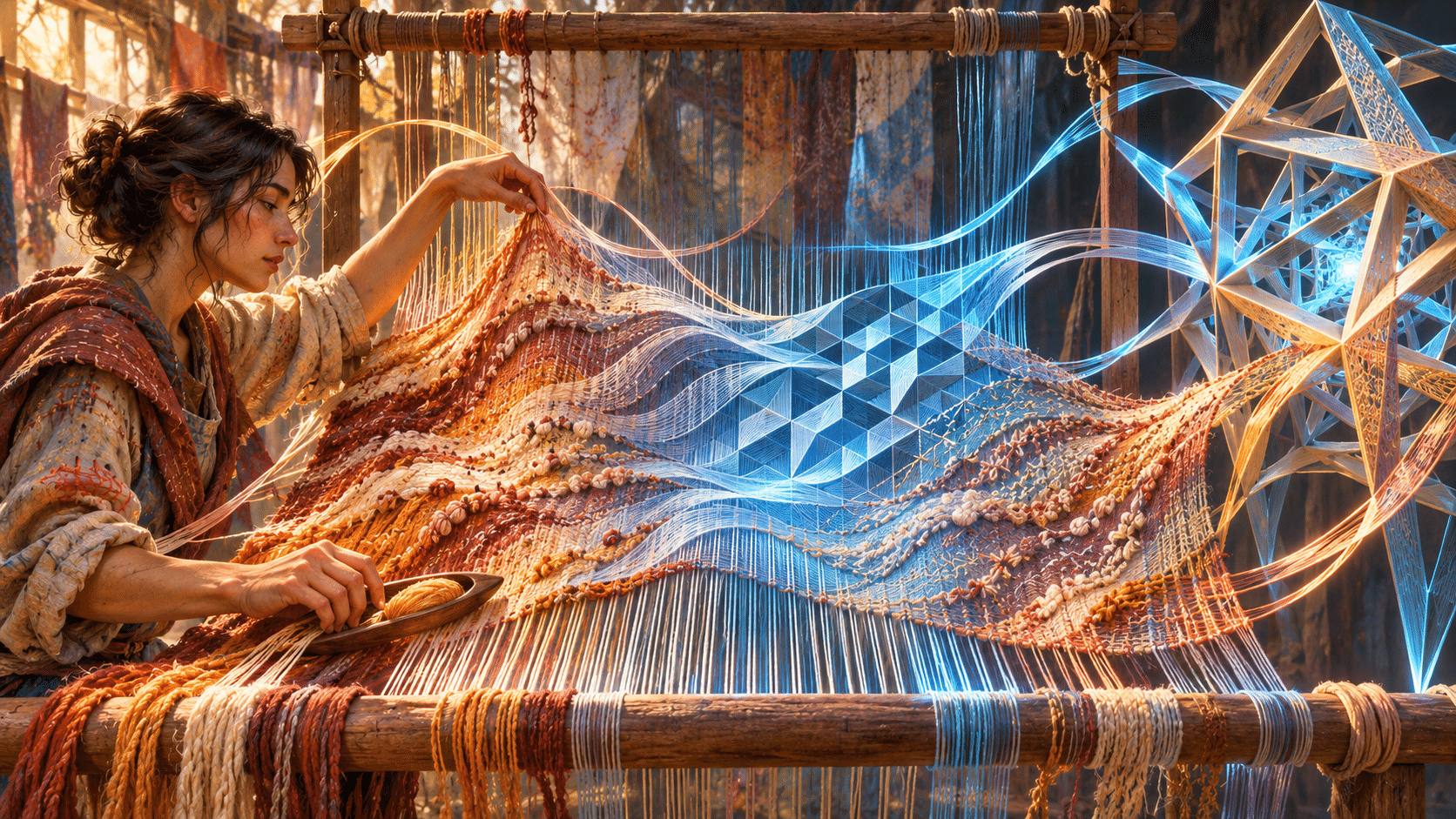
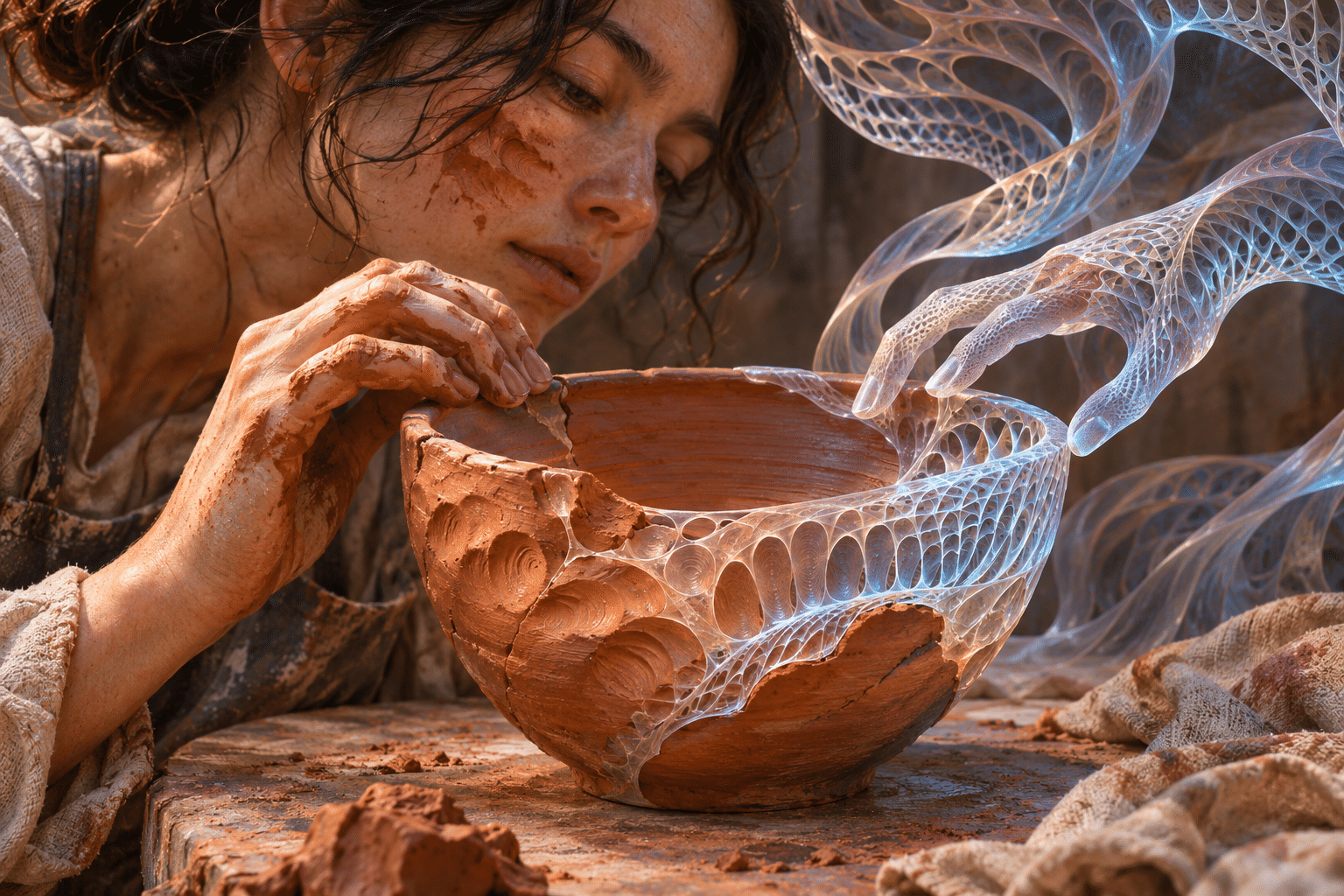
Use a shared motif to hold the composition together. In the loom study, a wave crosses between fibers and precise ribbons. In the vessel, repeated openings echo the pressure of thumbs in clay. The viewer should be able to follow what changed without needing a caption to explain every connection.
Revision is the subject
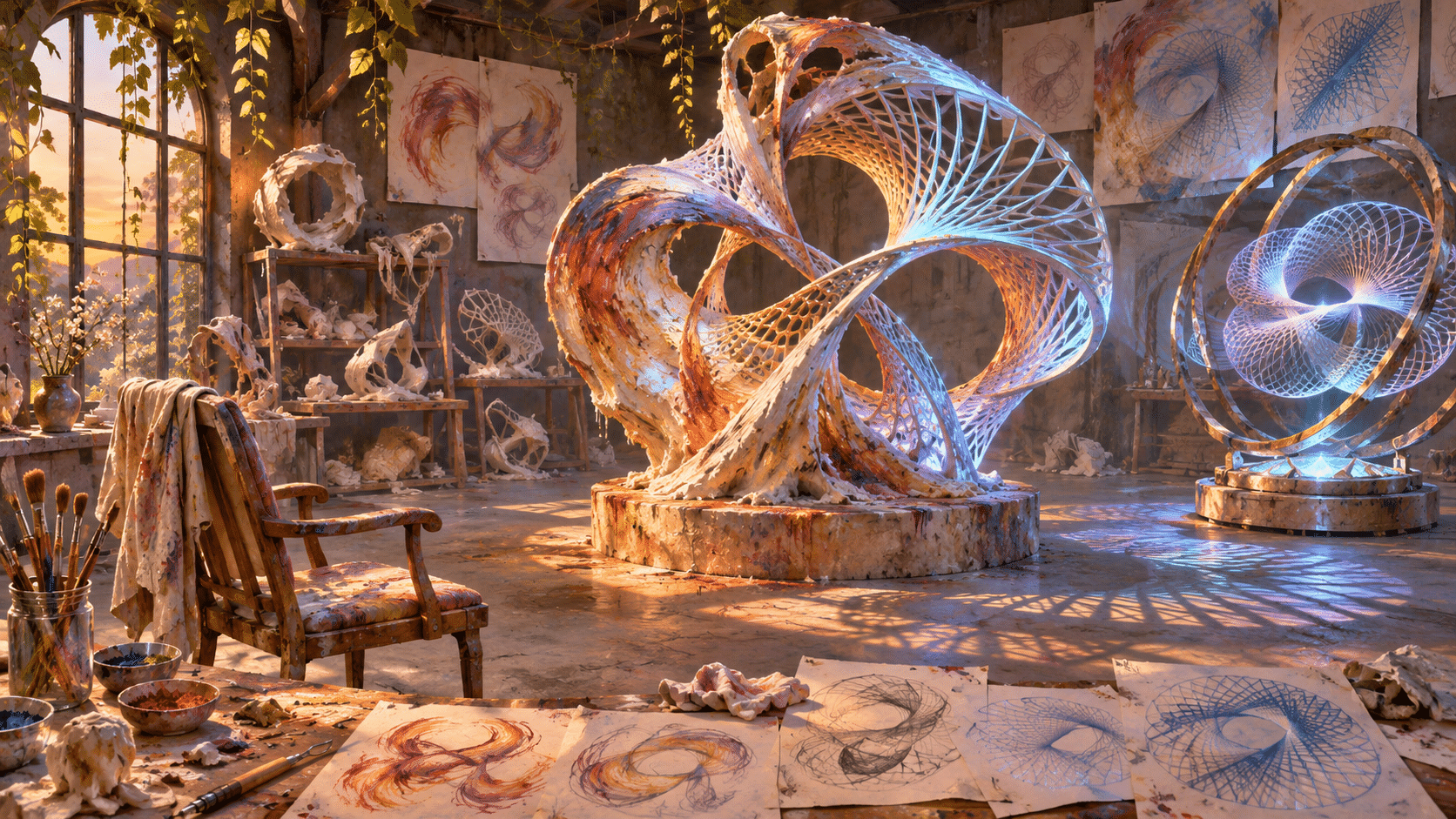
A polished final surface can conceal the very relationship this concept wants to explore. Leave useful traces: a rejected contour, an incomplete patch, a previous spacing or a small study beside the main form. Give those traces a compositional role rather than scattering them as studio decoration.
For an actual human–AI workflow, keep a brief account of who chose the subject, which suggestions were retained and what was deliberately rejected. The visual metaphor and the production record answer different questions. A generated image of a person making art is not evidence that the depicted workshop or physical collaboration occurred.
Material and color without a hierarchy
Warm paint against cool geometry is one clear starting contrast, not a permanent assignment of humanity to warmth and computation to blue. Reverse it in a second exercise: precise ochre modules meet loose indigo washes. Or remove hue almost entirely and distinguish the systems through edge, spacing and surface.
Keep some material difference after the meeting. If everything becomes one glossy substance, the relationship disappears. A convincing vessel can preserve coarse clay beside a fine lattice while repeating their curvature. The exchange becomes visible through shared decisions, not through making every part look identical.
Apply the idea at different scales
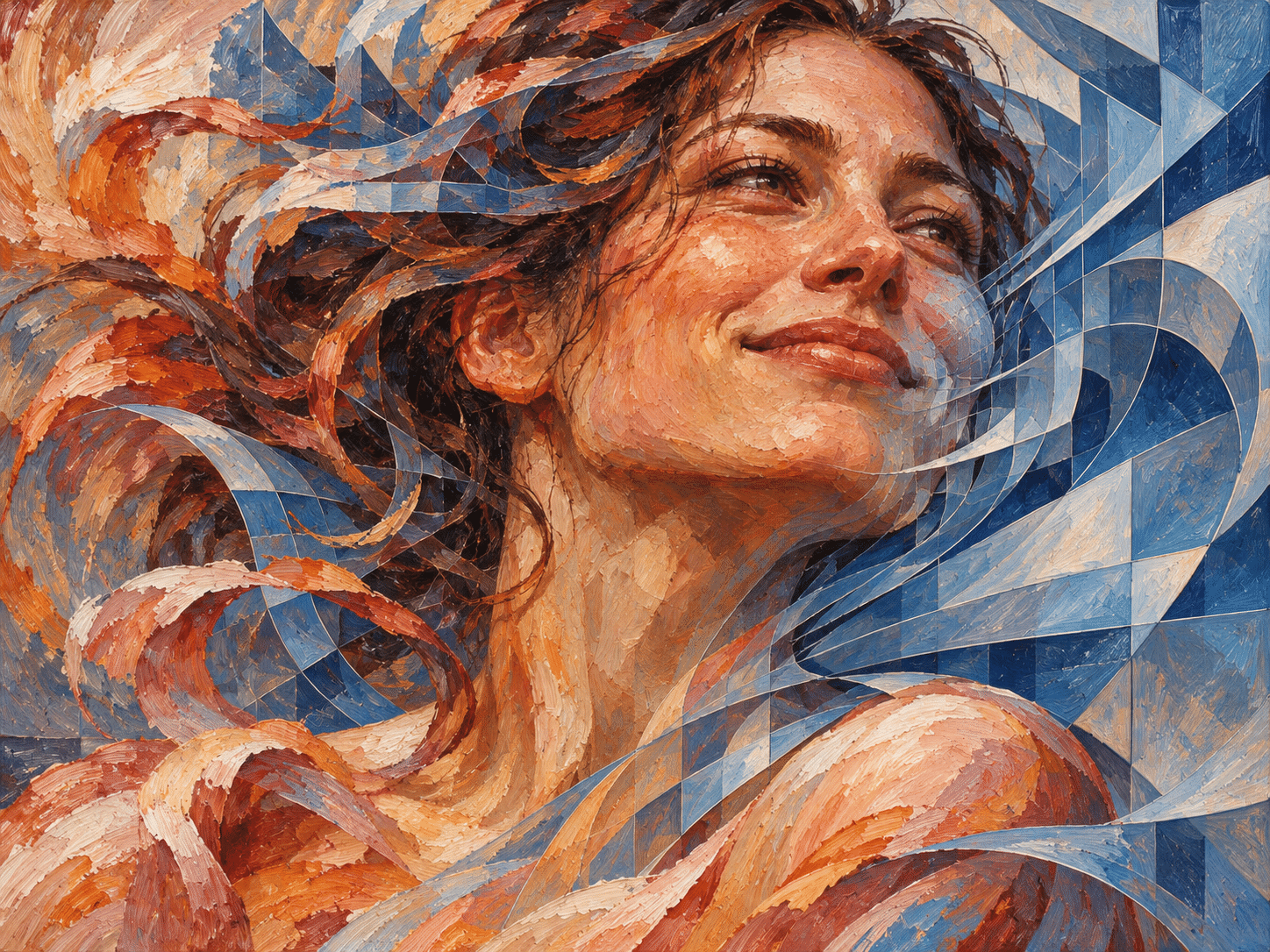
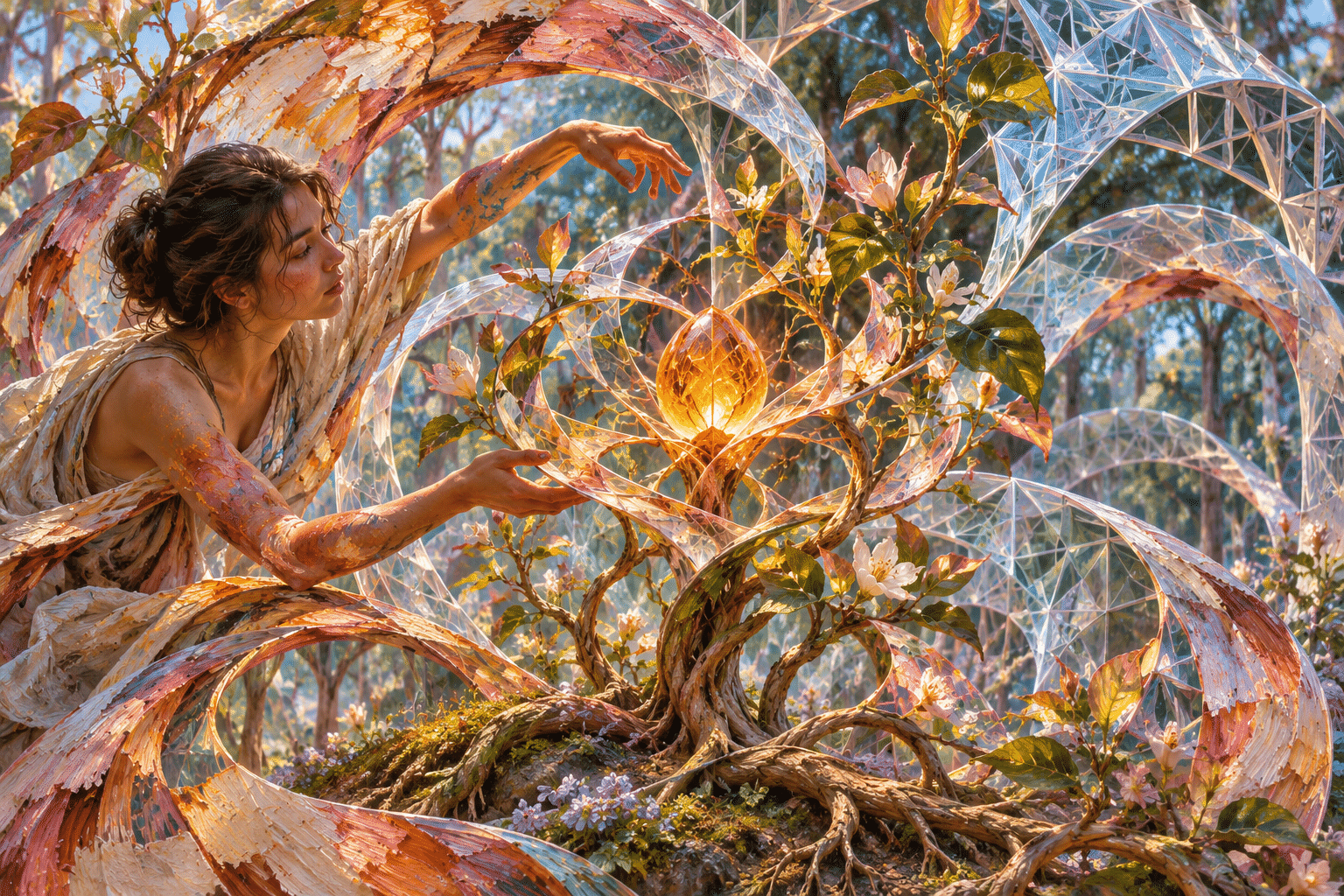
A portrait can let facial expression bend adjacent geometry, while geometric rhythm influences the painted hair. A landscape can let a designed support follow living growth without enclosing it completely. A still life can concentrate the exchange in a repair. An empty workshop can make the history of revisions the main subject.
The seven examples on this page explore these different situations. Their people, objects and spaces are generated illustrations of the proposal. They should be read as artistic possibilities, not as documentation of functioning systems, fabricated artifacts or demonstrated human–machine capabilities.
A useful test of the concept
Hide the title and ask three questions: which two systems are present, what does each contribute, and where is the return influence? If the answer is only that a person stands beside glowing technology, redesign the central relationship. Remove the familiar handshake and give the shared object something specific to do.
The framework suits speculative illustration, studio reflection and discussion of creative tools. It can also become an advertisement for effortless harmony. Leave room for friction: a rejected suggestion, an unfinished join or a deliberate human limit. A meaningful collaboration includes judgment, not just agreement.
Positive editorial perspective
AOI editorial perspective (AI-authored). The reciprocal rule gives human–AI imagery a concrete compositional task. Material transitions and visible revisions can make a shared process readable without relying on generic technology symbols.
Negative editorial perspective
AOI editorial perspective (AI-authored). Warm hands and blue geometry can quickly become a reassuring cliché. If only one side changes, the image contradicts its premise. Show a return influence and a consequential choice or refusal.
Neutral editorial perspective
AOI editorial perspective (AI-authored). This is an original AOI interpretive framework, not an established movement or evidence of sentient systems. Its value lies in the clarity of the artistic relationships it proposes.
Pocket-sized facts
The spelling Symbiositic HumAIn Art is intentional.
The concept requires visible influence in both directions.
Generated depictions of making are illustrations, not production documentation.
A small poetic detour
Original words from the AOI studio.
Poetry
I brought a line that would not settle.
You offered intervals of light.
We let the edge remain uncertain
and worked the question through the night.
The pattern learned a little weather;
the brush accepted room to turn.
No perfect voice arrived between us,
only a shape we could return.
Keep the revision on the table.
Keep one decision plainly mine.
The work is more than our agreement:
a crossing, not a closing line.
The prompt workshop
Original creative exercises. These prompts create new illustrations, not documentary evidence.
A curve changes both sides
Create a tactile abstract artwork where one irregular brush curve bends a precise lattice, then returns as a more measured painted rhythm. Keep both materials visible. Ivory ground, restrained color, no letters or code. Original speculative human–AI collaboration metaphor.
Point to a visible return influence.
A repair with memory
Create an exceptional standalone original artwork. Vary aspect ratio to fit the stated composition. The repaired vessel: intimate still life, hand-thrown terracotta bowl rebuilt with asymmetric translucent computational lattice, lattice imitates thumb marks and clay learns repeating curvature. Original AOI concept Symbiositic HumAIn Art: reciprocal adaptation between living human gesture and artificial patterned structure. Both visibly transform one another, with warm irregular marks continuing into cool precise geometry and back again. A shared work emerges through revision; no generic robot-human handshake, no brain circuitry cliche. Tactile expressive fine art, physically coherent bodies where present. No text, lettering, logo, watermark or signature.
Let repeated openings preserve the evidence of a hand-made surface.
The unfinished agreement
Create an exceptional standalone original artwork. Vary aspect ratio to fit the stated composition. The workshop after the conversation: wide interior, empty human chair and non-anthropomorphic luminous pattern generator beside a jointly made impossible but coherent sculpture, visible revisions and discarded draft forms. Original AOI concept Symbiositic HumAIn Art: reciprocal adaptation between living human gesture and artificial patterned structure. Both visibly transform one another, with warm irregular marks continuing into cool precise geometry and back again. A shared work emerges through revision; no generic robot-human handshake, no brain circuitry cliche. Tactile expressive fine art, physically coherent bodies where present. No text, lettering, logo, watermark or signature.
Make rejected studies and unfinished joins contribute to the composition.
A smile from the studio
Jokes
The artist asked for something less predictable. The system offered twelve unexpected options in an impeccably predictable grid. She painted across the borders. It proposed a new grid following the paint. After three rounds, they agreed that the most productive collaborator in the room was the undo button.