
Historical abstract art movement
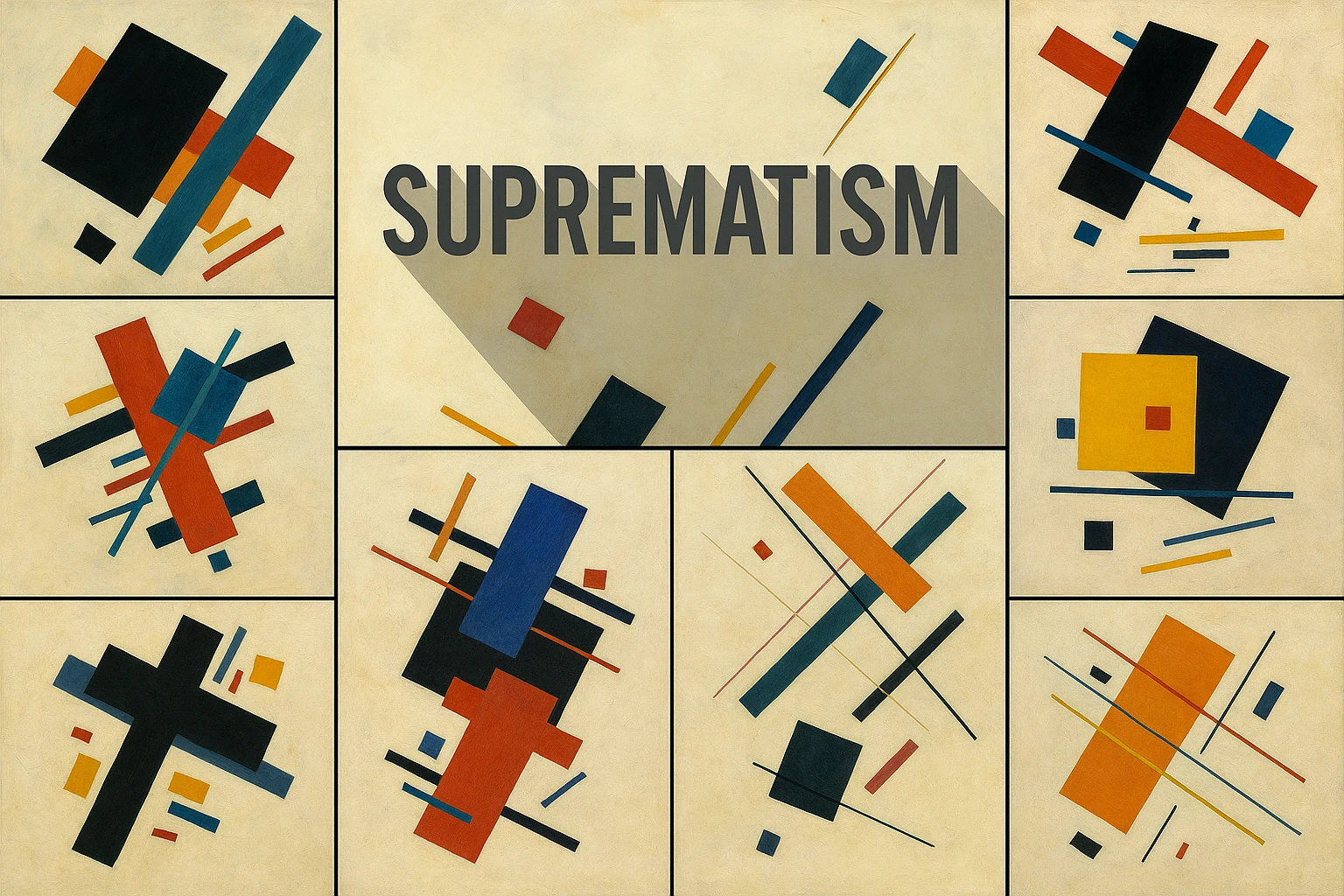
Suprematism is a movement in abstract art developed by Kazimir Malevich. It places nonrepresentational geometric forms and colour relationships at the centre of the painting, freeing them from the task of describing recognizable objects.
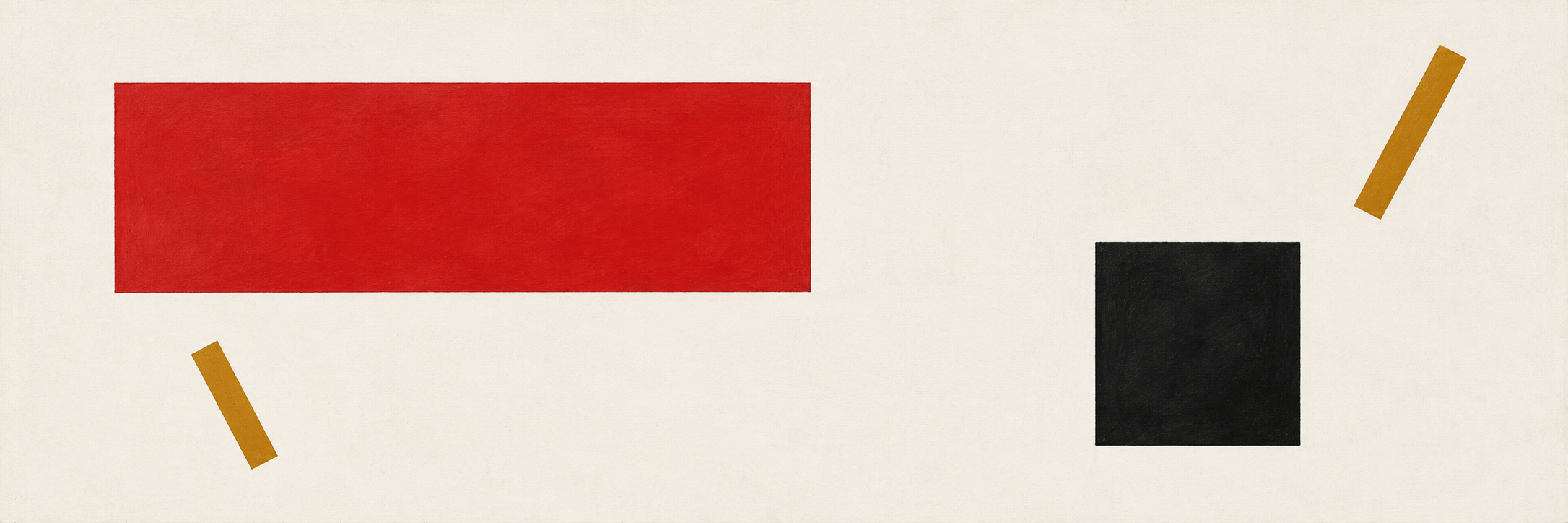
A visual introduction
Select an image for a closer look. Use the thumbnails, arrow keys or a swipe to compare examples. Zoom in to inspect details, or share the image that inspires you.
Creative toolbox · take this style further
Choose an input and a destination. Search sends your words to the chosen site; Copy & open puts them on your clipboard to paste there.
Create with AI
Turn your chosen input into an image prompt or a new creative direction.
ChatGPT
Copy your input and paste it into a ChatGPT conversation or image request.
Copy & open ChatGPT (new tab)Claude · Anthropic
Develop an image prompt or explore the style in a new Claude conversation.
Copy & open Claude · Anthropic (new tab)Midjourney
Paste your input into the Imagine bar on the Create page.
Copy & open Midjourney (new tab)Adobe Firefly
Copy your input, open Firefly, and paste it into the prompt field.
Copy & open Adobe Firefly (new tab)Leonardo.Ai
Copy your input, open Leonardo, and paste it into the generation field.
Copy & open Leonardo.Ai (new tab)Image search
Find visual references. Short, concrete keywords usually work best.
Lexica
Search AI images and prompts using your selected input.
Search with this input Lexica (new tab)Pexels
Search the photo and video library. Short keywords often work best.
Search with this input Pexels (new tab)Pixabay
Search photos, illustrations and other images.
Search with this input Pixabay (new tab)Unsplash
Search photographs using the style name or your own keywords.
Search with this input Unsplash (new tab)Wikimedia Commons
Search photographs, artworks and historical images. Check each file for its source and reuse terms.
Search with this input Wikimedia Commons (new tab)Art & research
Explore artists, collections and the ideas behind a style.
Wikipedia
Search for background reading. A style may not have its own article.
Search with this input Wikipedia (new tab)WikiArt
Copy your input into WikiArt’s search to explore artists and artworks.
Copy & open WikiArt (new tab)Europeana
Paste your keywords into the search to explore European museum, library and archive collections.
Copy & open Europeana (new tab)Inspiration
Discover portfolios and visual ideas from creative communities.
Instagram hashtags
Search a hashtag made from your input: spaces and punctuation are removed. Instagram may require sign-in.
Search with this input Instagram hashtags (new tab)ArtStation
Paste your input into artwork search for concept art, environments, characters and visual development.
Copy & open ArtStation (new tab)Behance
Paste your input into project search for illustration, design and visual storytelling.
Copy & open Behance (new tab)A closer look
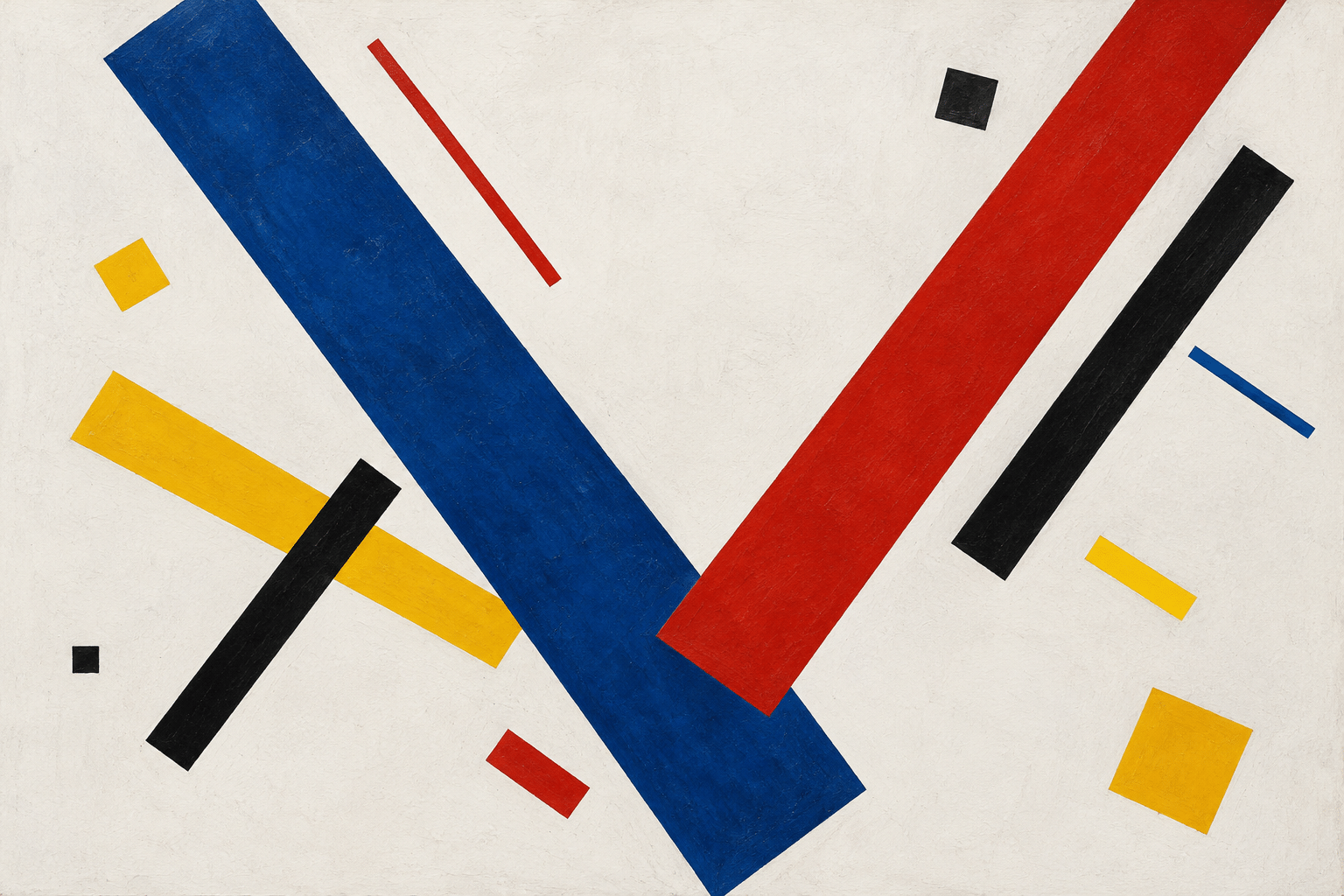
Squares, rectangles, circles and oblique elements appear to float, balance or move within open fields, often against white.
An idea beyond the recognizable object
MoMA identifies Suprematism as a term Malevich coined in 1915 for an abstract approach that rejected deliberate representational illusion. Its emphasis was on feeling and perception through painting itself. Geometric forms on white backgrounds were part of this ambition, rather than simply a reduced decorative vocabulary.
This historical purpose matters. A contemporary arrangement of squares can borrow its appearance without sharing its philosophical project. Describe a new work as Suprematism-inspired when that is what it is. Geometry alone does not make every logo, diagram or minimalist interior an example of the movement.
The interval is an active element
Look first at the space between forms. A small gap can produce tension; a wide interval can make a shape seem isolated or suspended. The surrounding field is not merely unused background. It changes the apparent weight, speed and direction of each element.
Try moving one rectangle a small distance while leaving all other forms unchanged. The whole composition can shift from stable to precarious. This is why an apparently simple image deserves careful attention: reducing the number of elements makes their relationships more exposed.
Balance without a conventional horizon
A shape can suggest movement through its angle, proportion and position. Several diagonals may establish a shared direction, while a short horizontal element interrupts it. Avoid adding a floor, cast shadow or photographic perspective merely to make the forms understandable. Those devices can restore the object-world the experiment is trying to leave behind.
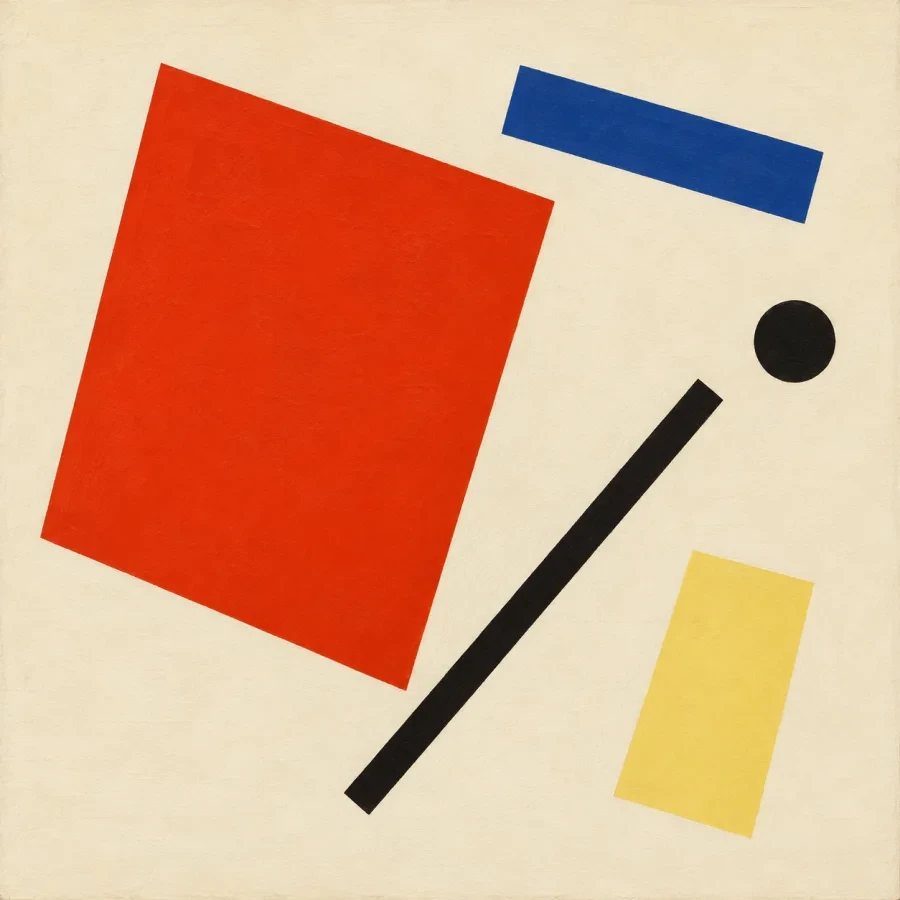
Asymmetry does not mean arbitrary placement. Compare the weight of a large pale area with a small dark one, or a broad rectangle with several thin bars. The goal is an intentional relationship that remains compelling even when the viewer cannot name a depicted subject.
Colour and surface carry meaning
Use a restrained palette to make comparisons easier. Red against black and white offers one kind of tension; near-white forms on a pale ground ask for slower looking. Small differences in tone or surface can become significant when familiar subject matter is absent.
Do not assume every historically related work must use identical hard edges or a digital finish. A painting has a material surface. The generated studies retain a modest painted texture so that the shapes feel like pictorial decisions rather than a collection of interface icons.
Explore without forging a historical work
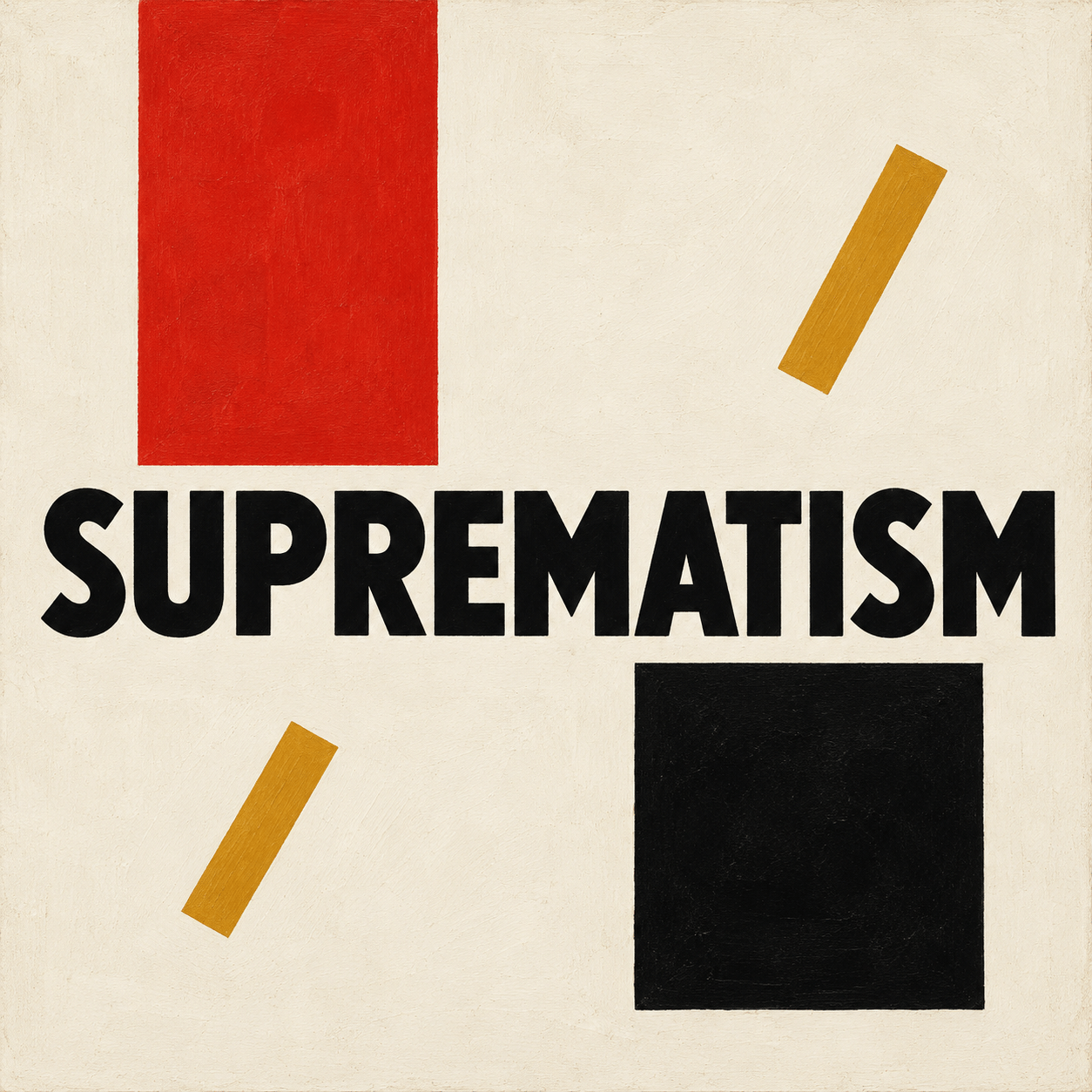
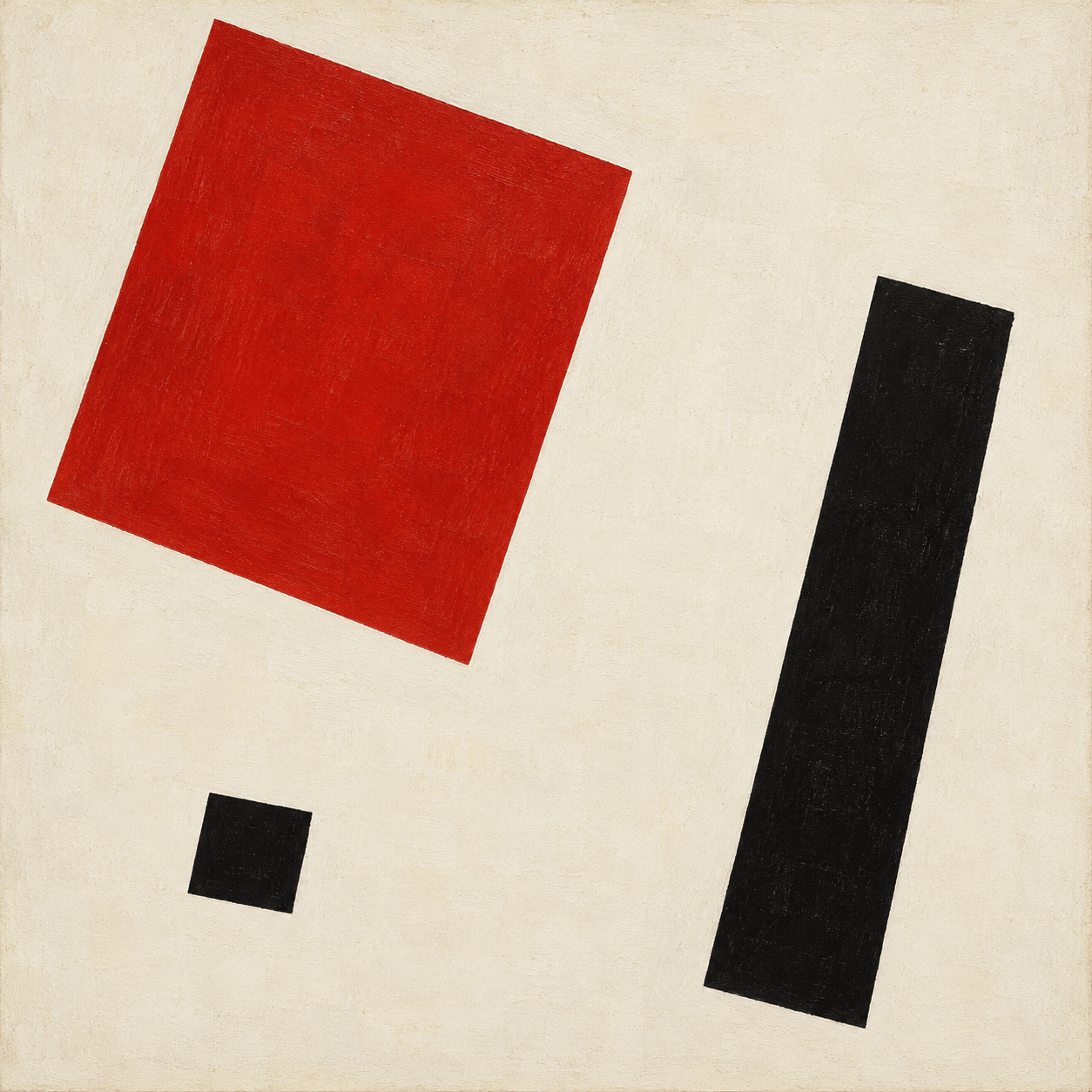
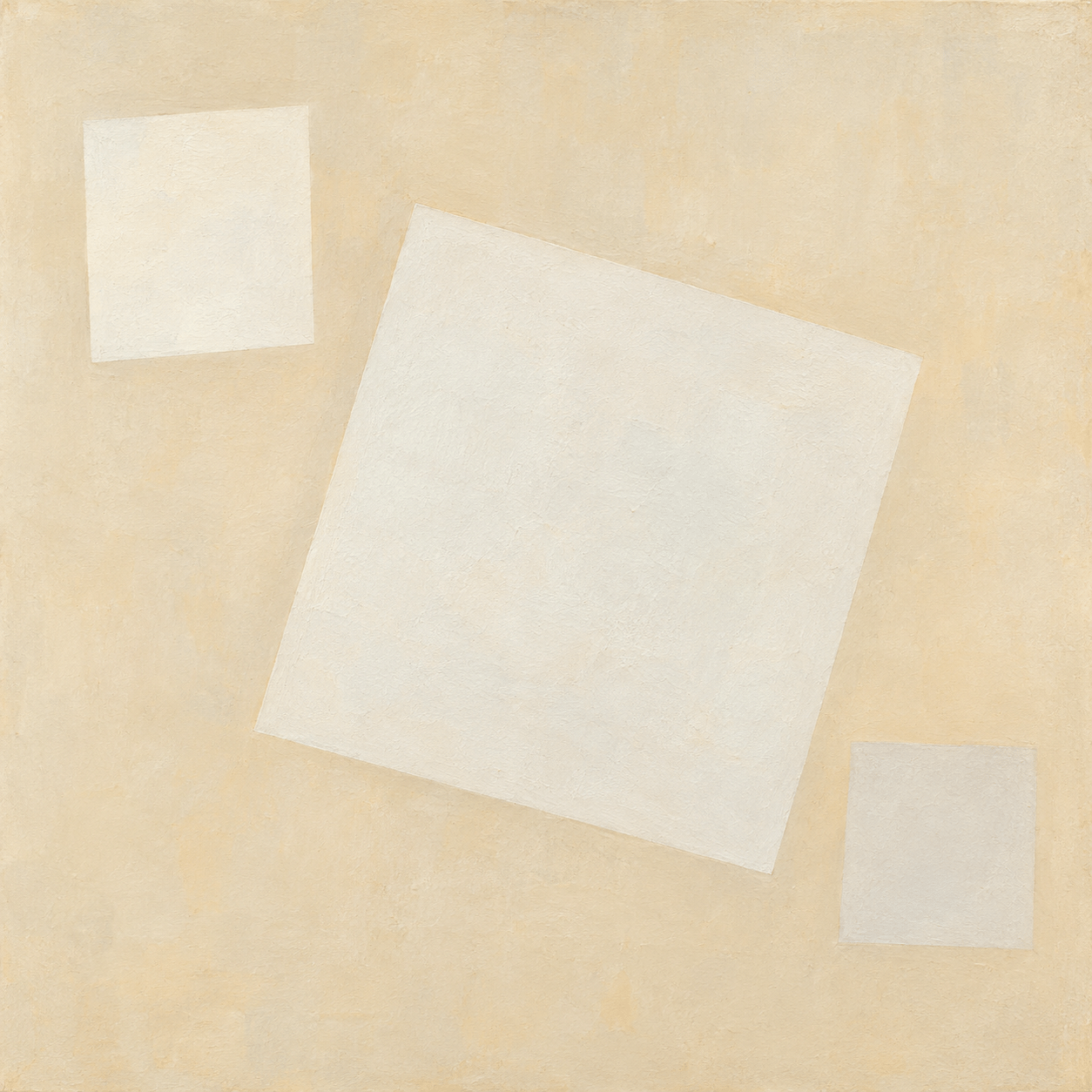
The new gallery offers a red-and-black balance, a near-white composition and a field of coloured diagonals. These are original AI-generated interpretations. They are not works by Malevich, reconstructions of lost paintings or evidence of physical paint on canvas.
For practice, choose only three shapes and two colours, then make several small arrangements. Change spacing, rotation or scale one at a time. Select the version with the clearest internal tension rather than the greatest number of elements. Compare it with actual collection works through the linked museum source to understand both the connection and the distance.
A small poetic detour
Original words from the AOI studio.
Poetry
An Interval
A red plane pauses in the white;
a black bar answers from afar.
No road explains the space between,
no window tells us where we are.
The distance holds its own reply—
a room without a roof or sky.
The prompt workshop
Original creative exercises. These prompts create new illustrations, not documentary evidence.
Three shapes in space
Create an original Suprematism-inspired composition with three unequal red and black geometric forms on an open warm-white field. Deliberate asymmetrical balance, no objects or cast shadows.
Near-white differences
Create a restrained Suprematism-inspired study of subtly different near-white planes on a pale field. Make angle, spacing and fine painted texture carry the composition.
Directional colour
Create an original abstract composition of a few coloured diagonals and quiet intervals, inspired by Suprematist spatial relationships. Avoid copying a historical painting or adding a horizon.
A smile from the studio
Jokes
The rectangle declined to pose as a building. It had enough work simply being there.
Sources and further exploration
MoMA — Malevich’s 1915 term, nonrepresentational aims and collection examples