
Contemporary Japanese art concept and curatorial framework
Explore Superflat, Takashi Murakami’s concept linking flat visual space and Japanese popular culture, with original prompts for pattern, contour and color.
A visual introduction
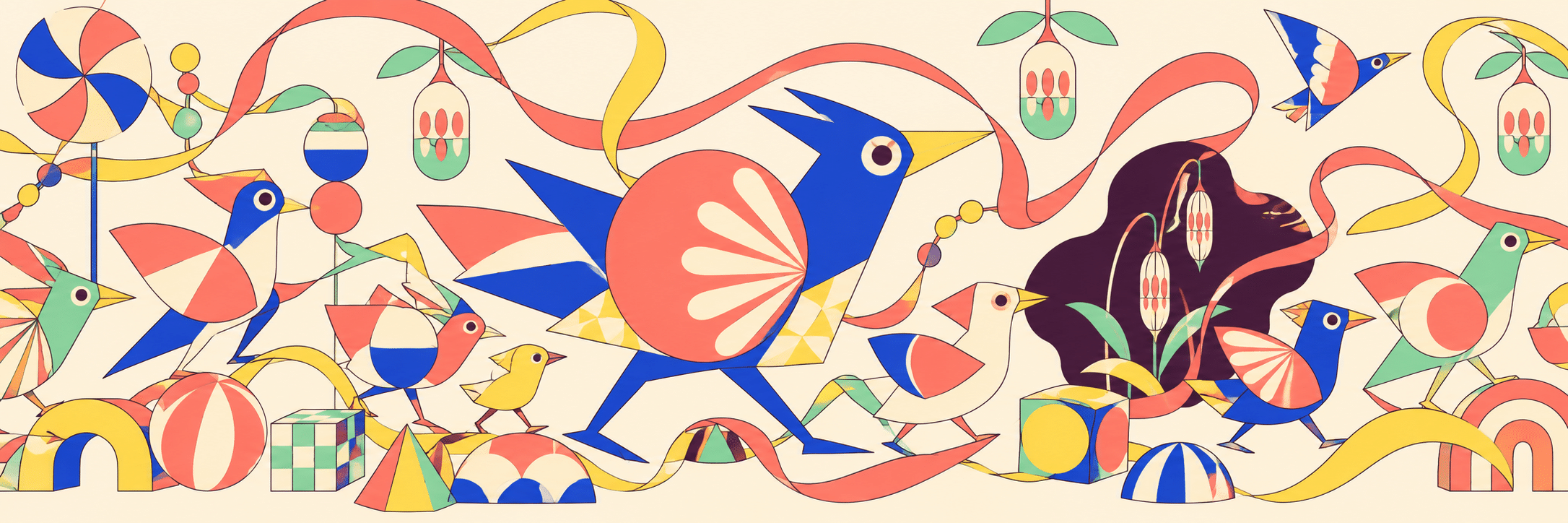
Five original AOI studies explore character circulation, pattern, empty space and flattened landscape. The documented artworks discussed below are linked to their institutions and are not reproduced in this gallery.
Select an image for a closer look. Use the thumbnails, arrow keys or a swipe to compare examples. Zoom in to inspect details, or share the image that inspires you.

Creative toolbox · take this style further
Choose an input and a destination. Search sends your words to the chosen site; Copy & open puts them on your clipboard to paste there.
Create with AI
Turn your chosen input into an image prompt or a new creative direction.
ChatGPT
Copy your input and paste it into a ChatGPT conversation or image request.
Copy & open ChatGPT (new tab)Claude · Anthropic
Develop an image prompt or explore the style in a new Claude conversation.
Copy & open Claude · Anthropic (new tab)Midjourney
Paste your input into the Imagine bar on the Create page.
Copy & open Midjourney (new tab)Adobe Firefly
Copy your input, open Firefly, and paste it into the prompt field.
Copy & open Adobe Firefly (new tab)Leonardo.Ai
Copy your input, open Leonardo, and paste it into the generation field.
Copy & open Leonardo.Ai (new tab)Image search
Find visual references. Short, concrete keywords usually work best.
Lexica
Search AI images and prompts using your selected input.
Search with this input Lexica (new tab)Pexels
Search the photo and video library. Short keywords often work best.
Search with this input Pexels (new tab)Pixabay
Search photos, illustrations and other images.
Search with this input Pixabay (new tab)Unsplash
Search photographs using the style name or your own keywords.
Search with this input Unsplash (new tab)Wikimedia Commons
Search photographs, artworks and historical images. Check each file for its source and reuse terms.
Search with this input Wikimedia Commons (new tab)Art & research
Explore artists, collections and the ideas behind a style.
Wikipedia
Search for background reading. A style may not have its own article.
Search with this input Wikipedia (new tab)WikiArt
Copy your input into WikiArt’s search to explore artists and artworks.
Copy & open WikiArt (new tab)Europeana
Paste your keywords into the search to explore European museum, library and archive collections.
Copy & open Europeana (new tab)Inspiration
Discover portfolios and visual ideas from creative communities.
Instagram hashtags
Search a hashtag made from your input: spaces and punctuation are removed. Instagram may require sign-in.
Search with this input Instagram hashtags (new tab)ArtStation
Paste your input into artwork search for concept art, environments, characters and visual development.
Copy & open ArtStation (new tab)Behance
Paste your input into project search for illustration, design and visual storytelling.
Copy & open Behance (new tab)A closer look
Crisp contours, shallow overlaps, saturated color fields and changes of scale keep attention moving across the surface. Repeated motifs can behave like characters or signs; a quiet interval can disturb an otherwise crowded, cheerful pattern.
What Superflat names
Superflat is associated with Takashi Murakami’s articulated concept and related exhibitions and work. It is more specific than any smooth digital illustration with bright colors. Its use of flatness can concern visual form as well as relationships between different categories of culture. Individual works require context, and the concept should not be treated as a complete explanation of Japanese contemporary art.
Murakami’s 2000 essay A Theory of Super Flat Japanese Art proposed connections between earlier Japanese pictorial practices and contemporary animation. MOCA’s Superflat exhibition in 2001 presented nineteen artists across painting, photography, animation, fashion, sculpture and other media. The museum describes an argument developed by Murakami: read that genealogy as a particular curatorial thesis, not a neutral rule that every Japanese artwork must obey. [1]
Look across the surface
Begin with the path your eye takes. A hard contour can make a small motif read as clearly as a large one. Overlap can suggest layers without opening a convincing deep space. Repetition may pull attention sideways instead of toward a vanishing point. These relationships are more useful to notice than simply counting bright colors.
Flatness does not require every area to be equally busy or every mark to be mechanically smooth. A dense pattern becomes stronger when a quiet interval interrupts it. Compare the size of motifs, the weight of their edges and the amount of background between them. Ask which forms feel like objects, which act as signs, and when that distinction becomes uncertain.
Three documented works to study
Takashi Murakami’s 727 (1996), held by MoMA, spans three panels and places the artist’s Mr. DOB character within a sweeping wave. The museum relates its built-up and sanded acrylic surface to Murakami’s training in nihonga and reads the painting as anticipating his later Superflat theory. This is a useful counterexample to the idea that a flattened image must be materially simple or digitally made. Study the museum record and image rather than treating an AI illustration as a reproduction. [2]
Chiho Aoshima’s City Glow appeared as a multi-panel graphic installation in New York’s Union Square subway station in May 2005, within the public projects accompanying Little Boy. Public Art Fund describes humanlike towers among abundant vegetation. The encounter between fantastic landscape and everyday transit matters as much as the palette. This reference concerns that particular installation; works sharing a title may use different media. [3]
Aoshima’s City Glow, Mountain Whisper (2006) extended across seventeen arches at Gloucester Road Underground station in London. The commissioning archive describes a landscape shifting between day and night and between urban and rural imagery. It offers another way to think about surface: a long composition is encountered through movement, with architecture separating and reconnecting its parts. [4]
Characters, culture and circulation
MOCA’s later account of Murakami’s practice emphasizes the crossings between fine art, popular imagery, fashion and commerce. Those crossings give the word flat a cultural dimension beyond the treatment of perspective. A motif may be encountered in an exhibition, as an image on a screen or through a commercial object, with its meaning affected by the setting. [5]
For your own analysis, follow one motif through those settings. Does repetition make it familiar, funny, desirable or exhausting? Does a polished surface invite quick recognition while leaving a more uncomfortable question underneath? These are questions to test against a particular work, not a claim that every cute image is secretly critical.
The original AOI image studies
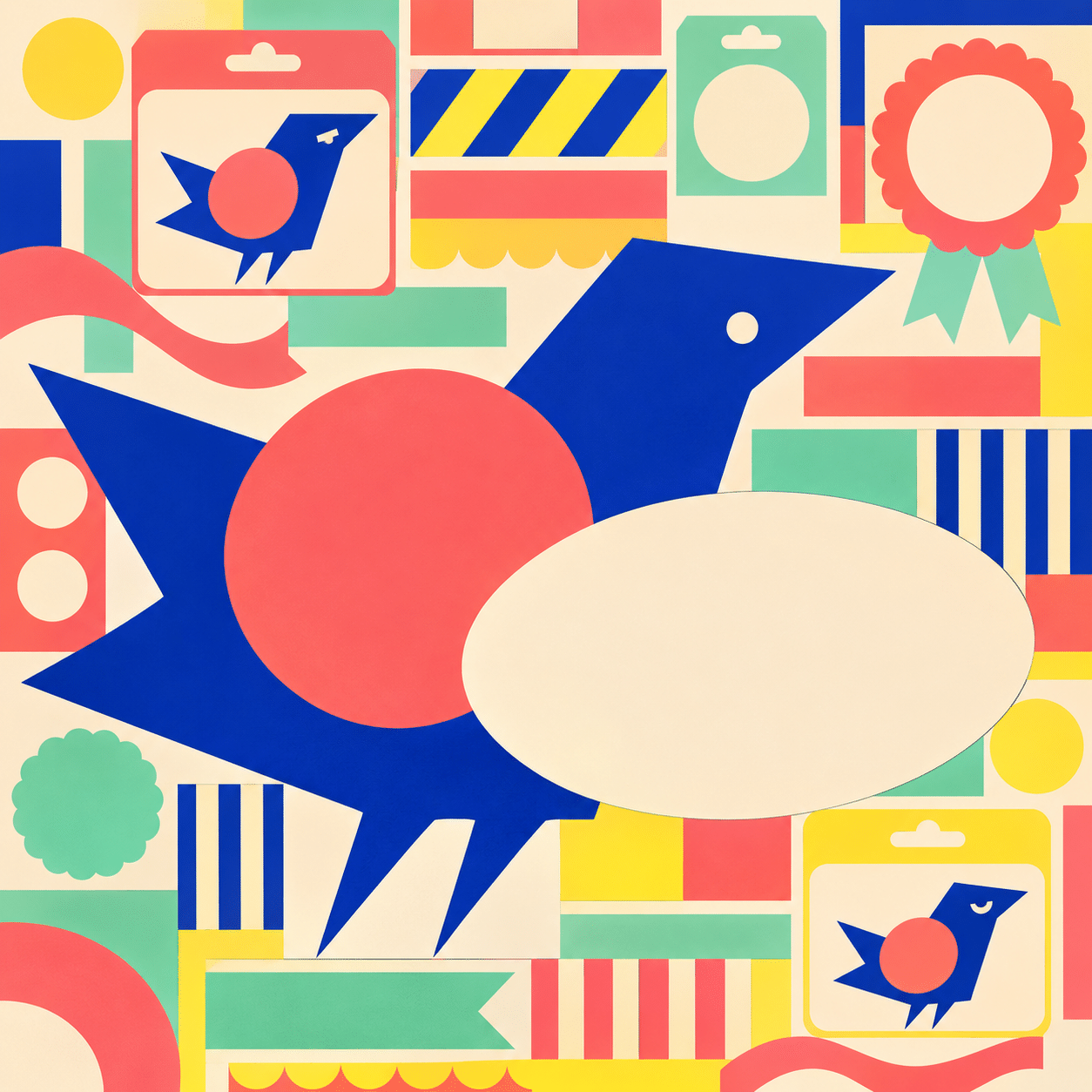
A Character in Circulation repeats an invented cobalt bird on abstract package shapes. Changing its scale makes the same silhouette alternate between a dominant figure and a small sign. The blank cream oval interrupts easy recognition; it is part of the composition, not a space waiting for advertising copy.
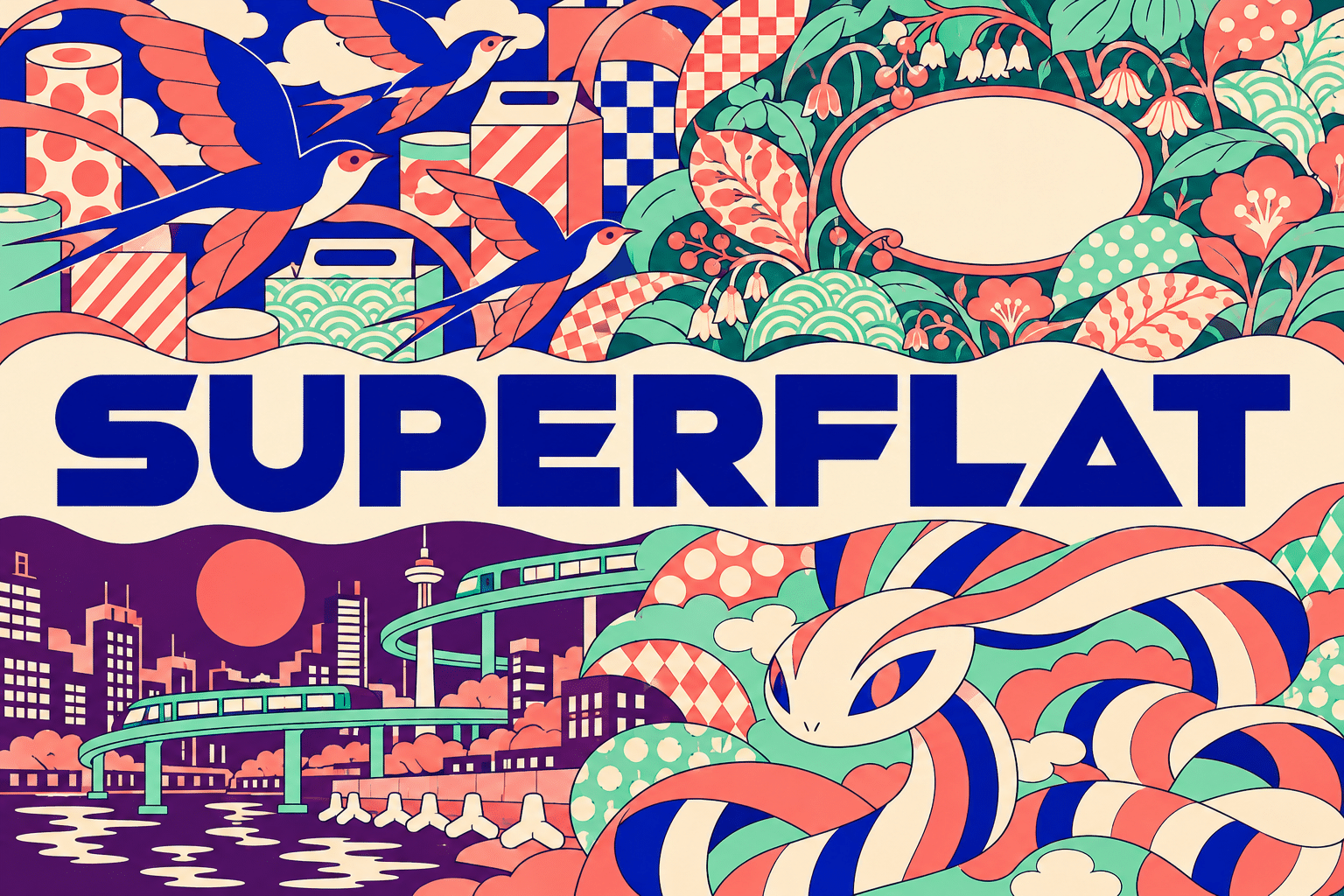
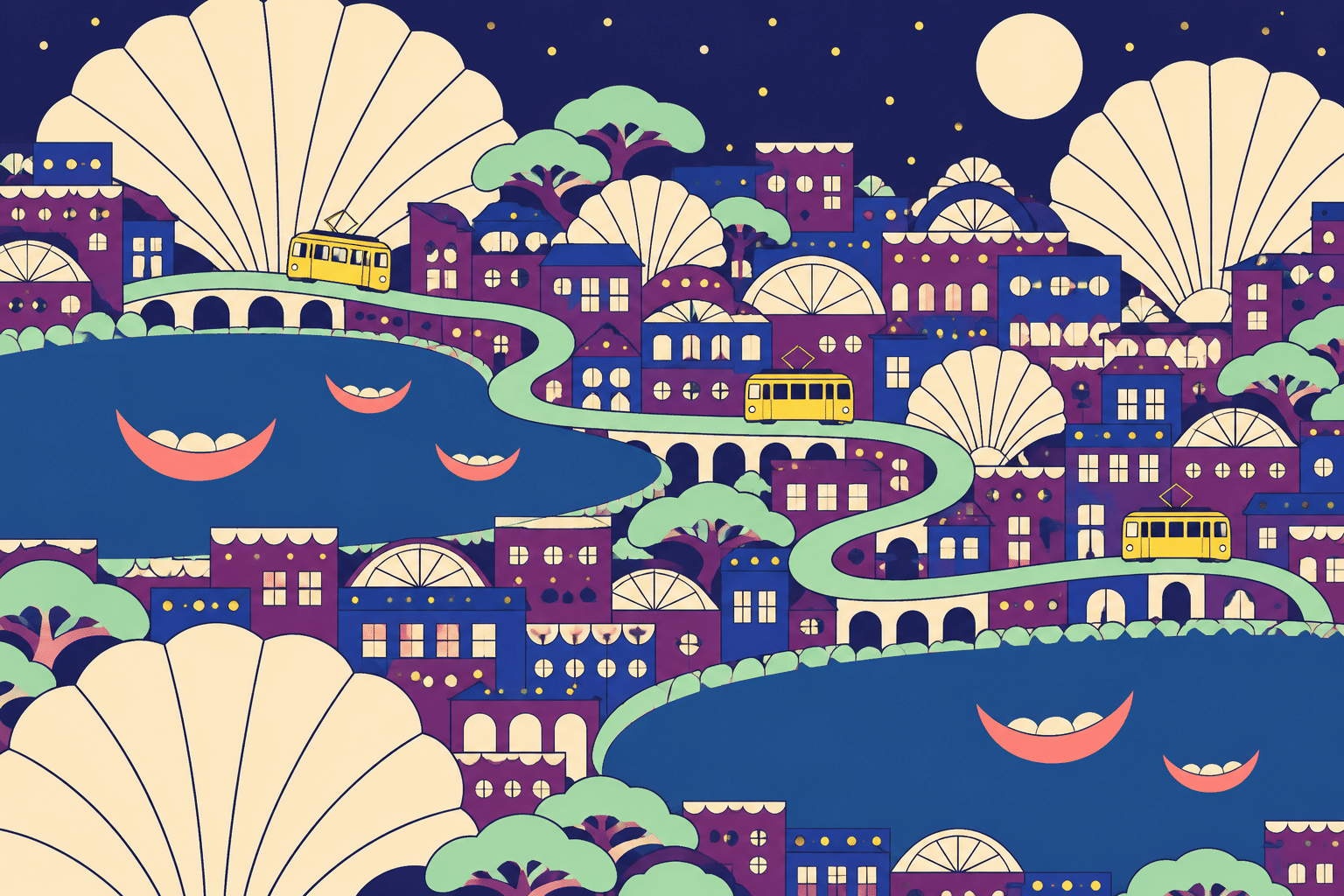
A Garden with a Missing Center concentrates on pattern rather than a character. Raspberry leaves, mint fans and orange pods become almost excessive around an unusually silent oval. Night Transit on a Single Plane tests a wider scene: trams, shells, boats and buildings share a shallow graphic space without following one consistent naturalistic scale.
The banner and centrally titled collage connect these visual exercises. All five are new AI-generated AOI interpretations. They demonstrate selected formal questions and do not reproduce Murakami’s or Aoshima’s works, establish their authorship, or stand in for the documented cultural histories linked above.
A practical looking and making workshop
For an independent study, make depth deliberately shallow and let edges, pattern and color carry the image. Decide which shapes overlap and which simply touch so the surface remains organized. A cheerful palette can coexist with an unsettling repetition or an empty center, but that tension should be visible rather than asserted. Invent your own motifs instead of reproducing recognizable artist characters.
Start with three large shapes and one recurring sign. Choose a limited palette, then decide where repetition stops. Make a second version with fewer motifs and compare the rhythm. A composition should still read when reduced to a small preview; tiny details should enrich that structure rather than hide the absence of one.
If using a generator, specify the relationships you want: hard contour, shallow overlap, deliberate scale change, one quiet interval. An instruction containing only the style name may return familiar motifs with little compositional purpose. Inspect the actual result, then revise the weakest relationship instead of adding more decoration.
Useful applications and important distinctions
These formal exercises can inform an editorial illustration, poster, surface pattern or imagined exhibition graphic. Their usefulness depends on the brief: repetition can create identity, while density can also make a small image illegible. Let the intended viewing distance determine how much detail survives.
Superflat is not a synonym for all manga, all anime, kawaii imagery or Japanese art. Nor does a lack of modeled depth mean a lack of ideas. Keep historical claims attached to sources and your own interpretations attached to visible decisions. A strong study gives the viewer something specific to notice, compare and question.
A small poetic detour
Original words from the AOI studio.
Poetry
A bird becomes a sign,
a sign returns as flight.
The garden crowds the border
and leaves its center white.
No distant road receives us;
the colors hold us here.
Across a single surface
something bright becomes unclear.
The prompt workshop
Original creative exercises. These prompts create new illustrations, not documentary evidence.
A recurring character
Invent a simple angular bird silhouette with a circular wing. Repeat it at three scales across a flat field of abstract packaging shapes. Use cobalt, coral, mint and cream, crisp contours, shallow overlaps and one large quiet interval. No text, brands or existing artist characters.
A garden around an absence
Create a dense flat garden of invented leaves, seed disks and striped pods around a mostly empty cream oval. Organize raspberry, mint, orange and cobalt shapes through clear contour, changing scale and controlled repetition. Let the empty center create tension. No faces, letters or realistic depth.
A journey across the surface
Design a wide imaginary night shoreline on one graphic plane. Repeat a small yellow tram along mint curves between plum buildings, oversized cream shells and coral crescent boats. Use deliberate scale shifts, two broad areas of still water and crisp edges. No text, realistic perspective or identifiable city.
People & works to explore
References discussed in this article. Consult the sources below for context.
Artists and practitioners
Takashi Murakami — Superflat theory and exhibitions; 727
Chiho Aoshima — City Glow; City Glow, Mountain Whisper
Paintings and other works
Takashi Murakami, 727 (1996), MoMA
Chiho Aoshima, City Glow (2005), Union Square subway installation
Chiho Aoshima, City Glow, Mountain Whisper (2006), Gloucester Road Underground commission
A smile from the studio
Jokes
The bird was offered a starring role, a sticker deal and a package design. It asked whether any of them came with more depth.
Sources and further exploration
[1] MOCA — Superflat, 2001; exhibition scope and Murakami’s 2000 theoretical essay
[2] MoMA — Takashi Murakami, 727 (1996); three-panel painting, materials and context
[3] Public Art Fund — Chiho Aoshima, City Glow and Paradise (2005); Union Square installations
[4] Art on the Underground — City Glow, Mountain Whisper (2006); seventeen-arch commission
[5] MOCA — Murakami and Clara Kim, 2026; framing art, popular culture and commerce