
An AOI translucent-material study
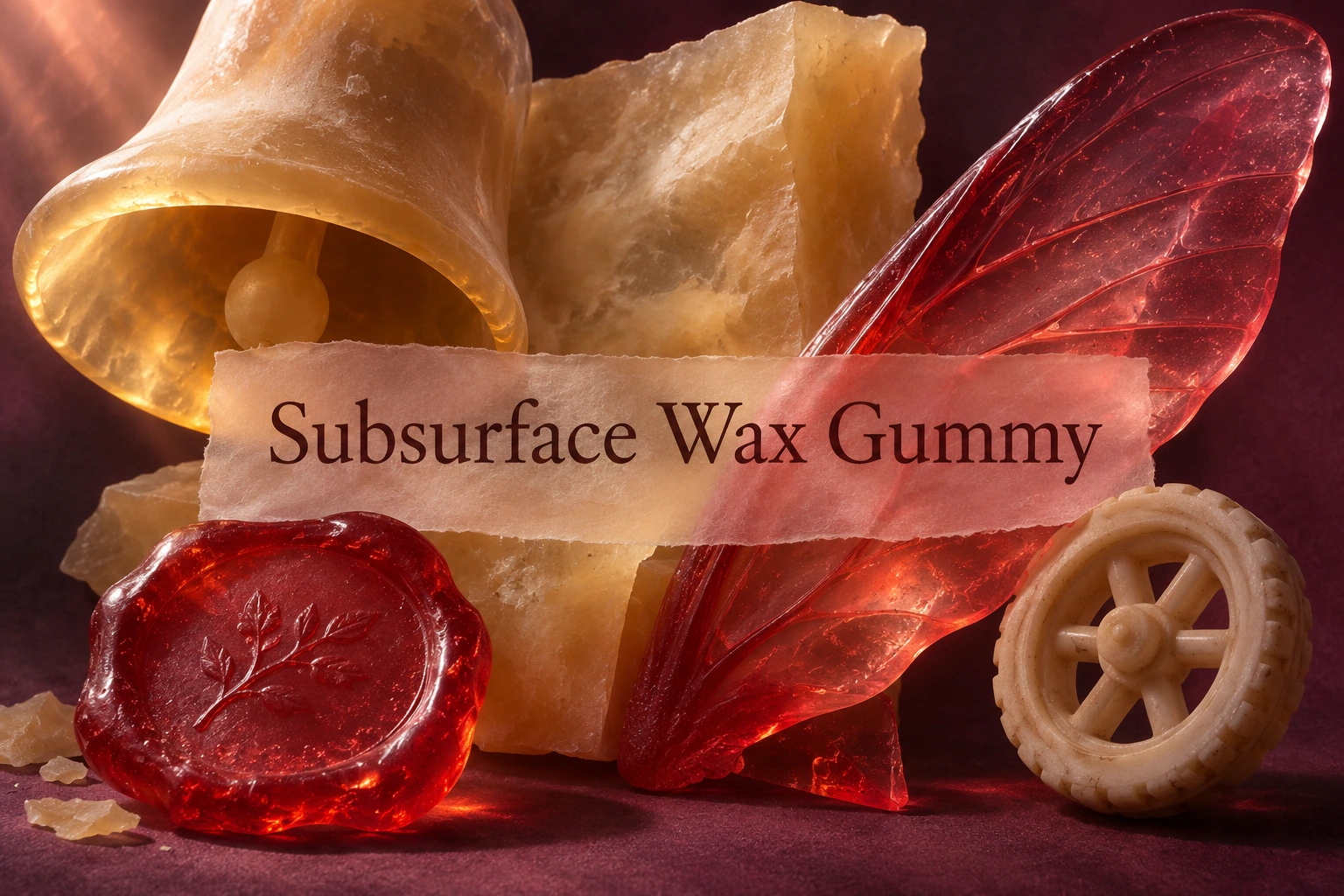
A bell can look heavy at its crown and almost edible at its lip. Subsurface Wax Gummy gives two materials the same beam of light, then asks where each one lets that light out.
An A⊕I –[-.+] creαt¡ve c⊕ncept, n⊕t αn estαbl¡she∂ h¡st⊕r¡cαl m⊕vement.

A visual introduction
Seven original AI interpretations vary thickness, contact and light direction. Begin with the bell, then compare the material study with the deliberately impractical everyday objects.
Select an image for a closer look. Use the thumbnails, arrow keys or a swipe to compare examples. Zoom in to inspect details, or share the image that inspires you.
Creative toolbox · take this style further
Choose an input and a destination. Search sends your words to the chosen site; Copy & open puts them on your clipboard to paste there.
Create with AI
Turn your chosen input into an image prompt or a new creative direction.
ChatGPT
Copy your input and paste it into a ChatGPT conversation or image request.
Copy & open ChatGPT (new tab)Claude · Anthropic
Develop an image prompt or explore the style in a new Claude conversation.
Copy & open Claude · Anthropic (new tab)Midjourney
Paste your input into the Imagine bar on the Create page.
Copy & open Midjourney (new tab)Adobe Firefly
Copy your input, open Firefly, and paste it into the prompt field.
Copy & open Adobe Firefly (new tab)Leonardo.Ai
Copy your input, open Leonardo, and paste it into the generation field.
Copy & open Leonardo.Ai (new tab)Image search
Find visual references. Short, concrete keywords usually work best.
Lexica
Search AI images and prompts using your selected input.
Search with this input Lexica (new tab)Pexels
Search the photo and video library. Short keywords often work best.
Search with this input Pexels (new tab)Pixabay
Search photos, illustrations and other images.
Search with this input Pixabay (new tab)Unsplash
Search photographs using the style name or your own keywords.
Search with this input Unsplash (new tab)Wikimedia Commons
Search photographs, artworks and historical images. Check each file for its source and reuse terms.
Search with this input Wikimedia Commons (new tab)Art & research
Explore artists, collections and the ideas behind a style.
Wikipedia
Search for background reading. A style may not have its own article.
Search with this input Wikipedia (new tab)WikiArt
Copy your input into WikiArt’s search to explore artists and artworks.
Copy & open WikiArt (new tab)Europeana
Paste your keywords into the search to explore European museum, library and archive collections.
Copy & open Europeana (new tab)Inspiration
Discover portfolios and visual ideas from creative communities.
Instagram hashtags
Search a hashtag made from your input: spaces and punctuation are removed. Instagram may require sign-in.
Search with this input Instagram hashtags (new tab)ArtStation
Paste your input into artwork search for concept art, environments, characters and visual development.
Copy & open ArtStation (new tab)Behance
Paste your input into project search for illustration, design and visual storytelling.
Copy & open Behance (new tab)A closer look
Clouded amber wax softens a shadow from within. Clearer ruby gummy carries colour through the thin parts. A dark foot, pin or slab keeps the objects in contact with the world.
The lamp is outside the bell
Start with a heavy cloudy shape and a narrow rim. Now light both from behind. Light can enter a translucent material at one point, scatter inside it and emerge some distance away. In their 2001 paper, Henrik Wann Jensen, Stephen Marschner, Marc Levoy and Pat Hanrahan show why reflection at a single surface point misses this spread, including the softening of shadow boundaries.
AOI uses wax and gummy as two visual roles. The wax suggests a dense, milky body and a softly lit margin. The gummy can support a clearer interior and a sharper surface glint. Actual waxes, gels, dyes and thicknesses vary widely. The pair in this guide is an artistic decision, with an external lamp to keep it accountable.
A wedge is more revealing than a sphere
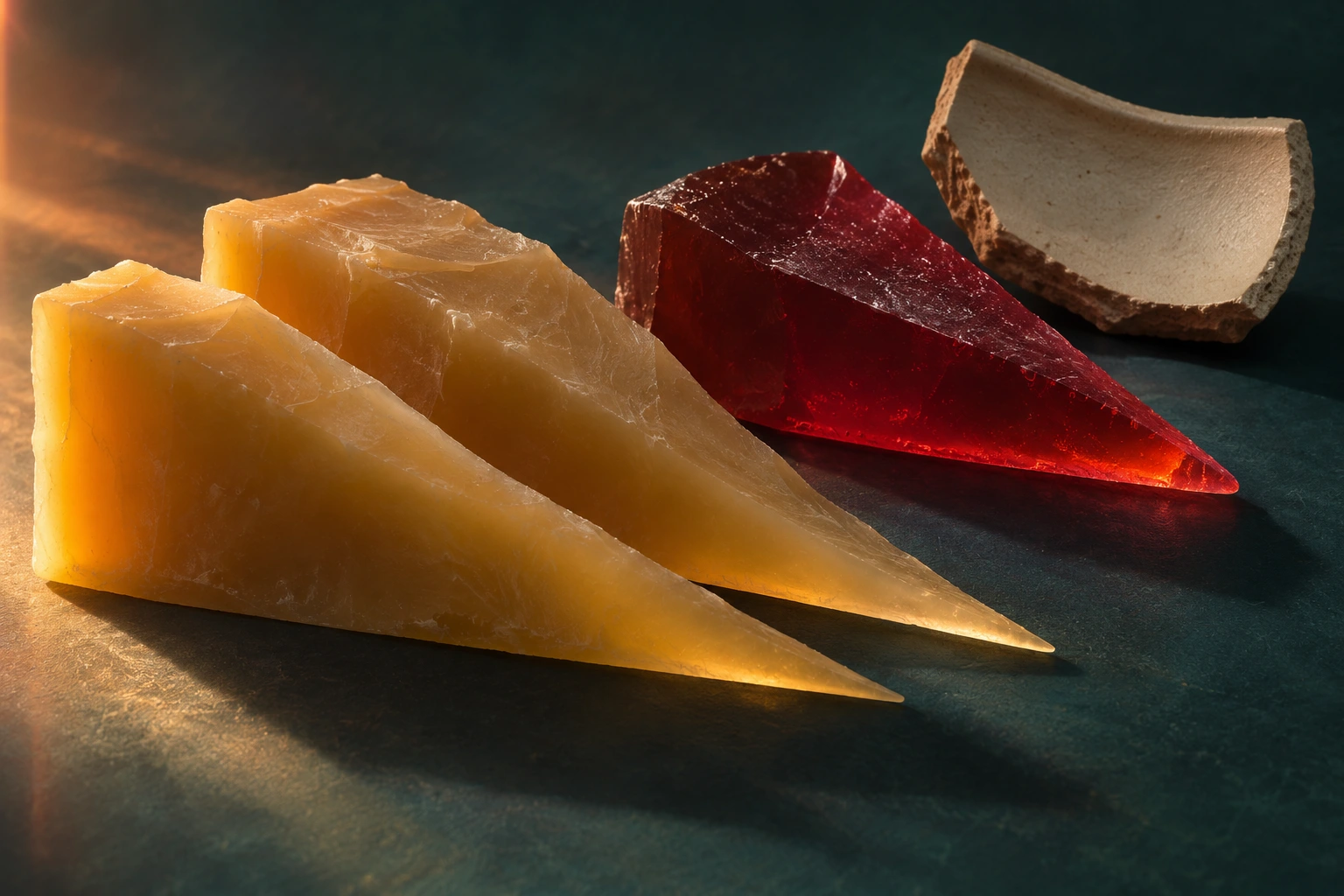
A sphere gives you a pretty rim almost for free. A wedge offers a longer and less forgiving journey from a thin tip to a thick back. Place two wedges in the same light, one cloudy and one clearer, beside an opaque shard. Cover the brightest area for a moment. You should still be able to describe the cut and tell where the light comes from.
Blender’s Principled shader distinguishes the distance light scatters under a surface from roughness at its boundary and transmission through it. That distinction travels well into an image prompt. Specify where the gummy is polished, where the wax is cut and how far the bright patch reaches into the body. A generated image offers a visual comparison rather than a measurement of scattering distance.
Give a soft material a demanding job
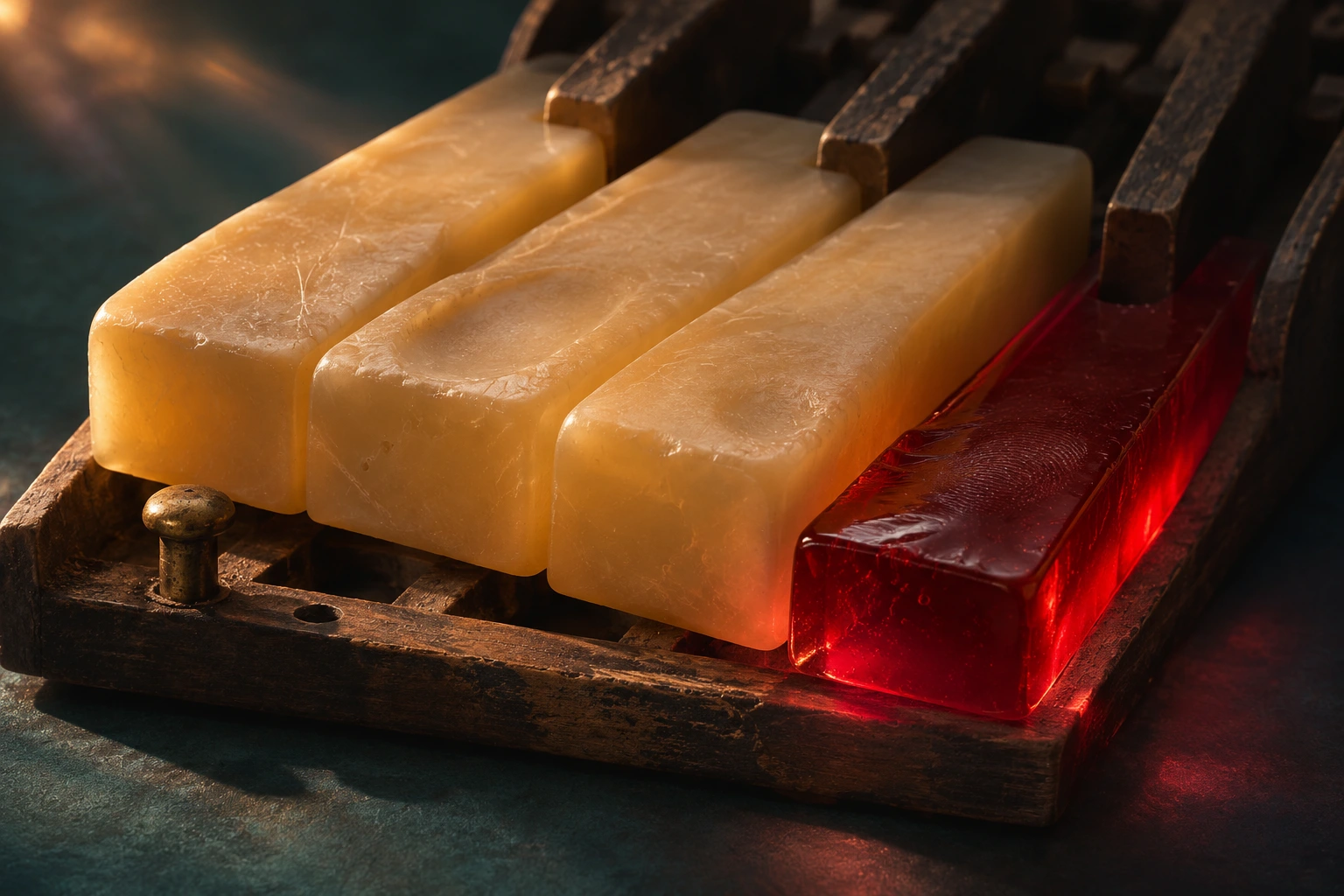
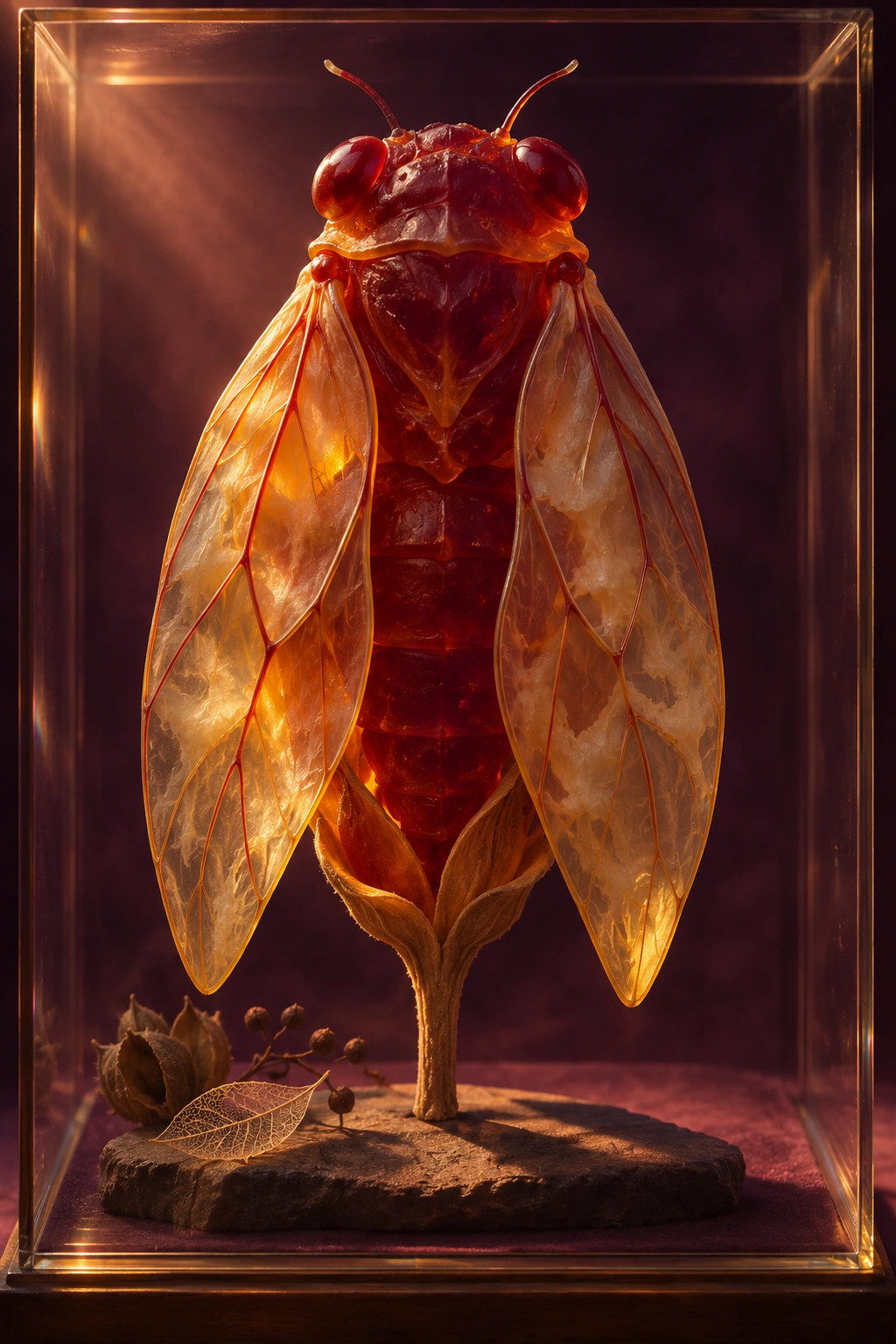
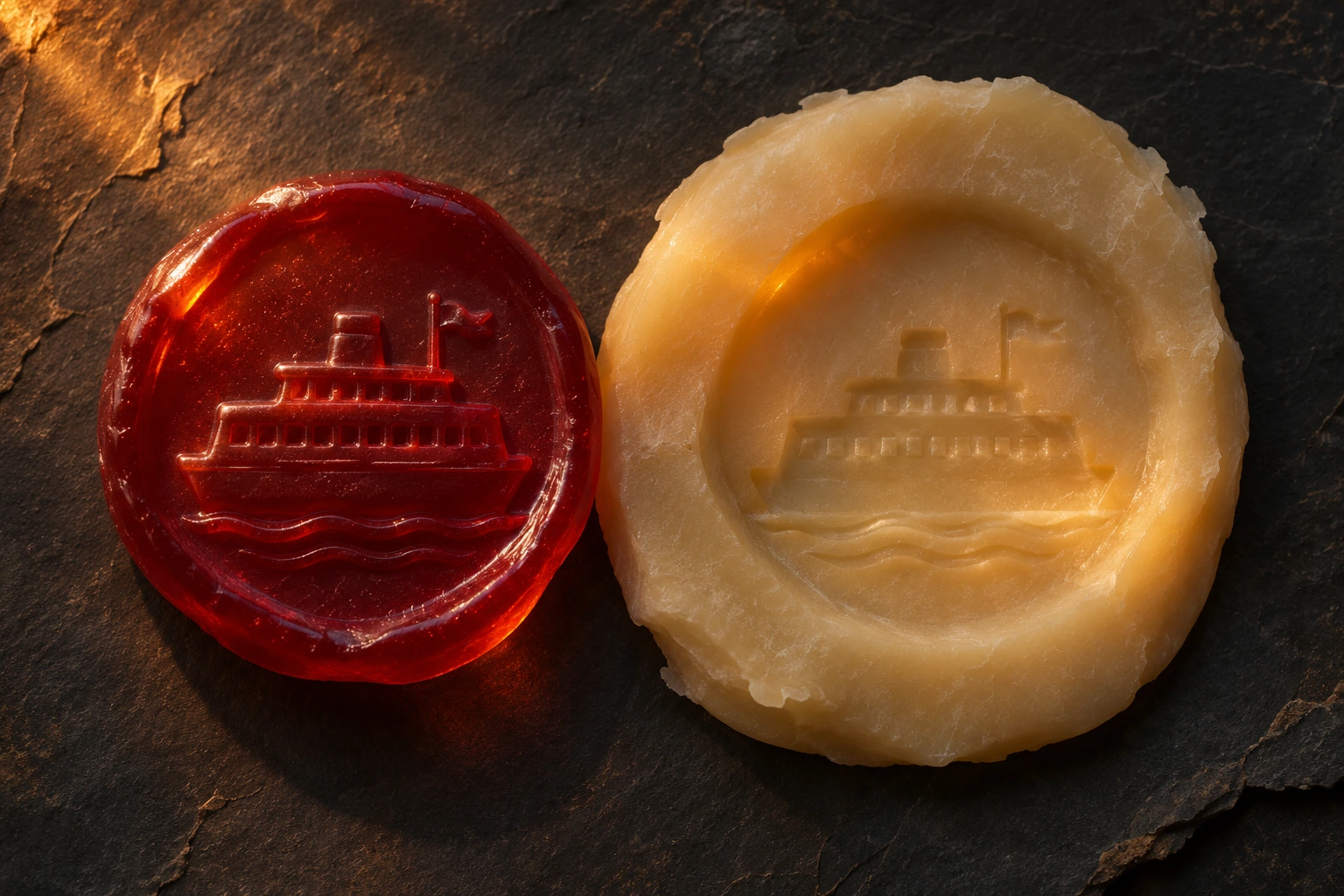
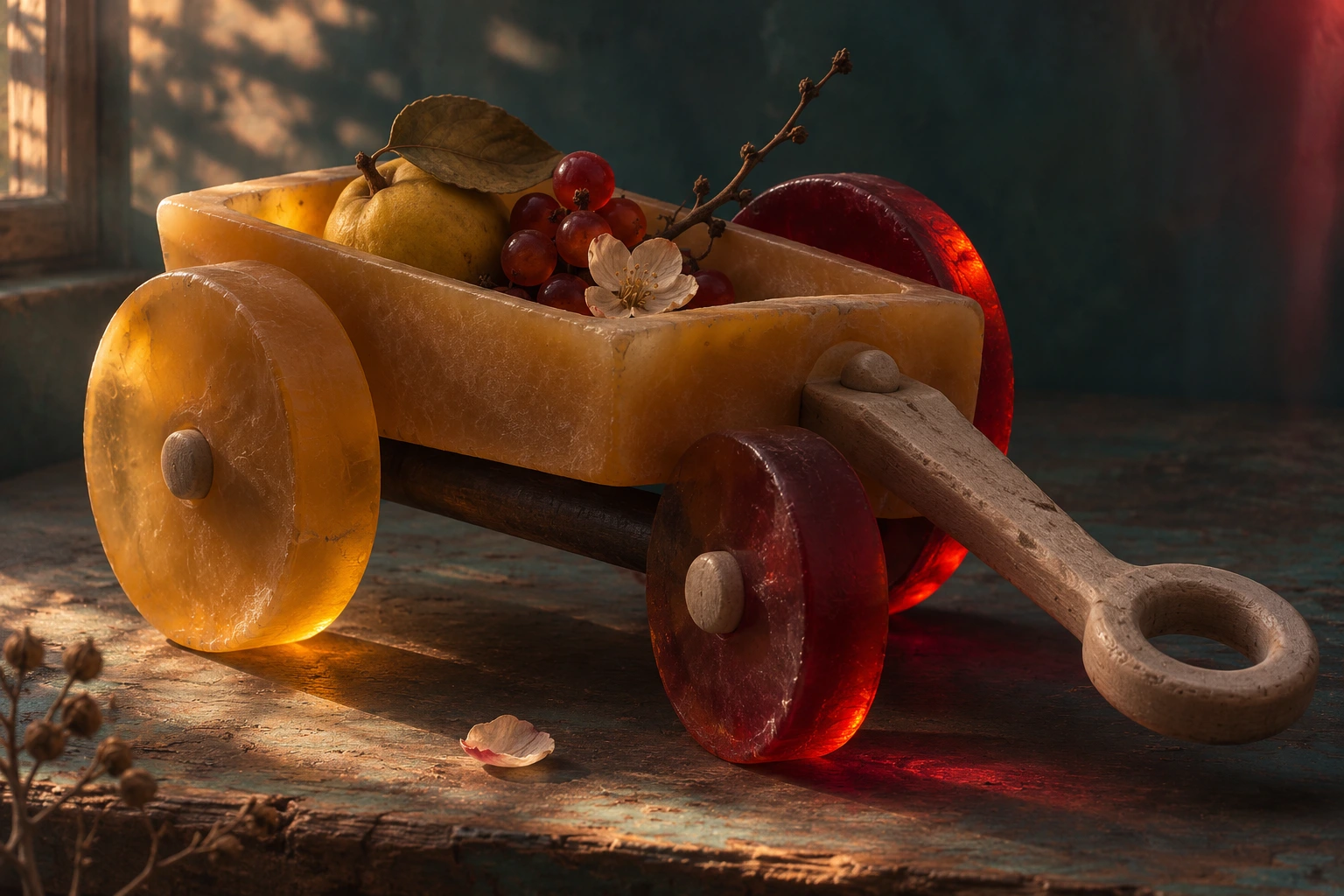
A pressed key has to travel. A stamp has to leave an impression. A cart wheel has to support an axle. Each familiar task supplies a different reason to study edges and thickness. The winged specimen is the quiet exception. Its thin wings offer a long area where the casting might almost disappear into the light.
Try changing just the backdrop. Deep plum makes an amber edge easy to see. A pale wall makes its saturation harder to sustain and brings the contact shadow forward. If all the thick parts look as bright as the thinnest ones, move the light and restore a quiet core before adding another colour.
Three readings from Penny’s desk
Positive review. The contact between a dark support and a light-filled rim gives the invented materials weight.
Negative review. A glowing outline can become decorative shorthand when it continues around a side the lamp could scarcely reach.
Neutral review. The comparison addresses visible changes with thickness. The generated files contain no physical material samples or calibrated optical measurements.
A small poetic detour
Original words from the AOI studio.
Poetry
Under the lip of a silent bell
a little honey keeps the sun.
The clapper waits in cherry red.
The note has colour before sound.
The prompt workshop
Original creative exercises. These prompts create new illustrations, not documentary evidence.
Read one wedge
Two freshly cut translucent wedges, one cloudy beeswax and one clear cherry gummy, on a charcoal slab. Rear light enters from the left. Show the slow change from luminous tips to thicker, darker cores. Add a matte ceramic shard for comparison.
Give the bell a clapper
Build a small hanging bell with a clouded amber body, a thin cut rim and a translucent red gummy clapper. One low side window lights the lip. Leave the space inside the bell dark enough to see the clapper hang free.
Take the sheen away
Repeat the bell with the same geometry and light. Roughen only the red clapper’s outside surface, keeping its colour and thickness. Compare its softened reflection with the coloured light still travelling through its lower edge.
A smile from the studio
Jokes
The bell maker tested the new casting by ear. The confectioner asked for a second opinion.