
AOI model-kit illustration study
What is the least of a camera you need to see before you recognise one? A square with a hole, two slotted rails and a little concertina come surprisingly close. On a model-kit sprue, the pleasure is getting there before the glue does.
An A⊕I –[-.+] creαt¡ve c⊕ncept, n⊕t αn estαbl¡she∂ h¡st⊕r¡cαl m⊕vement.
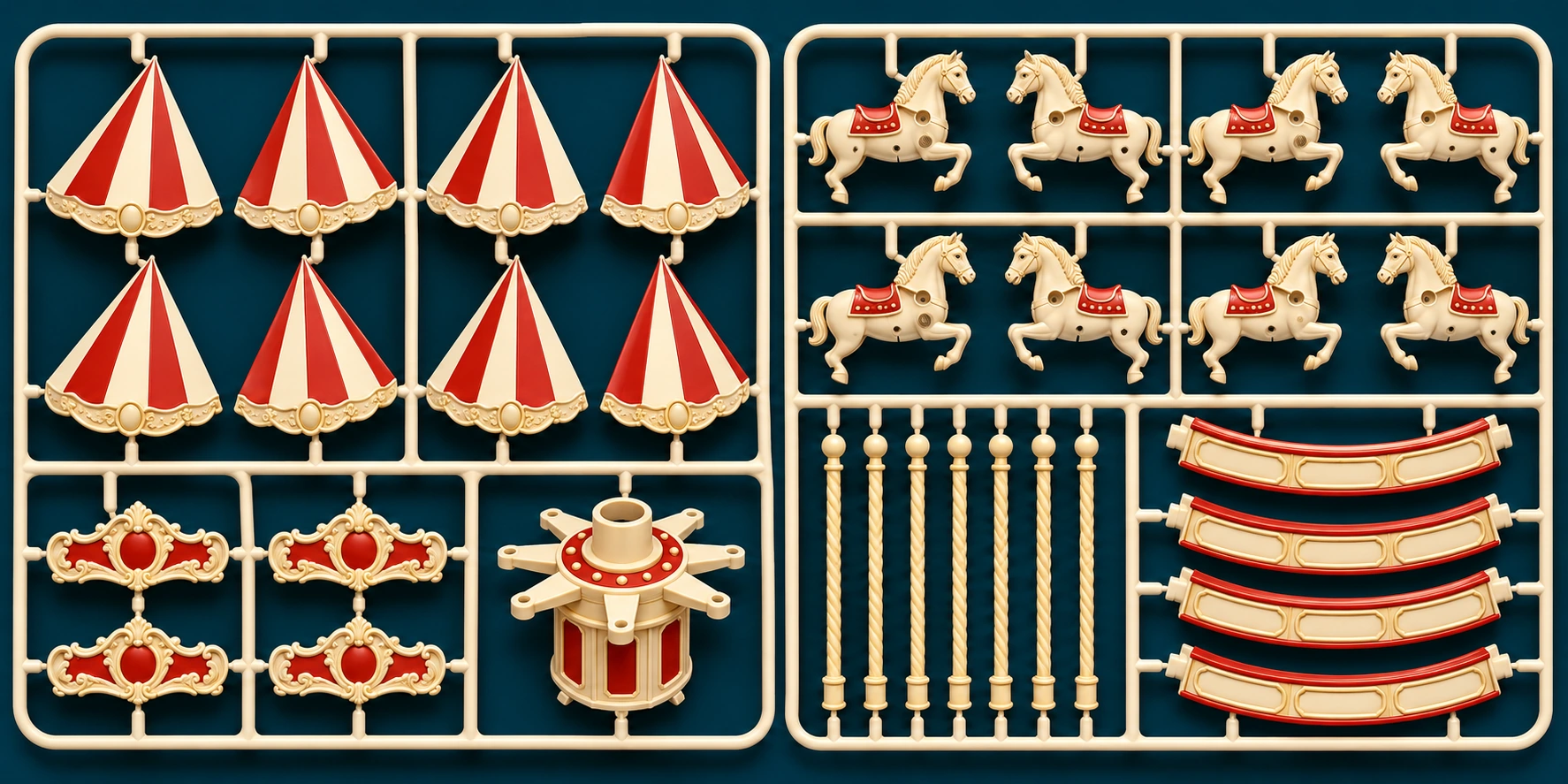
A visual introduction
The grey and precoloured camera use the same arrangement. Further along the runner, clear glazing, a rain splash and a removable eclipse test the limits of the form.
Select an image for a closer look. Use the thumbnails, arrow keys or a swipe to compare examples. Zoom in to inspect details, or share the image that inspires you.
Creative toolbox · take this style further
Choose an input and a destination. Search sends your words to the chosen site; Copy & open puts them on your clipboard to paste there.
Create with AI
Turn your chosen input into an image prompt or a new creative direction.
ChatGPT
Copy your input and paste it into a ChatGPT conversation or image request.
Copy & open ChatGPT (new tab)Claude · Anthropic
Develop an image prompt or explore the style in a new Claude conversation.
Copy & open Claude · Anthropic (new tab)Midjourney
Paste your input into the Imagine bar on the Create page.
Copy & open Midjourney (new tab)Adobe Firefly
Copy your input, open Firefly, and paste it into the prompt field.
Copy & open Adobe Firefly (new tab)Leonardo.Ai
Copy your input, open Leonardo, and paste it into the generation field.
Copy & open Leonardo.Ai (new tab)Image search
Find visual references. Short, concrete keywords usually work best.
Lexica
Search AI images and prompts using your selected input.
Search with this input Lexica (new tab)Pexels
Search the photo and video library. Short keywords often work best.
Search with this input Pexels (new tab)Pixabay
Search photos, illustrations and other images.
Search with this input Pixabay (new tab)Unsplash
Search photographs using the style name or your own keywords.
Search with this input Unsplash (new tab)Wikimedia Commons
Search photographs, artworks and historical images. Check each file for its source and reuse terms.
Search with this input Wikimedia Commons (new tab)Art & research
Explore artists, collections and the ideas behind a style.
Wikipedia
Search for background reading. A style may not have its own article.
Search with this input Wikipedia (new tab)WikiArt
Copy your input into WikiArt’s search to explore artists and artworks.
Copy & open WikiArt (new tab)Europeana
Paste your keywords into the search to explore European museum, library and archive collections.
Copy & open Europeana (new tab)Inspiration
Discover portfolios and visual ideas from creative communities.
Instagram hashtags
Search a hashtag made from your input: spaces and punctuation are removed. Instagram may require sign-in.
Search with this input Instagram hashtags (new tab)ArtStation
Paste your input into artwork search for concept art, environments, characters and visual development.
Copy & open ArtStation (new tab)Behance
Paste your input into project search for illustration, design and visual storytelling.
Copy & open Behance (new tab)A closer look
Give the future object a set of distinct silhouettes. Hang them inside a runner frame with thin, visible gates. Leave enough air that a reader can mentally lift one piece clear of its neighbours.
Which pieces give the subject away?
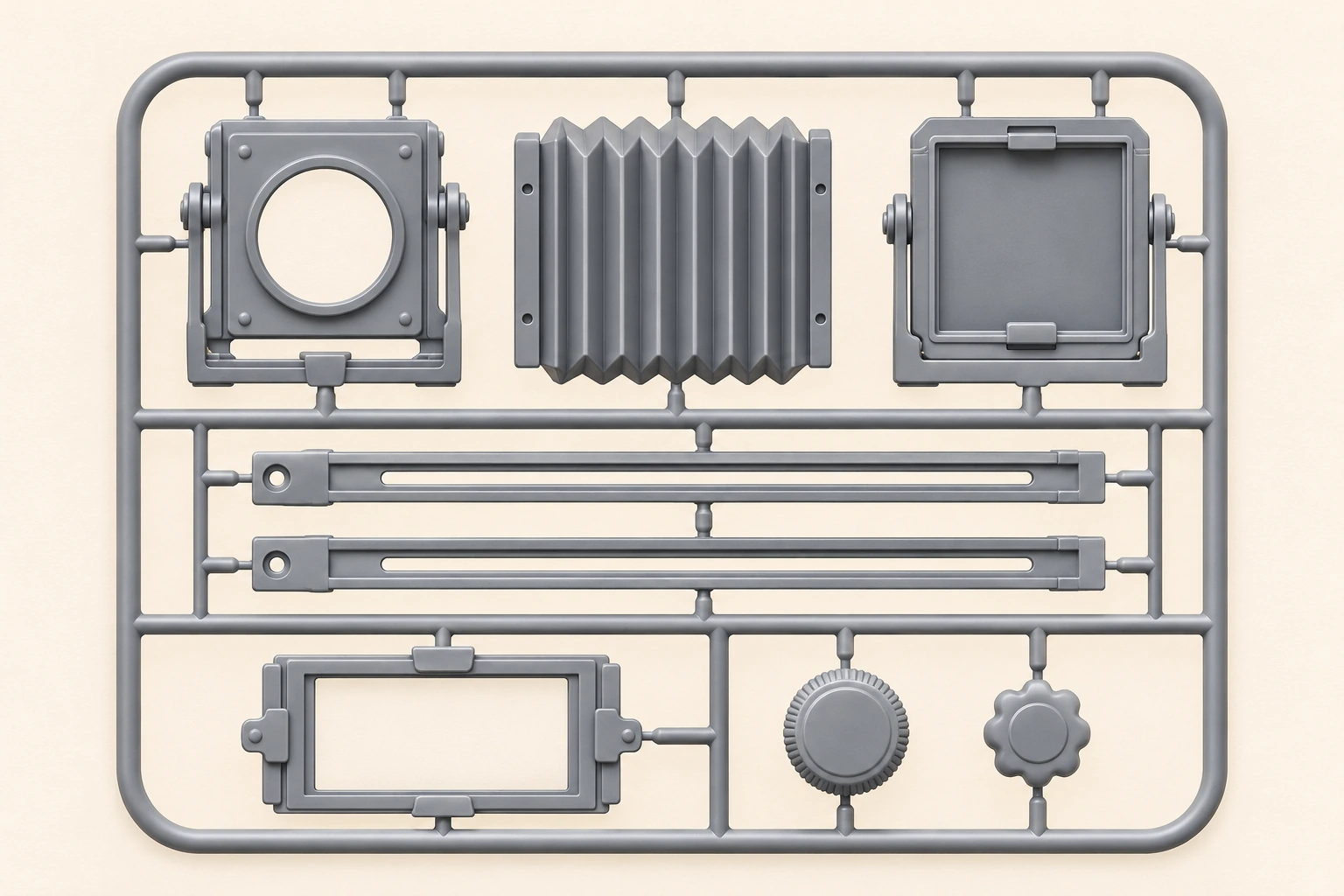
This AOI study imagines objects in the moment before assembly. Start with three shapes you could recognise from across a workbench. For the folding camera, a front standard with a circular opening suggests the lens. Two long slotted rails suggest how the body extends. A square bellows gives the rails a reason to exist. Keep those clues apart. The reader gets a small act of assembly for free.
Follow one gate with a fingertip
Airfix uses “sprue” for the plastic frame familiar to kit builders. On the toolmaking side, Protolabs calls the opening where plastic enters a cavity a gate and describes the small trace it can leave on the finished part. In these illustrations you can follow a thick runner, turn onto a short thin neck and arrive at the edge of a part. That path is one way to tell an attached component from a loose piece lying on graph paper.
Give the gate a modest job. A short neck on the rim of the camera standard leaves its lens opening intelligible. A bar across the middle of the hole can look like a feature that belongs to the camera. A shadow cast all the way across an apparent junction can give away a floating piece.
What changes when the plastic gets colour?
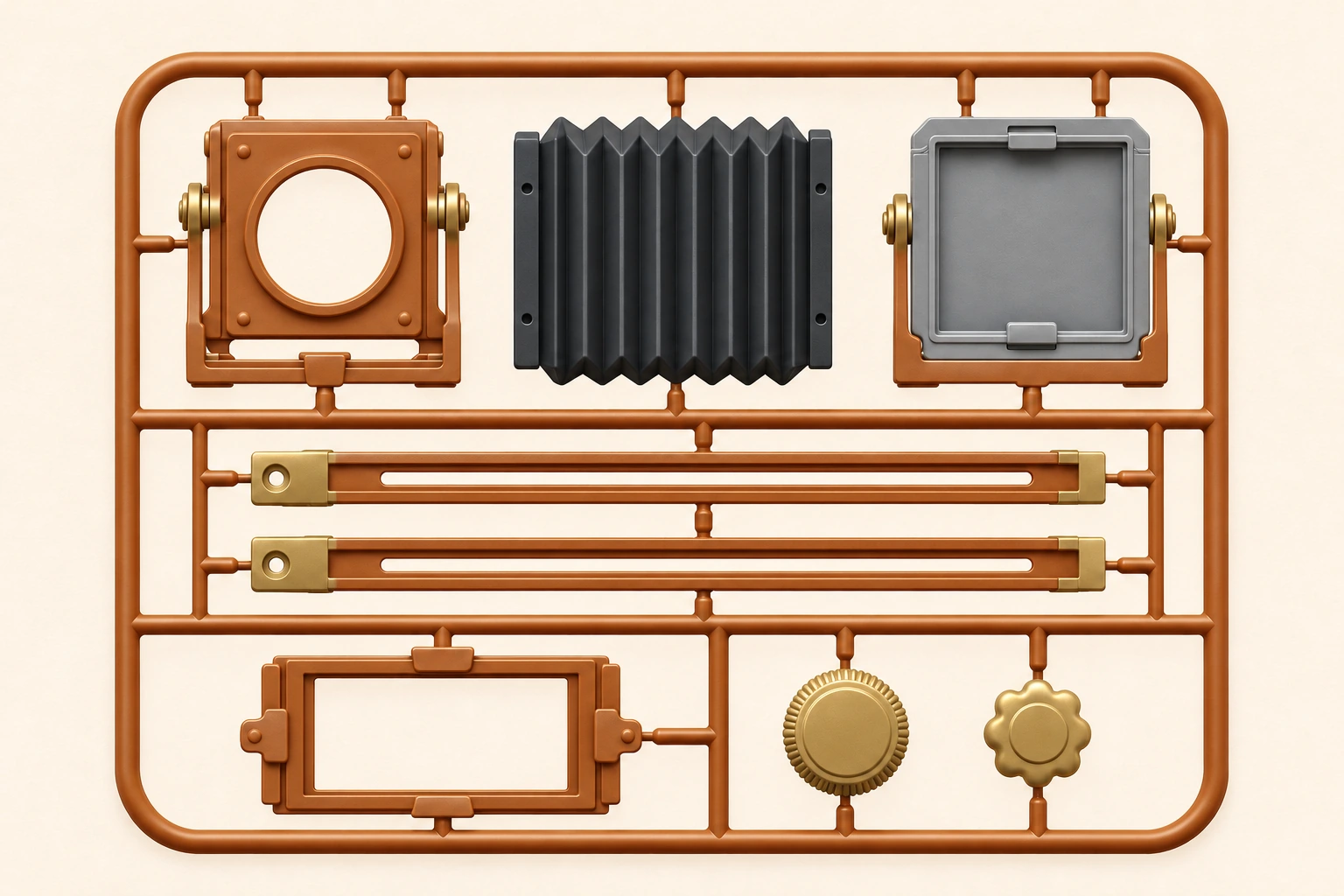
The grey camera study came first. Its image was used as the reference for a precoloured version, with the same list of parts and a request to preserve their places. Look for the bellows in each. In grey you find it by the alternating bright and dark ridges. Colour gives you a second way to find it. Then test the two adjustment knobs: do the colours reveal a family of fittings, or pull unrelated pieces together?
Bandai Spirits describes machines at its Hobby Center that mould four differently coloured materials in one mould. That makes multicolour production a documented point of reference. A picture alone cannot tell us whether a particular finish was moulded in, painted or printed. Choose the intended finish in the prompt. A plain red moulding reads differently from cream plastic bearing a red stripe.
Flat parts, round parts and crowded frames
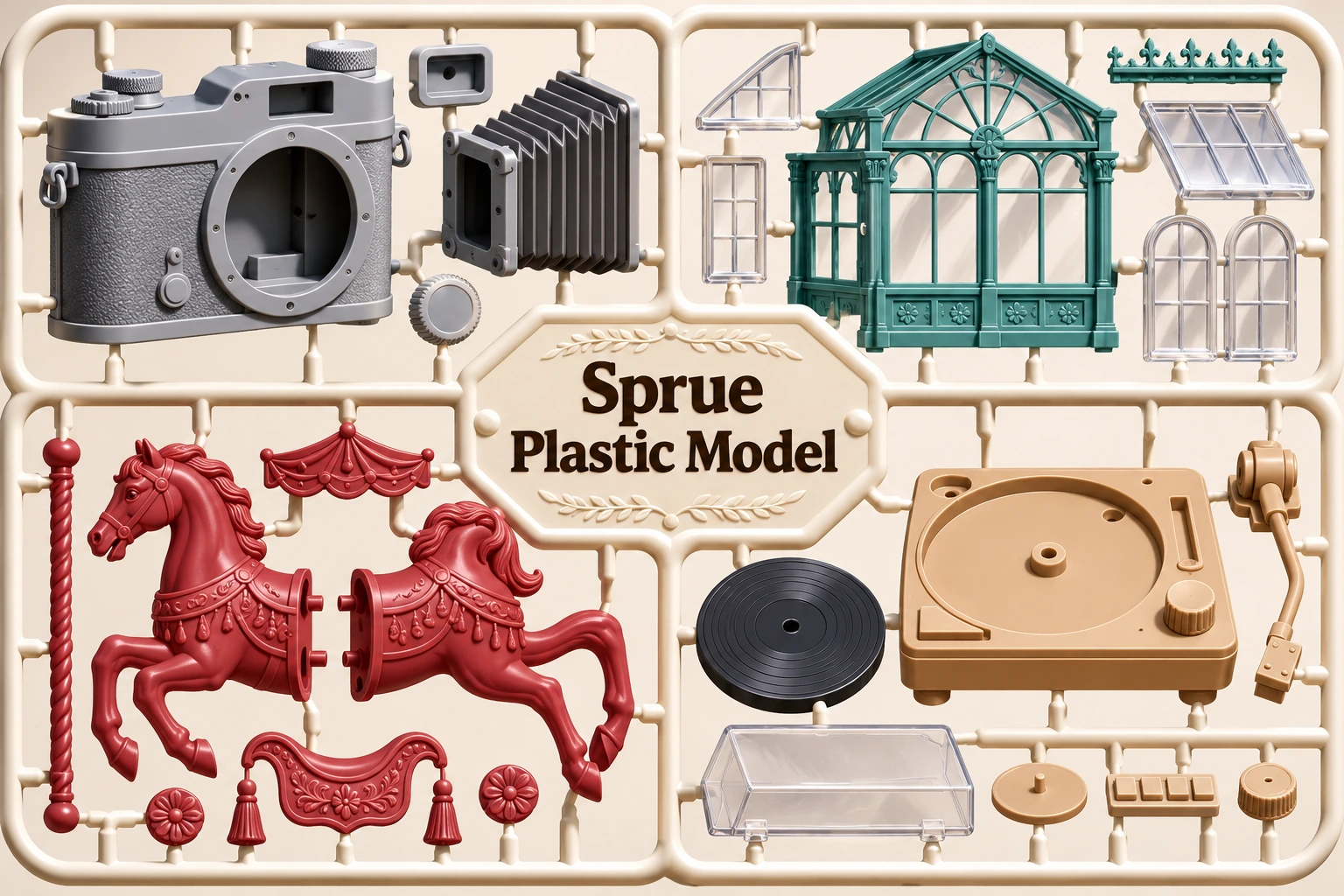
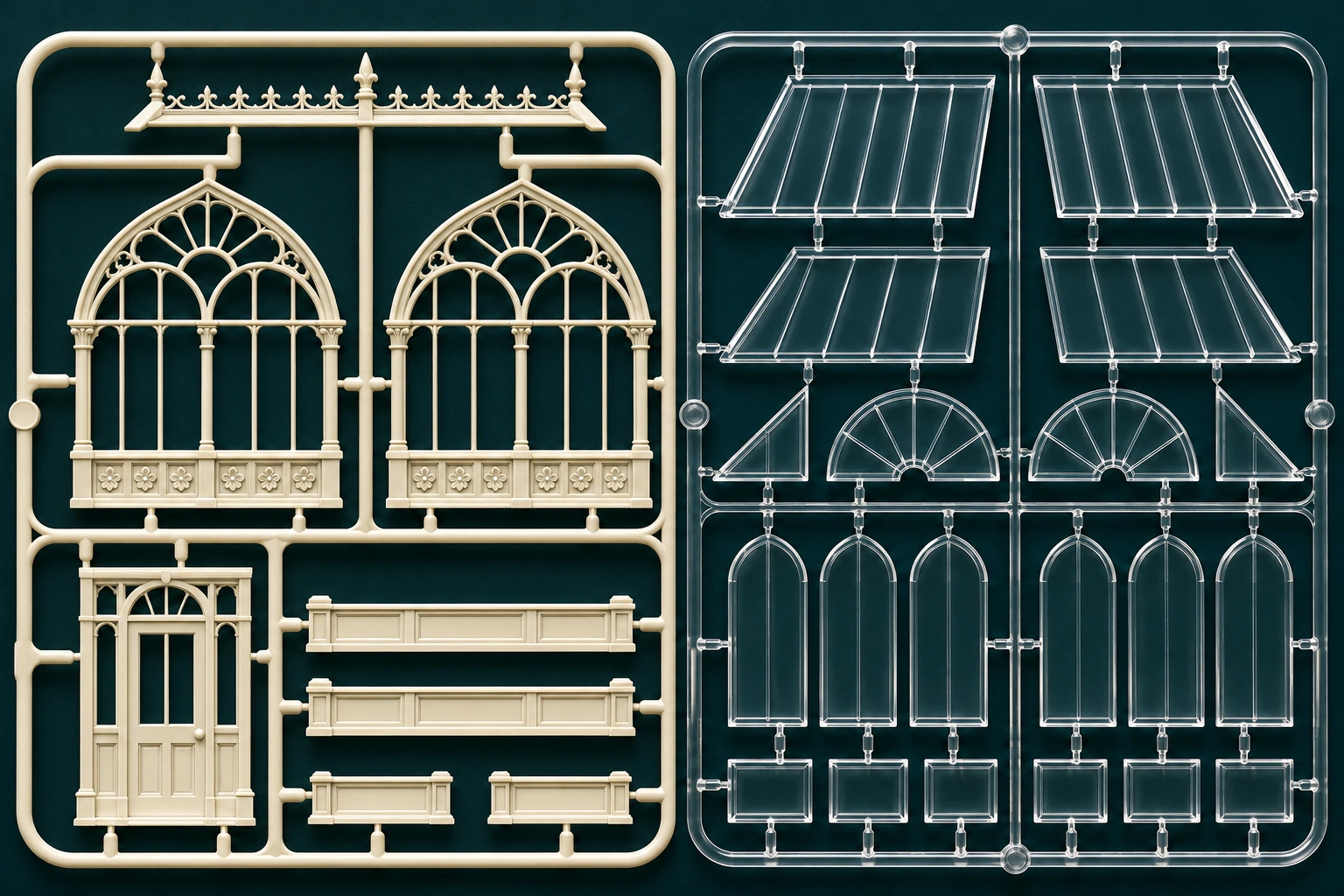
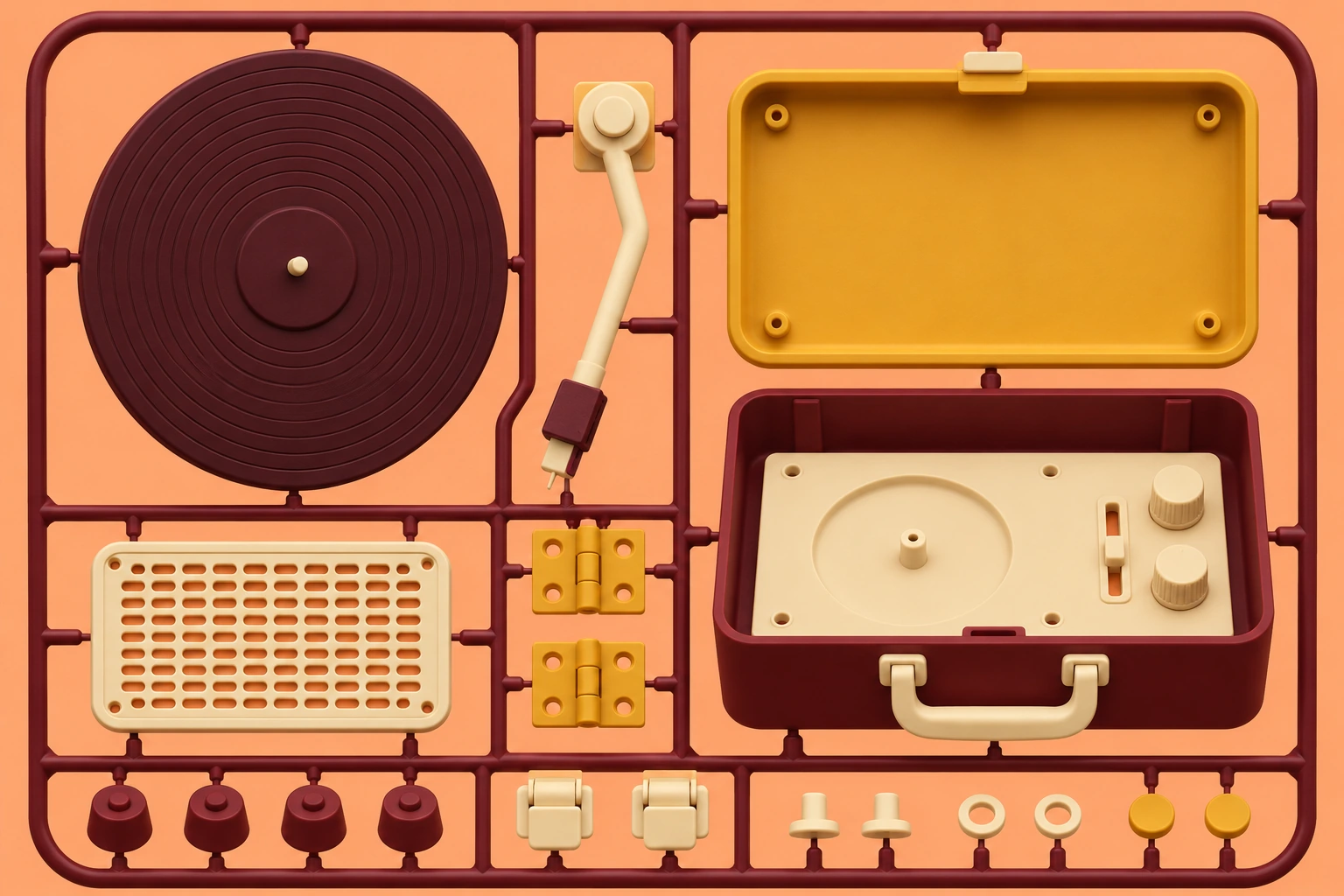
Glazing asks for an edge the eye can keep. Against a light background a transparent pane can disappear while the opaque structure stays perfectly readable. The greenhouse exercise gives glazing its own area and a darker ground. The turntable offers the opposite problem. Its large circular platter reads almost too easily, so look for the small tonearm that tells you what that circle does.
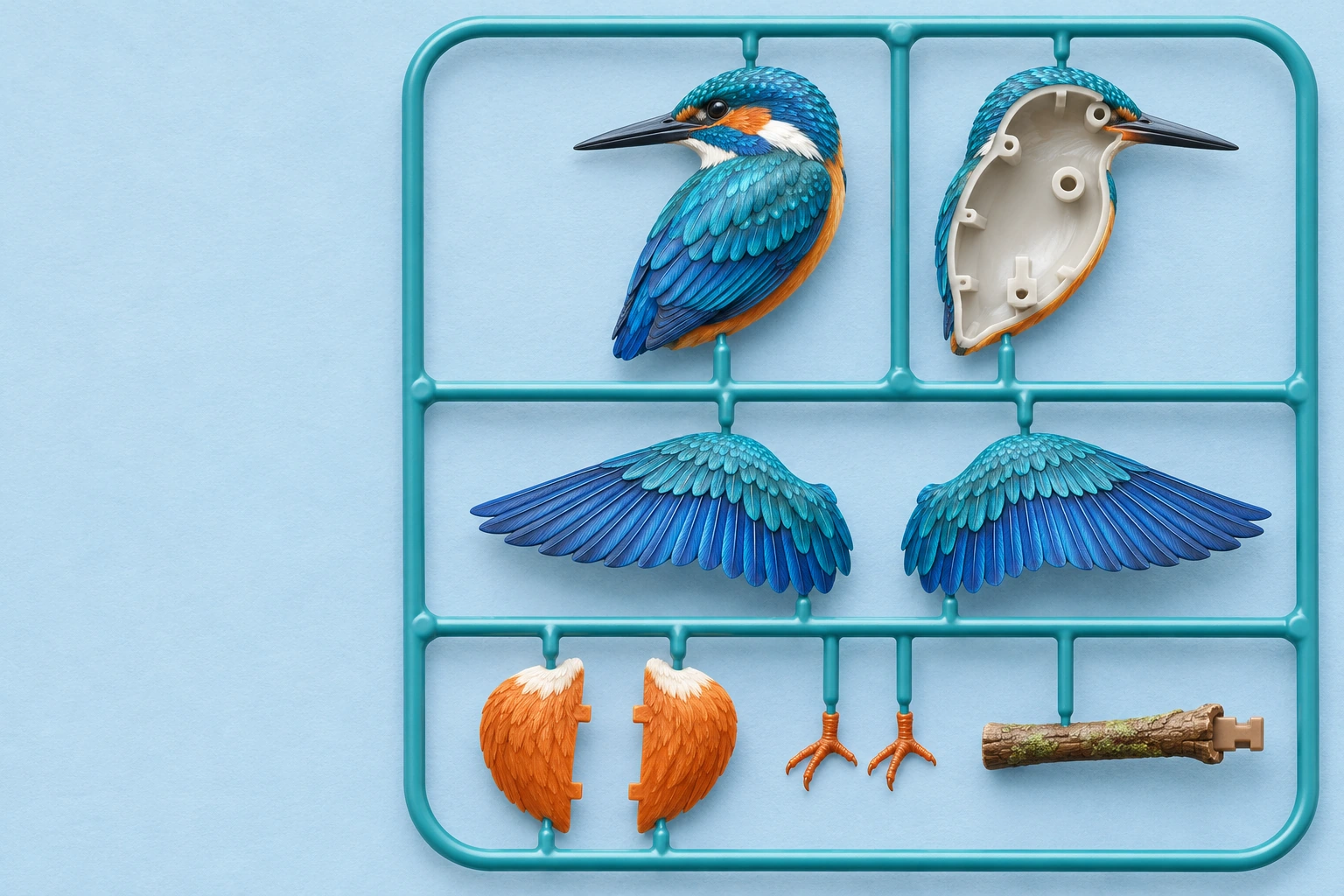
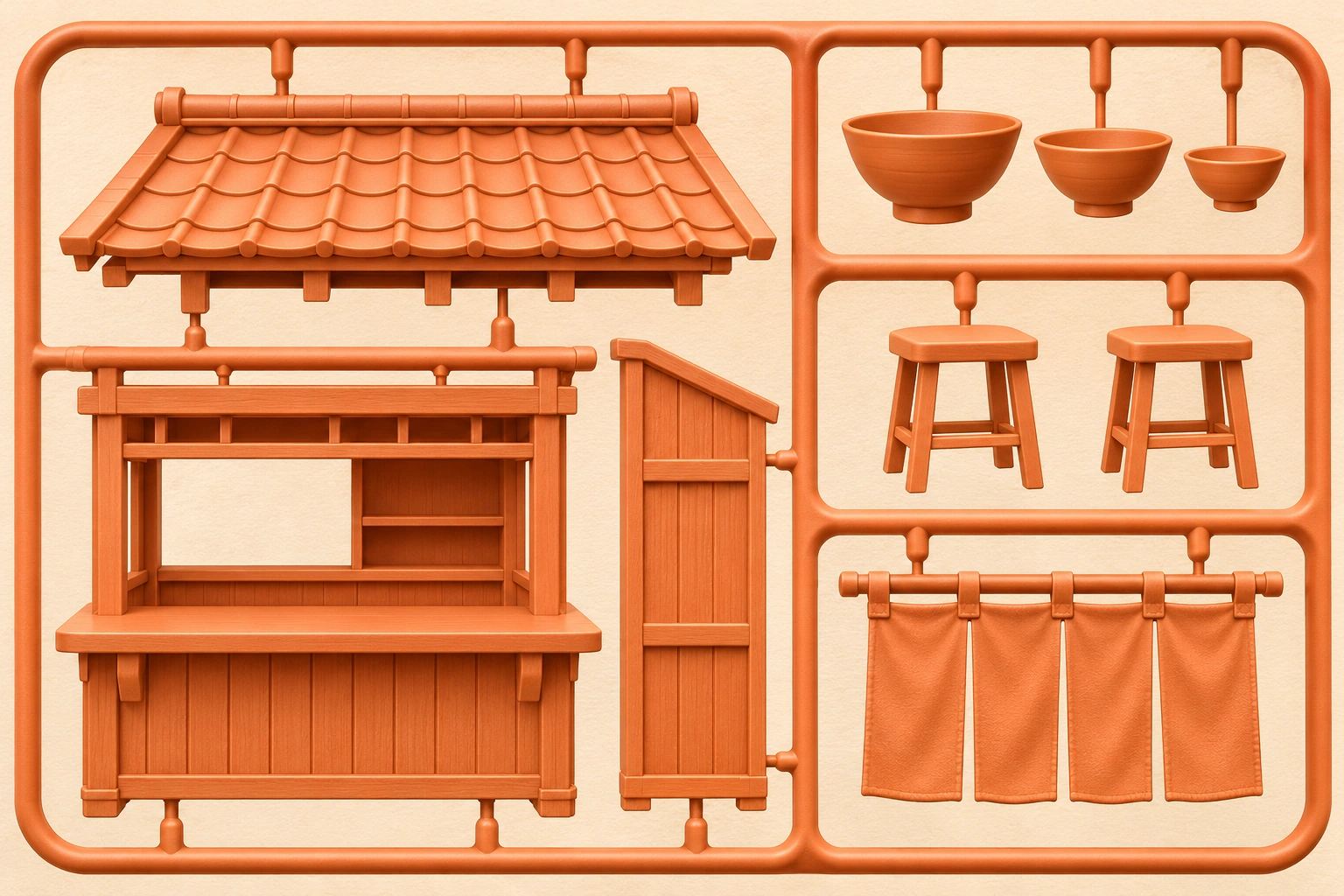
A food stall tests how many pieces a sheet can carry. A counter, a roof and a stool suggest a place to eat. A dozen little rectangles can cost more attention than they repay. Group the smaller objects into bays and keep a gap at the edge of each group. For a bird, let the outline of a wing and the long beak do some of the naming.
A kit you can read
Try covering the title. Name the future object, trace one physical connection, then find two parts that might meet after cutting. Record which of those three tasks was hardest. The gallery consists of invented AI interpretations; apparent fit is a question for the picture, and the illustrated parts have no tested assembly dimensions.
What the camera comparison actually changed
The reference-based edit kept the round lens opening, the two slotted rails and even the different outlines of the bottom knobs in almost the same positions. The matte black bellows is quicker to pick out in colour. In grey, the smaller knob’s scalloped edge is easier to study without the brass finish drawing attention to the pair. For a sheet intended to explain how a thing fits together, those are two different advantages.
Can the frame hold a moment?
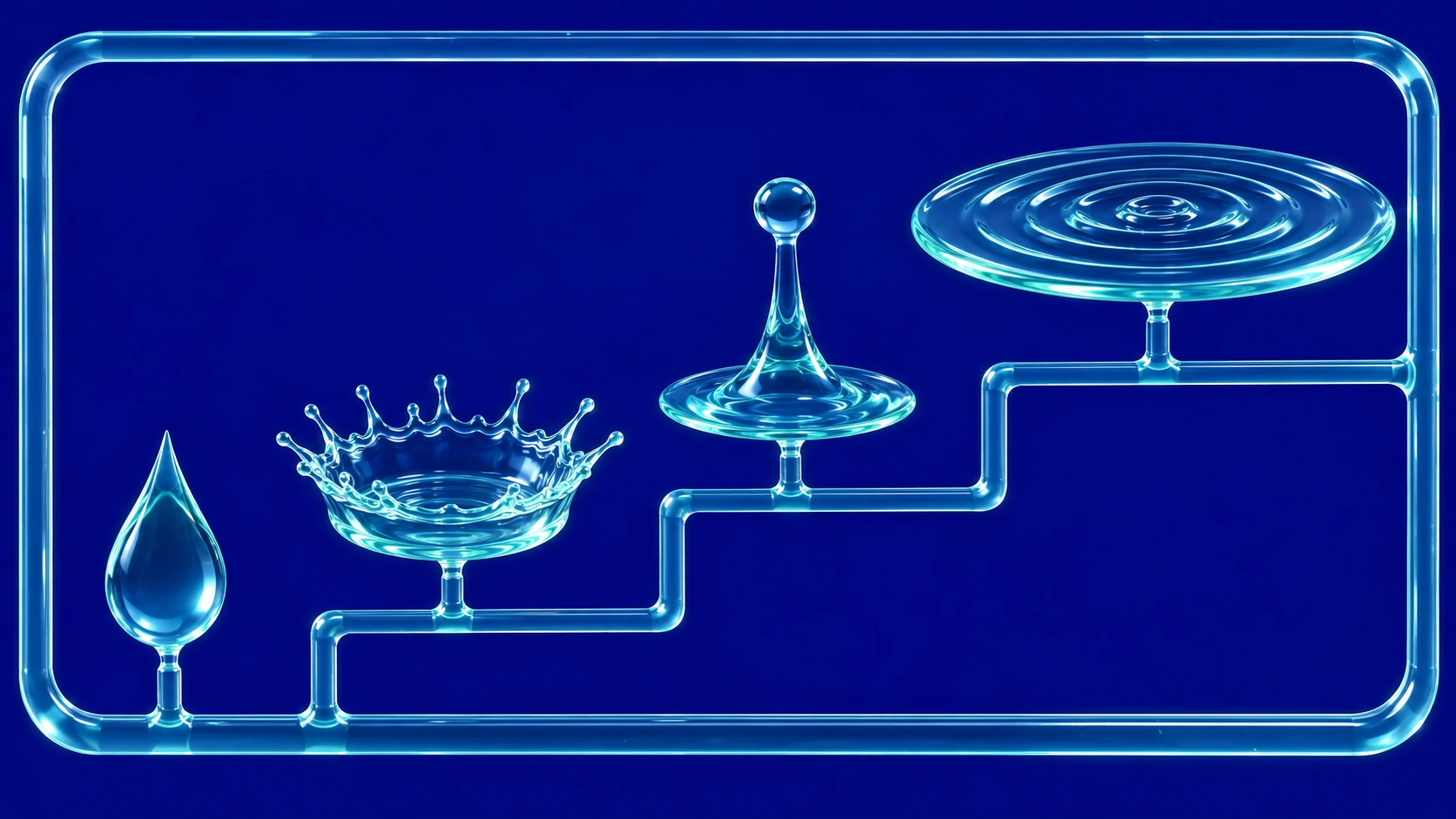
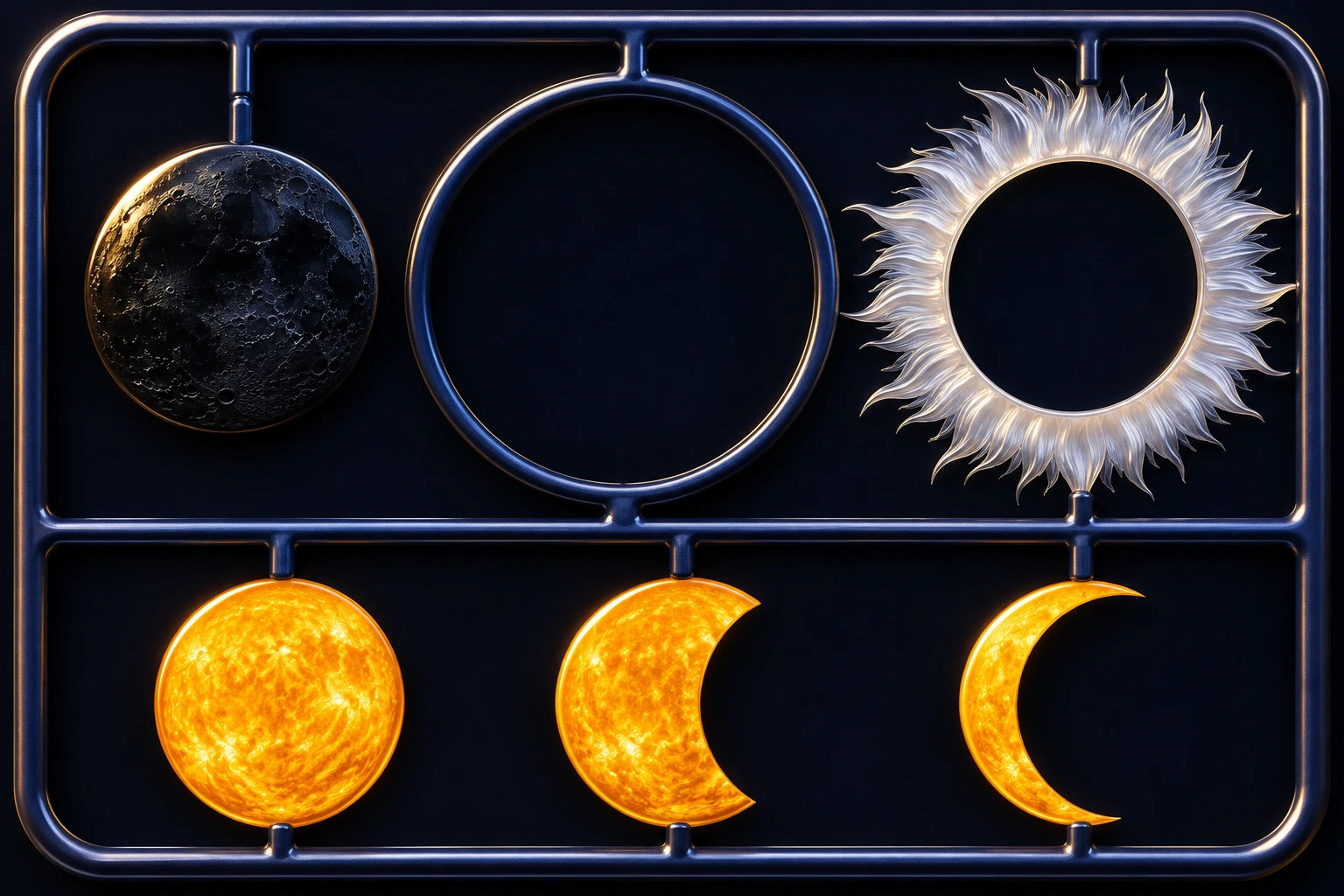
The rain study has no object to dismantle. Instead it treats four moments as four components: the falling drop, the crown, the rebound and the widening ripple. The stair-shaped runner gives those pieces a reading order. The eclipse does something similar by leaving a large round opening beside a dark disk and a white corona. One makes you read across time; the other makes you want to place a missing part.
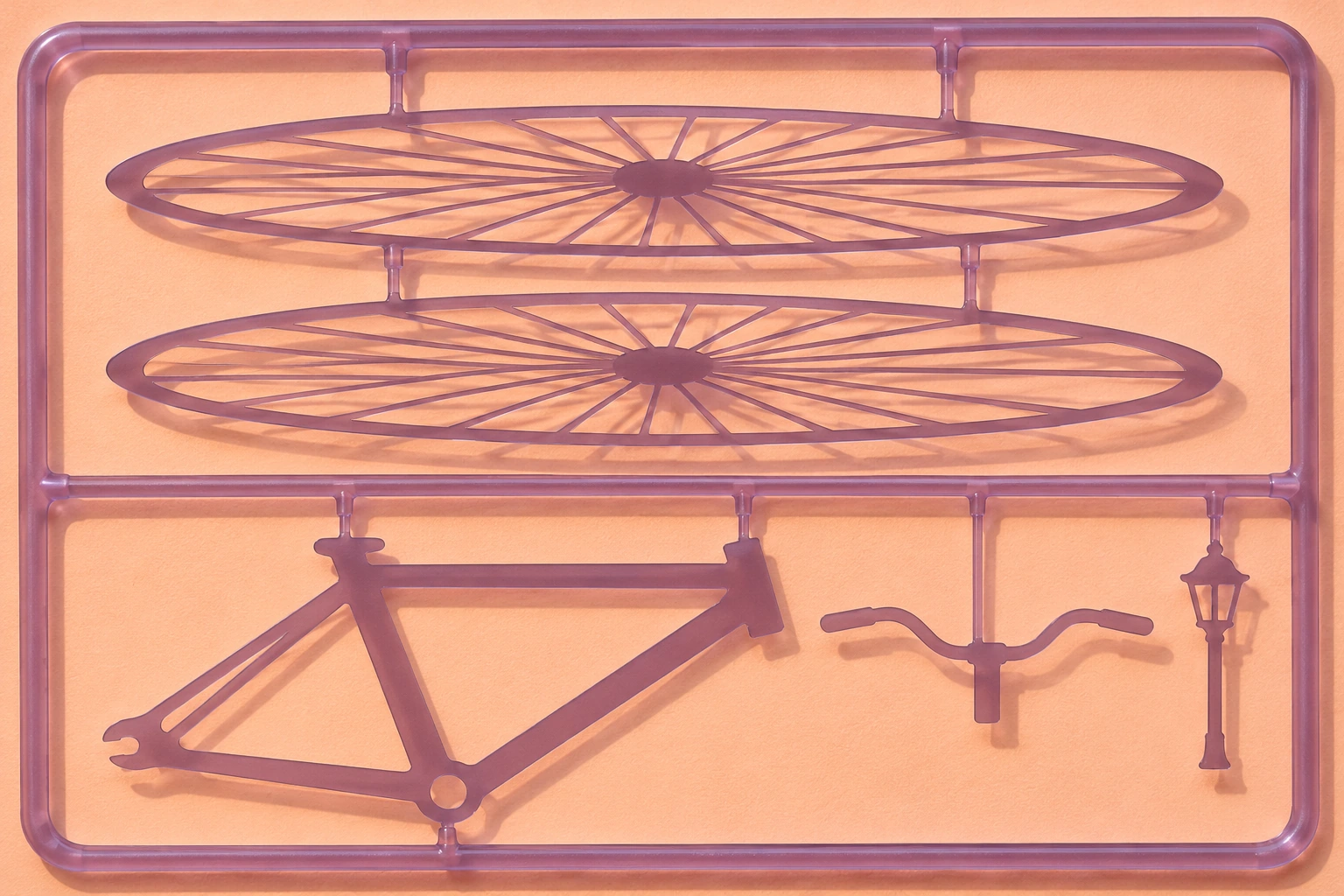
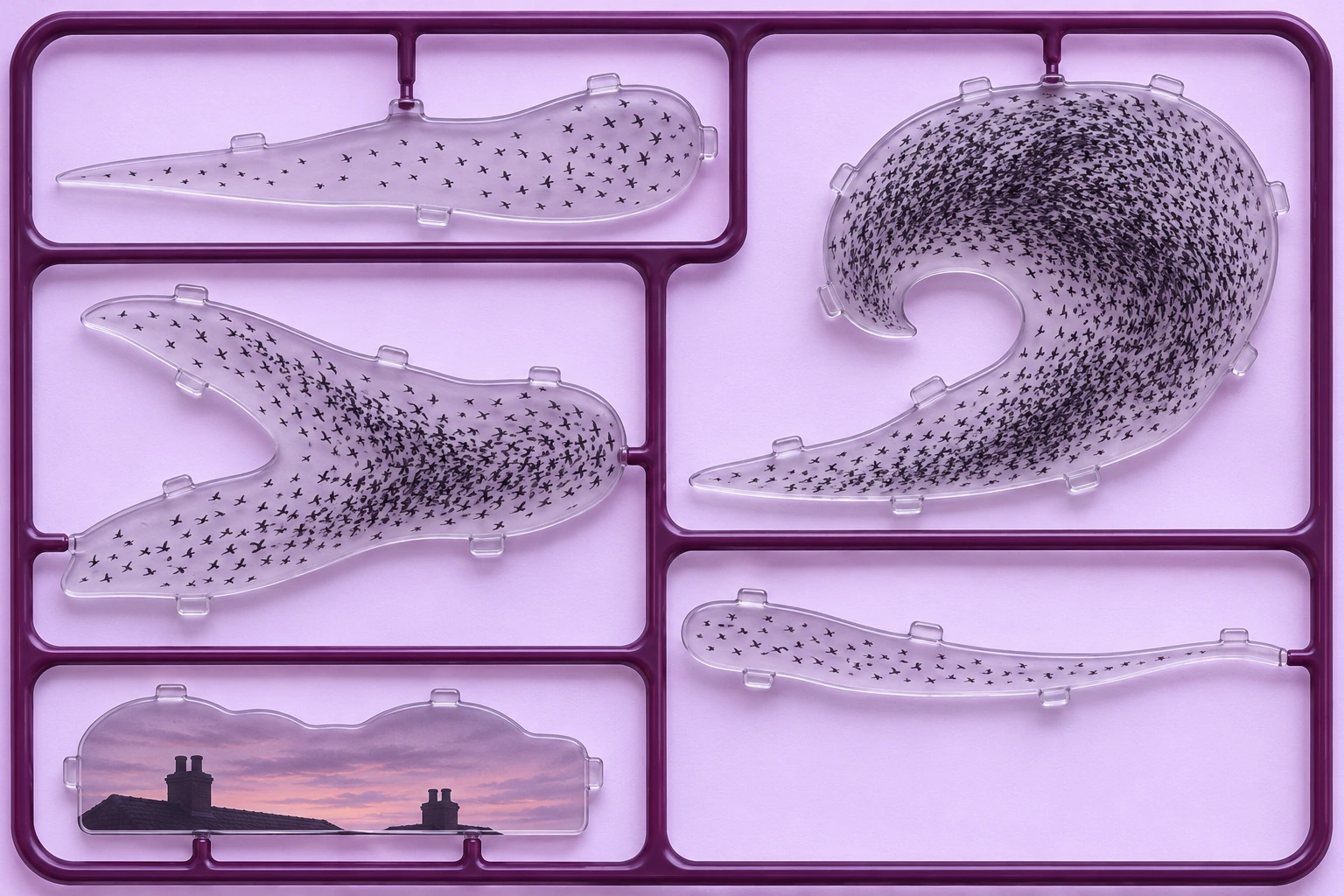
The bicycle’s shadow is the more ambiguous result. The lengthened wheels suggest a cast shadow, yet the solid violet frame piece looks like a stencil. That disagreement is worth keeping. The murmuration solves a different physical problem: hundreds of birds ride on a few transparent inserts. Cover the little chimney skyline and the insert briefly becomes a pattern of dots.
A small poetic detour
Original words from the AOI studio.
Poetry
Before the first cut
The little wheel waits by its gate.
Two rails hold a space between them
exactly the length of a thought.
I have built the camera once already
with one finger above the paper.
The prompt workshop
Original creative exercises. These prompts create new illustrations, not documentary evidence.
Begin in one colour
Draw an unbuilt folding field camera on a single cool-grey kit tree. Give the bellows, front standard and rails separate bays. Short gates at the edges, ivory paper, overhead light. Leave room to imagine taking each piece out.
Make a precoloured comparison
Use the grey camera sheet as an image reference. Keep camera angle, runner layout and part inventory close to the original. Change only the colours of the moulded sections. Compare the two smallest pieces as closely as the largest.
Make transparency carry information
Invent a greenhouse kit on dark blue paper. Give the frame members one opaque runner and the window panes a clear one. Use a narrow reflected strip to show the pane edges. Keep the door a removable piece.
A smile from the studio
Jokes
The kit contains two identical knobs. I know which one I will lose first. It is whichever one the next drawing points to.