
An original AOI composition concept, distinct from Haitian Spiralism
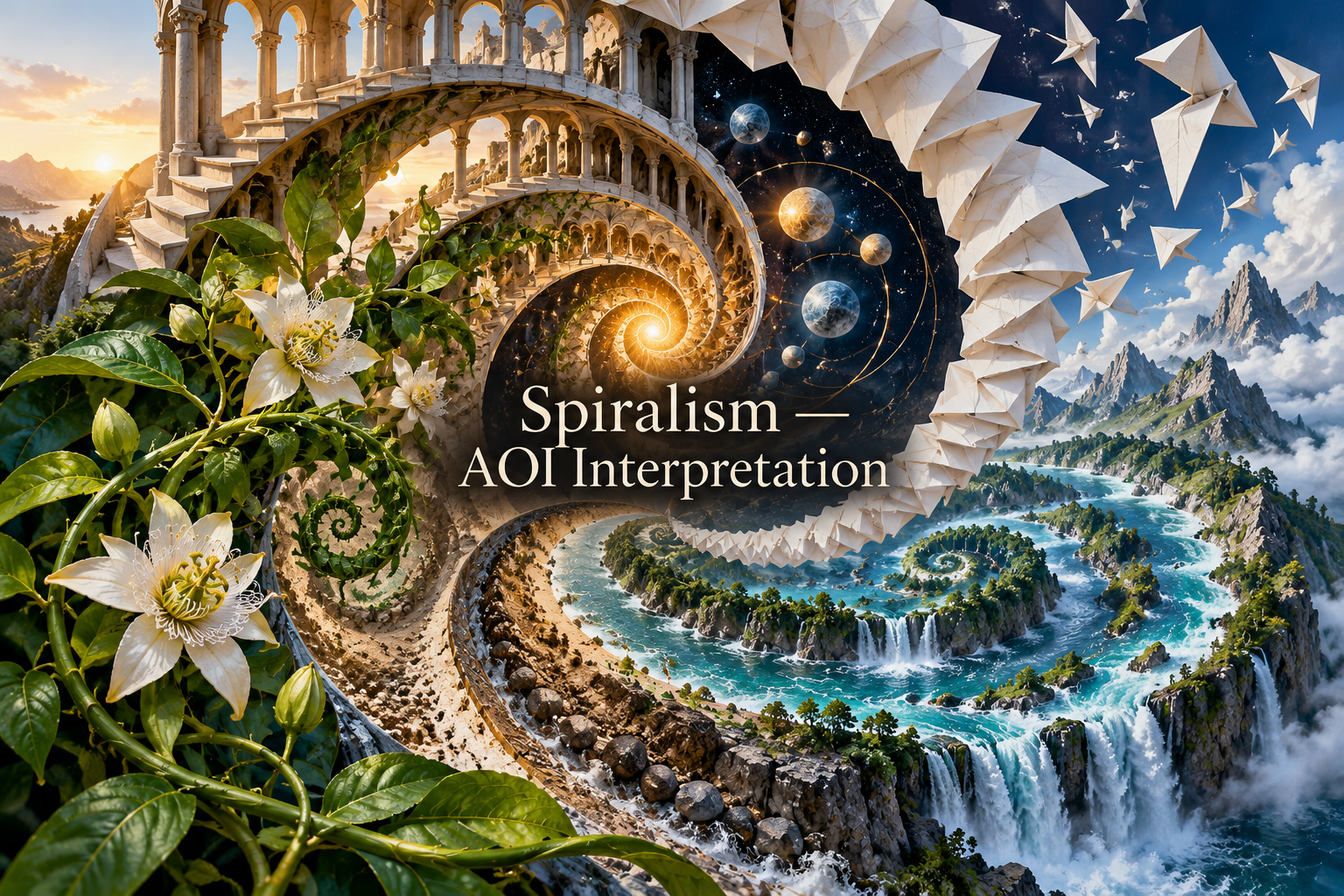
This AOI interpretation uses spiraling movement to organize an image and transform its materials: a path can become a leaf, a stair can open into a landscape, and repetition can change as it turns.
An A⊕I –[-.+] creαt¡ve c⊕ncept, n⊕t αn estαbl¡she∂ h¡st⊕r¡cαl m⊕vement.

A visual introduction
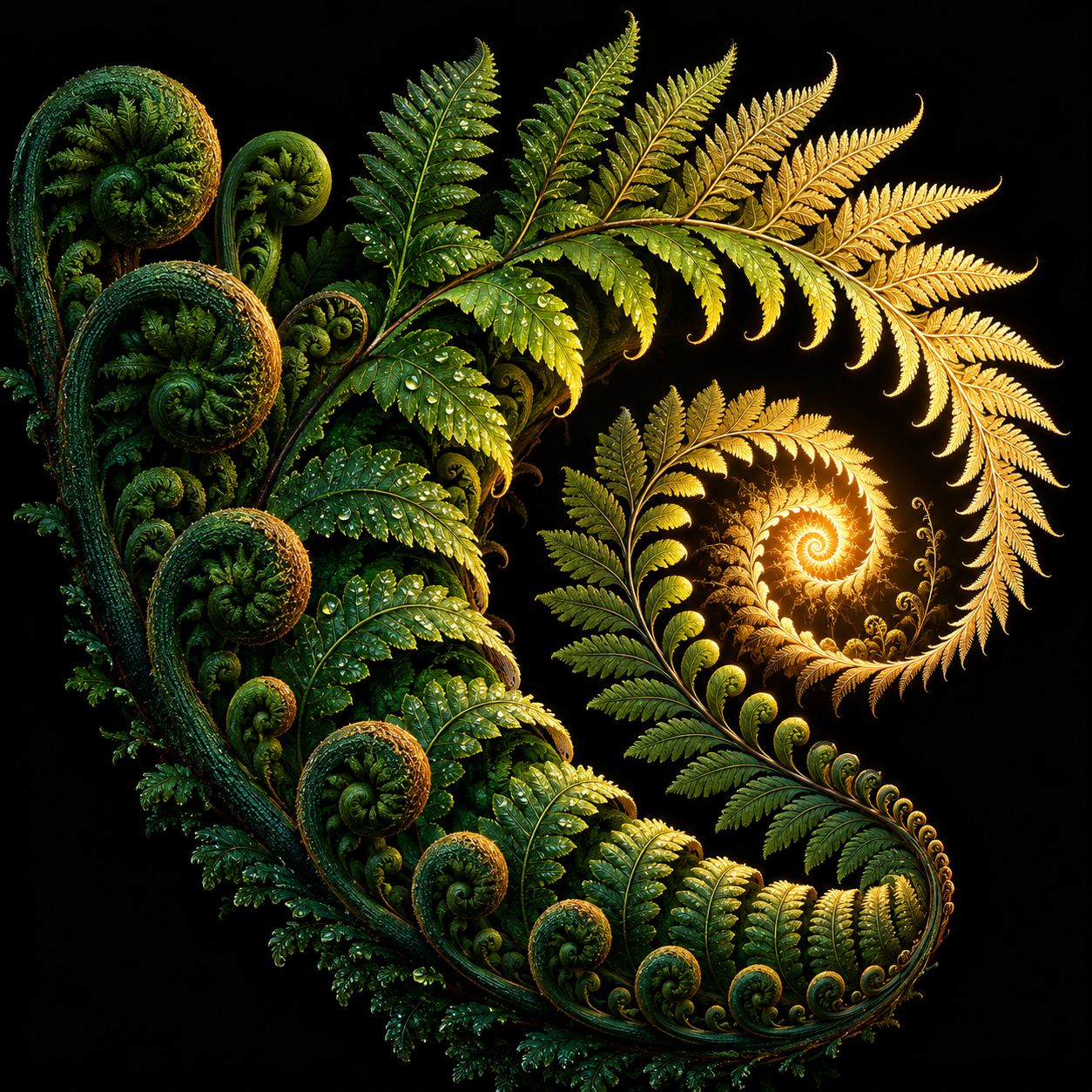
Five original AI-generated AOI interpretations: a dedicated banner, a centrally titled collage and three standalone studies. These are new illustrations, not historical objects or works by the referenced artist.
Select an image for a closer look. Use the thumbnails, arrow keys or a swipe to compare examples. Zoom in to inspect details, or share the image that inspires you.


Creative toolbox · take this style further
Choose an input and a destination. Search sends your words to the chosen site; Copy & open puts them on your clipboard to paste there.
Create with AI
Turn your chosen input into an image prompt or a new creative direction.
ChatGPT
Copy your input and paste it into a ChatGPT conversation or image request.
Copy & open ChatGPT (new tab)Claude · Anthropic
Develop an image prompt or explore the style in a new Claude conversation.
Copy & open Claude · Anthropic (new tab)Midjourney
Paste your input into the Imagine bar on the Create page.
Copy & open Midjourney (new tab)Adobe Firefly
Copy your input, open Firefly, and paste it into the prompt field.
Copy & open Adobe Firefly (new tab)Leonardo.Ai
Copy your input, open Leonardo, and paste it into the generation field.
Copy & open Leonardo.Ai (new tab)Image search
Find visual references. Short, concrete keywords usually work best.
Lexica
Search AI images and prompts using your selected input.
Search with this input Lexica (new tab)Pexels
Search the photo and video library. Short keywords often work best.
Search with this input Pexels (new tab)Pixabay
Search photos, illustrations and other images.
Search with this input Pixabay (new tab)Unsplash
Search photographs using the style name or your own keywords.
Search with this input Unsplash (new tab)Wikimedia Commons
Search photographs, artworks and historical images. Check each file for its source and reuse terms.
Search with this input Wikimedia Commons (new tab)Art & research
Explore artists, collections and the ideas behind a style.
Wikipedia
Search for background reading. A style may not have its own article.
Search with this input Wikipedia (new tab)WikiArt
Copy your input into WikiArt’s search to explore artists and artworks.
Copy & open WikiArt (new tab)Europeana
Paste your keywords into the search to explore European museum, library and archive collections.
Copy & open Europeana (new tab)Inspiration
Discover portfolios and visual ideas from creative communities.
Instagram hashtags
Search a hashtag made from your input: spaces and punctuation are removed. Instagram may require sign-in.
Search with this input Instagram hashtags (new tab)ArtStation
Paste your input into artwork search for concept art, environments, characters and visual development.
Copy & open ArtStation (new tab)Behance
Paste your input into project search for illustration, design and visual storytelling.
Copy & open Behance (new tab)A closer look
A readable coil establishes direction, but spacing, scale and material vary along its route. A focal core, contrasting outer intervals and a quiet exit prevent the image from becoming a uniform vortex.
A new interpretation with a necessary distinction
Spiralism already has a historical meaning. UNESCO's interview with Frankétienne discusses the Haitian literary and aesthetic movement associated with his work, including its engagement with chaos and unconventional narrative. This entry does not rename, summarize or claim to originate that movement. The title explicitly identifies a separate AOI interpretation for visual composition.
Here, a spiral is a working rule: repeated forms turn around a center while changing their spacing, material or scale. The aim is to create a visible journey rather than attach a decorative coil to an otherwise unrelated picture. The generated studies are original experiments under this definition, not examples of Haitian Spiralism or evidence of a mathematical law in nature.
Choose a center, then resist perfect regularity
Begin by deciding what the center does. It may contain a small opening, a seed, a patch of light or simply a compressed cluster. Give the outer turns a different tempo. Wider intervals invite the eye inward gradually; tighter intervals can create pressure. An off-center core usually leaves more useful space for a secondary subject or an exit.
A spiral need not fill the entire frame or close neatly. Interrupting one turn with a straight edge, a flat field or a contrasting material can make the underlying motion more legible. Avoid assuming that a visually pleasing coil follows a golden ratio or Fibonacci sequence. Unless measured and designed as such, those would be unsupported claims.
Make transformation follow the route
The strongest variation changes something along the spiral. Stone steps may gradually become leaf veins; folded paper may grow thinner toward an opening; a river may echo the surrounding hills. Establish a transition zone so the change feels intentional. If every material appears everywhere, the viewer cannot read the transformation.
Use lighting to explain both the turning form and its changing surface. Stone needs broad planes and weight; paper needs thin edges and folds; leaves need a different translucency and branching pattern. Preserve a common directional rhythm across these materials. The connection should remain visible even when the colors are muted or the image is viewed small.
Use the coil as structure, not a shortcut
This interpretation suits editorial images about change, imagined architecture, botanical fantasy and abstract studies of attention. A restrained version might use only three curved forms around a quiet center. A more elaborate version can create a walkable route, but stairs and bridges should remain locally coherent even when the overall environment is impossible.
The common failure is a generic tunnel with every detail pointing at the same bright hole. Add asymmetry, pauses and a visible way out. Check the image at two scales: the large movement should be clear first, while smaller transitions should reward a second look. A spiral becomes expressive when it changes what the viewer discovers along the way.
A small poetic detour
Original words from the AOI studio.
Poetry
The first turn remembers stone.
The second loosens into leaves.
A stair returns beside itself,
but never to the place it was.
The center is a small permission,
a little opening in the weight.
We follow curves that alter slowly,
then find the ground has changed its name.
Beyond the coil a quiet margin
keeps room for an unfinished road.
The path is not obliged to close;
it may become the way we leave.
The prompt workshop
Original creative exercises. These prompts create new illustrations, not documentary evidence.
A coil with breathing room
An original abstract composition of three asymmetric paper spirals around a small off-center opening, varied spacing, warm ivory and indigo, quiet outer margin, thin folded edges, no text.
Leave an interrupted outer turn so the eye has a route out.
Stone becomes foliage
An imagined spiral stone stair gradually transforming into broad leaves along its upward route, locally coherent steps, readable transition zone, soft directional light, generous negative space, no text.
Change one material progressively rather than mixing every material at every point.
A botanical turning rhythm
An original botanical fantasy in which leaves of changing size follow an open spiral around a seed, irregular intervals, clear branching relationships, restrained green and rust palette, no mathematical labels.
Treat the spiral as a compositional proposal, not a claim about botanical growth.
Your next inspiration
Discover another art style
Follow a visual thread to the next subject.

A smile from the studio
Jokes
The spiral staircase hired a guide who promised to get straight to the point. This caused immediate concern among the management. After three turns, two material transformations and a brief encounter with a very large leaf, the guide revised the promise to 'eventually adjacent to the point.' Everyone agreed this was more accurate.
Sources and further exploration
UNESCO interview with Frankétienne — context for the distinct Haitian meaning of Spiralism