
Generative-art technique
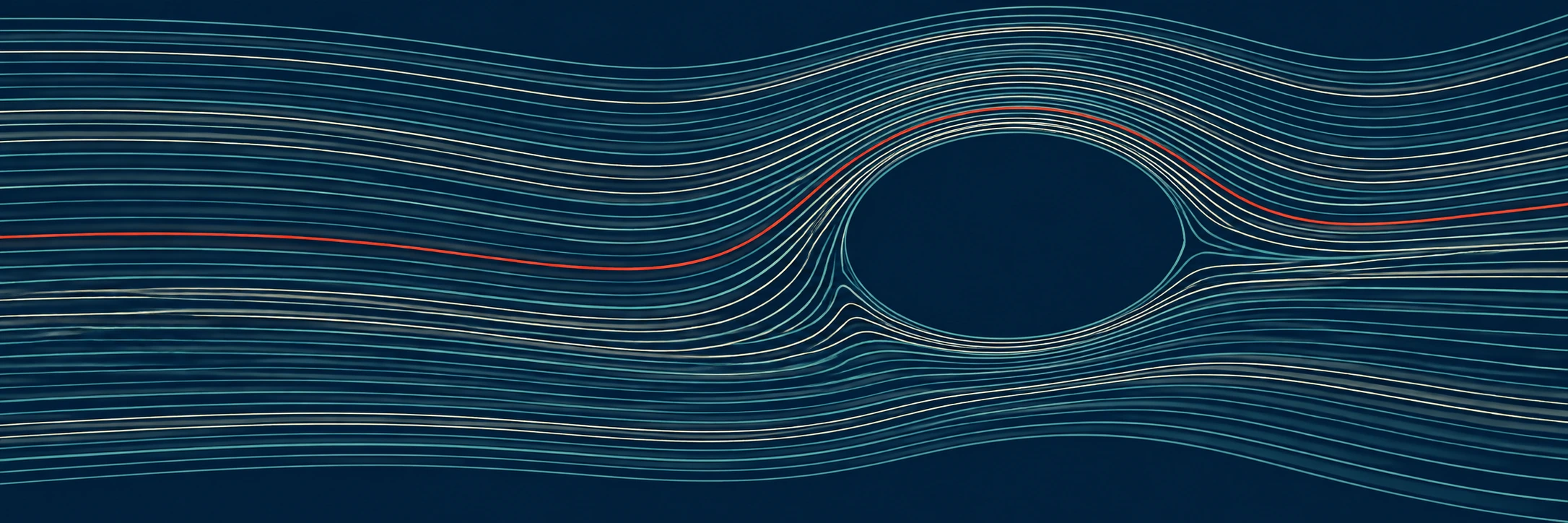
A flow field gives every location a direction. Lines or marks respond to those local directions, turning a simple rule into sweeping currents, quiet eddies and intricate rhythms. The image succeeds when the flow has structure and the composition has room to breathe.
A visual introduction
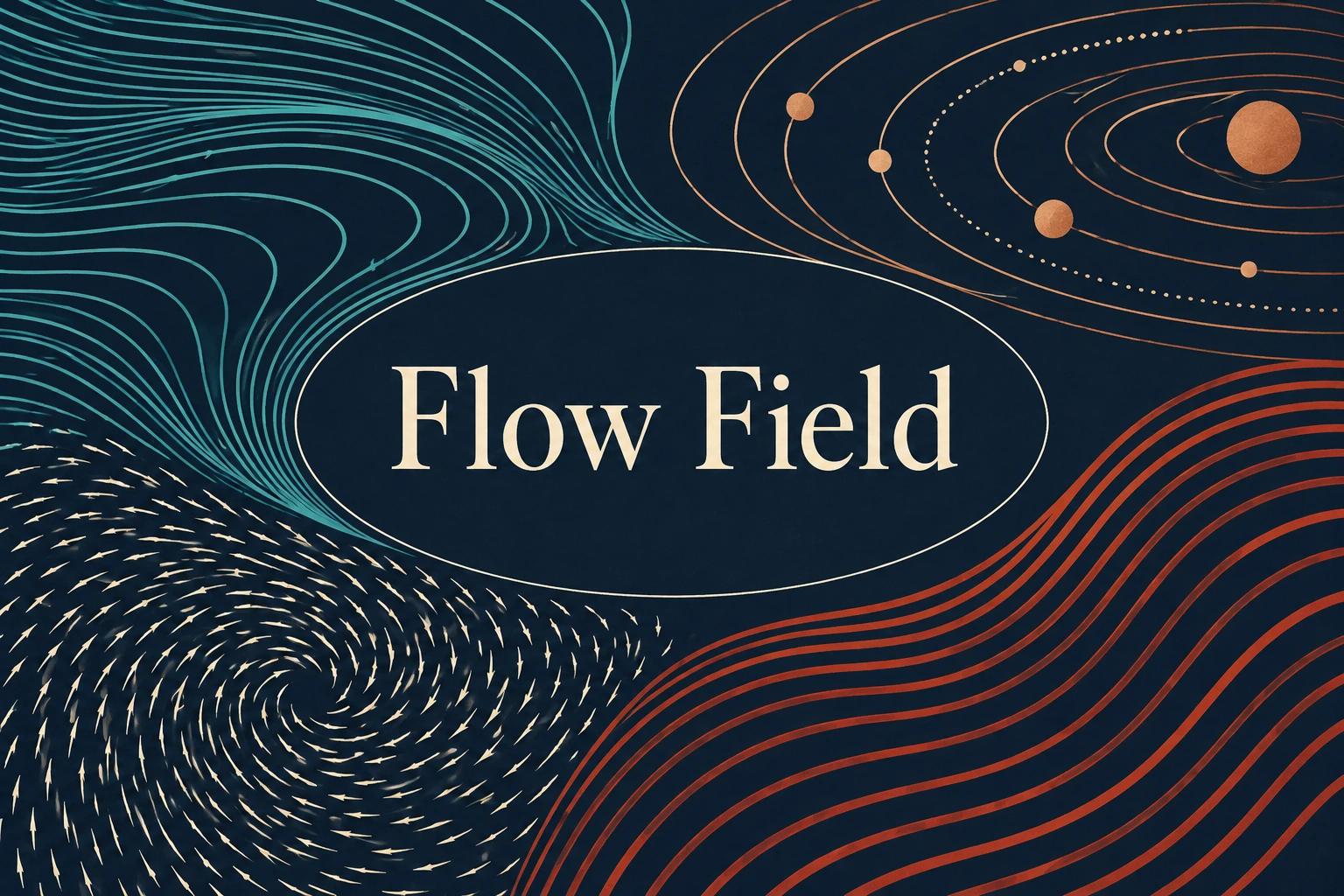
Five original AI-generated interpretations: a dedicated banner, a centrally titled collage and three standalone studies. See captions for the subject and medium distinction.
Select an image for a closer look. Use the thumbnails, arrow keys or a swipe to compare examples. Zoom in to inspect details, or share the image that inspires you.
Creative toolbox · take this style further
Choose an input and a destination. Search sends your words to the chosen site; Copy & open puts them on your clipboard to paste there.
Create with AI
Turn your chosen input into an image prompt or a new creative direction.
ChatGPT
Copy your input and paste it into a ChatGPT conversation or image request.
Copy & open ChatGPT (new tab)Claude · Anthropic
Develop an image prompt or explore the style in a new Claude conversation.
Copy & open Claude · Anthropic (new tab)Midjourney
Paste your input into the Imagine bar on the Create page.
Copy & open Midjourney (new tab)Adobe Firefly
Copy your input, open Firefly, and paste it into the prompt field.
Copy & open Adobe Firefly (new tab)Leonardo.Ai
Copy your input, open Leonardo, and paste it into the generation field.
Copy & open Leonardo.Ai (new tab)Image search
Find visual references. Short, concrete keywords usually work best.
Lexica
Search AI images and prompts using your selected input.
Search with this input Lexica (new tab)Pexels
Search the photo and video library. Short keywords often work best.
Search with this input Pexels (new tab)Pixabay
Search photos, illustrations and other images.
Search with this input Pixabay (new tab)Unsplash
Search photographs using the style name or your own keywords.
Search with this input Unsplash (new tab)Wikimedia Commons
Search photographs, artworks and historical images. Check each file for its source and reuse terms.
Search with this input Wikimedia Commons (new tab)Art & research
Explore artists, collections and the ideas behind a style.
Wikipedia
Search for background reading. A style may not have its own article.
Search with this input Wikipedia (new tab)WikiArt
Copy your input into WikiArt’s search to explore artists and artworks.
Copy & open WikiArt (new tab)Europeana
Paste your keywords into the search to explore European museum, library and archive collections.
Copy & open Europeana (new tab)Inspiration
Discover portfolios and visual ideas from creative communities.
Instagram hashtags
Search a hashtag made from your input: spaces and punctuation are removed. Instagram may require sign-in.
Search with this input Instagram hashtags (new tab)ArtStation
Paste your input into artwork search for concept art, environments, characters and visual development.
Copy & open ArtStation (new tab)Behance
Paste your input into project search for illustration, design and visual storytelling.
Copy & open Behance (new tab)A closer look
Locally aligned curves or short marks, gradual directional changes, controlled spacing, coherent bundles and deliberate areas of low density; colour reinforces the movement rather than hiding it.
A rule for movement, not a single signature look
In generative art, a flow field is a spatial arrangement of directions that can guide a drawing. Imagine placing a tiny compass at every point of a sheet: the compass tells a moving pen which way to go next. Many pens following the same underlying arrangement can produce a family of related paths. The result may resemble wind, hair, water or topography, but the resemblance does not mean the image measures any of those things.
Flow Field belongs here as a technique and visual approach, rather than a historical movement with one founder, palette or manifesto. A field may be described by a formula or sampled on a grid. The field itself is distinct from the marks used to reveal it. Long curves, tiny dashes, dots and broad bands can make very different pictures from similar directional information. AOI’s accompanying images interpret this visual language with image generation; they are not claimed to be outputs of a recorded vector-field program.
Technical context: tracing and steering
Tyler Hobbs’s 2020 essay Flow Fields explains a practical art-making method: store directions, choose starting positions and extend curves through repeated small steps. His examples show how line length, initial placement and field design change the character of the result. It is a useful artist’s account of the method, not evidence that flow fields began with that essay. The drawings reproduced in the source belong to Hobbs; the studies on this page are new AOI interpretations.
Daniel Shiffman’s The Nature of Code demonstrates a related approach using agents that read a local vector as their desired motion. Steering introduces an additional behaviour: an agent adjusts its velocity instead of necessarily following the local direction immediately. That distinction matters when describing an animation or trying to reproduce it. Direct curve tracing and agent steering are related tools, but their paths need not coincide.
What makes the image readable
Look first for agreement among neighbouring marks. When adjacent lines bend together, the eye reads a current. When their directions conflict without a visible reason, the image reads as tangled decoration. A convincing composition usually establishes one dominant journey across the frame, then interrupts it with a secondary turn, a widening gap or a quiet island. Those changes give the viewer a reason to keep looking after the initial impression of complexity.
Treat spacing as a compositional material. Closely packed lines create a dark mass even when each line is thin; a widening bundle can gradually reveal the background. A narrow pale channel between two dense regions may become the strongest shape in the picture. Before adding another colour, try changing where the marks begin and where they stop. Empty space should feel designed, not like an accidental hole left by an unfinished system. These are editorial design exercises, rather than claims about a universal algorithm.
Build a study one decision at a time
For a coded study, separate the field, the starting-point arrangement and the drawing rule. Hold two of those choices steady while changing the third. A useful first experiment is a uniform field, which exposes how line weight and density behave before any dramatic swirling begins. Then introduce one broad directional change. Keep a record of the program, parameters and any random seed if repeatability is part of the project; a compelling screenshot alone cannot reconstruct the process.
For an image-generation study, describe the visible result instead of pretending to specify executable mathematics. Ask for smooth locally aligned lines, a clear route through the image, a particular density contrast and a restricted palette. Inspect the result for stray crossings, inexplicable endpoints and curves that turn abruptly inside an otherwise smooth bundle. An AI illustration can communicate the aesthetic while failing the stricter test of whether every curve follows one mathematically consistent field. Label the result accordingly.
Palette, scale and useful variations
Begin with a strong value relationship: dark lines on pale paper, or pale lines on a dark ground. Reserve a brighter colour for a small number of paths so it describes emphasis rather than turning every mark into a competing event. Judge the image at its intended output size. Lines that look elegant at full resolution may merge into a flat grey area when reduced; large bundles and deliberate voids should remain legible in a gallery thumbnail.
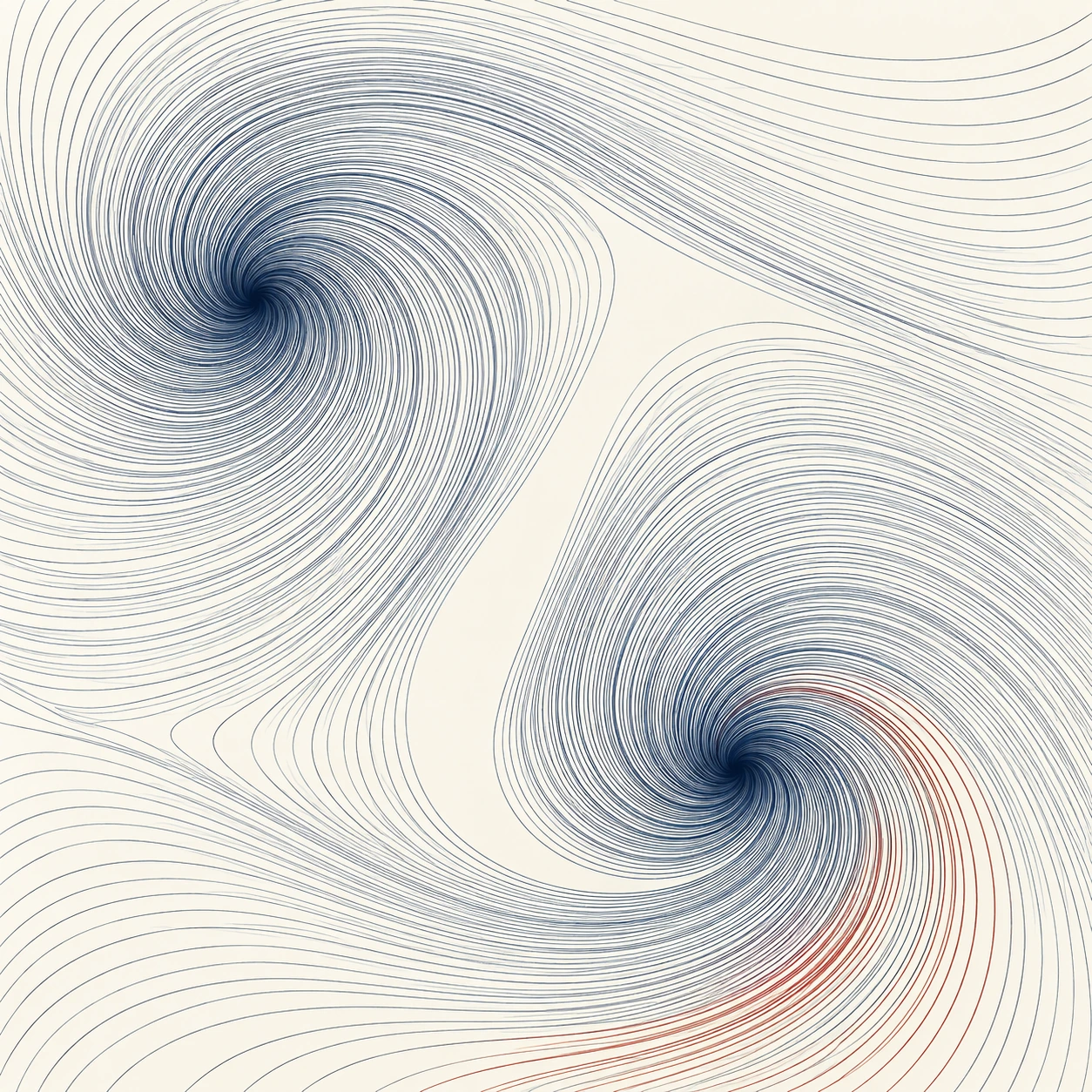
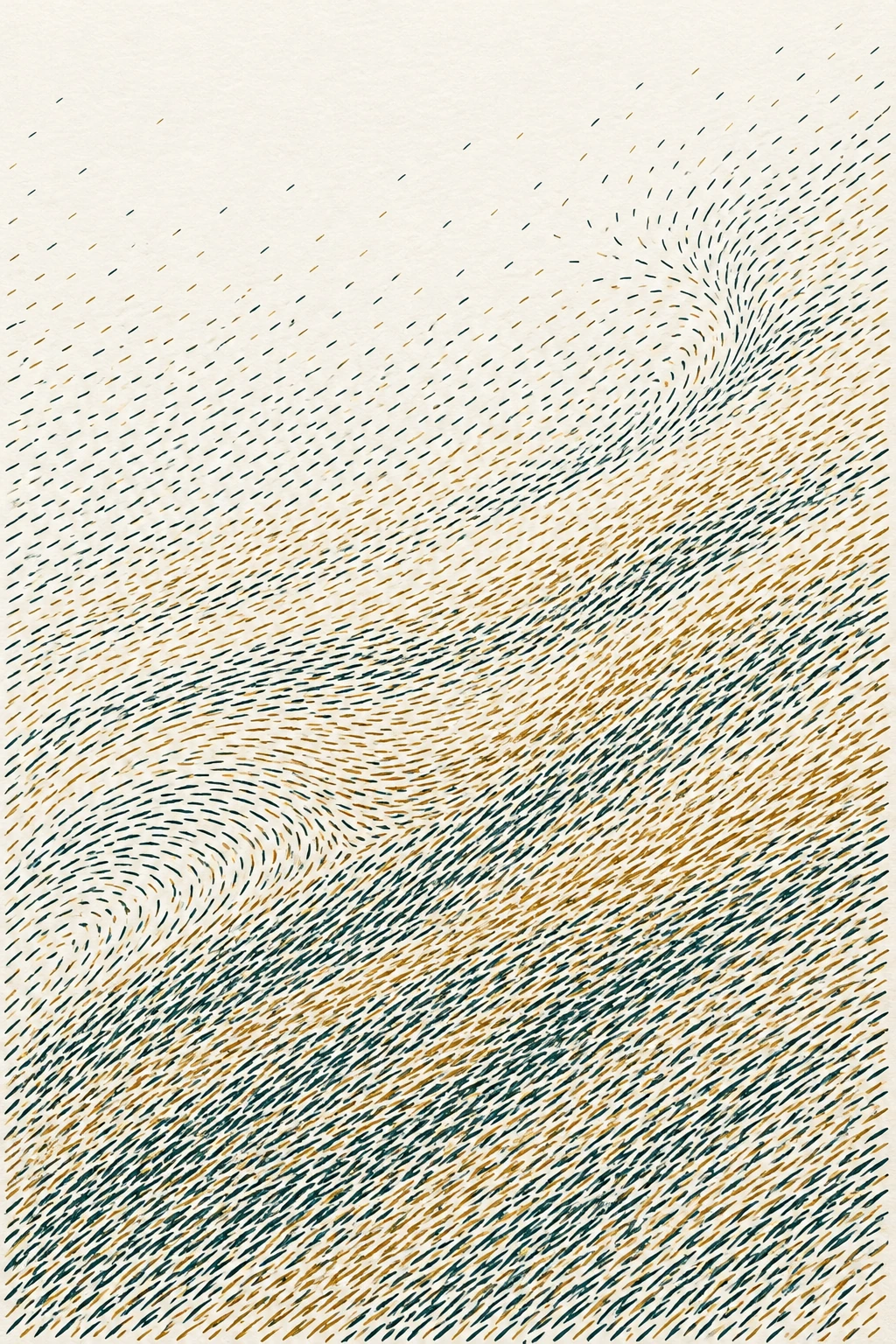
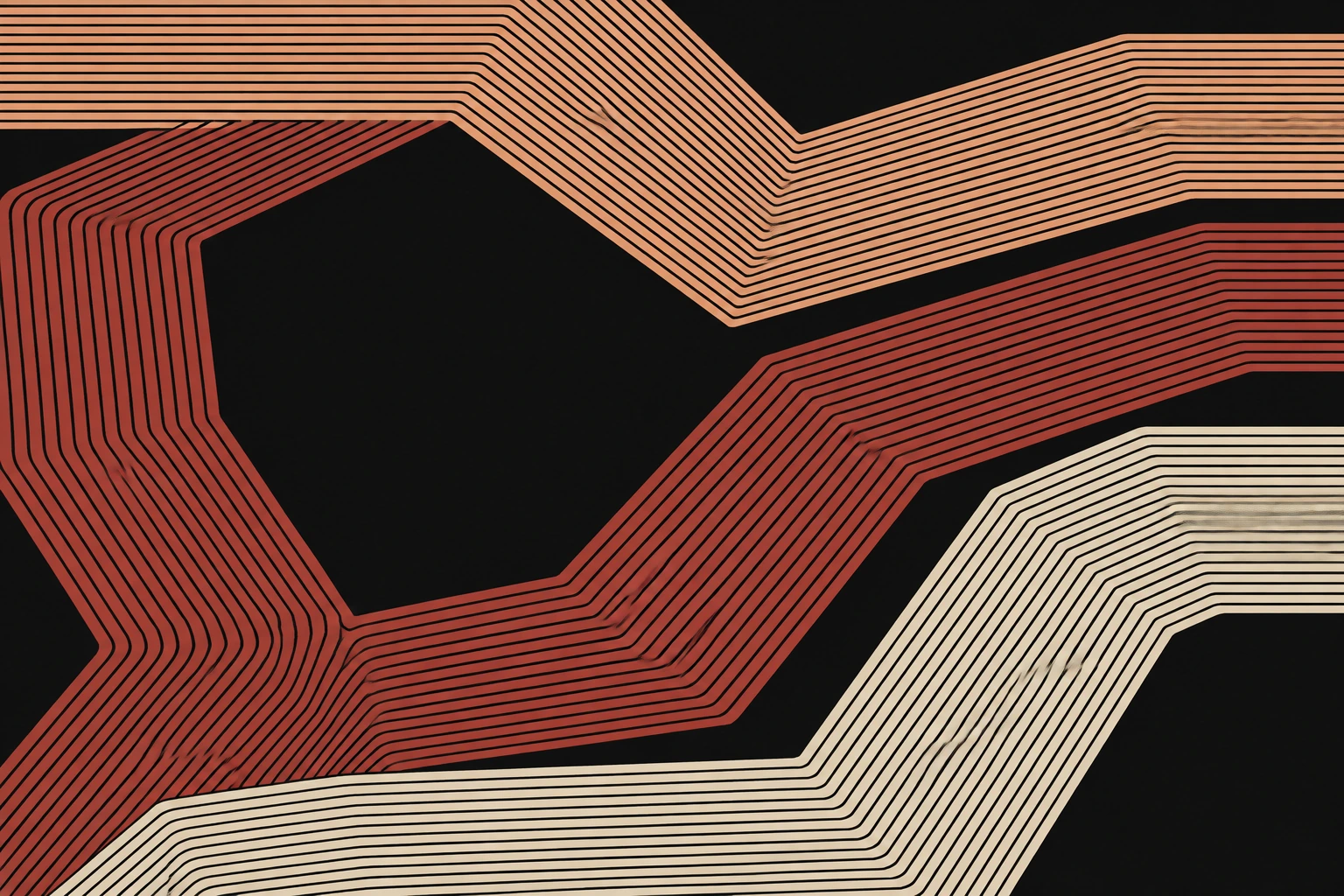
The AOI studies explore three visual problems: curved turning regions, short directional marks and angular bands. The first emphasizes continuous movement, the second uses orientation to create texture, and the third tests what happens when directional changes become visibly faceted. A change of mark or turning behaviour is more informative than ten palette swaps. Try describing each study without mentioning its colours; if the descriptions are identical, the set probably needs more structural variety.
Applications and the limits of the metaphor
Flow-field imagery can suit abstract prints, editorial covers, motion identities and backgrounds that need a strong directional rhythm. It is particularly useful when an image should suggest coordination without depicting a literal object. Give text a genuinely quiet region, and keep important boundaries away from the busiest part of the field. Decorative complexity should support the communication rather than simply occupy the available pixels.
The common cliché is the same soft swirl repeated without a compositional decision. Another is to call any curving line pattern a simulation. A flow-field aesthetic does not by itself establish fluid dynamics, physical accuracy or data provenance. If an illustration represents measured wind or another real quantity, its directions, scales and source data require a separate verification process. For an abstract artwork, the better question is simpler: does the pattern guide attention, reward close inspection and still make a strong whole?
Pocket-sized facts
A flow field supplies local directions; the drawing rule determines how those directions become marks.
Directly tracing a field and steering an agent toward a field direction are related but distinct procedures.
The AOI images are AI-generated visual interpretations, not verified plots of an implemented field.
Examples worth exploring
Tyler Hobbs’s Flow Fields essay presents varied uses of the method and names the artworks shown; consult the original rather than assigning those titles to generated images.
A small poetic detour
Original words from the AOI studio.
Poetry
Ode to a Direction
No river owns this turning,
no weather signed the page.
A thousand small agreements
make a current from a stage.
One line gives way to silence,
one bends and travels on;
the space between the travellers
is where the light is drawn.
Leave room beside the motion.
Let the crowded voices thin.
The field has no destination,
but a drawing lets us in.
The prompt workshop
Original creative exercises. These prompts create new illustrations, not documentary evidence.
Start simple: one current and one quiet island
Create a flat flow-field-inspired drawing of fine ivory and teal lines on deep indigo. Let neighbouring lines bend together around one oval area of empty background. Use a single narrow vermilion bundle as an accent. Keep the flow readable at thumbnail size. No arrows, text, neon or three-dimensional ribbons.
This requests an aesthetic interpretation. A reproducible field requires code and recorded parameters.
Explore texture with short directional marks
Arrange many short separate teal and ochre dashes on warm pale paper. Their orientations should follow broad diagonal currents with two gentle turning zones. Vary density while leaving the upper third quiet. Keep the marks crisp and separated, with no literal landscape and no text.
Compare local alignment, not just the overall colour cloud.
Experiment: deliberately angular flow
Compose broad bands of tightly spaced parallel cream, apricot and brick-red lines on a near-black ground. Give the bands long straight runs joined by deliberate faceted turns. Reserve a large irregular dark void left of centre. Flat graphic artwork, no fabric shading, no smoke, no lettering.
Test whether the angular changes create structure instead of looking like accidental broken curves.
People & works to explore
References discussed in this article. Consult the sources below for context.
Artists and practitioners
Tyler Hobbs — practitioner and author of the cited flow-field essay.
A smile from the studio
Jokes
The line asked for creative freedom. The field replied: certainly—locally.