
Art and cultural context · researched guide
Art in Slovakia encompasses changing artistic practices rather than one timeless rural aesthetic. The Slovak National Gallery provides an entry through modernism, individual works and the institutions that preserve them. This guide pairs that research route with a critical reading of our synthetic archive collage.
A visual introduction
Open any image to look closer, then browse the examples.
A closer look
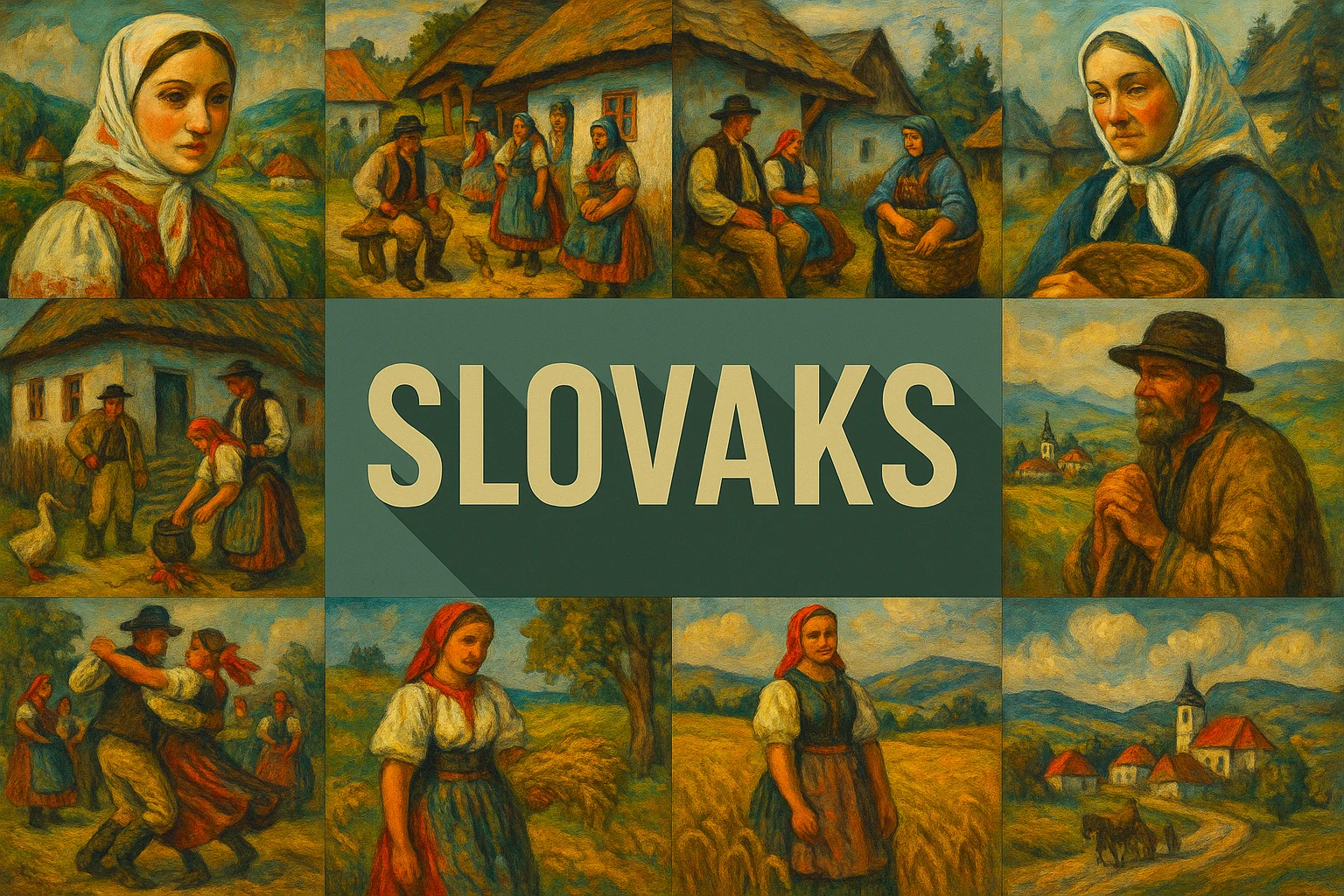
The collage repeats headscarves, cottages, field work and a musician in warm ochre and blue. Its brushlike texture makes the scenes feel as though they belong to one painted world. They are AI-generated illustrations, not works by the artists discussed below or reliable records of historical clothing.
Give modernism a period and a context
The Slovak National Gallery’s account of The Modern focuses on visual art in Slovakia during the first half of the twentieth century, especially developments between around 1890–1900 and 1948. It presents artistic responses to social and cultural change across different media. This is a historically framed inquiry, not an explanation based on national temperament. [1]
The cited display includes Mikuláš Galanda’s Landscape with a Chair (1929–1930), Ester Šimerová-Martinčeková’s Harbour in Dieppe (1931), and Ľudovít Fulla’s Song and Labour (1934–1935). Their titles alone suggest different subjects; the linked gallery account is the place to begin examining the works themselves. None is reproduced in our AOI collage. [1]
A collection leaves room for different questions
The gallery’s modern and contemporary painting collection was established after the institution’s foundation in 1948. Its selection of examples places Fulla’s Song and Labour alongside Martin Benka’s Na pole (1934) and Július Koller’s Otáznik (1969). A collection can connect such works historically without claiming that their visual methods are the same. [2]
Choose two documented works and compare the role of the figure, the amount of empty space and the handling of edges. Then read their records. What changes when you know the date and medium? Keep a distinction between what you observe and what you learn from the source. It is possible to have a strong interpretation without pretending that every detail is self-evident.
The building matters too
The Slovak National Gallery announced the start of restoration at the Ľudovít Fulla Gallery in Ružomberok on 15 June 2026. Its notice says the building had been closed since 2022 and the artworks moved into storage. The project was estimated to take 24 months from handover. This guide therefore directs readers to the official notice rather than presenting the gallery as an immediately available visit. [3]
That practical detail belongs in an art guide because access shapes what can be encountered. A collection may survive while its usual home is unavailable, and digital records become especially useful during that interval. An estimated construction period should not be converted into a guaranteed reopening date. Check the institution for updates.
Let the collage disclose its limitations
Our synthetic illustration makes rural scenes seem continuous and unchanging. The same colours recur in the clothing, roofs and fields. This is a coherent design choice, but it leaves little room for urban life, experimentation or disagreement. Those absences are limits of this illustration; they are not conclusions about Slovak art.
For a practical exercise, make two original images of the same familiar place: one organised around descriptive detail, the other around a few simplified shapes. Compare what each version brings forward and suppresses. Label generated work as generated, and use documented sources for historical claims. Looking becomes more interesting when the country label opens a conversation instead of closing it.
People & works to explore
References discussed in this article. Consult the sources below for context.
Artists and practitioners
Mikuláš Galanda — Landscape with a Chair
Ester Šimerová-Martinčeková — Harbour in Dieppe
Ľudovít Fulla — Song and Labour
Paintings and other works
Landscape with a Chair (1929–1930)
Harbour in Dieppe (1931)
Song and Labour (1934–1935)