
Maritime craft · incised drawing and decorated objects
Scrimshaw turns a small polished surface into a place for ships, portraits, flowers and private messages. This researched guide follows its maritime history, the marks that make it recognisable, and the limits of translating a material craft into AI-generated images.
A visual introduction
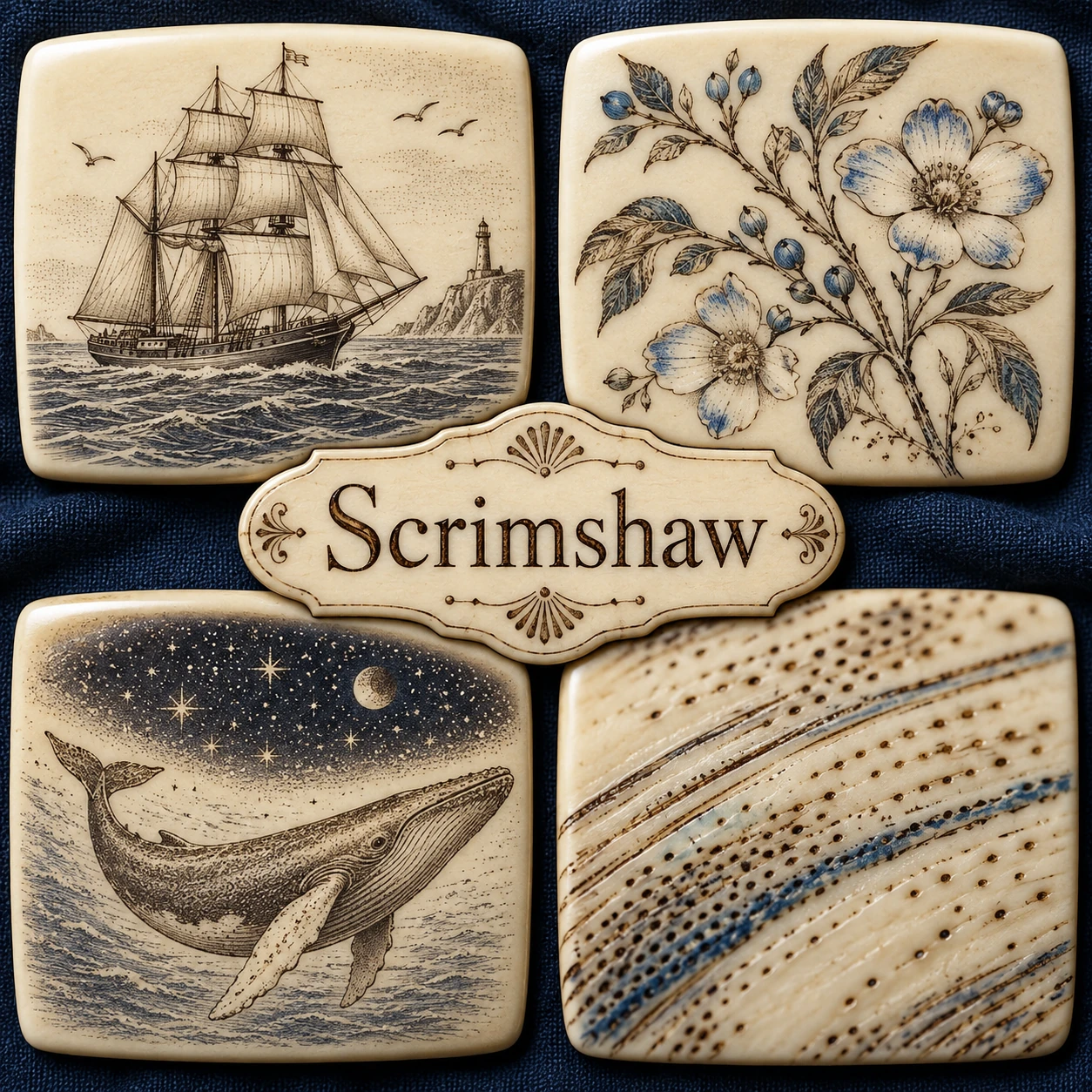
The new centered-title collage introduces the style. The previous collage is retained as Line and Surface Studies, alongside The Sea Remembers and the panoramic header. All four images are clearly labeled AI-generated interpretations.
Select an image for a closer look. Use the thumbnails, arrow keys or a swipe to compare examples. Zoom in to inspect details, or share the image that inspires you.
Creative toolbox · take this style further
Choose an input and a destination. Search sends your words to the chosen site; Copy & open puts them on your clipboard to paste there.
Create with AI
Turn your chosen input into an image prompt or a new creative direction.
ChatGPT
Copy your input and paste it into a ChatGPT conversation or image request.
Copy & open ChatGPT (new tab)Claude · Anthropic
Develop an image prompt or explore the style in a new Claude conversation.
Copy & open Claude · Anthropic (new tab)Midjourney
Paste your input into the Imagine bar on the Create page.
Copy & open Midjourney (new tab)Adobe Firefly
Copy your input, open Firefly, and paste it into the prompt field.
Copy & open Adobe Firefly (new tab)Leonardo.Ai
Copy your input, open Leonardo, and paste it into the generation field.
Copy & open Leonardo.Ai (new tab)Image search
Find visual references. Short, concrete keywords usually work best.
Lexica
Search AI images and prompts using your selected input.
Search with this input Lexica (new tab)Pexels
Search the photo and video library. Short keywords often work best.
Search with this input Pexels (new tab)Pixabay
Search photos, illustrations and other images.
Search with this input Pixabay (new tab)Unsplash
Search photographs using the style name or your own keywords.
Search with this input Unsplash (new tab)Wikimedia Commons
Search photographs, artworks and historical images. Check each file for its source and reuse terms.
Search with this input Wikimedia Commons (new tab)Art & research
Explore artists, collections and the ideas behind a style.
Wikipedia
Search for background reading. A style may not have its own article.
Search with this input Wikipedia (new tab)WikiArt
Copy your input into WikiArt’s search to explore artists and artworks.
Copy & open WikiArt (new tab)Europeana
Paste your keywords into the search to explore European museum, library and archive collections.
Copy & open Europeana (new tab)Inspiration
Discover portfolios and visual ideas from creative communities.
Instagram hashtags
Search a hashtag made from your input: spaces and punctuation are removed. Instagram may require sign-in.
Search with this input Instagram hashtags (new tab)ArtStation
Paste your input into artwork search for concept art, environments, characters and visual development.
Copy & open ArtStation (new tab)Behance
Paste your input into project search for illustration, design and visual storytelling.
Copy & open Behance (new tab)A closer look
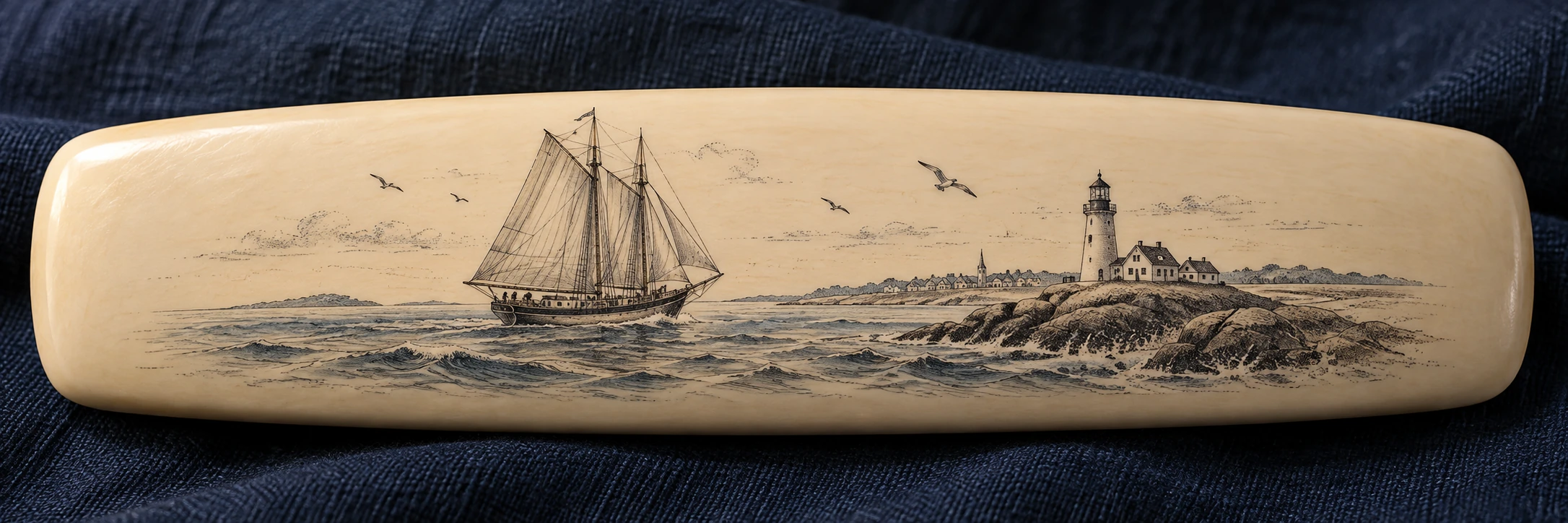
Fine dark lines and stippled points stand against a pale ground; the support’s curve and edge remain part of the composition. Our header, named collage and two additional examples are AI-generated studies of imagined resin objects, not photographs of historical scrimshaw.
What is scrimshaw?
Scrimshaw is a maritime craft tradition encompassing decorated and fashioned objects, especially those associated with whaling. Its best-known pictorial form uses incised marks darkened with pigment on a pale, polished surface. Historically, whale teeth, skeletal bone and baleen were among the materials; the category also reaches beyond them. It belongs here as an established craft and visual language, rather than a painting movement with a manifesto. The Powerhouse collection explicitly cautions against restricting the term to engraved whale teeth. [1]
For image-making, the essential relationship is between the small mark and the substantial object carrying it. A scratch becomes a rope; a few punctures gather into a cloud; an untouched interval supplies the light. I like an art that can make a convincing sea without insisting that every available millimetre become weather. The patience is visible, even when the subject is moving.
History: resist the single-inventor story
Nineteenth-century commercial whaling provides the central setting for much familiar pictorial scrimshaw. Yet a confident claim that one American sailor invented it would flatten the evidence. New Bedford Whaling Museum identifies British South Sea whalers among its early practitioners. Royal Museums Greenwich dates its unsigned tooth AAA0022 to circa 1810, using the vessels’ rig and construction as clues. An approximate catalogue date is evidence to discuss, not an exact birthday for an entire tradition. [2][3]
There is an older and wider history of working marine materials. Cape Cod National Seashore explicitly points to Wampanoag practice preceding the whaling industry. New Bedford’s The Wider World & Scrimshaw places whaling objects in conversation with living Indigenous traditions and Pacific and Arctic exchange. It features work by Aquinnah Wampanoag artists Jonathan James-Perry and Patricia James-Perry. These connections deserve named communities and specific objects, not a vague label applied to every carved object from the sea. [4][5]
The distinction matters when researching an image. “Whaling-era scrimshaw” is a useful collecting category. It does not make all Indigenous carving a branch of that category, nor does an unidentified maker give us permission to assign a convenient nationality. Read the object record before borrowing its story. Where an attribution is uncertain, leave that uncertainty visible.
How the surface carries the picture
The Powerhouse describes preparation through smoothing and polishing, followed by incision with available pointed or bladed tools. Pigment darkens the recesses; removing excess reveals the drawing. A less obvious detail is image transfer: printed illustrations could be pricked through, with the resulting points connected on the object. The same collection discusses both freehand and borrowed imagery, and objects ranging from pie-crust crimpers to work boxes. Scrimshaw was not confined to ships or pictures intended only for display. [1]
For this guide’s visual exercises, distinguish three effects. Contour describes an edge, hatching builds a dark region with repeated lines, and stippling builds one with separated points. A convincing generated study should let you see which is doing the work. If every shadow becomes a smooth photographic gradient, the object may still be attractive, but the pictured technique has become harder to read.
Surface curvature is equally useful. A straight horizon in the drawing can bend visually as it follows a convex support. Light falls across the support as well as across the invented scene. That produces two kinds of space: the small world inside the image and the real-looking object in front of you. Ask a generator for both deliberately. Otherwise it may helpfully convert a miniature into an enormous landscape with a cream border.
Three museum encounters worth slowing down for
Start with Greenwich’s AAA0022. One side combines a whaler and small boats in a hunting scene; the other carries warships and a harbour. The two-sided object asks for turning and comparison, something a single flat reproduction can hide. Its maker is recorded as unknown. For close study, separate what the catalogue identifies from what you think you recognise in a small online photograph. [3]
Next consider the decorated busks in New Bedford’s exhibition: narrow supports associated with dress could carry flowers, personal messages and other imagery. One baleen example, inscribed with the name John Gibbs, includes a navigation chart. The museum asks whether Gibbs made it or received it, and how its maker encountered that knowledge. This is a particularly good research habit: let the evidence generate questions instead of polishing ambiguity into biography. [5]
For an identified scrimshander, Frederick Myrick offers a different route into the subject. Mystic Seaport’s research bibliography points readers to a catalogue raisonné of his “Susan’s Teeth” and a separate study of their physical characteristics. That separation is instructive. A name, a ship and an appealing story are only the beginning; material details, inscriptions and construction demand their own work. Our generated illustrations on this page are not reconstructions of Myrick’s objects. [6]
Beauty, labour and the animal behind the material
These objects can be exquisite without making their industry innocent. New Bedford’s exhibition explicitly connects commercial extraction to environmental damage and the lives of Native communities. “Byproduct” tells us where a material entered a production chain; it does not remove the whale from the chain. An honest guide can admire the marks while keeping that history in view. [5]
For our new illustrations, we chose imagined synthetic-resin supports. That is a design brief, not a laboratory identification: an AI image cannot prove what a physical object is made of, because there is no physical object to test. The pictures are labelled accordingly. They offer a way to explore the visual relationship of pale surface and dark incision without presenting newly sourced animal material as a creative requirement.
If you want an accessible physical starting point, the National Park Service demonstrates a paper-based interpretation, using scratched marks and dark pigment. That is a learning exercise, not an antique-making recipe. Keep material claims, actual handwork and digital simulation separate in the caption. Precise language does a surprising amount of conservation work for very little ink. [4]
Reading our header, named collage and two examples
The header stretches a coastal panorama across a long, gently curved plaque. Notice the clear band above the rigging: the ship needs that quiet interval to remain legible. The dark cloth belongs to the staging, while the brown-black lines belong to the imagined decoration. Confusing those two layers is one of the quickest ways to get a plausible photograph of an implausible object.
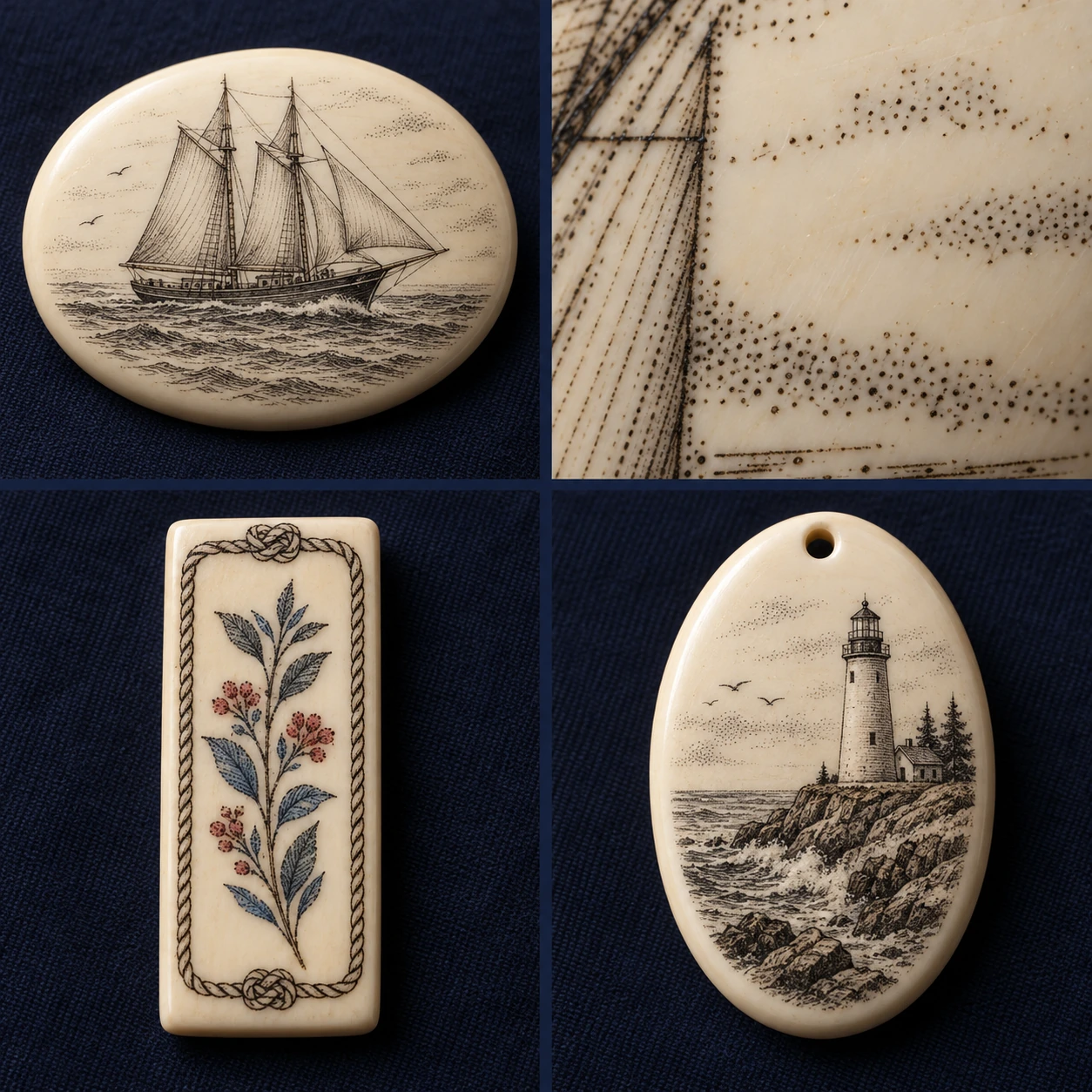
The new collage places Scrimshaw at its center and compares a sailing scene, a botanical sprig, a whale and a close view of incised-looking marks. The earlier four-panel image remains available under its new name, Line and Surface Studies (Example): it moves from a sailing scene to dots and lines, a botanical keepsake and a lighthouse pendant. Compare mark density and the spacing of unworked surface across both images.
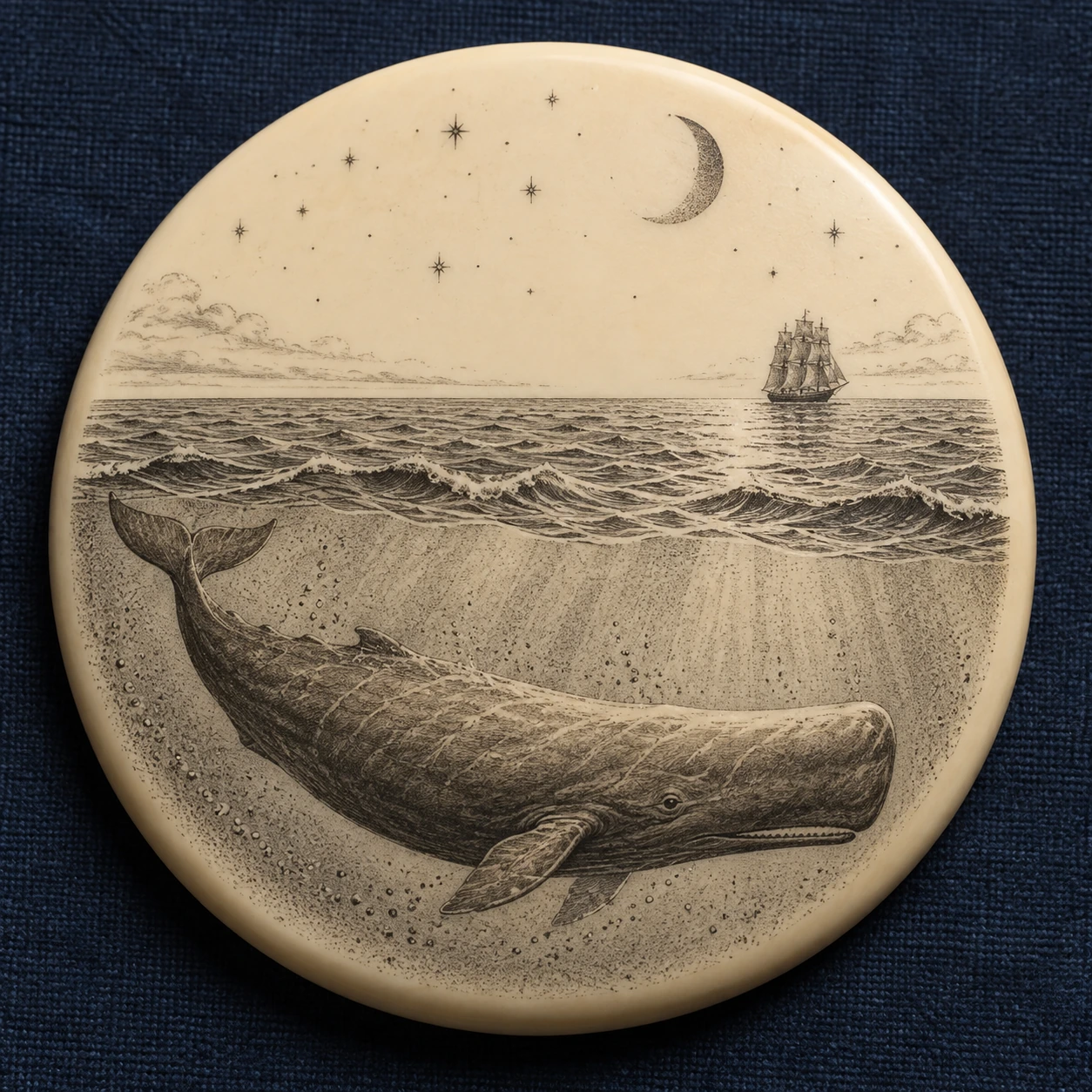
The Sea Remembers takes a more openly invented approach. A large whale occupies the lower field, with a tiny vessel and crescent above. It gives the animal pictorial weight instead of reducing it to a source of material. This is our contemporary visual argument, not an interpretation attributed to a historical maker. The moon, horizon and underwater view form a poetic composite rather than a record of an observed event.
Usability in AI art generation
Scrimshaw is useful in AI art when you want the image to feel held by an object: a pendant, keepsake panel, small box lid or imagined museum display. Start with the support and mark-making, then name the subject. “Fine pigment-filled incisions and stippled points on a gently convex cream resin plaque” gives the model more to work with than “scrimshaw, masterpiece, ultra-detailed.” The latter is a request for enthusiasm. Enthusiasm is not a material specification.
Expect several recurring failure modes. The model may substitute raised relief for shallow lines, make the object look like paper, add unreadable inscriptions, or turn subtle material texture into dramatic cracks. Rigging may join impossible points, and a macro crop may show dots that sit on top of the surface rather than marks within it. Inspect the result at full size. Attractive output can still contradict the process you meant to describe.
Separate a flat design study from a photographed-object study. For the first, ask for a clean monochrome motif with controlled line density and generous negative space. For the second, add the support’s edge, curvature, lighting and surrounding material. Do not demand a front-on diagram and a dramatic three-quarter product view in the same sentence unless you deliberately want a compromise.
Contemporary subjects can work beautifully. Try a tiny lunar observatory, a moth among garden plants or an imaginary harbour. Preserve the discipline of the marks rather than treating historical iconography as compulsory. Describe the output as scrimshaw-inspired digital art. It cannot establish an object’s age, maker, species, provenance or hand-carved status. Nor is a generated design automatically a usable engraving file: any physical fabrication needs its own redraw, material testing and tool-specific preparation.
A small exercise in restraint
Make three versions of the same lighthouse. In the first, describe it with contours only. In the second, add sparse stippling on one side. In the third, add a small region of crosshatching beneath the rock. Keep the object, viewpoint and lighting as consistent as your tool allows, and record the prompt changes. A model may alter other details anyway; compare the actual results rather than assuming the experiment was perfectly controlled.
Then reduce each version to the size of a pendant on screen. Which still reads? Which collapses into grey? Return to the larger image and inspect where the marks became crowded. This gives you a practical selection criterion beyond “more detail.” The final choice may be the least busy one. Management will survive this reduction in output.
My favourite detail remains the untouched surface. It makes the rigging possible; it gives the whale room; it declines to explain itself. Leave some of it alone. A sea should have somewhere to go.
The prompt workshop
Original creative exercises. These prompts create new illustrations, not documentary evidence.
Starting point: a readable miniature
Scrimshaw-inspired digital concept, small oval cream synthetic-resin plaque, one lighthouse and rocky shore drawn with fine dark pigment-filled shallow incisions, sparse stippling, generous unmarked space, complete object visible on navy linen, gentle raking light, no text, no raised relief.
Original AOI exercise. Generated appearance is not evidence of historical manufacture or material identity.
Richer composition: a keepsake garden
Imagined contemporary scrimshaw-inspired resin keepsake panel, botanical sprig with delicate incised contour and stippled leaves, restrained muted blue and red accents, thin ornamental border, smooth polished cream surface, visible narrow edge, balanced negative space, no tooth, no antique attribution, no lettering.
Original AOI exercise. Generated appearance is not evidence of historical manufacture or material identity.
Experiment: a lunar harbour
Original science-fiction scrimshaw-inspired miniature on an imagined animal-free cream resin medallion, tiny lunar observatory beneath a ringed planet, fine black-brown scratches and separated stippled dots, scene follows the gentle curvature, only one dense shadow region, quiet blank sky, photographed object study, no relief carving or fake signature.
Original AOI exercise. Generated appearance is not evidence of historical manufacture or material identity.
Your next inspiration
Discover another art style
Follow a visual thread to the next subject.
People & works to explore
References discussed in this article. Consult the sources below for context.
Artists and practitioners
Frederick Myrick — identified scrimshander; specialist catalogues listed by Mystic Seaport [6]
Patricia James-Perry — Aquinnah Wampanoag artist whose scrimshaw pin appears in The Wider World & Scrimshaw [5]
Unknown makers — retain the catalogue’s attribution where a name is not established
Paintings and other works
Whale tooth AAA0022 — unknown maker, circa 1810, Royal Museums Greenwich [3]
Whale tooth depicting a woman E1390 — unknown maker, nineteenth century, Powerhouse [1]
John Gibbs busk 1957.4.2 — maker uncertain, nineteenth century, New Bedford Whaling Museum [5]
Sources and further exploration
[1] Powerhouse — Whale tooth scrimshaw depicting a woman, E1390
[2] New Bedford Whaling Museum — Art and Literature
[3] Royal Museums Greenwich — Whale tooth, AAA0022, circa 1810
[4] National Park Service — Make Your Own Scrimshaw
[5] New Bedford Whaling Museum — The Wider World & Scrimshaw