
Art and cultural context · researched guide
Art in Poland includes many periods, media and arguments about what art can be. This introduction follows the National Museum in Warsaw from painting and design into a sculpture collection that also engages installation and performance. The aim is a useful research route, not a single Polish visual formula.
A visual introduction
Open any image to look closer, then browse the examples.
A closer look
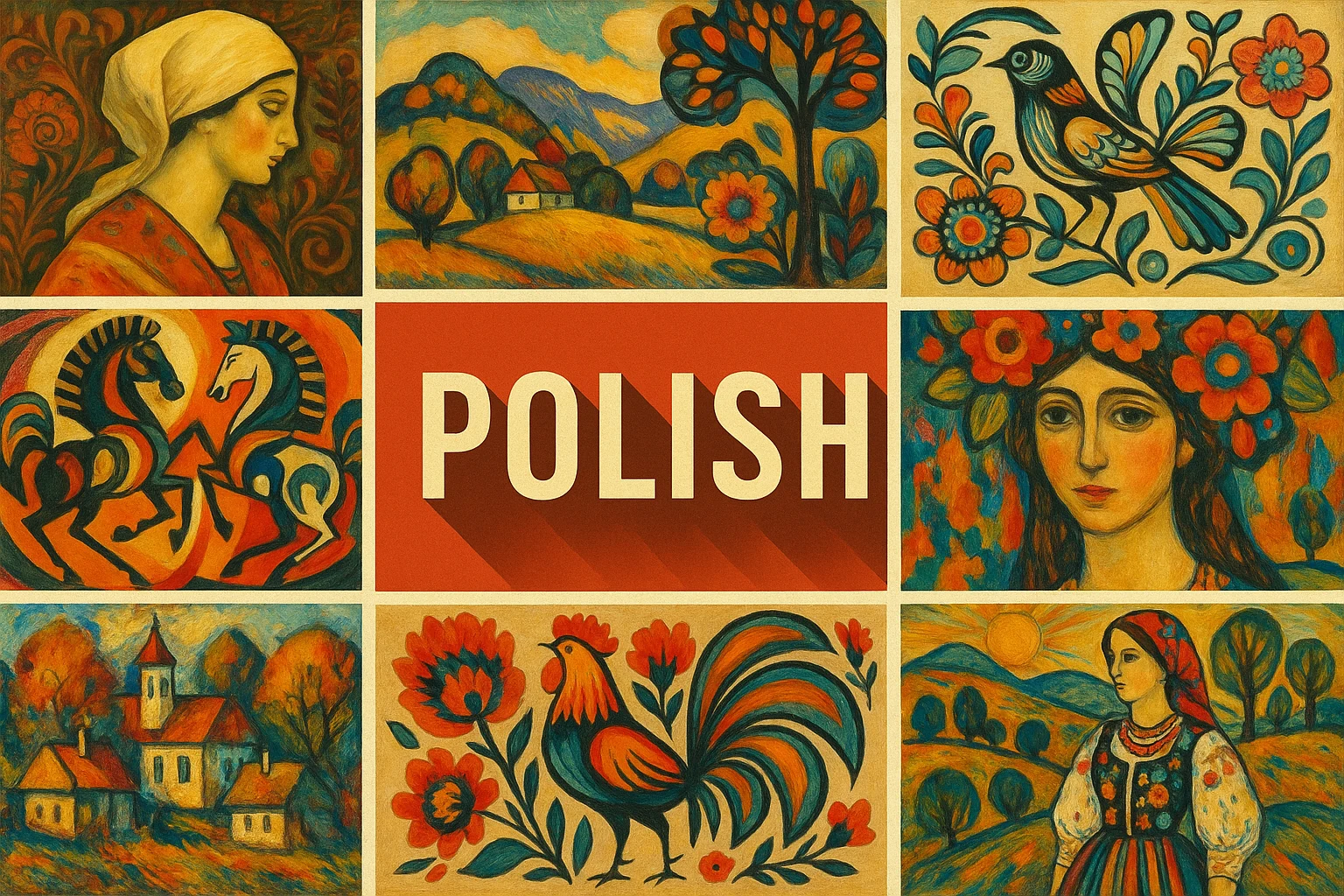
The AI archive collage combines invented portraits, cottages, flowers, horses and birds in red, teal and ochre. Flat ornament alternates with painterly landscapes. Its decorative unity is a feature of the generated image, not evidence of one national style or the provenance of a regional craft.
A national museum is not a national style chart
The National Museum in Warsaw describes collections ranging from antiquity to the present and including art from Poland and other parts of the world. Its permanent gallery overview distinguishes, among other areas, nineteenth-century art and Polish design. Location, collection scope and an object’s origin are different pieces of information. [1][2]
Begin with a medium or a question. A designed household object may invite discussion of manufacture and use, while a history painting may organise a public narrative through figures and gesture. Putting both under the heading Polish art is a useful filing decision. It is not a description of what either object actually does.
Modern and contemporary means more than recent painting
The museum’s contemporary collection account describes painting and works on paper, and notes that it began building a collection of video and multimedia documentation of performance and artistic actions in 2012. The same page says its twentieth- and twenty-first-century gallery is currently unavailable to the public; check the museum before planning a visit. This availability note was reviewed on 3 October 2026. [3]
A collection record and an open exhibition are not the same thing. Online research can introduce works that are not on display, and documentation can preserve aspects of an event without recreating the event itself. Always identify whether the object you are studying is a painting, a recording, a photograph of an installation or another form of evidence.
Sculpture changes the question
The Królikarnia museum’s contemporary sculpture collection explicitly considers sculpture as an object and as part of performance or installation. Its account names artists including Katarzyna Kobro, Maria Pinińska-Bereś and Joanna Rajkowska within a heterogeneous collection. Their inclusion offers several directions for research, not a claim that their practices are equivalent. [4]
When looking at a documented sculpture, ask how it relates to the viewer’s body and to the space around it. Can you understand it from one position? Does the photograph conceal its scale, material or surroundings? These questions help resist the tendency to treat every artwork as an image designed for a screen.
Use ornament carefully
The rooster, horses and flowers in our collage may prompt associations with folk decoration, but the synthetic image does not identify a regional workshop, technique or historical object. We therefore make no authenticity claim for those motifs. If your project concerns a specific tradition, find a documented example with a place, maker where known, date and material.
For a purely contemporary exercise, invent a small decorative system from two shapes and repeat it across a page. Describe it as your own pattern study. If you later draw on a particular documented source, credit that source and explain what you changed. A useful guide should increase the precision of your attention, not make a familiar-looking pattern stand in for an entire country.
People & works to explore
References discussed in this article. Consult the sources below for context.
Artists and practitioners
Katarzyna Kobro — represented in the cited sculpture collection
Maria Pinińska-Bereś — represented in the cited sculpture collection
Joanna Rajkowska — represented in the cited sculpture collection