
Established
Neoplasticism, or Neo-Plasticism, was Piet Mondrian’s theory of how a painting could hold unequal forces in balance. A long black line, a small blue plane and the white between them could each pull their weight.
A visual introduction
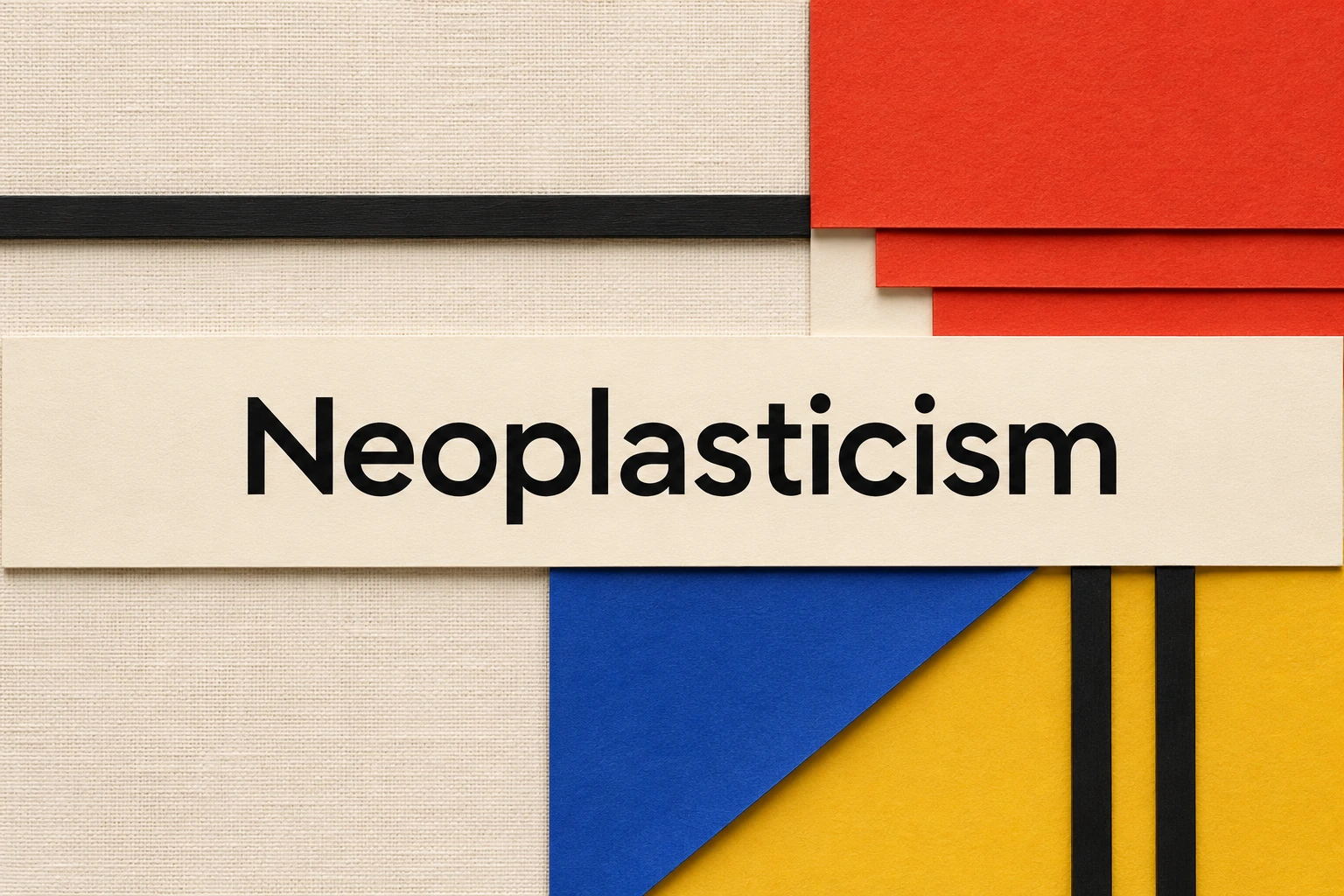
Compare the archive painting with the paired divider study. The titled paper collage translates those flat relationships into layers that cast shadows.
Select an image for a closer look. Use the thumbnails, arrow keys or a swipe to compare examples. Zoom in to inspect details, or share the image that inspires you.

Creative toolbox · take this style further
Choose an input and a destination. Search sends your words to the chosen site; Copy & open puts them on your clipboard to paste there.
Create with AI
Turn your chosen input into an image prompt or a new creative direction.
ChatGPT
Copy your input and paste it into a ChatGPT conversation or image request.
Copy & open ChatGPT (new tab)Claude · Anthropic
Develop an image prompt or explore the style in a new Claude conversation.
Copy & open Claude · Anthropic (new tab)Midjourney
Paste your input into the Imagine bar on the Create page.
Copy & open Midjourney (new tab)Adobe Firefly
Copy your input, open Firefly, and paste it into the prompt field.
Copy & open Adobe Firefly (new tab)Leonardo.Ai
Copy your input, open Leonardo, and paste it into the generation field.
Copy & open Leonardo.Ai (new tab)Image search
Find visual references. Short, concrete keywords usually work best.
Lexica
Search AI images and prompts using your selected input.
Search with this input Lexica (new tab)Pexels
Search the photo and video library. Short keywords often work best.
Search with this input Pexels (new tab)Pixabay
Search photos, illustrations and other images.
Search with this input Pixabay (new tab)Unsplash
Search photographs using the style name or your own keywords.
Search with this input Unsplash (new tab)Wikimedia Commons
Search photographs, artworks and historical images. Check each file for its source and reuse terms.
Search with this input Wikimedia Commons (new tab)Art & research
Explore artists, collections and the ideas behind a style.
Wikipedia
Search for background reading. A style may not have its own article.
Search with this input Wikipedia (new tab)WikiArt
Copy your input into WikiArt’s search to explore artists and artworks.
Copy & open WikiArt (new tab)Europeana
Paste your keywords into the search to explore European museum, library and archive collections.
Copy & open Europeana (new tab)Inspiration
Discover portfolios and visual ideas from creative communities.
Instagram hashtags
Search a hashtag made from your input: spaces and punctuation are removed. Instagram may require sign-in.
Search with this input Instagram hashtags (new tab)ArtStation
Paste your input into artwork search for concept art, environments, characters and visual development.
Copy & open ArtStation (new tab)Behance
Paste your input into project search for illustration, design and visual storytelling.
Copy & open Behance (new tab)A closer look
Look first at the unpainted-looking spaces. Their height and width determine whether two colored planes seem to press together or have room to breathe.
What Mondrian meant by balance
In 1917 Piet Mondrian began setting out his ideas in De Stijl, the Dutch journal founded by Theo van Doesburg. Mondrian thought that the irregular shapes of things seen in nature concealed an underlying order. A painter could give that order visible form through a few relationships, such as a horizontal meeting a vertical or a patch of red beside a stretch of white. Neoplasticism names that artistic theory. De Stijl also brought together architects and designers who took those ideas in different directions.
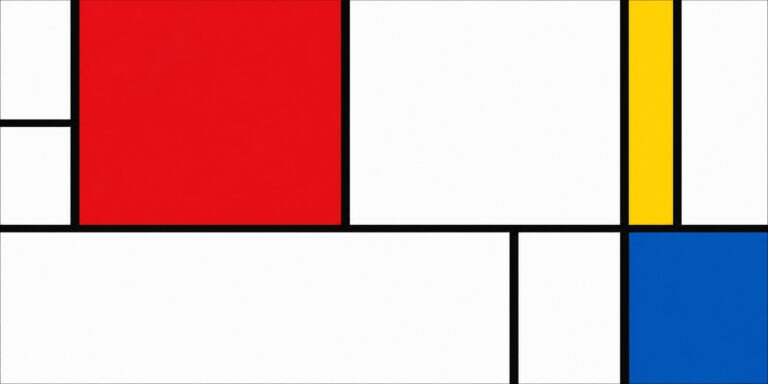
Look at the AOI cover painting. The large red plane sits high and slightly to the right. The broad blue plane pulls the eye down and left. Now look between them. Several small ivory rectangles make the trip feel longer than the distance across the canvas would suggest. Those intervals do as much compositional work as the red and blue.
Four lines, then a whole city
In Tableau I: Lozenge with Four Lines and Gray (1926), Mondrian turns the square canvas onto a point. The four painted lines keep their horizontal and vertical bearings. Follow one toward the edge and notice the acute angle where the sloping canvas cuts it short. The shape of the support supplies a direction the painter can leave out of his brushwork.
In Broadway Boogie Woogie (1942–43), the bars themselves change character. Black drops out. Runs of yellow break into small colored and pale beats. Trace a single run with your finger and notice where your eye jumps sideways at a crossing. The first painting puts pressure on the perimeter. The second finds much of its rhythm inside the grid. Both are oils on canvas.
Move one line
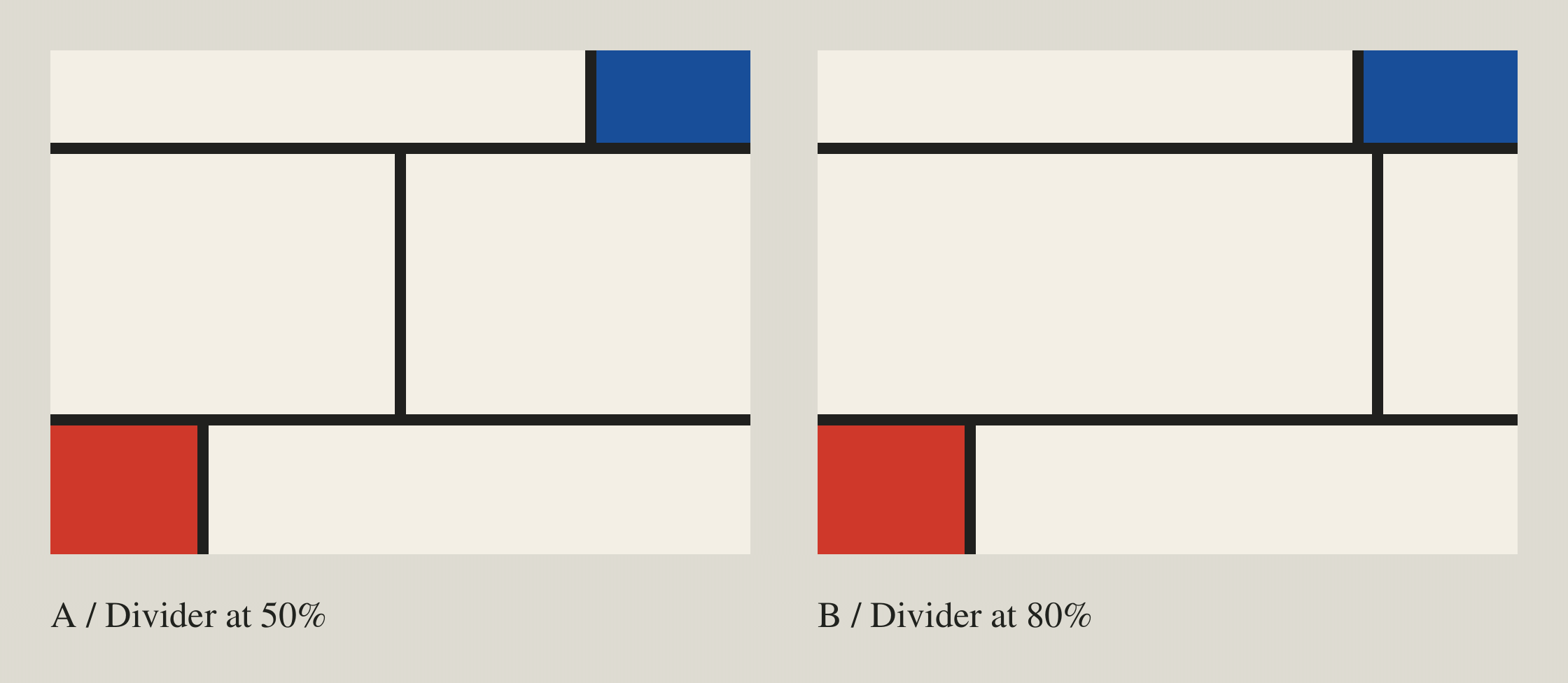
In the paired study, the blue and red rectangles occupy exactly the same area in both panels. Look at the middle band. In A, the upright cuts it in half. In B, the upright sits four-fifths of the way across, close to the blue rectangle above. Which panel draws your eye toward the right edge first?
Make the comparison with two sheets of paper and a loose black strip. Keep the colors fixed. Slide the strip until the narrow space beside it starts to read like a second stripe. Mark that position, step back, and try again. Recording where your reading changed gives you a reason to choose a spacing.
Take the painting off the easel
Mondrian pinned colored card to his studio walls and arranged furniture in relation to it. In a room, a doorway cuts a real opening, a cabinet has depth, and a person moving through the space keeps changing the view. Try placing a colored paper panel next to a door. Open the door halfway and look again from the threshold.
Van Doesburg and Cornelis van Eesteren explored a related architectural problem in their 1923 Contra-Construction Project (Axonometric). Follow one colored plane until another conceals its edge. That overlap lets you read a three-dimensional arrangement on a flat sheet. The diagonal blue fold in our titled collage is a contemporary material variation. Compare it with Mondrian’s lozenge, where the diagonal belongs to the outer edge.
A small poetic detour
Original words from the AOI studio.
Poetry
One upright, loose on the table.
I push it the width of a nail.
The blue stays where I put it.
The white has somewhere else to go.
The prompt workshop
Original creative exercises. These prompts create new illustrations, not documentary evidence.
Unequal balance
Create an original geometric composition of unequal rectangular white fields, a few black lines and small red, blue and yellow planes. Seek asymmetrical balance without reproducing a known Mondrian arrangement.
Two distances, one divider
Create two equal rectangular panels. Repeat a small red plane and a small blue plane in the same positions in each. In the pale middle band put a black upright halfway across the first panel and four-fifths across the second. Keep its thickness constant. Show both panels straight on.
Compare the two colored areas first. If they have changed, the image varies more than one thing.
A restricted vocabulary
Design an original contemporary wall-panel concept using only straight vertical and horizontal boundaries, varied rectangular proportions and a restrained primary-color accent. Keep the arrangement independent and carefully balanced.
Your next inspiration
Discover another art style
Follow a visual thread to the next subject.
People & works to explore
References discussed in this article. Consult the sources below for context.
Artists and practitioners
Piet Mondrian developed the theory in painting and writing.
Theo van Doesburg and Cornelis van Eesteren collaborated on the architectural study discussed here.
Paintings and other works
Piet Mondrian, Tableau I: Lozenge with Four Lines and Gray (1926).
Piet Mondrian, Broadway Boogie Woogie (1942–43).
Theo van Doesburg and Cornelis van Eesteren, Contra-Construction Project (Axonometric) (1923).
A smile from the studio
Jokes
I spent lunch moving one black line three millimetres to the left. My studio mate ate the sandwich and left the plate as a circle in the composition. We have agreed to work in separate rooms.
Sources and further exploration
Guggenheim, Composition XI | Van Doesburg’s journal and the wider De Stijl group
MoMA, Tableau I | Examine the edge of the 1926 lozenge
MoMA, Broadway Boogie Woogie | Follow a bar as it breaks into colored beats
MoMA, Contra-Construction Project | Read the colored planes in the architectural drawing
MoMA’s Neo-Plasticism collection | Compare paintings with a stained-glass design