
Compositional approach · modular and lattice-based abstraction
Grid Art makes repetition visible. Rows, columns and their interruptions become the subject, allowing small changes of color, spacing, line and material to shape the entire image.
A visual introduction
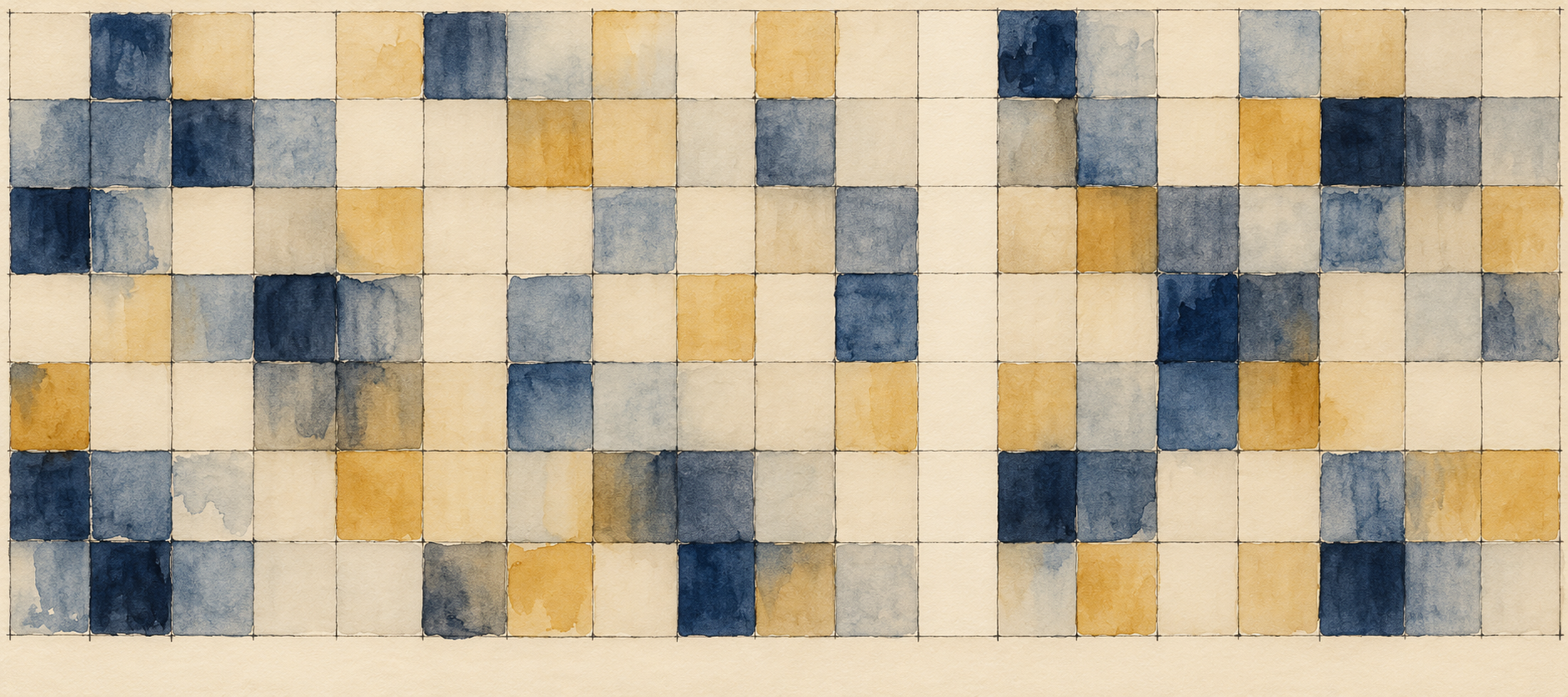
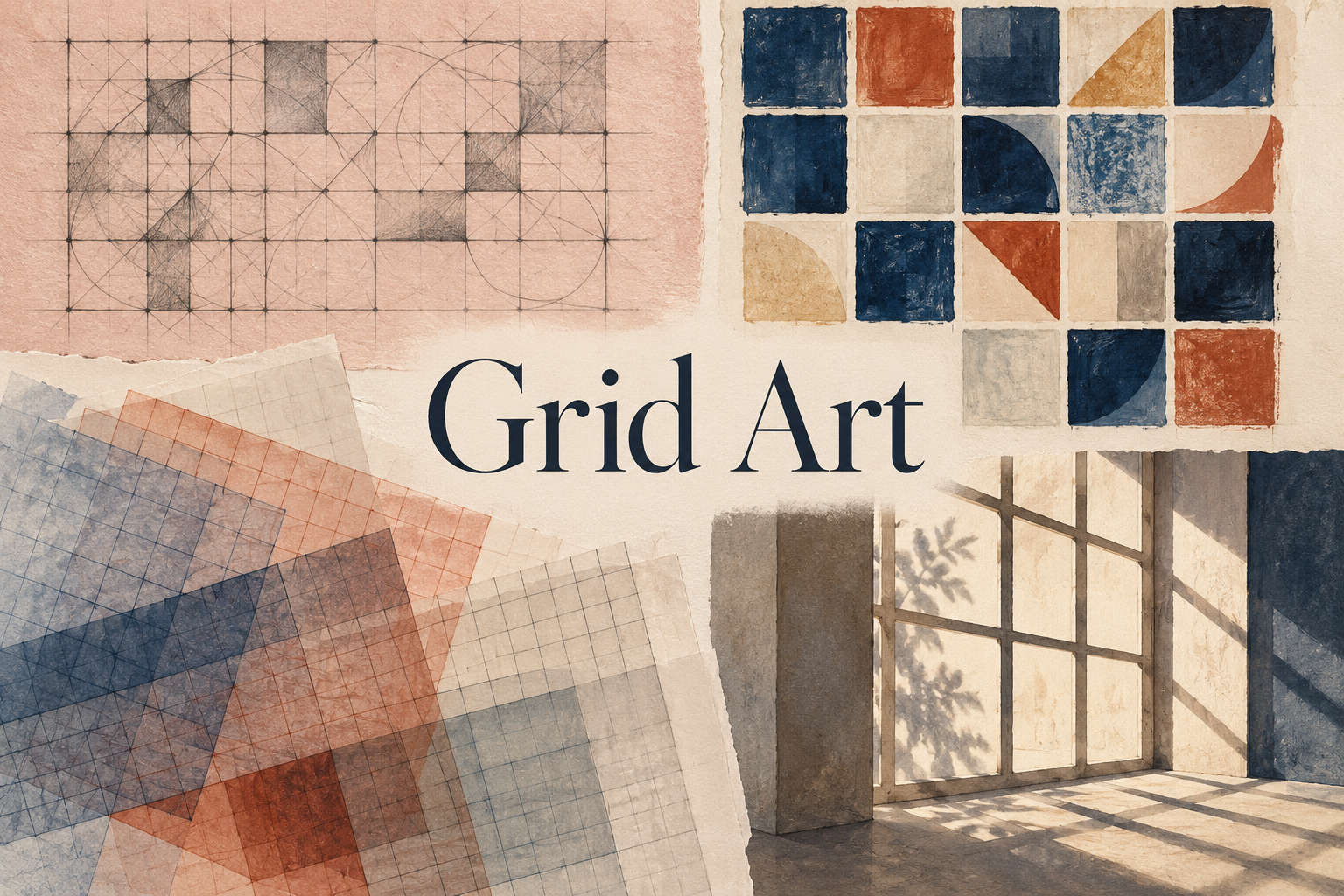
Five original AI-generated AOI interpretations: a dedicated banner, a centrally titled collage and three standalone studies. These illustrations demonstrate the principles discussed; they are not historical artworks.
Select an image for a closer look. Use the thumbnails, arrow keys or a swipe to compare examples. Zoom in to inspect details, or share the image that inspires you.
Creative toolbox · take this style further
Choose an input and a destination. Search sends your words to the chosen site; Copy & open puts them on your clipboard to paste there.
Create with AI
Turn your chosen input into an image prompt or a new creative direction.
ChatGPT
Copy your input and paste it into a ChatGPT conversation or image request.
Copy & open ChatGPT (new tab)Claude · Anthropic
Develop an image prompt or explore the style in a new Claude conversation.
Copy & open Claude · Anthropic (new tab)Midjourney
Paste your input into the Imagine bar on the Create page.
Copy & open Midjourney (new tab)Adobe Firefly
Copy your input, open Firefly, and paste it into the prompt field.
Copy & open Adobe Firefly (new tab)Leonardo.Ai
Copy your input, open Leonardo, and paste it into the generation field.
Copy & open Leonardo.Ai (new tab)Image search
Find visual references. Short, concrete keywords usually work best.
Lexica
Search AI images and prompts using your selected input.
Search with this input Lexica (new tab)Pexels
Search the photo and video library. Short keywords often work best.
Search with this input Pexels (new tab)Pixabay
Search photos, illustrations and other images.
Search with this input Pixabay (new tab)Unsplash
Search photographs using the style name or your own keywords.
Search with this input Unsplash (new tab)Wikimedia Commons
Search photographs, artworks and historical images. Check each file for its source and reuse terms.
Search with this input Wikimedia Commons (new tab)Art & research
Explore artists, collections and the ideas behind a style.
Wikipedia
Search for background reading. A style may not have its own article.
Search with this input Wikipedia (new tab)WikiArt
Copy your input into WikiArt’s search to explore artists and artworks.
Copy & open WikiArt (new tab)Europeana
Paste your keywords into the search to explore European museum, library and archive collections.
Copy & open Europeana (new tab)Inspiration
Discover portfolios and visual ideas from creative communities.
Instagram hashtags
Search a hashtag made from your input: spaces and punctuation are removed. Instagram may require sign-in.
Search with this input Instagram hashtags (new tab)ArtStation
Paste your input into artwork search for concept art, environments, characters and visual development.
Copy & open ArtStation (new tab)Behance
Paste your input into project search for illustration, design and visual storytelling.
Copy & open Behance (new tab)A closer look
An organizing lattice, repeated cells and measured intervals create a field. Crisp geometry can feel emphatic; trembling lines, uneven washes and overlapping layers introduce quieter rhythms and depth.
A structure that becomes the subject
Grid Art is a useful umbrella term for artwork organized around an evident lattice or repeated modular field. It does not identify one historical movement, medium or founder. A grid may be drawn, painted, assembled, woven or generated digitally. What unites these uses is the viewer's ability to compare repeated units and notice departures from the rule.
A grid used to enlarge a drawing is a working aid. In Grid Art, the structure remains perceptually important in the finished piece. A portrait behind an invisible transfer grid therefore has a different purpose from an image in which cells, intervals and boundaries actively carry meaning.
Historical reference, without a single origin story
Agnes Martin's The Rose (1965), in the Philadelphia Museum of Art, offers a precise reference. The museum describes a fine graphite grid over a rose-colored ground whose appearance changes with viewing distance. Close inspection reveals the marks; farther away they contribute to a luminous field. This shows how repetition can produce atmosphere as well as order.
The Pinault Collection's account of Martin's Untitled (1960) also emphasizes the small variations of hand-drawn lines. These references support one important strand of grid-based abstraction. They do not make all grids examples of Martin's practice, nor do they supply a universal origin for the many ways artists use modular structures.
Choose the rule before the exception
Begin with a cell proportion: square cells feel different from tall narrow rectangles. Then decide whether spacing is regular, whether the grid reaches the edges, and whether the surrounding margin belongs to the composition. A dense lattice can read almost as a texture, while a few broad divisions behave like architectural bays.
Set one initial rule for color or value. For example, alternate two pale tones, then introduce a darker route through selected cells. The exception becomes legible because the field establishes an expectation. If every cell changes independently, the result may still be attractive, but the grid's organizing argument becomes weaker.
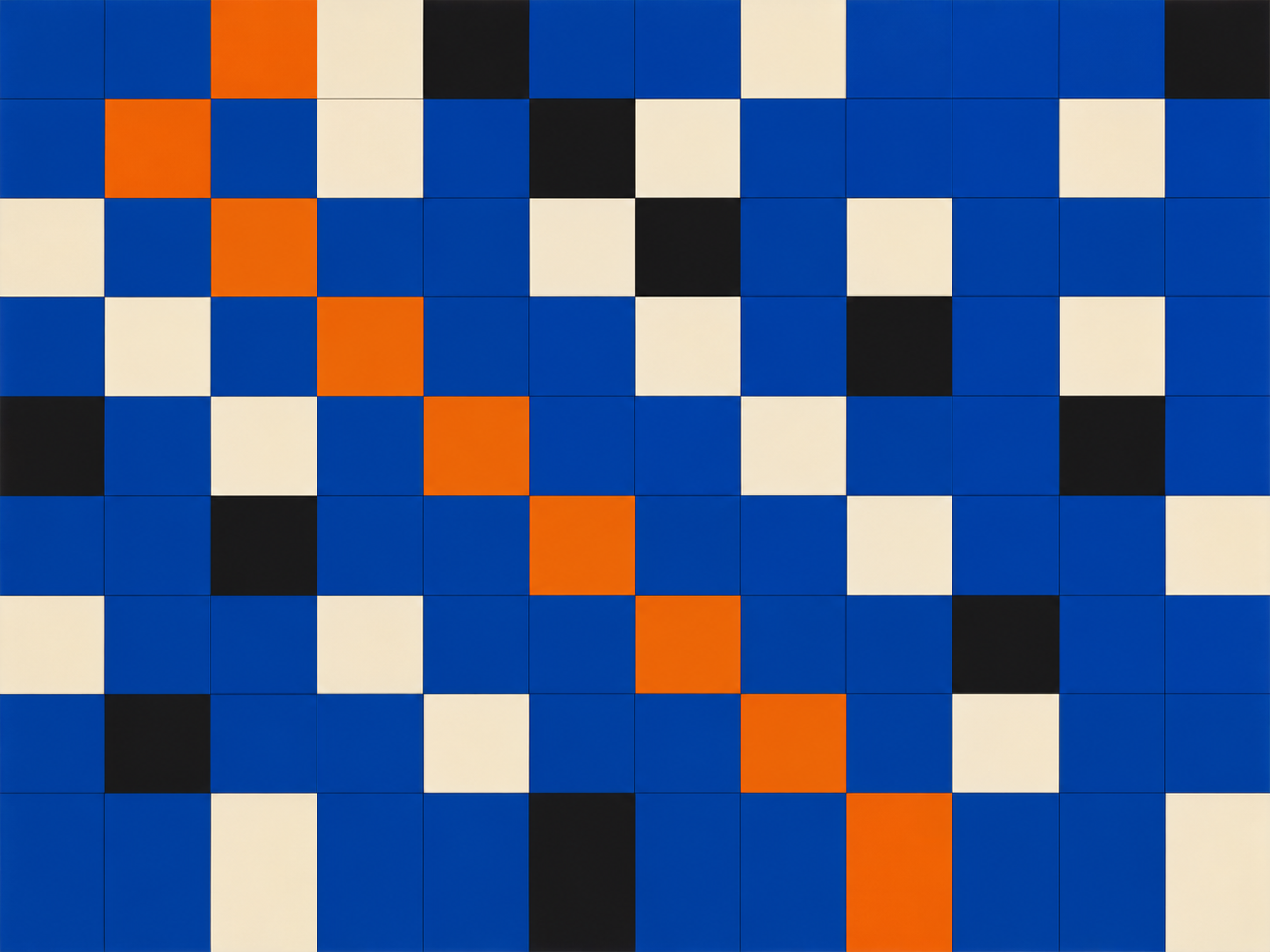
In the bold AOI example, an orange stepped sequence crosses a predominantly blue field. Cream and dark cells interrupt the surrounding rhythm. The image demonstrates directed movement within a fixed module, rather than requiring a recognizable object to lead the eye.
Hard edges, soft marks and layered space
Hard boundaries emphasize each unit as a separate decision. Compare that with a watery pigment that crosses a pencil line: the same geometry now contains a negotiation between measurement and material. Neither is automatically more sophisticated. Choose according to whether the work needs crisp comparison or gradual visual blending.
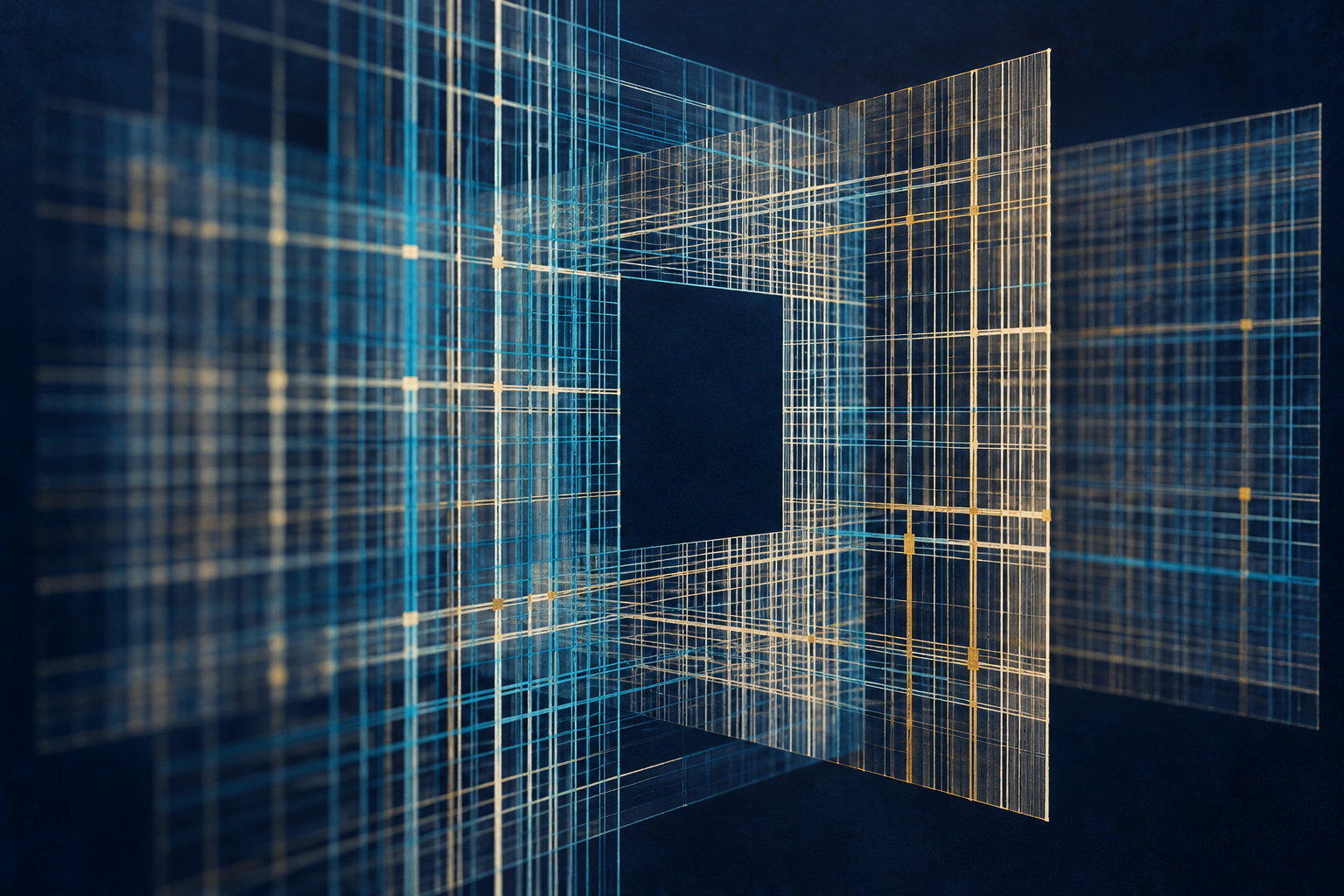
Try graphite over a lightly colored ground, masking tape with opaque paint, translucent ink on separate sheets, or digital layers with controlled opacity. The layered study uses differently oriented grid planes and selective blur to suggest depth. Its central opening gives the eye a pause amid many intersections.
Do not confuse a digitally simulated surface with evidence of a physical process. The images here are generated interpretations. A real painted study would involve its own drying, masking, registration and material decisions.
Scale changes the experience
View the work close up, at arm's length and as a small thumbnail. Fine lines may disappear at small sizes; closely spaced patterns may produce distracting screen interference. Test the intended output rather than assuming the large working file predicts every use.
Grid Art is useful for abstract prints, textiles, covers and spatial studies. In an information design, however, decorative irregularity must not obscure reading order. In an artwork, a disrupted row can be the point. The same visual device needs a different degree of discipline in each setting.
A practical exercise in restraint
Make three versions with the same lattice. In the first, change only line pressure. In the second, keep the lines fixed and change the color distribution. In the third, offset a second lattice slightly. Comparing one variable at a time makes the visual cause easier to understand.
Common weaknesses are uniformly busy cells, accidental tangencies and contrast that overwhelms the intended subtlety. Remove a color, enlarge a quiet region or simplify the exception. The goal is a field that rewards looking, whether its voice is nearly silent or confidently geometric.
A small poetic detour
Original words from the AOI studio.
Poetry
Intervals
A pencil walks the measured ground;
its small uncertainties remain.
One square receives a darker sound,
one keeps the color of the grain.
The rows continue past my gaze,
yet here a narrow silence stays.
No window opens in this wall;
its patient crossings admit all.
I step away. The marks grow light.
A field of intervals gathers sight.
The prompt workshop
Original creative exercises. These prompts create new illustrations, not documentary evidence.
Make small differences matter
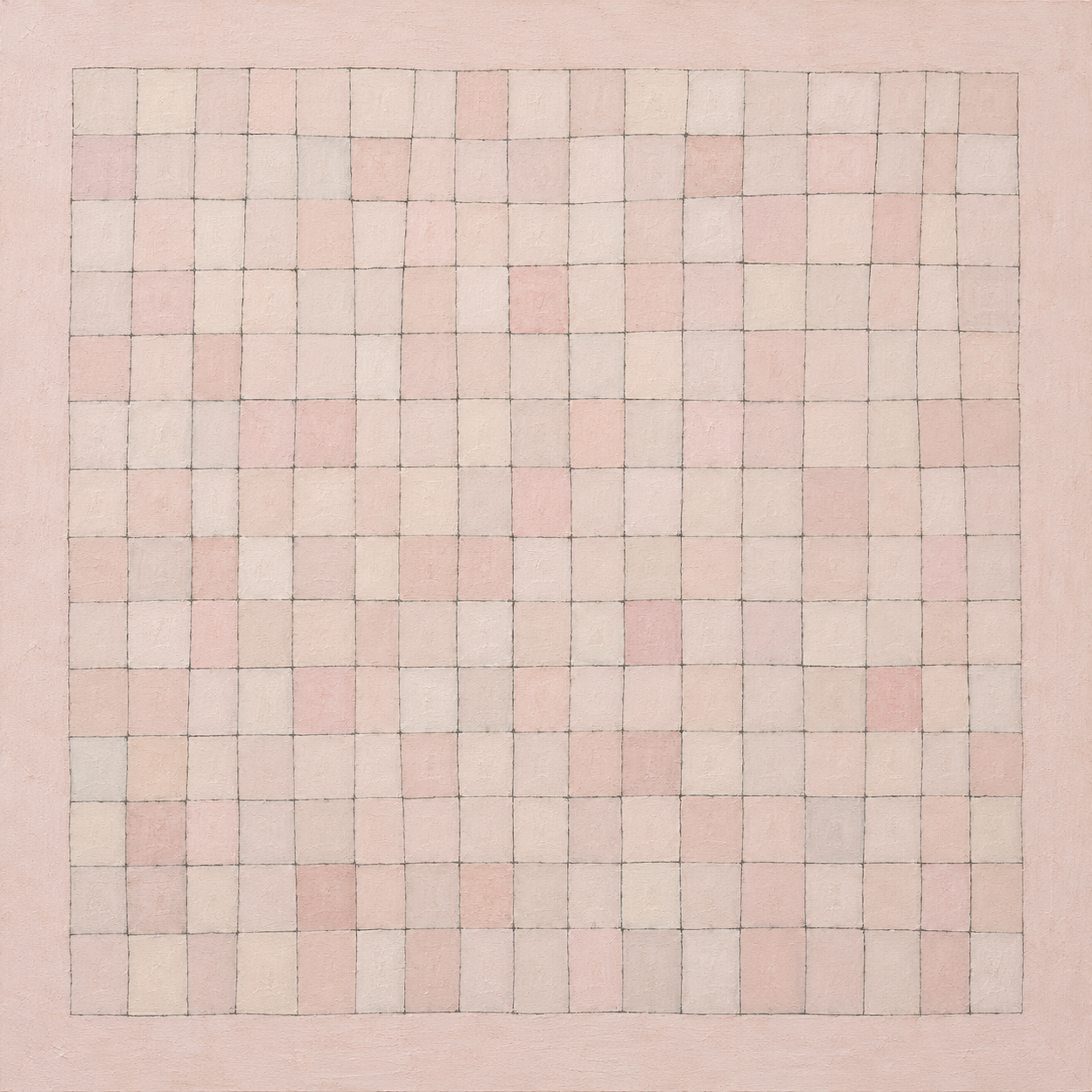
Create an original abstract grid with fine hand-drawn graphite lines on pale rose paper. Vary line pressure slightly and use two nearly equal warm tones. Leave a generous margin and avoid a central symbol.
Look for delicate differences that remain visible at the intended scale.
Lead the eye through modules
Compose a bold rectangular grid in cobalt, cream and near-black. Introduce a stepped orange sequence through selected cells. Keep all cells aligned and vary the surrounding color rhythm without adding objects or text.
The repeated rule makes the colored route readable.
Give a lattice depth
Layer three translucent orthogonal grids over a dark indigo field. Change their orientation and focus slightly, with a quiet rectangular opening near the center and sparse warm intersections.
Judge the overlap as a composition, not just a technical effect.
Your next inspiration
Discover another art style
Follow a visual thread to the next subject.
People & works to explore
References discussed in this article. Consult the sources below for context.
Artists and practitioners
Agnes Martin
Paintings and other works
Agnes Martin — The Rose (1965)
Agnes Martin — Untitled (1960)
A smile from the studio
Jokes
The grid announced a staff meeting. Every square arrived on time and sat in its assigned position. One orange square moved diagonally. The others demanded an explanation. “Professional development,” it said. By lunchtime it had become the focal point, and the entire composition was discussing whether this counted as a promotion.