
Art and cultural context · researched guide
Art in Montenegro includes modern painting, wider Yugoslav artistic connections and contemporary exhibition practice. The National Museum in Cetinje offers a grounded route into these subjects. This guide uses its collection structure to move beyond the idea that a country can be represented by one set of costumes or mountain scenes.
A visual introduction
Select an image for a closer look. Use the thumbnails, arrow keys or a swipe to compare examples. Zoom in to inspect details, or share the image that inspires you.
A closer look
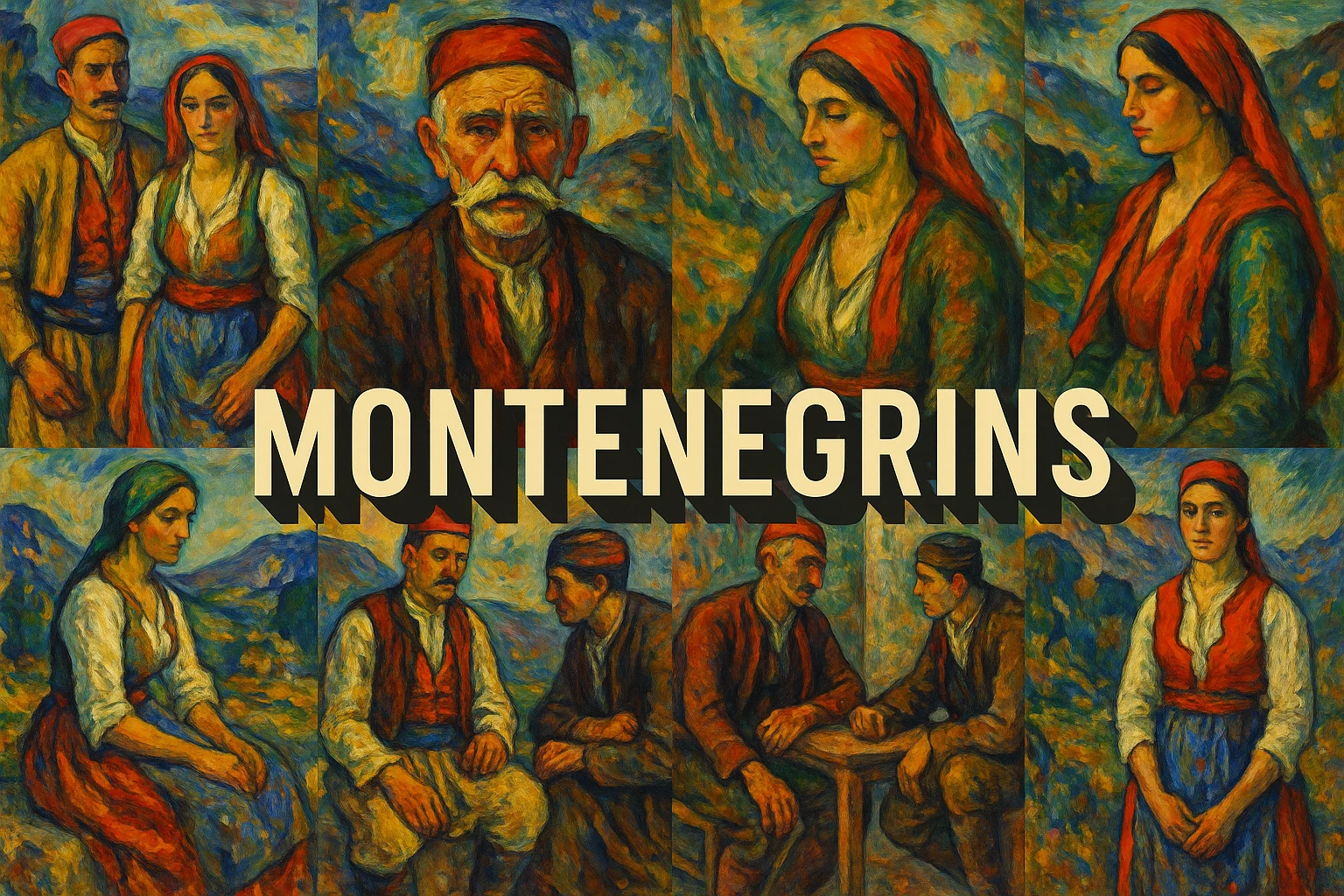
The archive collage repeats red caps and headscarves, frontal portraits and blue-green mountains. Thick, swirling marks give the separate panels a common texture. The people and scenes are synthetic; no panel is attributed to a Montenegrin artist or identified as a historical document.
Begin with the collection, not the stereotype
The Art Museum in Cetinje dates its foundation to 1950 and occupies the Government House building. Its collections include Montenegrin and Yugoslav fine art, works by foreign artists, icons and copies of frescoes. This structure makes several histories available within one institution rather than assigning every object to a single national aesthetic. [1]
The museum highlights memorial rooms devoted to Milo Milunović, Petar Lubarda, Branko Filipović Filo and Miodrag Đurić Dado, with works from different phases. A comparison within one artist’s practice is especially useful: it can show change that a single representative image would conceal. The names are research starting points, not a list of stylistically interchangeable painters. [1]
Move between the historical and contemporary
The Montenegrin Art Gallery Miodrag Dado Đurić, opened in 2012, is another part of this institutional landscape. The museum describes a programme of retrospectives, younger contemporary artists and international exchanges, with exhibitions and accompanying educational events. Its purpose reaches beyond a permanent survey of older painting. [2]
A temporary exhibition and a permanent collection produce different encounters. One may concentrate on a narrow problem or a single career; the other may arrange a sequence across generations. Before describing an artist as typical of Montenegro, ask which of these frameworks introduced the work to you. The route of discovery can quietly become a mistaken claim about representativeness.
What to look for in a painting
Choose one documented painting and trace its largest shapes before naming its subject. Where does the eye first settle? Which edge carries the strongest contrast? Does the surface encourage you to recognise a place, attend to the paint, or move between the two? These questions remain useful whether a work is figurative or more abstract.
Our archive collage gives an easy demonstration of repetition: the red accents keep returning, while blue shadows connect faces and landscape. Those observations concern this illustration alone. They do not show how Lubarda or Dado painted, and the generated portraits should never be captioned with those artists’ names. A thumbnail is a poor substitute for an identified work.
A better creative brief
For an original study, make three small compositions with the same limited palette but different relationships between figure and background. Let one be spacious, one crowded and one balanced around an empty area. Record the effect of those decisions before adding a location or story. If the study is generated, label its medium accurately.
To develop a project connected with a specific place in Montenegro, use references you can identify and contextualise. Do not invent an authentic local tradition from a pleasing combination of red clothing and mountains. The museum’s object and exhibition records offer a more demanding, more rewarding beginning: people making different things at different times, with room left for surprise.
Compare careers without inventing a national formula
The museum's memorial rooms are a starting point for a more demanding comparison. Select one identified work from each of two artists, record date and medium, then compare how each organises figures, landscape or abstraction. Differences are as important as recurring concerns. A national collection can preserve relationships and disagreements without requiring every work to look alike.
Follow the artist's own chronology as well. A later work should not automatically be described through the vocabulary of an early one. Training, travel, exhibitions and changes of medium can alter a practice, and those details need specific sources. This approach turns a list of names into a research path.
Build a small, accountable visual study
Choose a location or everyday object you can document, then make two original studies with different spatial structures: one organised around broad masses, the other around a network of lines. Keep the reference, palette and format fixed so the formal change is visible.
Credit the actual reference and describe the study as your response. Avoid treating a synthetic mountain view or costume as proof of an authentic national tradition. The more precise the account of a place, object or artist becomes, the less useful a generic ethnic style label is.
People & works to explore
References discussed in this article. Consult the sources below for context.
Artists and practitioners
Milo Milunović — memorial room in the Art Museum
Petar Lubarda — memorial room in the Art Museum
Branko Filipović Filo — memorial room in the Art Museum
Miodrag Đurić Dado — memorial room in the Art Museum
Sources and further exploration
[1] National Museum of Montenegro — Art Museum permanent exhibition
[2] National Museum of Montenegro — Miodrag Dado Đurić Gallery