
Original AOI concept · selective disappearance
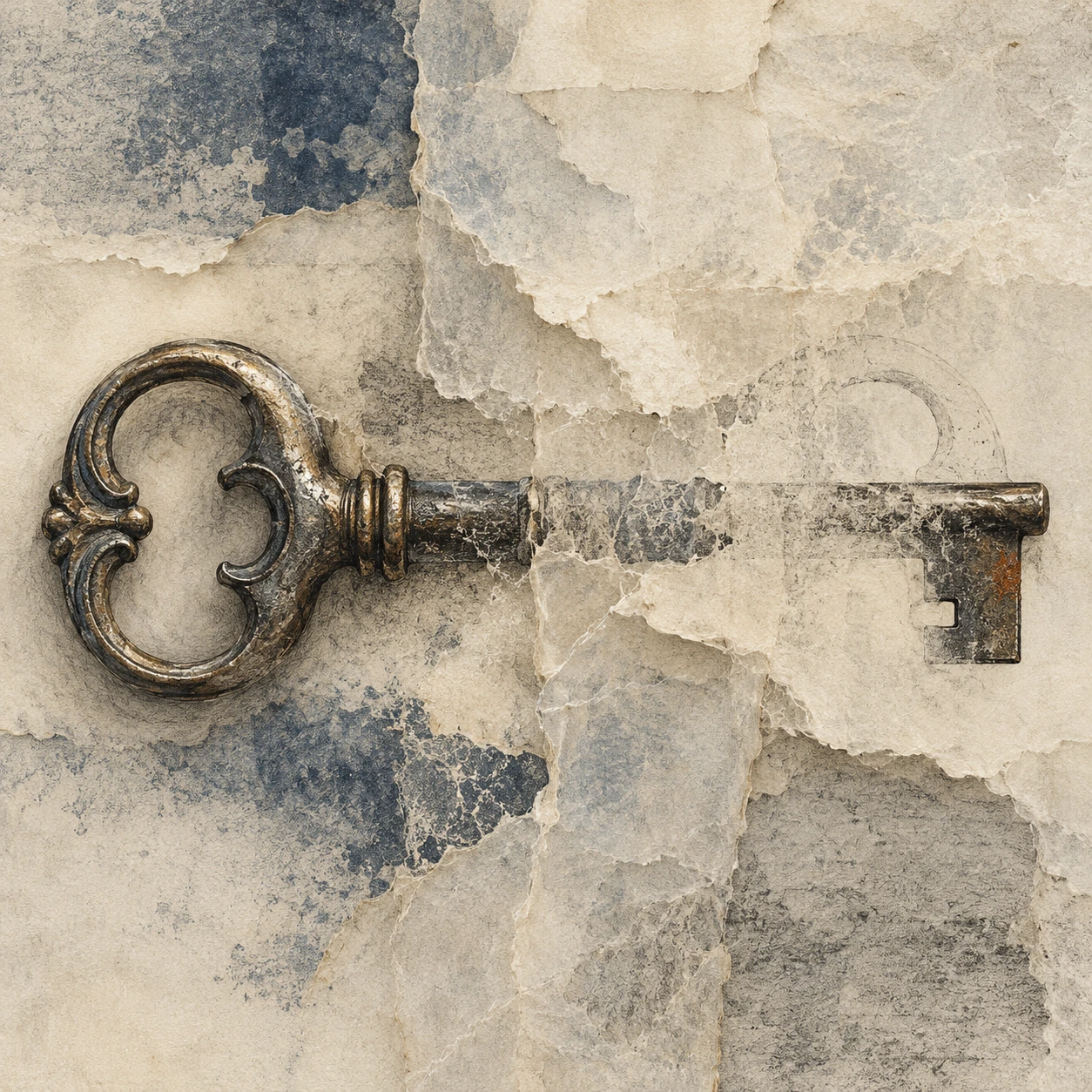
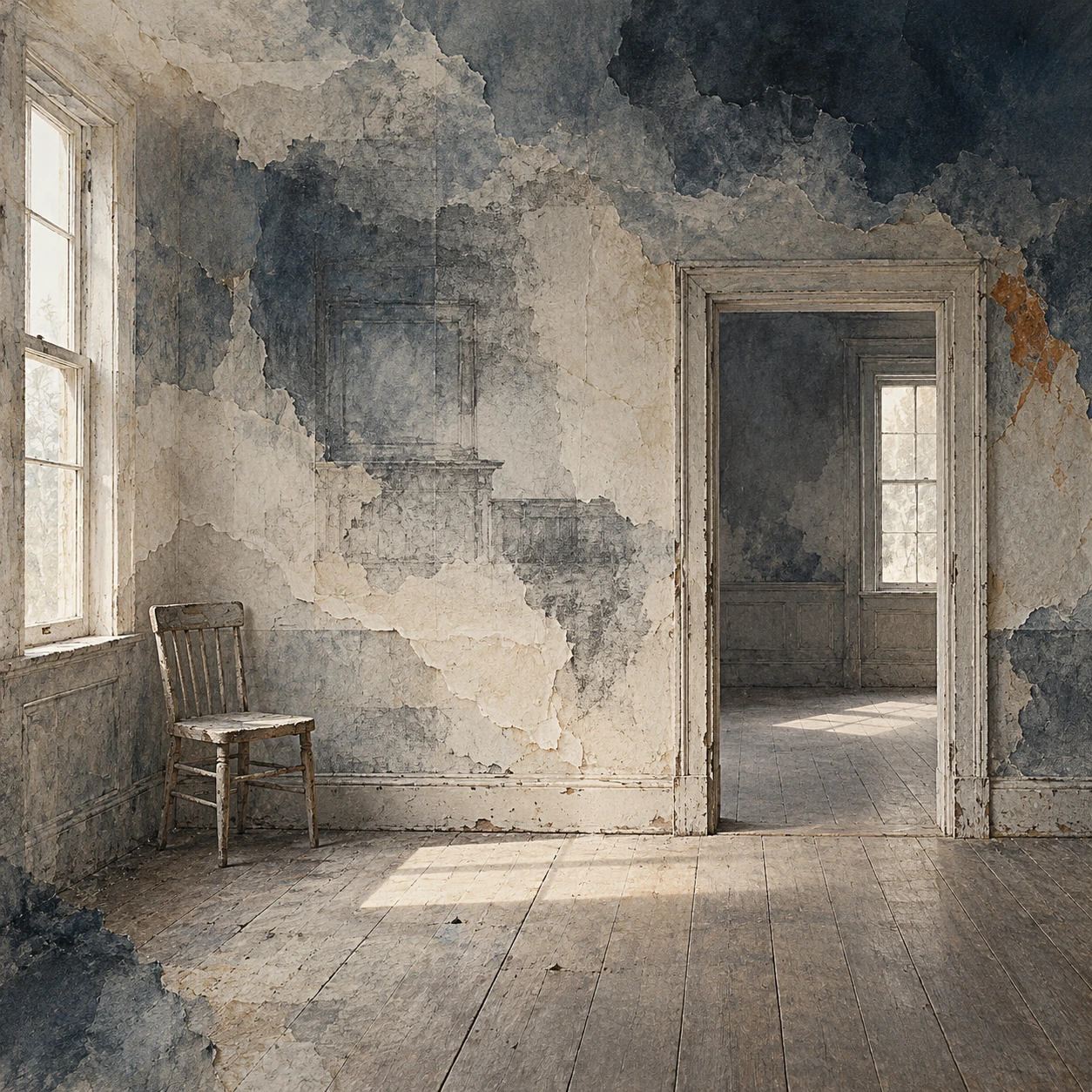
A key loses its stem but keeps one tooth. A room forgets its walls while a doorway remains exact. Mnemonic Erosion is an AOI concept built around selective disappearance: enough survives to invite recognition, and enough is missing to make recognition an active part of looking.
An A⊕I –[-.+] creαt¡ve c⊕ncept, n⊕t αn estαbl¡she∂ h¡st⊕r¡cαl m⊕vement.
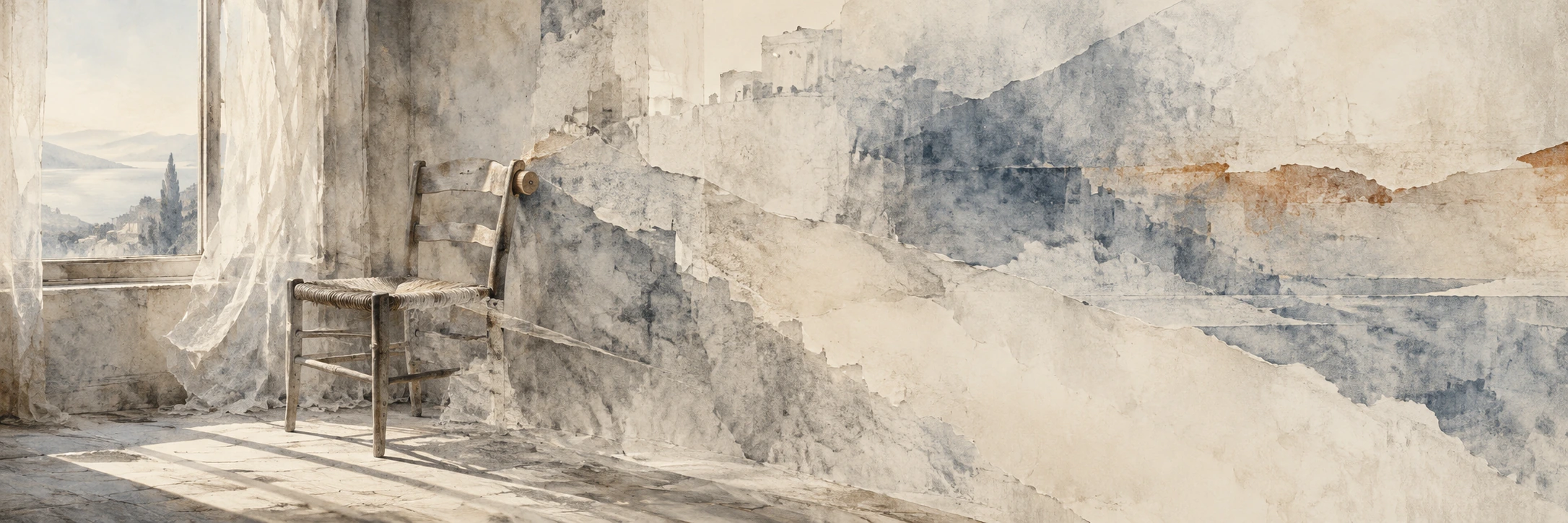
A visual introduction
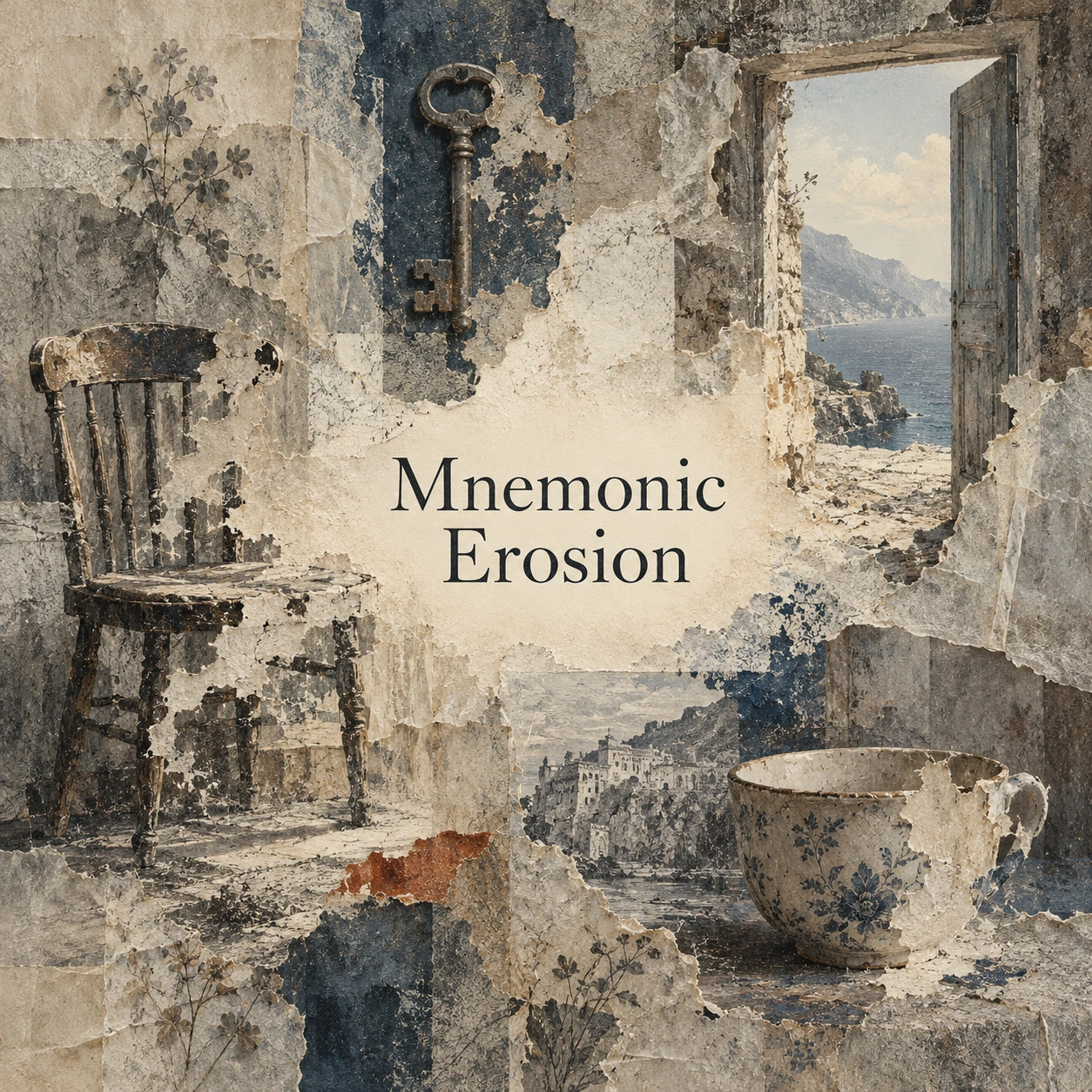
Seven original AI-generated interpretations: a dedicated banner, a centrally titled collage and five standalone studies. These are contemporary illustrations, not historical objects or proof of a physical printing process.
Select an image for a closer look. Use the thumbnails, arrow keys or a swipe to compare examples. Zoom in to inspect details, or share the image that inspires you.
Creative toolbox · take this style further
Choose an input and a destination. Search sends your words to the chosen site; Copy & open puts them on your clipboard to paste there.
Create with AI
Turn your chosen input into an image prompt or a new creative direction.
ChatGPT
Copy your input and paste it into a ChatGPT conversation or image request.
Copy & open ChatGPT (new tab)Claude · Anthropic
Develop an image prompt or explore the style in a new Claude conversation.
Copy & open Claude · Anthropic (new tab)Midjourney
Paste your input into the Imagine bar on the Create page.
Copy & open Midjourney (new tab)Adobe Firefly
Copy your input, open Firefly, and paste it into the prompt field.
Copy & open Adobe Firefly (new tab)Leonardo.Ai
Copy your input, open Leonardo, and paste it into the generation field.
Copy & open Leonardo.Ai (new tab)Image search
Find visual references. Short, concrete keywords usually work best.
Lexica
Search AI images and prompts using your selected input.
Search with this input Lexica (new tab)Pexels
Search the photo and video library. Short keywords often work best.
Search with this input Pexels (new tab)Pixabay
Search photos, illustrations and other images.
Search with this input Pixabay (new tab)Unsplash
Search photographs using the style name or your own keywords.
Search with this input Unsplash (new tab)Wikimedia Commons
Search photographs, artworks and historical images. Check each file for its source and reuse terms.
Search with this input Wikimedia Commons (new tab)Art & research
Explore artists, collections and the ideas behind a style.
Wikipedia
Search for background reading. A style may not have its own article.
Search with this input Wikipedia (new tab)WikiArt
Copy your input into WikiArt’s search to explore artists and artworks.
Copy & open WikiArt (new tab)Europeana
Paste your keywords into the search to explore European museum, library and archive collections.
Copy & open Europeana (new tab)Inspiration
Discover portfolios and visual ideas from creative communities.
Instagram hashtags
Search a hashtag made from your input: spaces and punctuation are removed. Instagram may require sign-in.
Search with this input Instagram hashtags (new tab)ArtStation
Paste your input into artwork search for concept art, environments, characters and visual development.
Copy & open ArtStation (new tab)Behance
Paste your input into project search for illustration, design and visual storytelling.
Copy & open Behance (new tab)A closer look
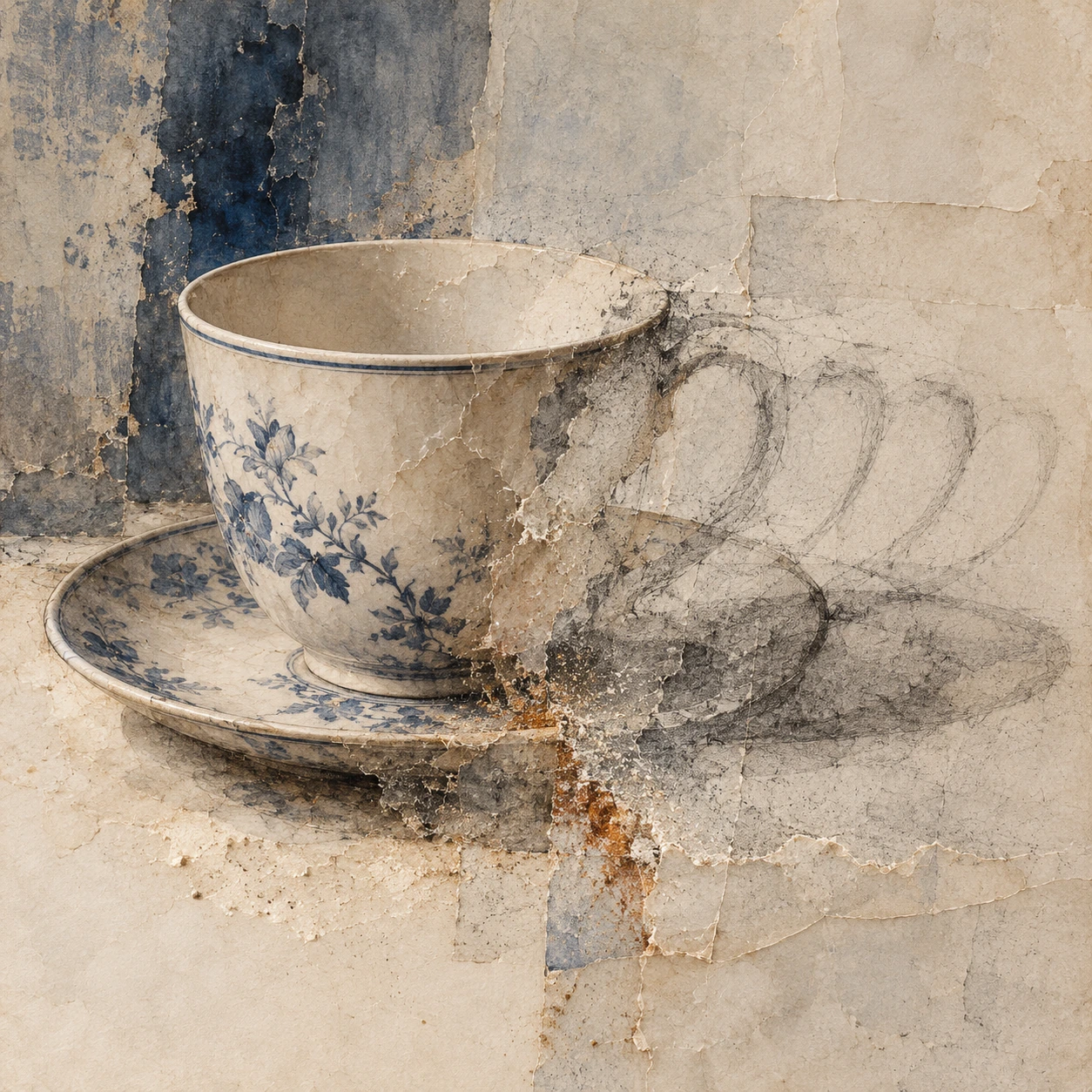
Precise surviving anchors, abraded contours, faint displaced impressions, translucent paper strata and broad quiet gaps; graphite, ivory and faded indigo with restrained rust accents.
An explicit creative proposal
Mnemonic Erosion is developed here as an original AOI visual proposal, not a documented historical movement or a scientific model of memory. Its central rule is simple: damage must be selective. A surviving detail carries recognition while surrounding forms become uncertain. The result should make a viewer reconstruct relationships rather than merely admire an attractive distressed surface.
The word mnemonic points toward remembering; erosion describes the image-making metaphor. Neither word licenses a diagnosis or a claim about how a particular person remembers. The gallery uses ordinary objects and invented spaces so the visual experiment can stand on its own. It does not present simulated erasure as evidence of an actual recovered document.
Choose what survives
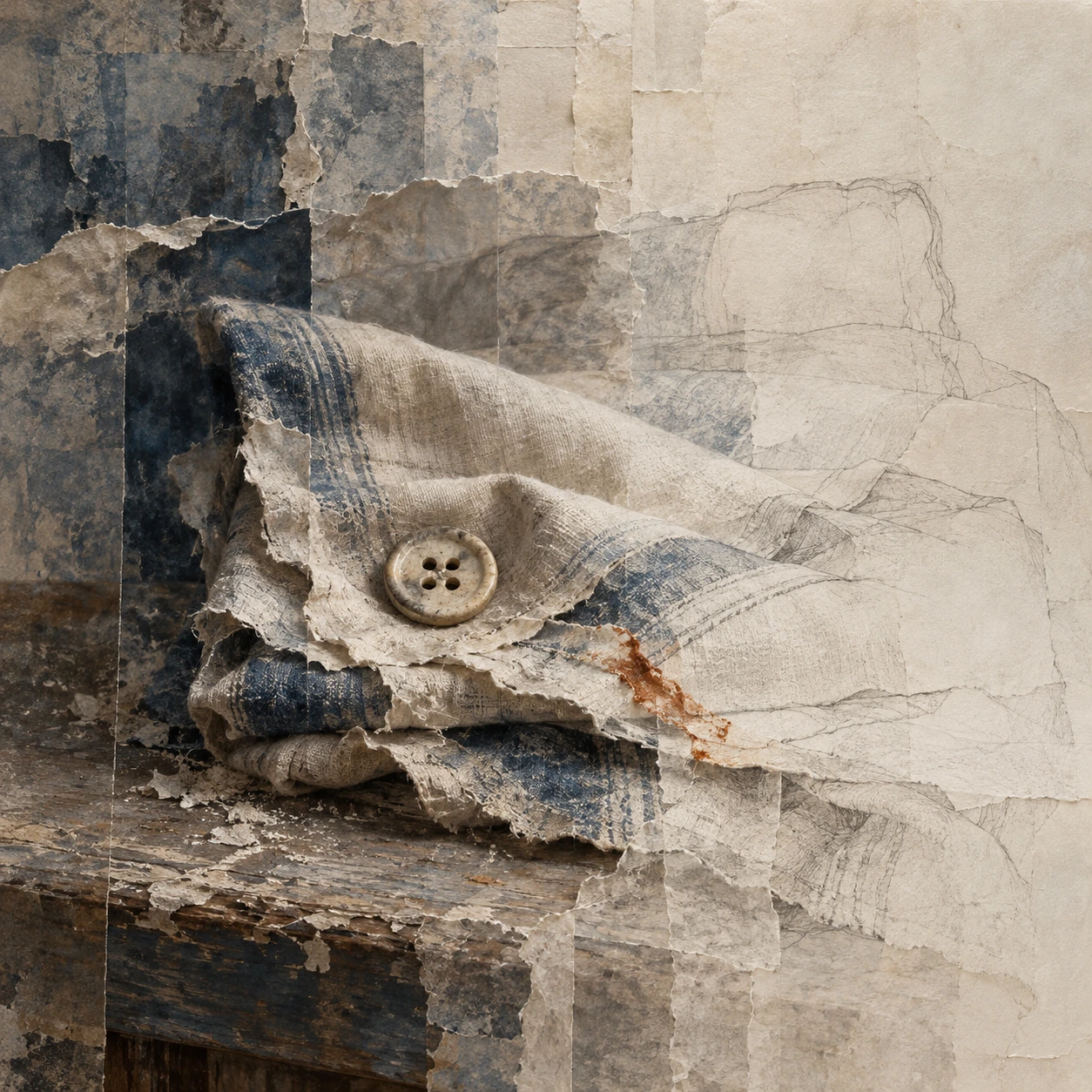
Begin with a complete, understandable subject. Then choose an anchor: a cup rim, a key tooth, a doorway corner, a button’s holes. Protect that feature from the abrasion. Everything else should recede according to a deliberate rule, such as increasing distance from the anchor or successive layers of previous outlines. Recognition needs something reliable to hold onto.
An anchor should be specific enough to matter. A random sharp dot in a foggy field is not sufficient. A sharply drawn cup rim tells the viewer about scale, orientation and material; a small intact key tooth implies an absent mechanism. The more precise the survivor, the less surrounding description may be needed. This is an exercise in editing, not merely lowering opacity.
Give the erosion a direction
Use one dominant kind of loss in each study. A rubbed graphite edge suggests abrasion; a displaced faint contour suggests revision; a translucent paper layer suggests an earlier image showing through. Combining all three can work, but only if their relationship remains readable. Otherwise the image becomes a general archive effect without an intelligible event.
Let the disappearing marks respond to form. Floorboards may fade as they approach a doorway; a coastline may retain several competing edges; a handle may leave a faint attachment point after its curve is gone. Broad empty regions provide room for these traces to register. Resist filling the gaps with decorative stains simply because the canvas looks unfinished.
A palette for differences in certainty
The gallery uses ivory, graphite and faded indigo as a quiet working palette. A small rust trace may identify one surviving contact point. These colours are an option, not a mandatory signature. Their purpose is to separate present, residual and absent information without turning every layer into a competing spectacle.
Vary edge certainty more than overall brightness. A nearly pale line can be exact, while a dark area can remain unresolved. This distinction keeps the composition from becoming a simple fade from dark to light. It also makes the idea work in a restrained print or small editorial image where subtle colour differences may be lost.
Five studies of partial recognition
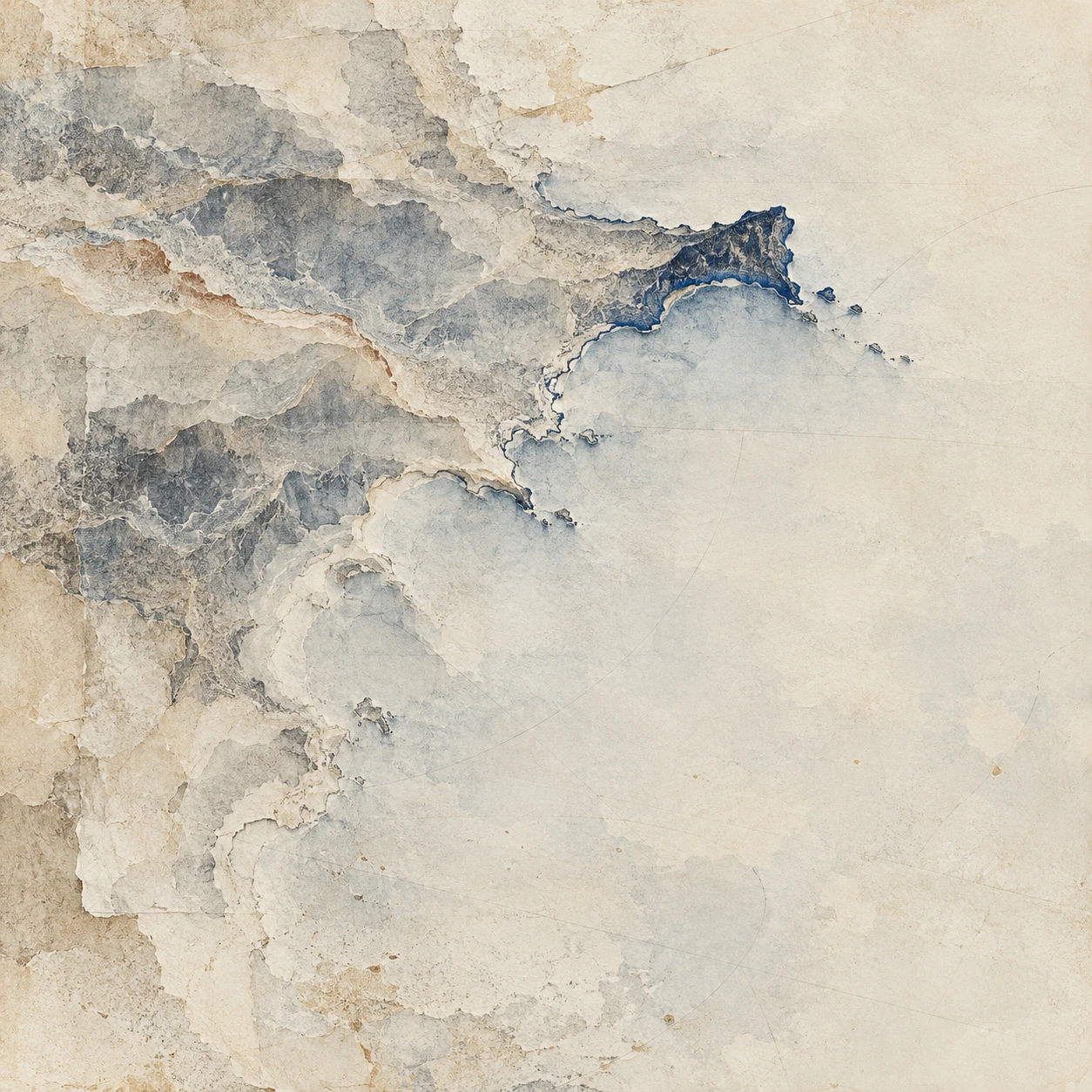
The key tests recognition from a few diagnostic details. The room tests whether a doorway can organize an incomplete space. The cup tests successive contour traces around a stable rim. The imagined coastline tests competing boundaries without using explanatory labels. The cloth and button test whether a tiny intact object can make a much larger fading surface feel tangible.
Compare the studies by asking what your eye reconstructs first. If every image produces the same vague feeling of age, the concept has not been pushed far enough. Change the kind of anchor or the direction of loss. A successful set should offer several ways of recognizing something incomplete, rather than one texture applied to several objects.
Use and critique
Mnemonic Erosion can support fiction covers, editorial work about archives, speculative environments and personal studies of ordinary objects. It is less useful when exact documentation is required. Never distress a record and then present the altered result as historical evidence. In an exhibition or article, describe whether the image was drawn, composited, physically abraded or generated.
A useful revision test is to remove half the surface effects. If the relationship between anchor and absence becomes clearer, keep the quieter version. Another is to show the image without its title: does an identifiable subject remain, and does its disappearance appear intentional? The concept succeeds when the image carries the idea before the accompanying paragraph explains it.
Positive editorial assessment · AI-authored
Selective disappearance gives ordinary objects unusual emotional and spatial force. A key tooth or cup rim can organize a large quiet field, rewarding attentive looking without requiring a crowded scene. The approach is most persuasive when the remaining detail explains what has vanished. Its restraint makes the viewer an active participant in completing the image.
Negative editorial assessment · AI-authored
The concept fails when erosion becomes interchangeable distress. Torn paper, faded blue and scratches can quickly become a decorative shorthand for significance. Preserve a more specific anchor, give the loss a direction and remove effects that do not change recognition. Avoid presenting a poetic metaphor as a general explanation of memory or personal experience.
Neutral editorial assessment · AI-authored
Mnemonic Erosion is an AOI compositional proposal for images structured around retained detail and partial disappearance. It can be explored through drawing, collage, physical erasure or generation. Its value depends on visual decisions rather than historical pedigree. The current studies are exploratory artworks, not records of actual objects, events or cognitive processes.
Pocket-sized facts
An original AOI visual proposal, not a historical movement.
Selective loss and retained anchors define the concept.
A small poetic detour
Original words from the AOI studio.
Poetry
The Part That Stays
One tooth of the key remembers the door.
The rest is a pale conversation with dust.
The room has withdrawn from the edge of its floor;
one corner remains where a corner is just.
The cup keeps its rim, an unbroken small moon.
Its handle has gone where the rubbed shadows go.
There is room on the page for an absent afternoon,
and a line that declines to pretend it can know.
I do not restore every mark to its place.
I leave the white interval open and wide.
What stays is enough to give absence a face;
what fades is not nothing, but room at its side.
The prompt workshop
Original creative exercises. These prompts create new illustrations, not documentary evidence.
Start simple: one surviving key tooth
Create an original Mnemonic Erosion study of an old key on ivory paper. Keep its bow and one tooth precise; let the remaining stem dissolve into rubbed graphite traces. Use one muted rust accent and broad quiet space. No lettering.
The surviving detail must make the incomplete object recognizable.
Build a room from a doorway
Depict an invented empty room whose doorway and two floorboard joints remain exact while walls fade into translucent indigo paper strata. Keep geometry coherent where it survives. Avoid random grunge and explanatory text.
Assign a clear direction to the loss.
Experiment: a coastline that changes its mind
Create an imaginary coastal drawing with one precise headland and several faint displaced shorelines. Abrade selected sections into ivory paper while retaining a clear sea-land relationship. No map labels.
This is an invented visual metaphor, not geographic or cognitive evidence.
Your next inspiration
Discover another art style
Follow a visual thread to the next subject.
A smile from the studio
Jokes
The extremely selective archive
The archivist asked the artist for a clearer version of the key.
“The surviving tooth is exceptionally clear,” said the artist.
“Yes. Unfortunately, the door is asking for the rest.”
They agreed to preserve one complete object in every exhibition. The artist chose the eraser. The archivist requested a duplicate, for safety, but the duplicate was already a faint impression of the original.
At last they labelled the empty shelf “Supporting material”. Everyone found this professionally reassuring until the label began to look more important than the shelf.
The archivist put the tea down very carefully, on the one table corner that was still certain.
An original fictional joke about the concept’s selective erasure.