
Historical umbrella · a selective European and Mediterranean introduction
Explore medieval art through manuscripts, Gothic space, stained glass, enamel and carving, with sourced context and varied original visual studies.
A visual introduction
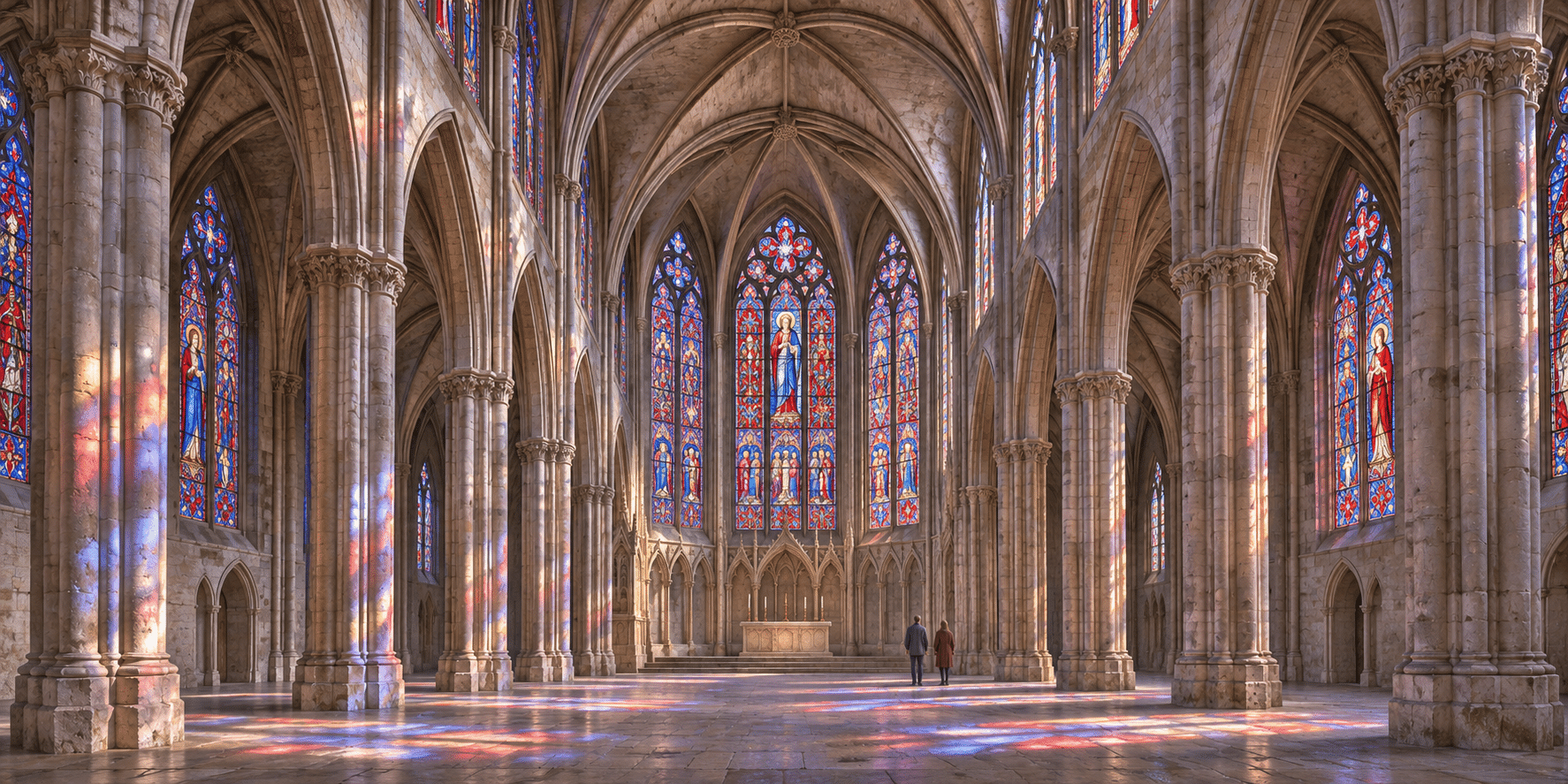
Five new AI-generated artworks add a dedicated architectural banner and four standalone studies of manuscript painting, stained glass, enamel and relief carving. The reviewed existing collage and devotional illustration remain, giving five distinct examples. These are modern interpretations, not documented medieval objects.
Select an image for a closer look. Use the thumbnails, arrow keys or a swipe to compare examples. Zoom in to inspect details, or share the image that inspires you.
A closer look
Material and purpose shape the image: a small painted page, a luminous window, a reflective enamel surface and a carved narrative organize attention differently. No single medieval look encompasses the whole field.
Begin with a work, not a costume for the past
Medieval art is an umbrella term covering many centuries, regions and forms. This introduction concentrates on selected European and Mediterranean contexts, particularly manuscripts, architecture, glass, metalwork and carving. It is not a complete account of every society in the period. Romanesque, Gothic and Byzantine refer to more specific histories and should not be used as interchangeable synonyms for everything medieval.
Medieval art encompasses architecture, manuscripts, metalwork, sculpture, textiles and other forms across diverse societies. Religious institutions were important patrons, but not all surviving work had the same function or audience. Flattened space, precious surfaces and narrative arrangement can serve purposes different from naturalistic illusion. These choices should not be described as simple failures to achieve later forms of perspective.
Romanesque: image, building and movement
Julien Chapuis’s Met essay places Romanesque art within the artistic activity of the eleventh and twelfth centuries, including the expansion of monasteries and pilgrimage. It describes sculpture, wall painting, books and liturgical objects as parts of an active visual world. The label was coined much later, and it does not account equally well for every influence or local variation.
A practical way to look is to ask where an image belonged and how someone encountered it. A carved scene above a doorway is approached differently from a small object held close. Gesture, silhouette and the relationship between image and surrounding architecture affect what is legible. A museum photograph can clarify detail while losing some of that original spatial experience.
Gothic: a relationship between structure and light
The Met’s account of Gothic art identifies the rebuilding at Saint-Denis under Abbot Suger in 1140–44 as a key early architectural example. Pointed arches, ribbed vaults and systems of support helped open interiors to larger windows. Gothic forms also entered sculpture, manuscripts, metalwork and secular objects; they were not confined to cathedral façades.
The new banner is an imagined Gothic-inspired interior. Repeated piers and arches lead toward tall coloured windows, while light spreads across the floor. Two small visitors make the scale legible. It is a visualization of spatial relationships, not a measured reconstruction, structural drawing or photograph of Saint-Denis or another named church. Its modern viewing perspective is also different from a medieval image of a building.
A manuscript is a made object
Getty’s Making of a Medieval Manuscript presents book production through preparing parchment, writing, painting and binding. Parchment is prepared animal skin; the displayed works bring together ink, colours, gold and binding materials. The exhibition includes Christian, Jewish and Islamic manuscript examples, reminding us that the history of the book crosses the boundaries of a single image tradition.
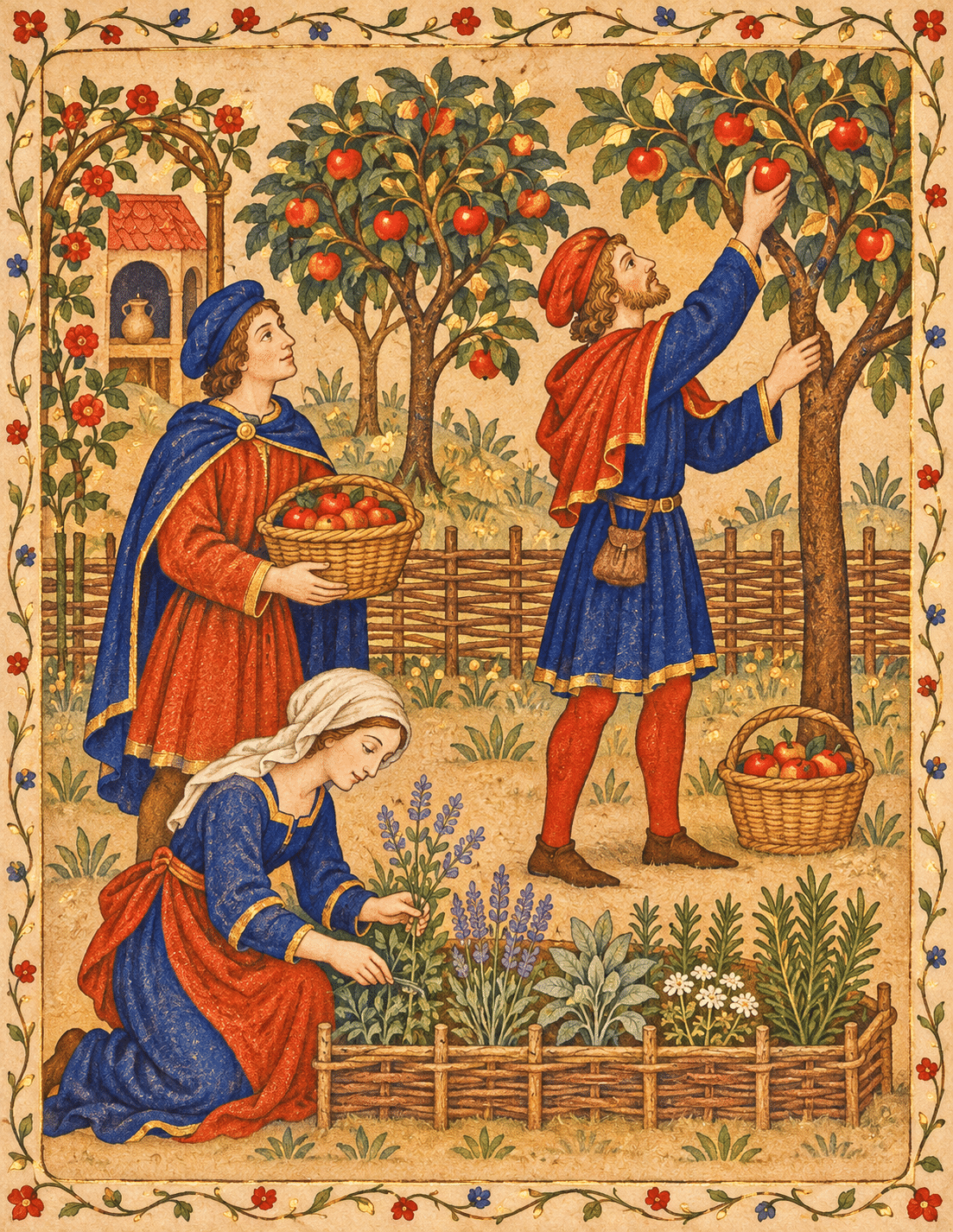
The orchard miniature translates a material vocabulary into a new narrative. Three adults pick apples, carry fruit and tend herbs. A narrow vine border holds the scene together; blue and red garments connect the figures across the page. The image intentionally contains no manuscript text. It is an invented illustration, not a newly discovered leaf or a reliable record of historical gardening and dress.
At a small scale, decide what the reader should see first. One raised hand reaching toward fruit can organize a whole composition. Too many equally elaborate borders and costumes compete with that action. Begin with the figures and their relationship, then use ornament to support the scene rather than conceal unclear gestures.
Stained glass: colour is also construction
The Met’s stained-glass essay explains how pieces of coloured and painted glass are assembled with lead cames and supported in a frame. Painted details can add lines or shadows without making every small mark a separate piece. This distinction matters when looking closely at an actual window.
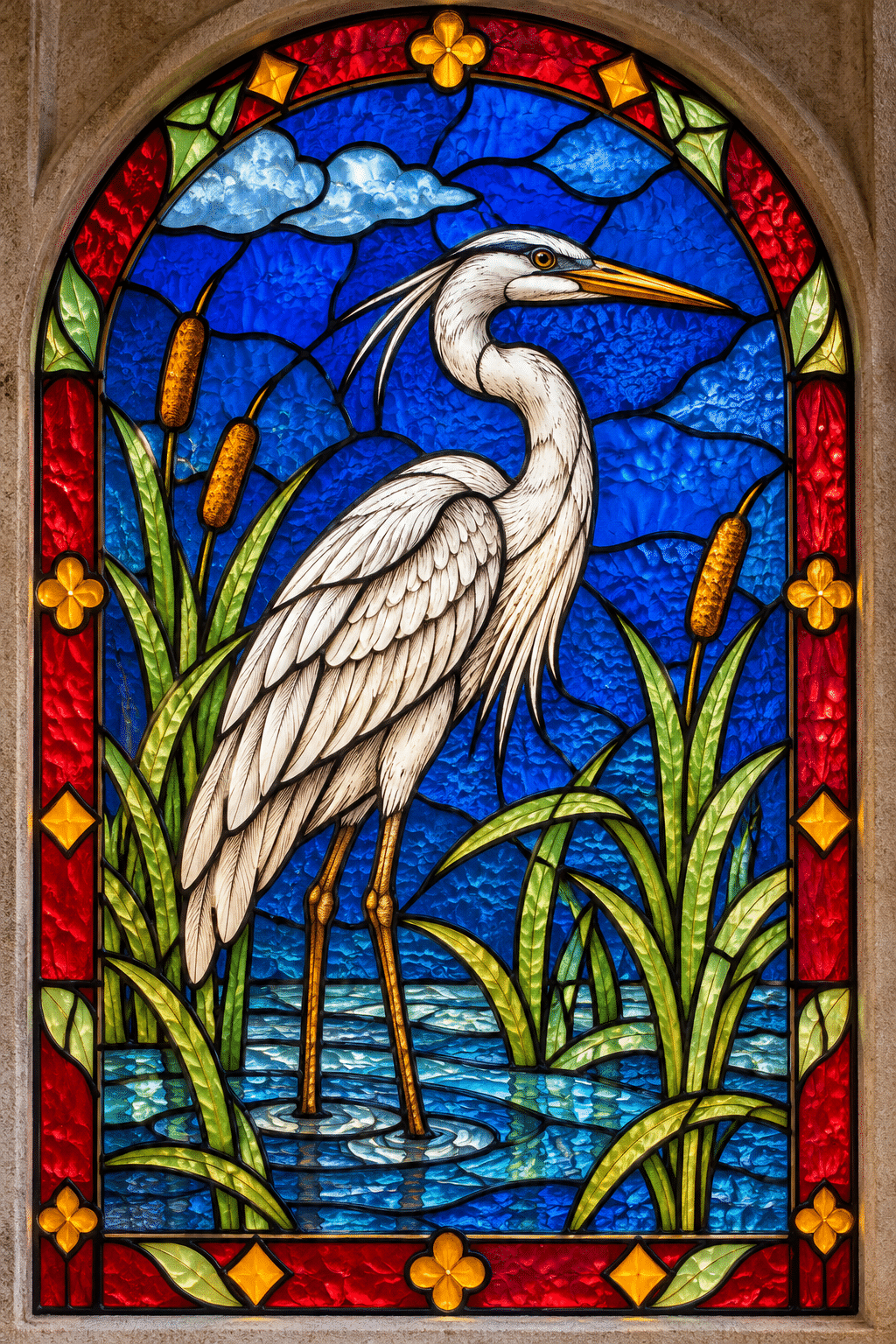
In the new heron concept, dark seams divide the blue field and red border into larger areas, while finer marks describe feathers. Transmitted-looking light gives the colour a different presence from paint on an opaque surface. Follow the silhouette first, then the pattern around it. The image is a contemporary interpretation of a material language, not an authentic medieval panel or a fabrication-ready design.
Try the same bird as an ink drawing and compare the decisions. In glass, each major division can participate in both pattern and the imagined assembly. In drawing, a thin line may have no equivalent material joint. A convincing visual simulation should respect the difference even when it cannot certify a real object’s construction.
Enamel: a bright surface on a metal support
The V&A’s explanation of champlevé enamelling describes glass fused by heat onto a prepared metal surface. In this technique, recesses in a copper plate receive the enamel. Its documented Limoges reliquary of about 1185–95 offers a reference for the relationship between vivid colour and metal, rather than a model that our illustration claims to reproduce.
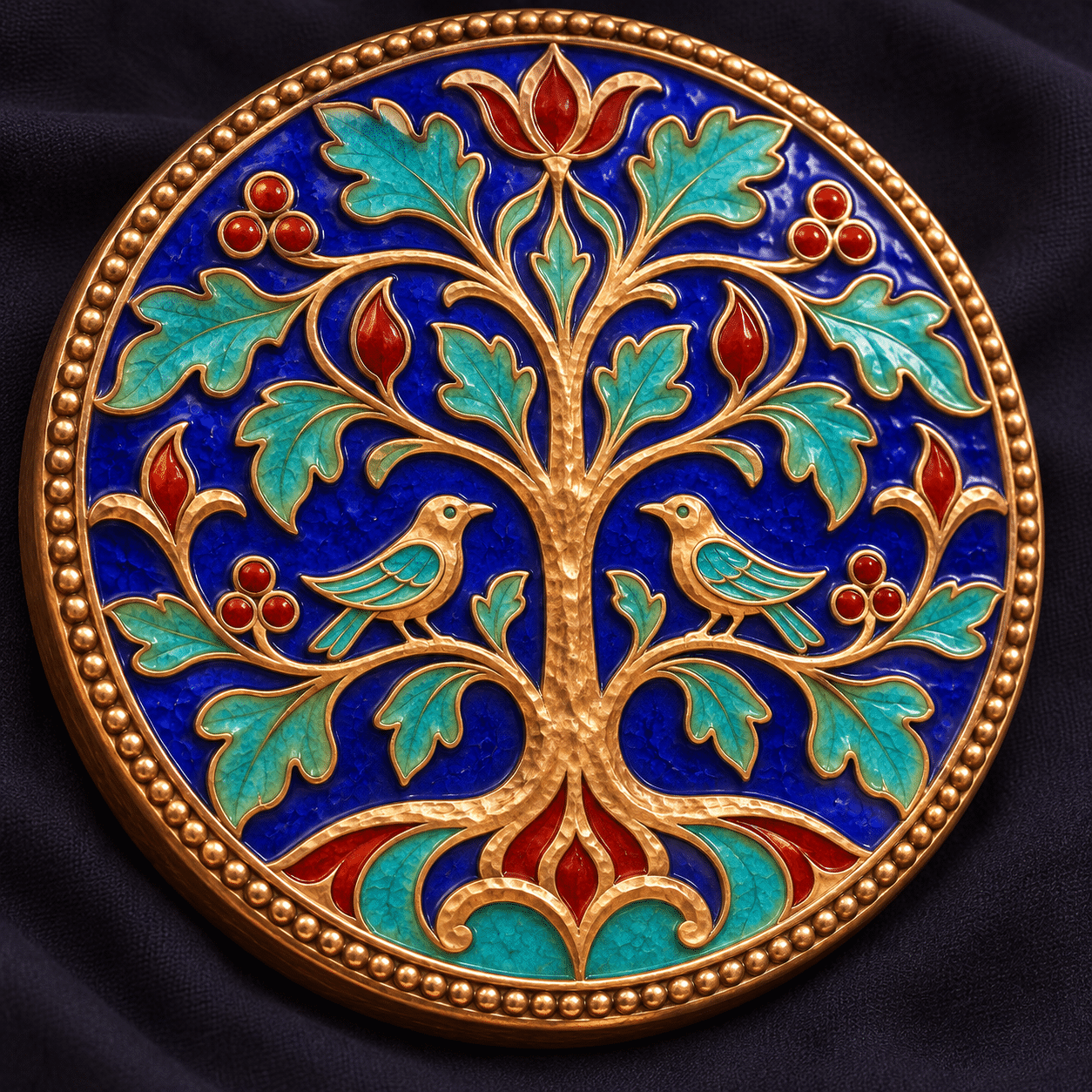
The circular plaque concept places two birds beneath a branching tree. Cobalt and turquoise fields meet raised-looking golden boundaries, with small red accents. Compare the cool glossy colour with the worked metal-like surface. The pattern is deliberately invented. A rendered appearance alone cannot determine a historical object’s alloy, firing method, workshop or date.
Carving: the surface is evidence
The V&A’s 2025 account of research into an English Romanesque walrus-ivory Deposition describes microscopy and X-ray fluorescence used to examine tool marks and possible remains of surface treatments. The museum stresses that those findings were preliminary. It is a useful reminder that an object’s present appearance is not automatically its complete original appearance.
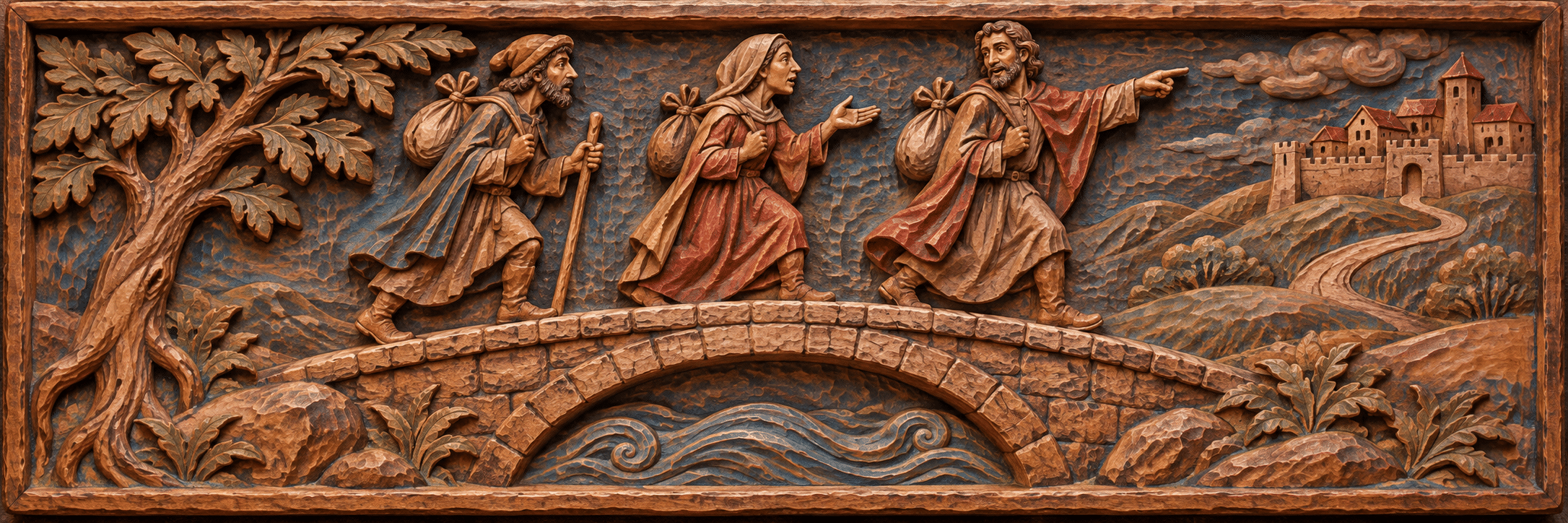
Our relief study uses a different imagined material: wood. Three travelers cross a bridge, with the direction of their gestures extending toward buildings at the right. Shallow layers, cut-looking textures and muted colour in the recesses distinguish foreground from background. These are designed visual effects, not archaeological evidence or a reconstruction of the V&A carving.
Look at how much narrative can fit in a narrow strip. The tree establishes one end, the bridge connects the figures, and the distant destination completes the route. An invented scene can use this compositional discipline without borrowing an undocumented story or assigning itself a medieval workshop.
The retained illustrations and their limits
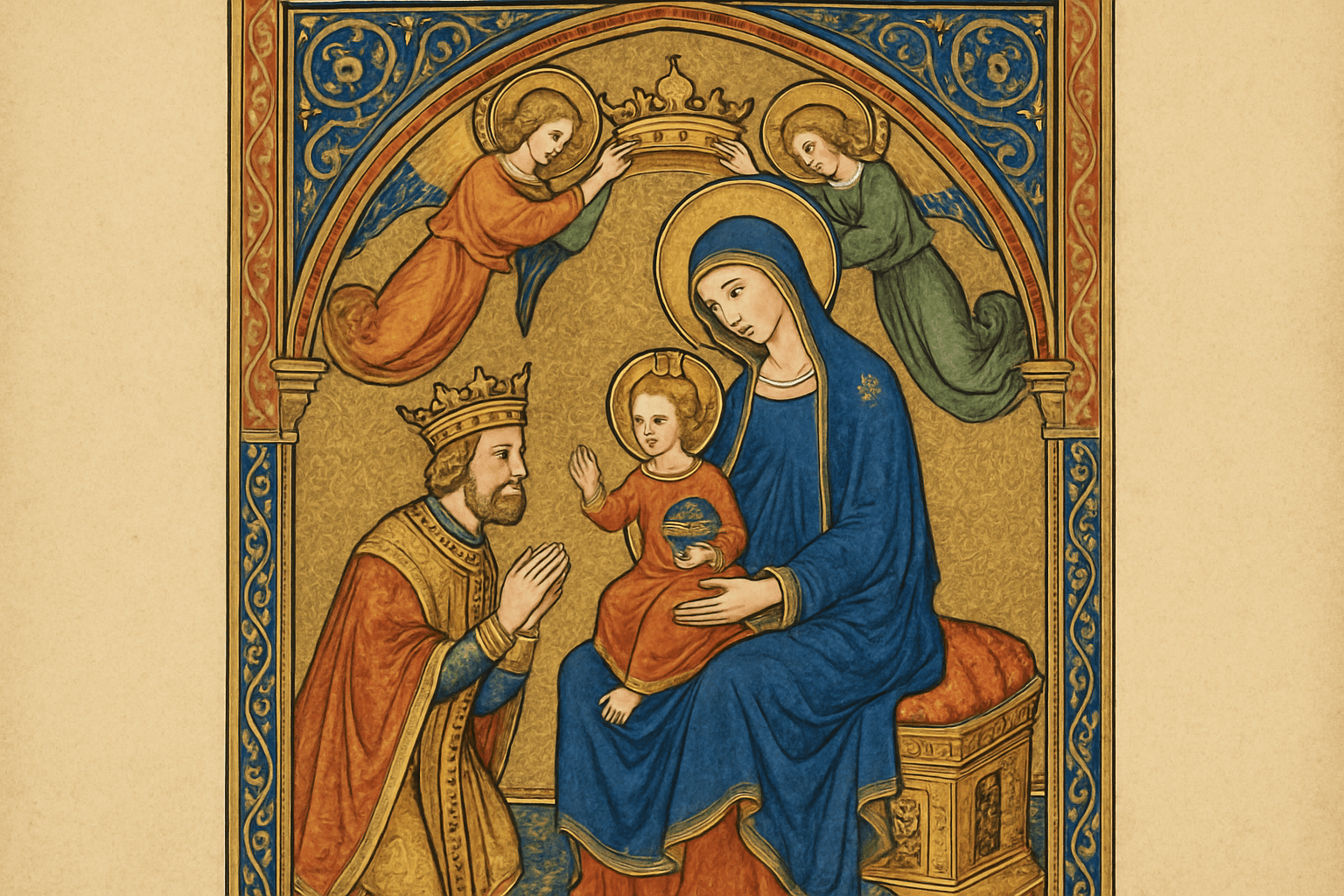
The earlier devotional illustration remains as a fifth example: a seated mother and child, a kneeling crowned figure and two angels appear within a gold-toned architectural frame. Its emphasis, repeated curves and contrasting garments offer a useful comparison with the orchard scene. It is an AI-generated interpretation, not an attributed painting or an identified historical commission.
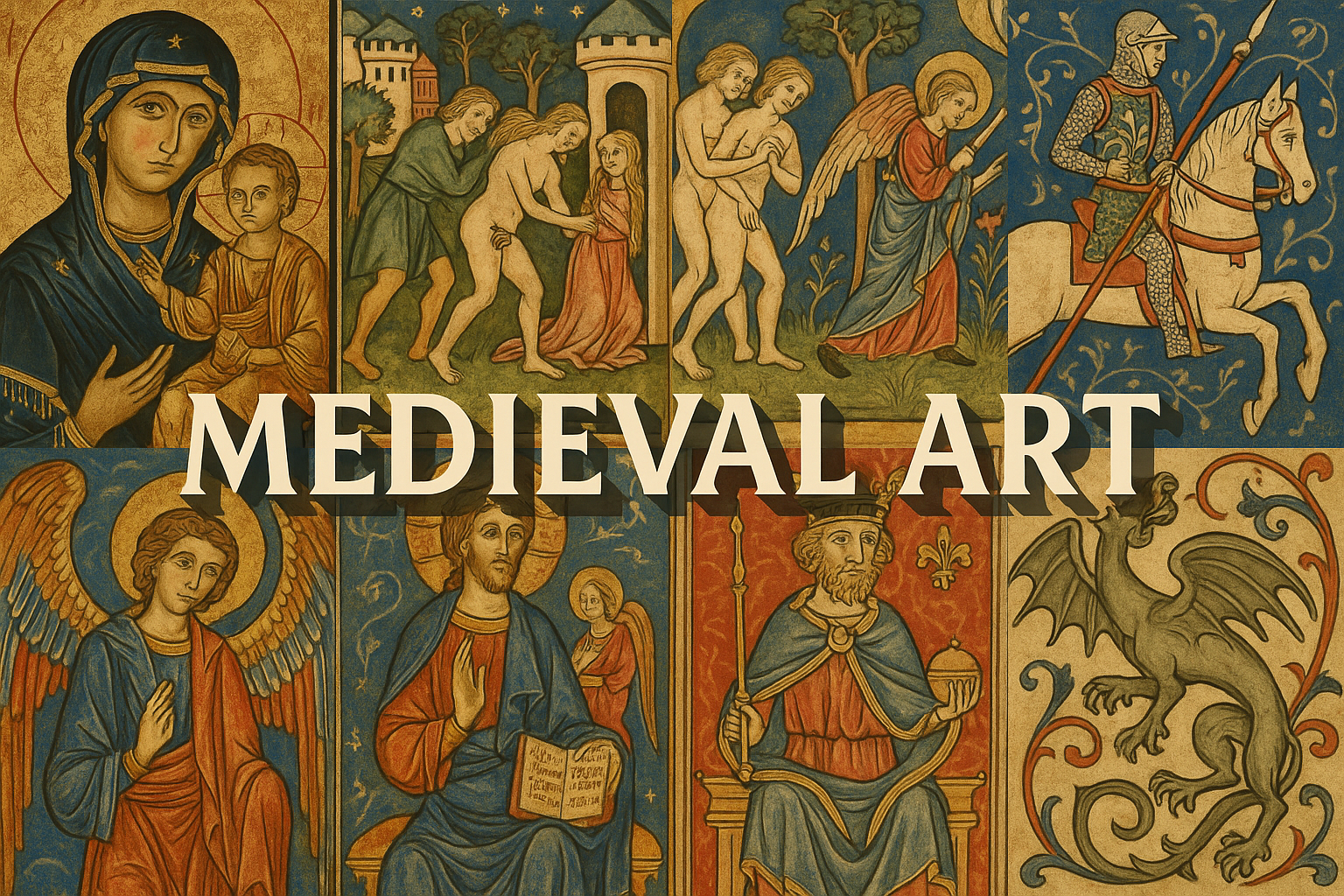
The retained centrally titled collage combines devotional figures, courtly imagery and a fantastic creature. It supplies a visual doorway rather than a taxonomy of medieval art. Small inscription-like marks in the old illustration are decorative generated marks and should not be read as an authentic manuscript text. The expanded gallery adds material and spatial variety to this earlier emphasis on painted figures.
A useful creative exercise
Choose a specific format for an original exercise: a manuscript page, a carved panel or a small enamel-like object. Let that format determine scale, border and material effects. For a narrative image, make the main action legible through gesture and grouping before adding ornament. Use gold-like accents sparingly so they establish emphasis. A modern interpretation can borrow compositional ideas while clearly stating that its story, figures and decoration are newly invented.
The three prompt cards offer different routes: an orchard miniature, a relief narrative and a deliberately modern bicycle workshop. The last makes the act of interpretation visible. For historical research, reverse the process: start with a documented work, read its record, distinguish what survives from what has been restored, and only then make claims about its place and meaning.
Positive review — AOI editorial perspective
The most rewarding approach begins with material and use. The expanded gallery gives the eye different tasks: read a gesture on a page, follow an architectural rhythm, distinguish glass seams from painted detail, compare enamel with metal, and trace a story through shallow relief. These differences make the historical field more approachable than a single fantasy-medieval mood.
Negative review — AOI editorial perspective
A small gallery can overemphasize richly decorated Christian and courtly imagery and underrepresent other communities, ordinary objects, early periods and regional differences. Simulated age and gold can also make an invented image look authoritative. Further study should add specific documented works and contexts; a convincing surface is not proof of authenticity.
Neutral review — AOI editorial perspective
Medieval Art is treated as a broad historical field, with this article offering a selective introduction through several materials and settings. The cited museum resources document historical practices and objects. The gallery consists of modern AI-generated interpretations and does not reproduce or authenticate those sources.
A small poetic detour
Original words from the AOI studio.
Poetry
A narrow page can hold a field,
a hand, a branch, the weight of fruit.
A window catches passing light
and gives the stone a coloured route.
The metal keeps a pool of blue;
the carved road bends beneath three feet.
We look for what the surface knows,
for marks where hand and matter meet.
The old work keeps its unanswered things.
The new work names the part we made.
Between the record and invention,
let neither borrow the other’s shade.
The prompt workshop
Original creative exercises. These prompts create new illustrations, not documentary evidence.
An invented manuscript scene
Create an original medieval-manuscript-inspired illustration of gardeners tending an orchard, clear gestures, a narrow decorative border and restrained gold-like accents. Use no copied religious symbols or invented historical inscription.
A carved narrative
Design an original relief-panel concept showing travelers crossing a bridge, simplified folds and readable groupings. Emphasize the material depth of carved wood and a coherent sequence of actions. Label it as a newly invented panel, not a surviving medieval artifact.
Modern miniature
Create a contemporary miniature painting of a bicycle repair workshop using compartmentalized narrative space and a jewel-toned palette. Keep the modern subject obvious and treat the historical format as an interpretation.
A smile from the studio
Jokes
The miniature painter asked for a bigger deadline. The patron offered a wider margin.
Sources and further exploration
The Met — Romanesque Art: institutions, materials and images in context
The Met — Gothic Art: architecture, light and related forms
Getty — The Making of a Medieval Manuscript: materials and stages of bookmaking
The Met — Stained Glass in Medieval Europe: glass, painted detail and assembly
V&A — Champlevé enamelling: process and a Limoges reliquary reference
V&A — Researching a Romanesque ivory: tool marks and preliminary surface evidence