
Art and cultural context · researched guide
Art in Lithuania cannot be reduced to pastoral landscapes, costume or one decorative vocabulary. The National Gallery of Art in Vilnius provides a more useful introduction through its revised display of early twentieth-century art: multiple media, differently remembered artists and a history that remains open to research.
A visual introduction
Open any image to look closer, then browse the examples.
A closer look
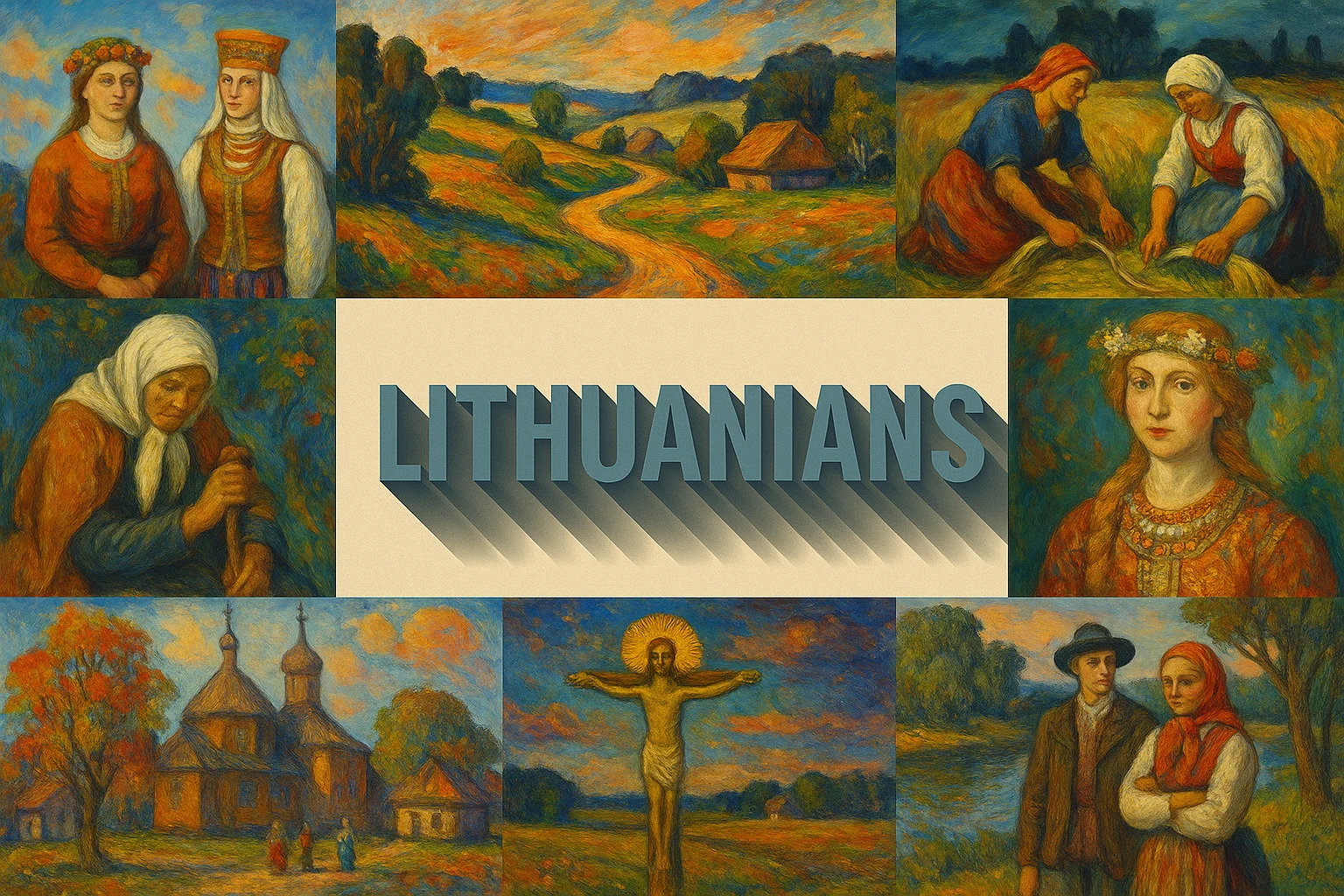
The archive collage brings together invented rural portraits, harvesting, a church and a devotional figure. Ochre fields and blue shadows connect the panels. These are generated illustrations, not verified records of Lithuanian artworks, religious objects or regional clothing.
A permanent display can change its argument
In April 2025, Lithuania’s National Gallery of Art introduced a new presentation of art from the first half of the twentieth century. Curators Giedrė Jankevičiūtė and Gabrielė Radzevičiūtė revisited the familiar narrative and included less widely recognised artists alongside major figures. The museum’s announcement explains this as a change informed by research, not simply a rearrangement of pictures. [1]
This is a valuable way to begin: an art history is an account assembled from evidence, and new attention can change its emphasis. Familiarity with a few celebrated names is not the same as understanding a period. Ask which practices have become visible, which remain difficult to access and what the exhibition’s structure encourages you to compare.
Many media, many kinds of attention
The revised display includes painting, sculpture and prints as well as photography, animation and book design. Its named artists include Mikalojus Konstantinas Čiurlionis, Barbora Didžiokienė, Marcė Katiliūtė and Domicelė Tarabildienė, among others. This selection is a museum’s particular route through the period, not a complete list of Lithuanian artists. [1]
Treat the change of medium as a change of question. A book illustration must work with a page and a reader’s pace. An animation unfolds through time. A sculpture occupies space shared with the viewer. Their relationships may be intellectually rich without being reducible to a common palette. An image search that presents them as equivalent rectangles can conceal those differences.
The archive collage needs its own caption
Look at how the generated image places the devotional figure below the central country label and balances it with a church and paired portraits. That arrangement gives unrelated motifs a feeling of belonging together. We can describe the arrangement; we cannot infer a common date, place, maker or religious meaning from it.
The costume and harvest scenes also narrow the imagined world to a rural past. This is precisely why the illustration is not presented as a national style guide. Its useful role is to make the limits of an AI mood board visible. The documented exhibition provides a richer route into urban artistic life, changing media and individual decisions.
Build a small research notebook
Choose three documented objects in different media. For each, record the artist’s credited name, title, date or date range, medium and collection link. Keep your visual observations in a separate column. If the record is incomplete, leave the gap visible; a plausible answer generated by a model is not an additional source.
Then write a short comparison around one question, such as how each work directs attention or constructs a sense of time. This makes the project specific enough to be useful. Use the gallery’s official page for current programmes and visitor information, since a dated exhibition announcement cannot establish today’s opening arrangements. The strongest introduction is one that gives you the means to keep discovering. [2]
People & works to explore
References discussed in this article. Consult the sources below for context.
Artists and practitioners
Mikalojus Konstantinas Čiurlionis — included in the cited display
Barbora Didžiokienė — included in the cited display
Marcė Katiliūtė — included in the cited display
Domicelė Tarabildienė — included in the cited display