
Art and cultural context · researched guide
Art in Latvia includes histories of painting, graphic art, sculpture and experimental practice. A national collection is a useful entrance into those histories, but it is not a universal style chart. This guide follows the Latvian National Museum of Art from its collection categories into questions of war, movement and visual interpretation.
A visual introduction
Open any image to look closer, then browse the examples.
A closer look
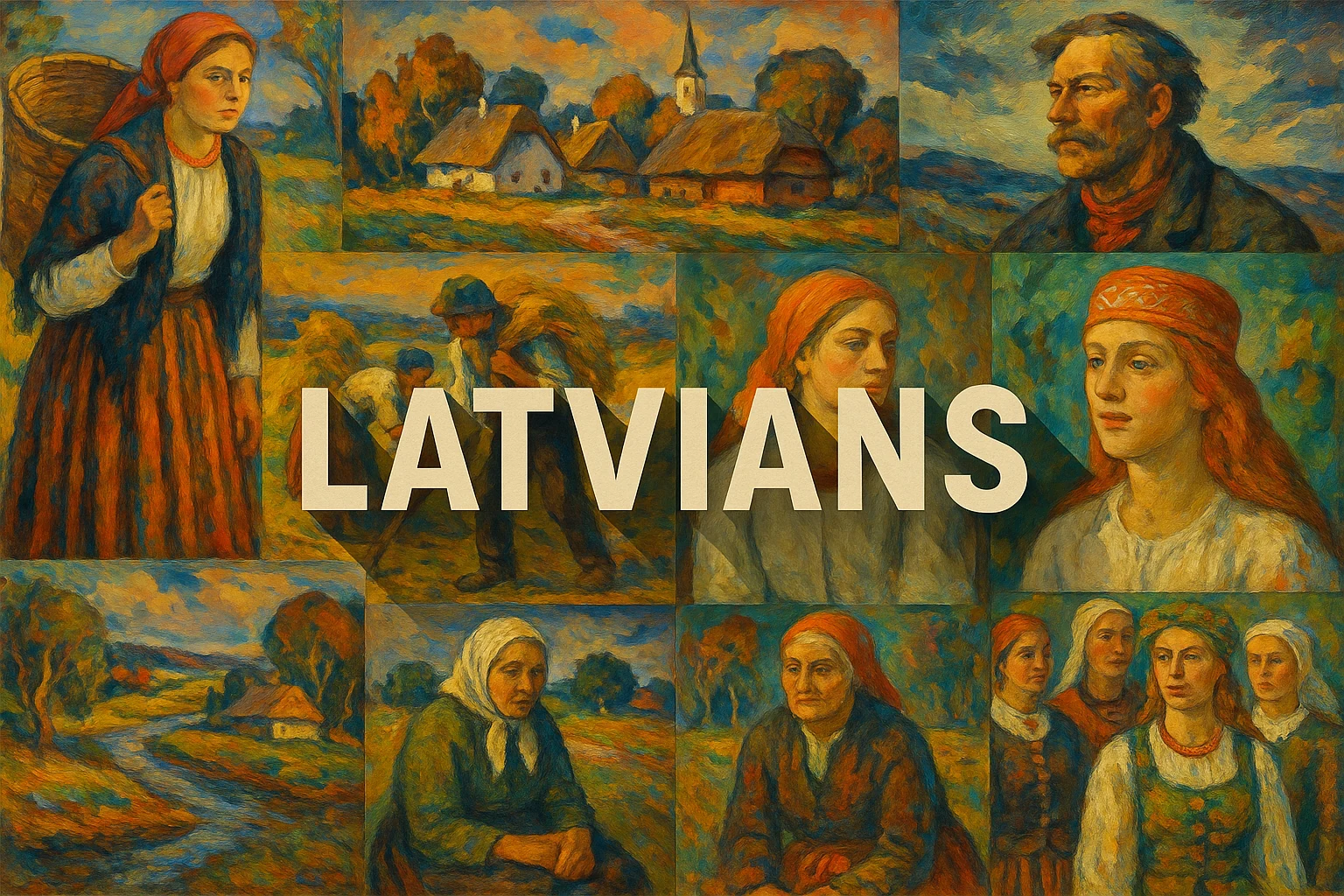
The AOI archive collage places portraits, cottages and field work in a repeated orange-blue palette. Softened edges and pastoral scenes make the panels feel continuous. The image is a synthetic mood board, not a set of identified Latvian artworks or an ethnographic record.
Use the museum’s distinctions
The Latvian National Museum of Art separates painting, graphic art and sculpture collections and provides memorial collections for individual artists, including Jāzeps Grosvalds. These distinctions are useful: they let the visitor follow a medium or a practice instead of assuming that nationality determines appearance. The collection portal links onward to more specific accounts. [1]
Begin by choosing one of those routes. A print asks questions about line, reproduction and paper that are different from those asked by a sculpture. Even two works on the same subject may address the viewer differently because of their scale, material or intended setting. An introduction becomes more accurate when it narrows its claims.
Modernism belongs to events as well as forms
The museum’s overview of Latvian Art 1915–1940 connects Jāzeps Grosvalds with images of refugees and riflemen during the First World War. It also names Jēkabs Kazaks and the influence of contemporary French painting. This brings historical experience and international artistic exchange into the same discussion. It does not mean that every artist used the same modernist vocabulary. [2]
The institution separately discusses Latvian artists who stayed in Soviet Russia, including Gustavs Klucis, Kārlis Johansons and Aleksandrs Drēviņš. Such a route complicates any account that places a national culture inside a sealed border. Use the artists’ own work and specific collection records to examine the differences; a general country label cannot resolve them. [2]
A collection can be reconsidered
The Latvian Centre for Contemporary Art’s 2024–2025 exhibition The Latvian Collection revisited works acquired for Malmö in 1939. Its account relates changes from 1920s modernism toward 1930s realism to cultural politics and invited contemporary responses to overlooked narratives. This is a past exhibition, cited as a research example rather than a current event recommendation. [3]
The useful lesson is methodological. A museum display has a history of selection: some works become familiar and others remain less visible. Ask what a particular display includes, who assembled it and what new research changes. Looking carefully at that frame does not diminish the artworks. It gives their encounter with the public a more precise setting.
Reading the illustration without mistaking it for history
Our collage’s cottages and repeated headscarves make rural life seem to be the whole subject. That is a limitation of the illustration, not a description of the range of Latvian art. Its invented faces should not acquire the names of real artists or sitters. Nor should its warm palette be advertised as a national characteristic.
For a useful exercise, choose one documented work from the museum and write five observations about its composition before reading the interpretation. Add the label information separately, then compare your account with the museum’s. If you develop an AI image from those observations, identify it as your own synthetic experiment. The aim is to learn to see, not to manufacture a convincing-looking replacement for the archive.
People & works to explore
References discussed in this article. Consult the sources below for context.
Artists and practitioners
Jāzeps Grosvalds — discussed in the museum’s wartime painting account
Jēkabs Kazaks — discussed in the museum’s modernist context