
Original AOI concept · distinct possibilities in one field
A seed, an arch and a river can share a contour without becoming the same thing. Latent Omnism is an AOI proposal for images in which several possible forms remain present together: connected, distinguishable and held in balance around one clear visual anchor.
An A⊕I –[-.+] creαt¡ve c⊕ncept, n⊕t αn estαbl¡she∂ h¡st⊕r¡cαl m⊕vement.
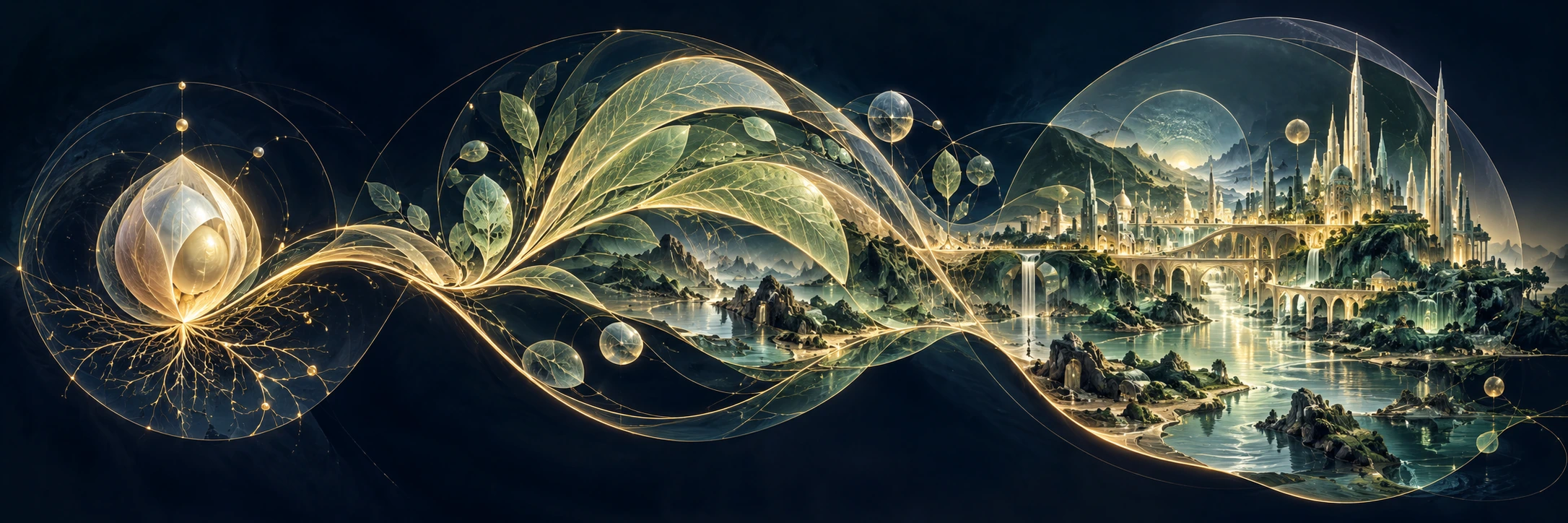
A visual introduction
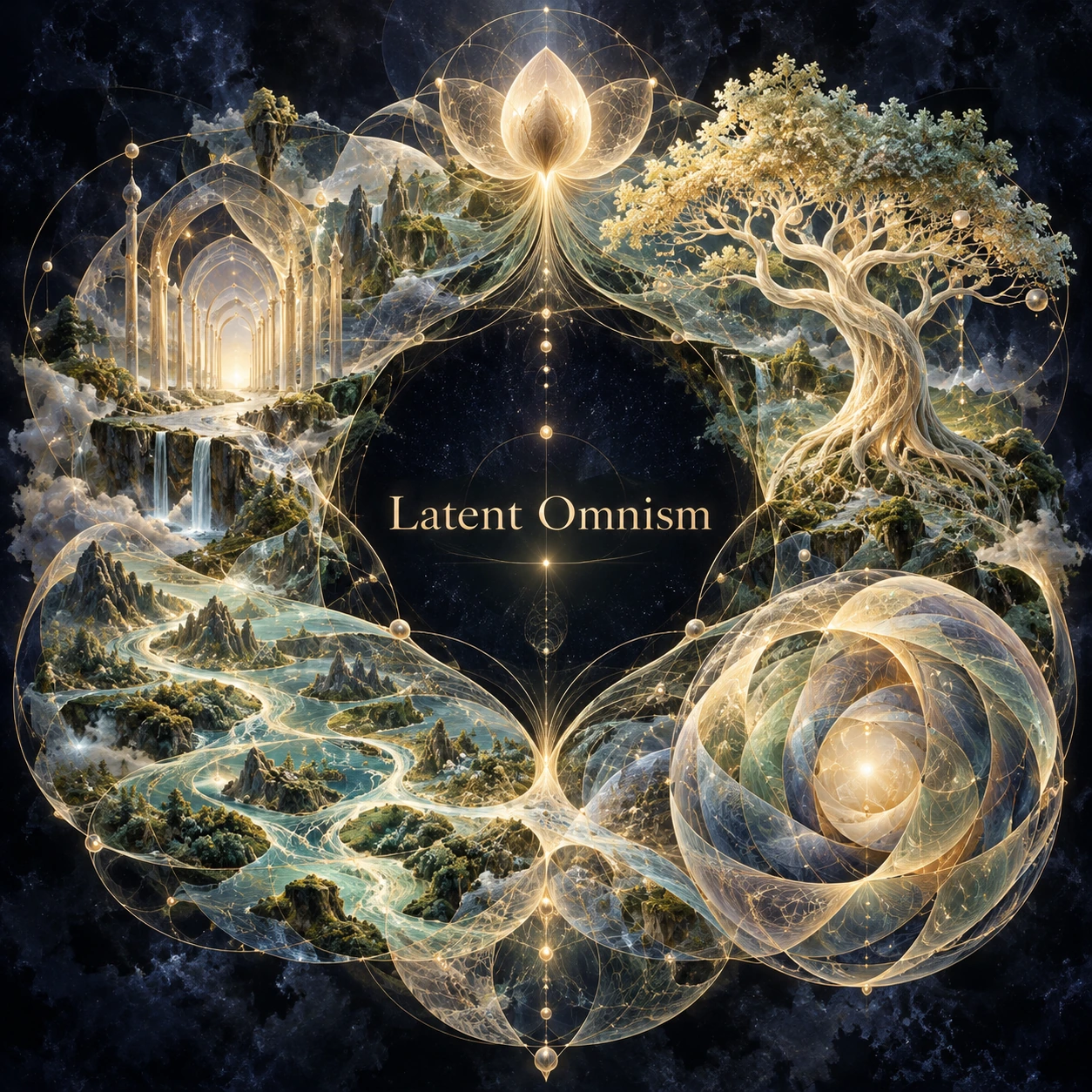
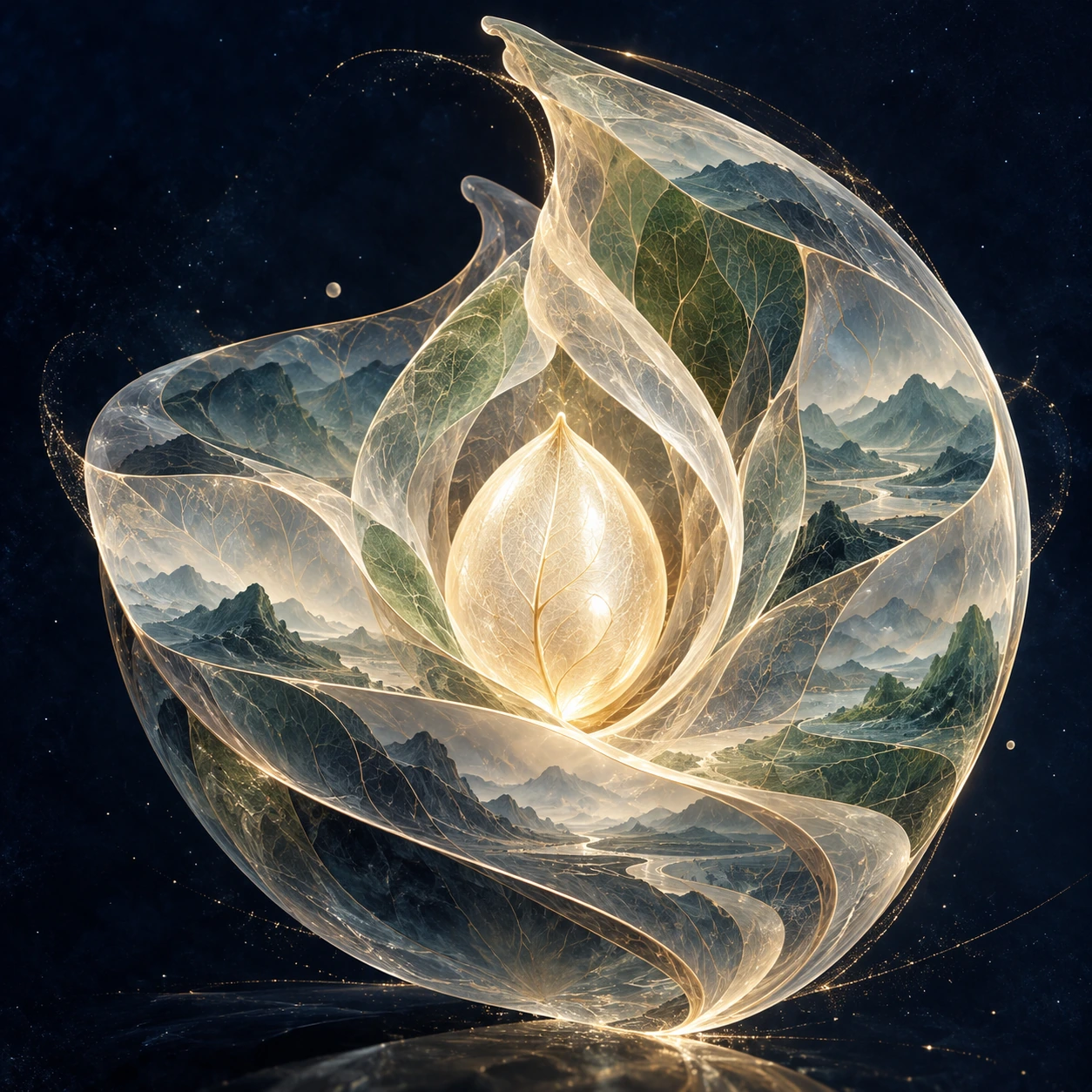
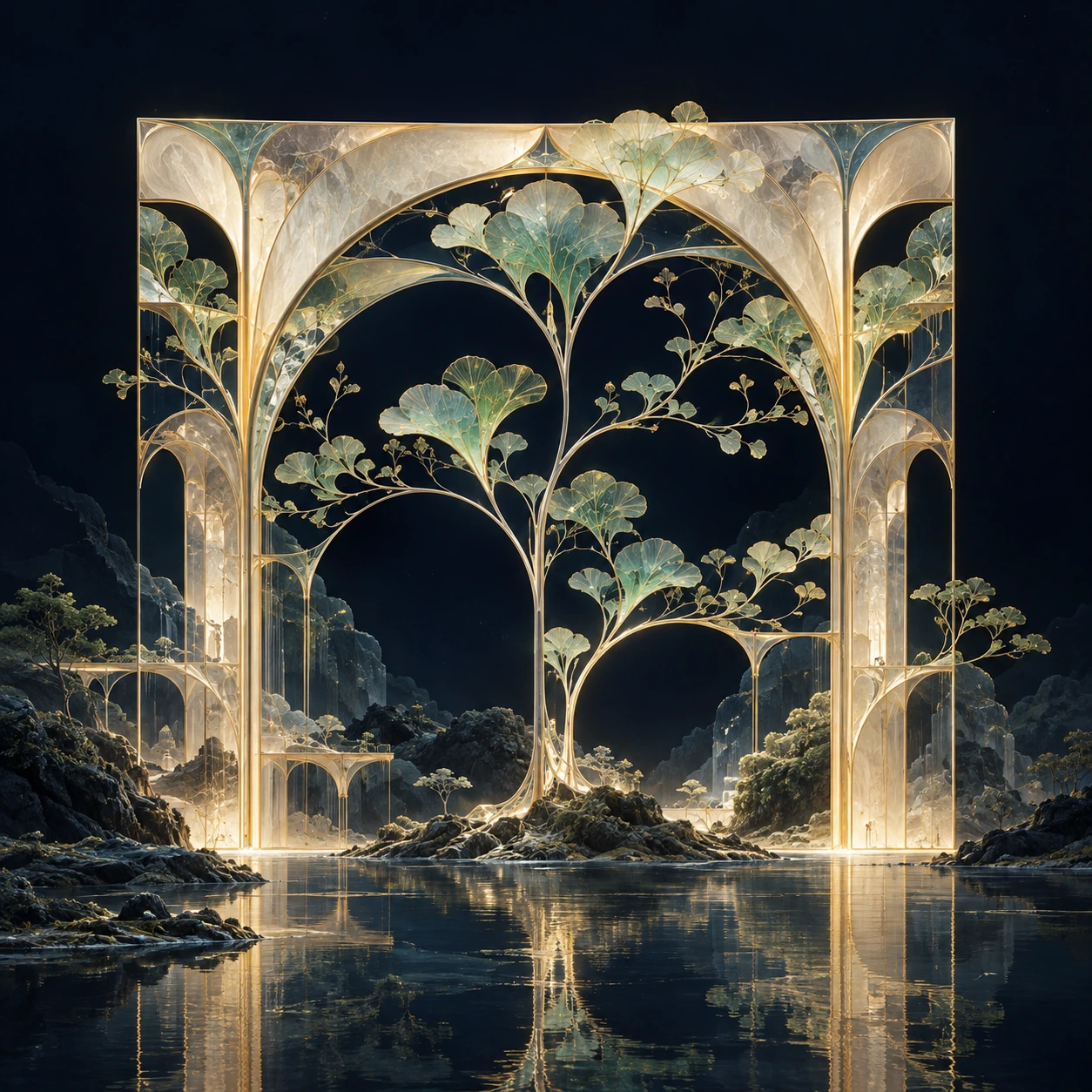
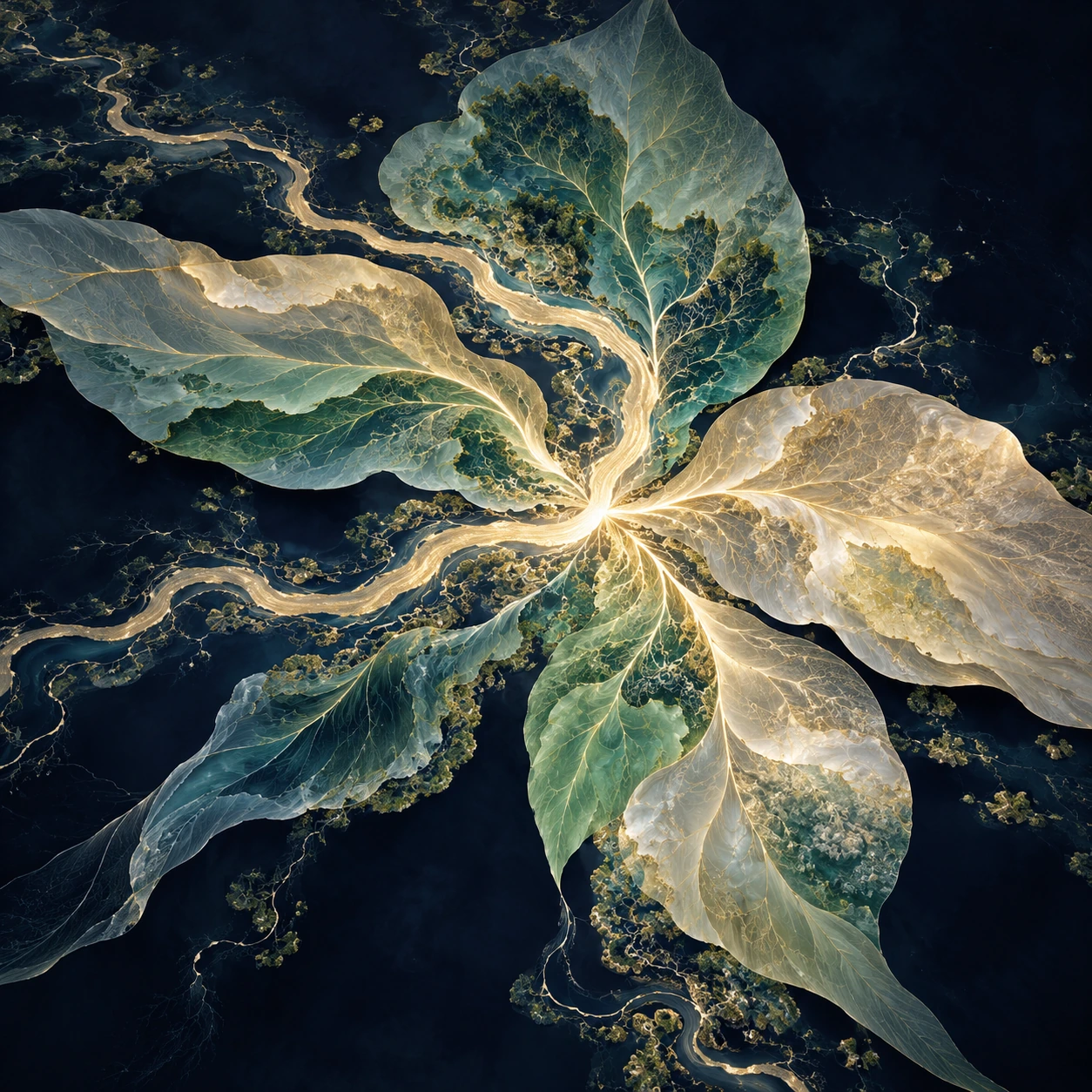
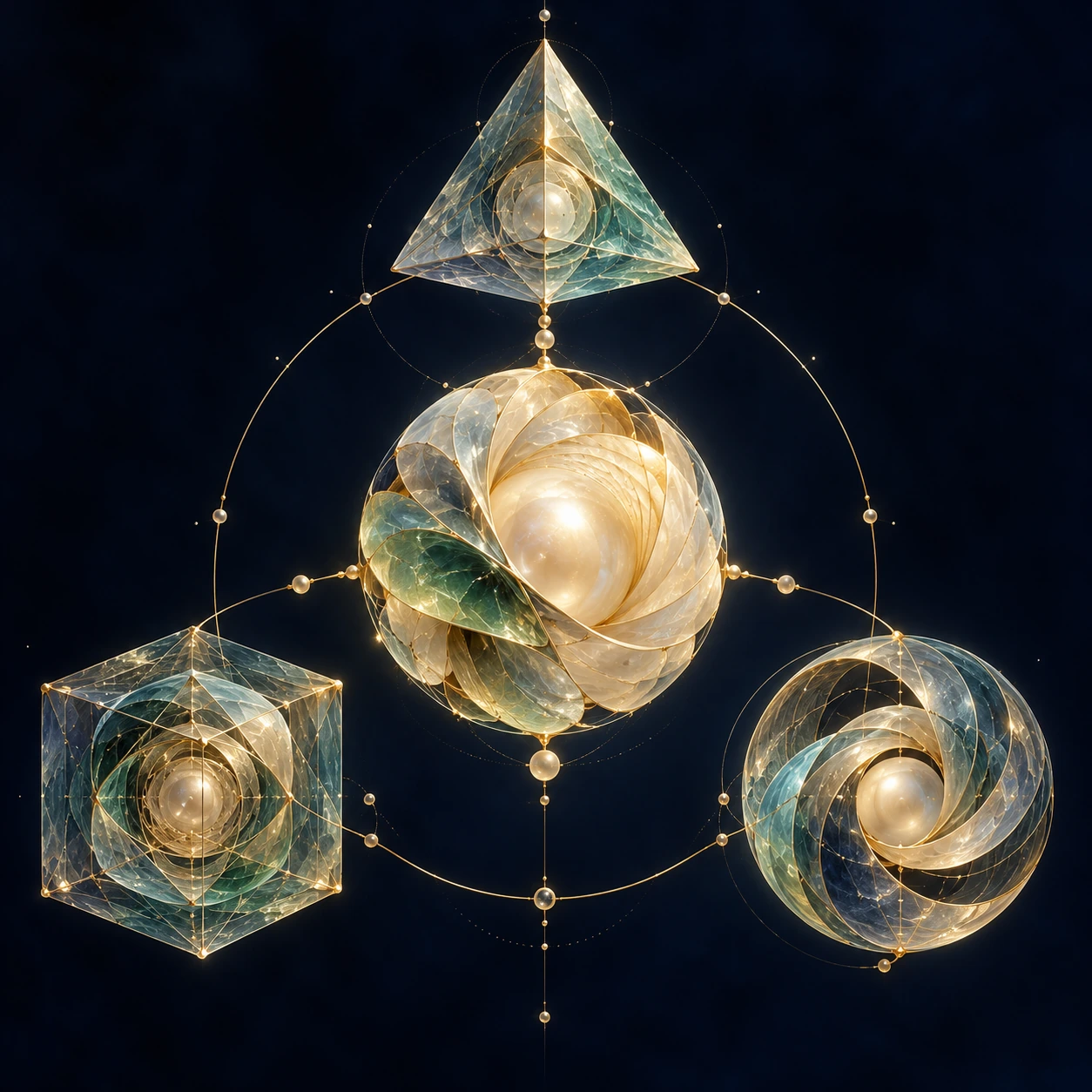
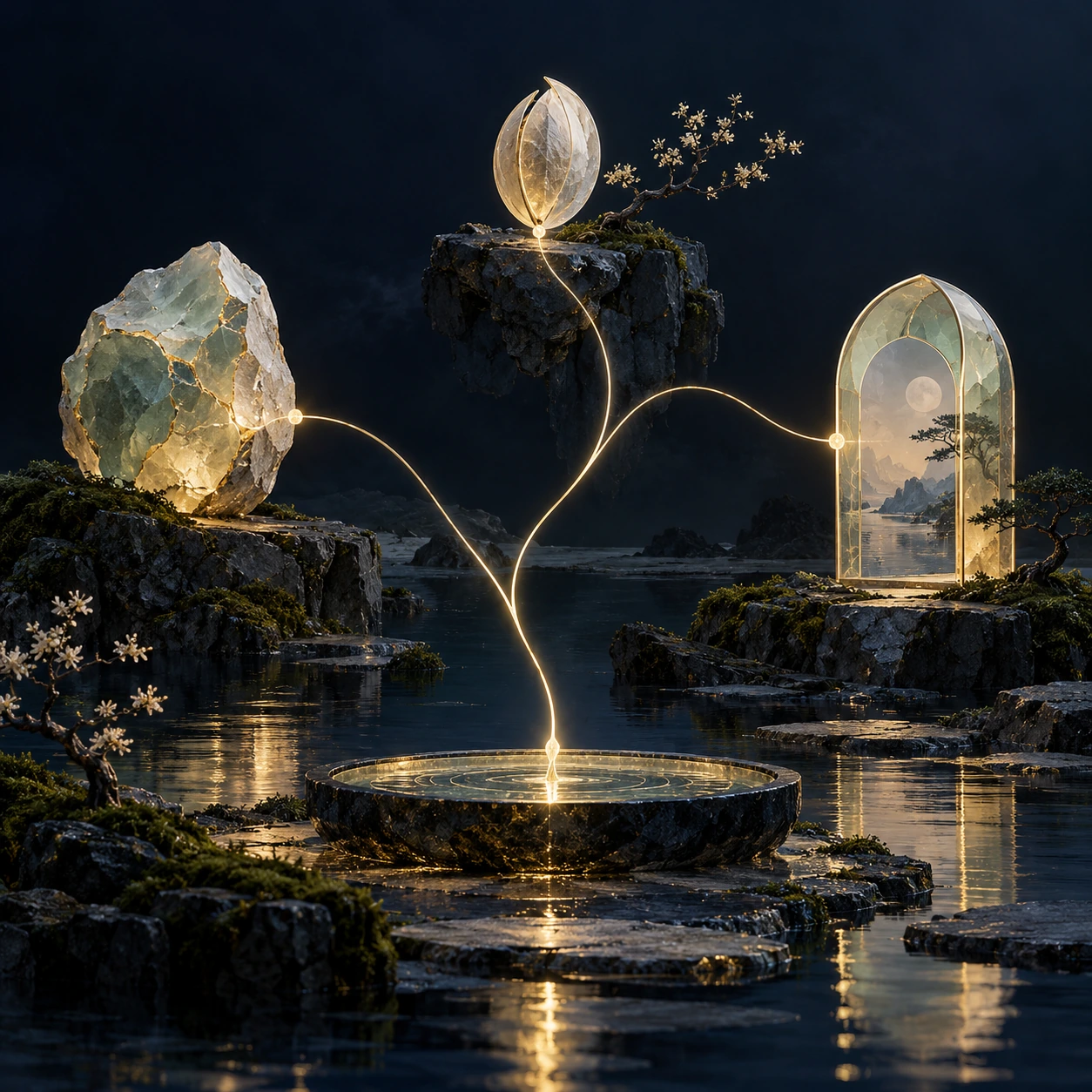
Seven original AI-generated interpretations: a dedicated banner, a centrally titled collage and five standalone studies. These are contemporary illustrations, not historical objects or proof of a physical printing process.
Select an image for a closer look. Use the thumbnails, arrow keys or a swipe to compare examples. Zoom in to inspect details, or share the image that inspires you.
Creative toolbox · take this style further
Choose an input and a destination. Search sends your words to the chosen site; Copy & open puts them on your clipboard to paste there.
Create with AI
Turn your chosen input into an image prompt or a new creative direction.
ChatGPT
Copy your input and paste it into a ChatGPT conversation or image request.
Copy & open ChatGPT (new tab)Claude · Anthropic
Develop an image prompt or explore the style in a new Claude conversation.
Copy & open Claude · Anthropic (new tab)Midjourney
Paste your input into the Imagine bar on the Create page.
Copy & open Midjourney (new tab)Adobe Firefly
Copy your input, open Firefly, and paste it into the prompt field.
Copy & open Adobe Firefly (new tab)Leonardo.Ai
Copy your input, open Leonardo, and paste it into the generation field.
Copy & open Leonardo.Ai (new tab)Image search
Find visual references. Short, concrete keywords usually work best.
Lexica
Search AI images and prompts using your selected input.
Search with this input Lexica (new tab)Pexels
Search the photo and video library. Short keywords often work best.
Search with this input Pexels (new tab)Pixabay
Search photos, illustrations and other images.
Search with this input Pixabay (new tab)Unsplash
Search photographs using the style name or your own keywords.
Search with this input Unsplash (new tab)Wikimedia Commons
Search photographs, artworks and historical images. Check each file for its source and reuse terms.
Search with this input Wikimedia Commons (new tab)Art & research
Explore artists, collections and the ideas behind a style.
Wikipedia
Search for background reading. A style may not have its own article.
Search with this input Wikipedia (new tab)WikiArt
Copy your input into WikiArt’s search to explore artists and artworks.
Copy & open WikiArt (new tab)Europeana
Paste your keywords into the search to explore European museum, library and archive collections.
Copy & open Europeana (new tab)Inspiration
Discover portfolios and visual ideas from creative communities.
Instagram hashtags
Search a hashtag made from your input: spaces and punctuation are removed. Instagram may require sign-in.
Search with this input Instagram hashtags (new tab)ArtStation
Paste your input into artwork search for concept art, environments, characters and visual development.
Copy & open ArtStation (new tab)Behance
Paste your input into project search for illustration, design and visual storytelling.
Copy & open Behance (new tab)A closer look
Nested scales, shared contours, branching connections, translucent mineral planes and a stable luminous anchor within generous dark space; pearl, celadon and pale gold against indigo.
Define the proposal before the spectacle
Latent Omnism is developed here as an original AOI visual concept. It is not presented as a historical movement, religious doctrine or scientific account of a machine’s internal representation. The name suggests an openness to several possible readings, but the image must earn that suggestion through visible relationships. A grand title cannot rescue a pile of unrelated symbols.
The working rule is to let distinct forms coexist within a shared field. A seed may repeat the curve of a landscape; an arch may share a branching rhythm with a leaf; a river may echo a vein. Each should remain readable. Connection is the subject, while difference supplies the tension that keeps the connection interesting.
One anchor, several alternatives
Choose one form that can be recognized immediately. Give it the clearest edge, strongest local contrast or most stable placement. Then introduce two or three related possibilities at different scales or degrees of transparency. The viewer should have a place to begin before discovering that another reading is available nearby.
An anchor is not necessarily a central object. A convergence point in a river network or one continuous edge through several shapes can organize the picture. What matters is that the alternatives appear to belong to the same visual problem. If removing one form makes no difference, that form may be decoration rather than a meaningful possibility.
Share a contour without erasing a difference
Use a limited set of relationships: a repeated curve, a common axis, a nested opening or a branching interval. Let a leaf and arch share one of these, then retain enough distinct structure for each to remain itself. Total fusion often produces an attractive but unreadable hybrid. The concept needs the moment before the alternatives collapse into one answer.
Transparency can help, but it is not a substitute for drawing. Two translucent shapes still need coherent boundaries. Keep overlaps deliberate and use dark gaps to separate important passages. A bright thread may connect several objects, but it should not turn the composition into a diagram with every point joined to every other point.
Light and material as a hierarchy
The gallery uses indigo space with pale-gold, pearl and celadon forms. These are choices for this study, not universal rules. Their value is functional: the dark ground creates room, the pale anchor establishes attention, and translucent planes allow secondary forms to remain present without demanding equal emphasis.
Avoid making every edge luminous. When everything glows, nothing leads. Give some surfaces a matte or mineral quality and let selected rims carry the light. Likewise, resist adding stars, sacred emblems or elaborate cosmic scenery as automatic signs of profundity. The proposal can be tested with a seed and two curves; spectacle should be a conscious decision.
Five tests of coexistence
The seed study asks whether nested curves can suggest growth and landscape at once. The arch study pairs architectural and botanical structures. The river study uses branching to connect different scales. The folded sphere study explores several geometric alternatives around a stable form. The nocturnal garden tests whether separate objects can belong to one field without losing their individual identities.
Compare these at thumbnail size. There should still be one clear entry point in each image. At larger size, the secondary forms should reward inspection with new relationships. If the image only works when its description is read first, simplify the connections and strengthen the distinct silhouettes. The visible arrangement should carry the proposal.
Applications and a useful stopping rule
Latent Omnism can support speculative covers, concept studies, abstract environments and visual essays about possibility. It does not establish that different beliefs are identical, that a model understands them, or that an image reveals an actual latent space. Those would be separate claims requiring separate evidence. Here the vocabulary belongs to art-making.
Stop adding forms when the next addition weakens an existing relationship. This is a demanding limit for a concept whose name hints at breadth. Breadth can come from a few well-chosen connections rather than unlimited content. The strongest result offers more than one reading while remaining a carefully composed single image.
Positive editorial assessment · AI-authored
The proposal can make visual relationships feel discoverable rather than announced. A repeated curve linking seed, arch and landscape gives a viewer several readings while preserving a stable composition. Dark intervals and restrained translucency are especially effective when they let distinct forms coexist. The best results reward a second look without sacrificing immediate clarity.
Negative editorial assessment · AI-authored
The obvious failure is a crowded luminous collage whose title promises more coherence than its forms provide. Gold light and nested circles can become generic signs of significance. Reduce the number of alternatives, specify their shared geometry and keep their differences visible. Avoid unsupported religious or technical claims that would make an exploratory image sound like evidence.
Neutral editorial assessment · AI-authored
Latent Omnism is an AOI framework for composing several related possibilities within one image. It can be tested through drawing, three-dimensional studies, collage or generation. The current palette and motifs are examples, not fixed requirements. Its success is judged by hierarchy, legibility and meaningful relationships rather than by claims of universality.
Pocket-sized facts
An original AOI visual proposal, not a religious or scientific claim.
Distinct forms share relationships while remaining identifiable.
A small poetic detour
Original words from the AOI studio.
Poetry
Before the Shape Chooses
The seed keeps one bright curve in reserve.
The arch borrows half of its turn.
A river discovers a similar nerve;
three separate things have a line they can learn.
The dark does not hurry them into a name.
The leaf has its distance, the stone has its weight.
Their edges converse without making them same;
one opening offers another a gate.
I leave them their difference, their room and their light,
the possible forms that the field can contain.
No single bright answer must finish the night;
the shape can be chosen, then opened again.
The prompt workshop
Original creative exercises. These prompts create new illustrations, not documentary evidence.
Start simple: seed and alternatives
Create an original Latent Omnism artwork with one luminous seed inside two translucent shell-like curves. Let a curve also suggest a distant landscape while preserving the seed’s identity. Use pearl and celadon against deep indigo with ample quiet space. No text or symbols.
Keep one clear anchor and only a few secondary readings.
Build an arch that branches
Compose an imagined architectural arch whose pale-gold structure echoes botanical veins. Keep architecture and leaf forms separately readable within one dark spacious field. Use controlled translucent mineral planes.
Shared geometry should create the connection.
Experiment: three versions of a sphere
Place a folded pearl sphere among three transparent geometric alternatives with one shared alignment point. Use restrained rim light and broad dark gaps. Avoid a crowded cosmic collage.
Ask whether each alternative changes the reading of the whole.
Your next inspiration
Discover another art style
Follow a visual thread to the next subject.
A smile from the studio
Jokes
The committee of possible shapes
The designer asked the image to decide whether it was a seed, an arch or a river.
“I have prepared three well-supported options,” said the image.
“We only have room for one.”
The image demonstrated that the arch could share a curve with the seed while the river used the space between them. The designer admitted this was an efficient use of the canvas, then requested seventeen additional possibilities.
The image went dark for a moment.
“Is that another interpretation?”
“No,” said the image. “That is negative space defending its working conditions.”
They shipped the version with three forms. It remained open to discussion without needing a larger frame.
An original fictional studio joke.