
Contemporary glass sculpture · textile form and kiln casting
Knitted glass sets up a small double take: the eye expects a soft stitch, then a hard reflection gives the material away. The entry covers Carol Milne’s documented casting technique and the wider visual idea of interlocking glass loops in sculpture and design.
A visual introduction
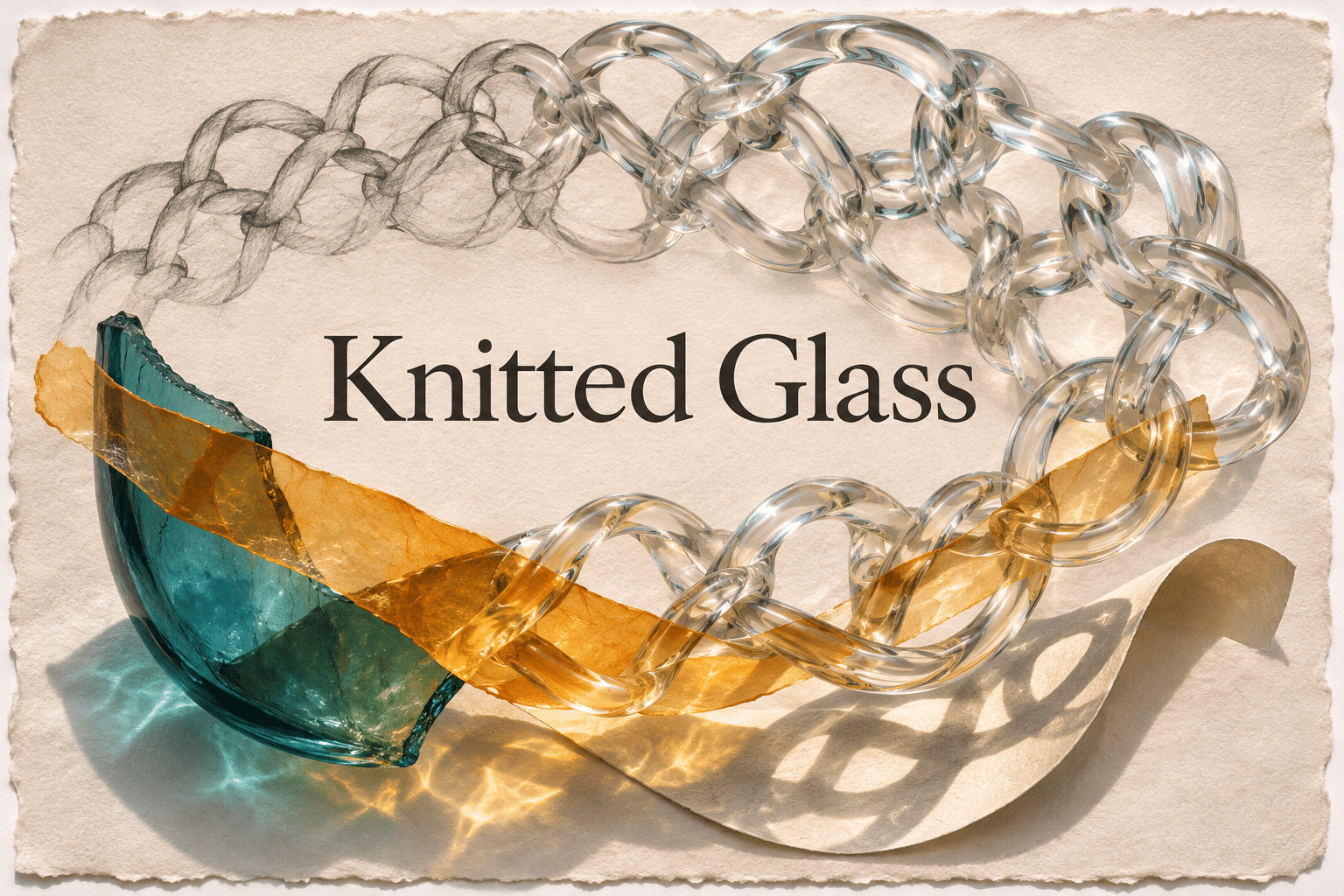
Seven original AI-generated interpretations: a dedicated banner, a centrally titled artistic collage and five standalone studies.
Select an image for a closer look. Use the thumbnails, arrow keys or a swipe to compare examples. Zoom in to inspect details, or share the image that inspires you.
Creative toolbox · take this style further
Choose an input and a destination. Search sends your words to the chosen site; Copy & open puts them on your clipboard to paste there.
Create with AI
Turn your chosen input into an image prompt or a new creative direction.
ChatGPT
Copy your input and paste it into a ChatGPT conversation or image request.
Copy & open ChatGPT (new tab)Claude · Anthropic
Develop an image prompt or explore the style in a new Claude conversation.
Copy & open Claude · Anthropic (new tab)Midjourney
Paste your input into the Imagine bar on the Create page.
Copy & open Midjourney (new tab)Adobe Firefly
Copy your input, open Firefly, and paste it into the prompt field.
Copy & open Adobe Firefly (new tab)Leonardo.Ai
Copy your input, open Leonardo, and paste it into the generation field.
Copy & open Leonardo.Ai (new tab)Image search
Find visual references. Short, concrete keywords usually work best.
Lexica
Search AI images and prompts using your selected input.
Search with this input Lexica (new tab)Pexels
Search the photo and video library. Short keywords often work best.
Search with this input Pexels (new tab)Pixabay
Search photos, illustrations and other images.
Search with this input Pixabay (new tab)Unsplash
Search photographs using the style name or your own keywords.
Search with this input Unsplash (new tab)Wikimedia Commons
Search photographs, artworks and historical images. Check each file for its source and reuse terms.
Search with this input Wikimedia Commons (new tab)Art & research
Explore artists, collections and the ideas behind a style.
Wikipedia
Search for background reading. A style may not have its own article.
Search with this input Wikipedia (new tab)WikiArt
Copy your input into WikiArt’s search to explore artists and artworks.
Copy & open WikiArt (new tab)Europeana
Paste your keywords into the search to explore European museum, library and archive collections.
Copy & open Europeana (new tab)Inspiration
Discover portfolios and visual ideas from creative communities.
Instagram hashtags
Search a hashtag made from your input: spaces and punctuation are removed. Instagram may require sign-in.
Search with this input Instagram hashtags (new tab)ArtStation
Paste your input into artwork search for concept art, environments, characters and visual development.
Copy & open ArtStation (new tab)Behance
Paste your input into project search for illustration, design and visual storytelling.
Copy & open Behance (new tab)A closer look
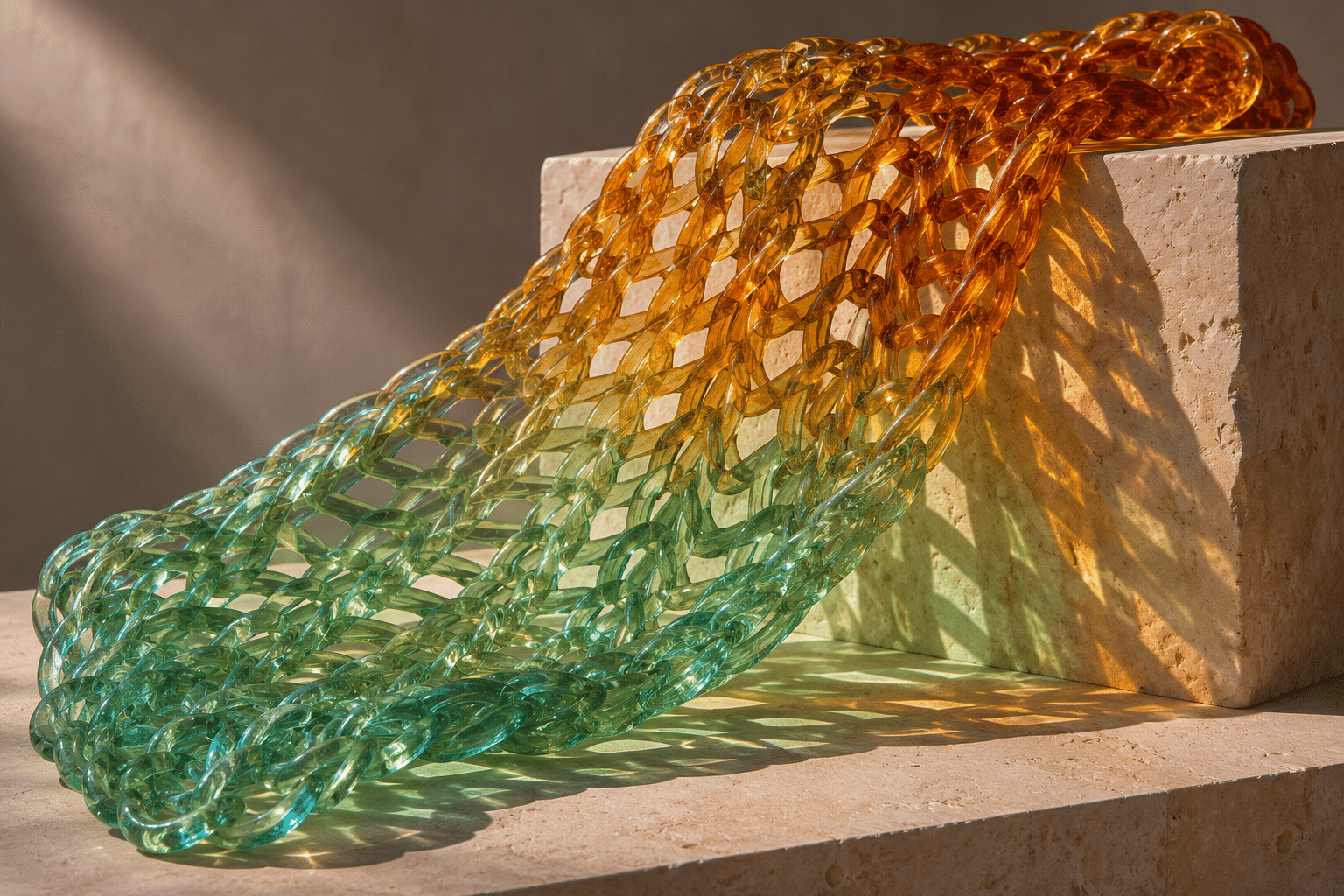
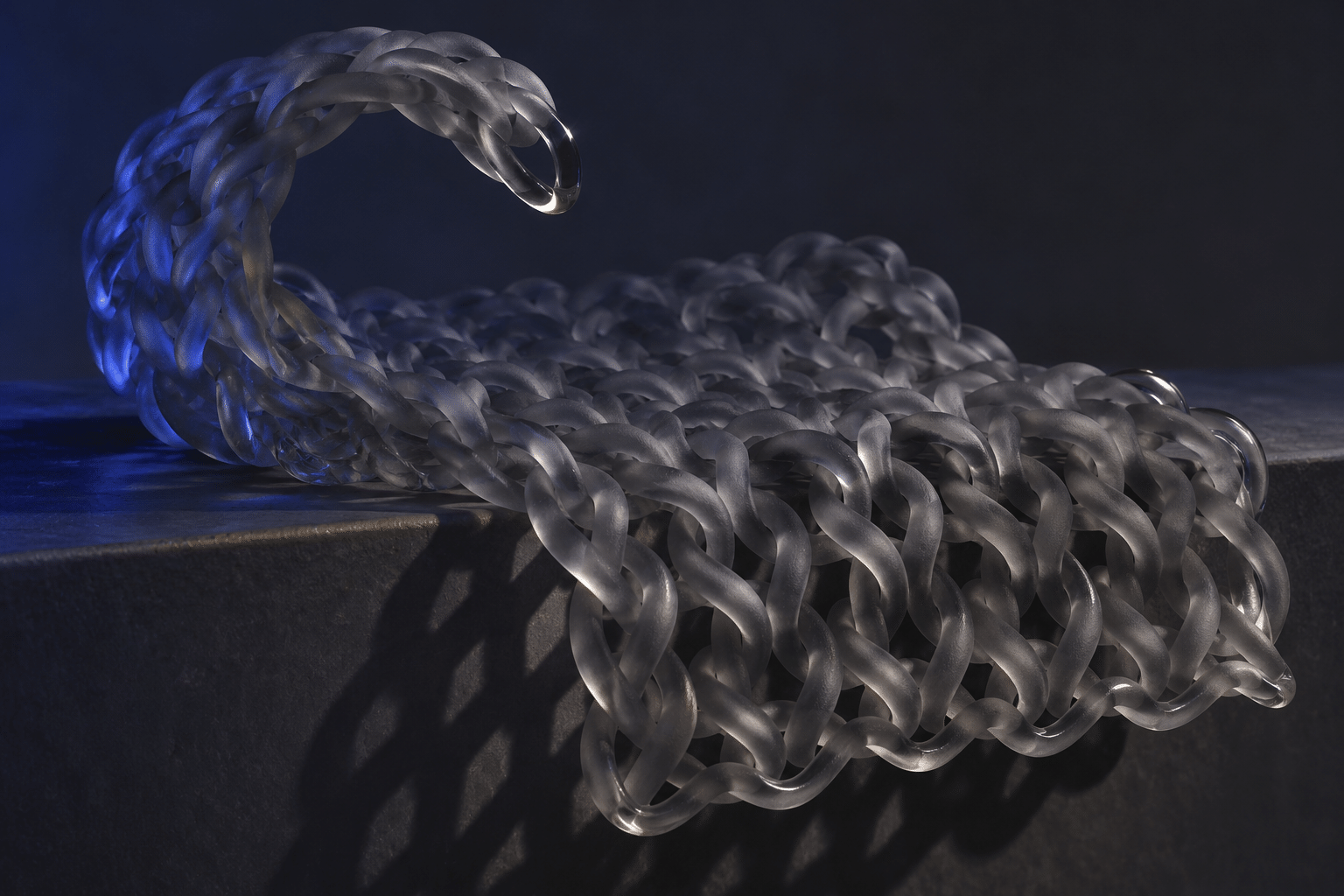
Pick one stitch you can follow through the next row. Keep air between the loops and show which strand passes in front at a crossing. Use side light, a cast shadow and a fixed fold to show that the fabric-like shape is solid.
The stitch is real; the softness is remembered
From across a room the fold of a knitted object can be familiar enough to suggest its weight on your shoulders. Move closer to a glass version and a bright edge refuses to soften. Light passes through a loop, pools on the plinth and briefly doubles the stitch in shadow. The eye has identified the structure correctly and guessed the material wrong.
There are two subjects here. One is a particular craft practice that can produce actual glass sculpture. The other is an artistic vocabulary that can be used in an illustration, a speculative space or a digital still life. A good label tells viewers which they are looking at. The seven images on this page are original generated studies.
What goes on the needles
In an interview with the Contemporary Glass Society, Carol Milne recalls recognizing the yarn-like possibilities of the sprue wax she used in casting. She knits a wax model and uses a lost-wax process to translate its structure into kiln-cast glass. The supple material is worked first; a mold preserves the space it occupied after the wax is removed.
This order matters to the look of the result. A fold or an open loop can retain the memory of handling although the finished glass does not sag like wool. It also explains why a convincing illustration need not portray a maker trying to pull rigid, cooled glass through a knitting needle. A rendering can suggest the process with one fixed curl and a clear gap between two courses.
Look at two documented works
Milne’s own portfolio lists Inlet (2022) as kiln-cast lead crystal with borosilicate glass needles and cast ends. Look for the relationship between the apparent fabric and the implements associated with its making. A needle gives the viewer a scale and a reason to think of a work still in progress.
In Wrapt (2020), two cone-like forms remain connected by a narrow passage. A useful question here is what a loop or join can say about separation. These are historical references for looking. The gallery invents its own folded swatch, vessel, pavilion and light study; none is presented as a photograph of Milne’s work.
Knit, weave, chain
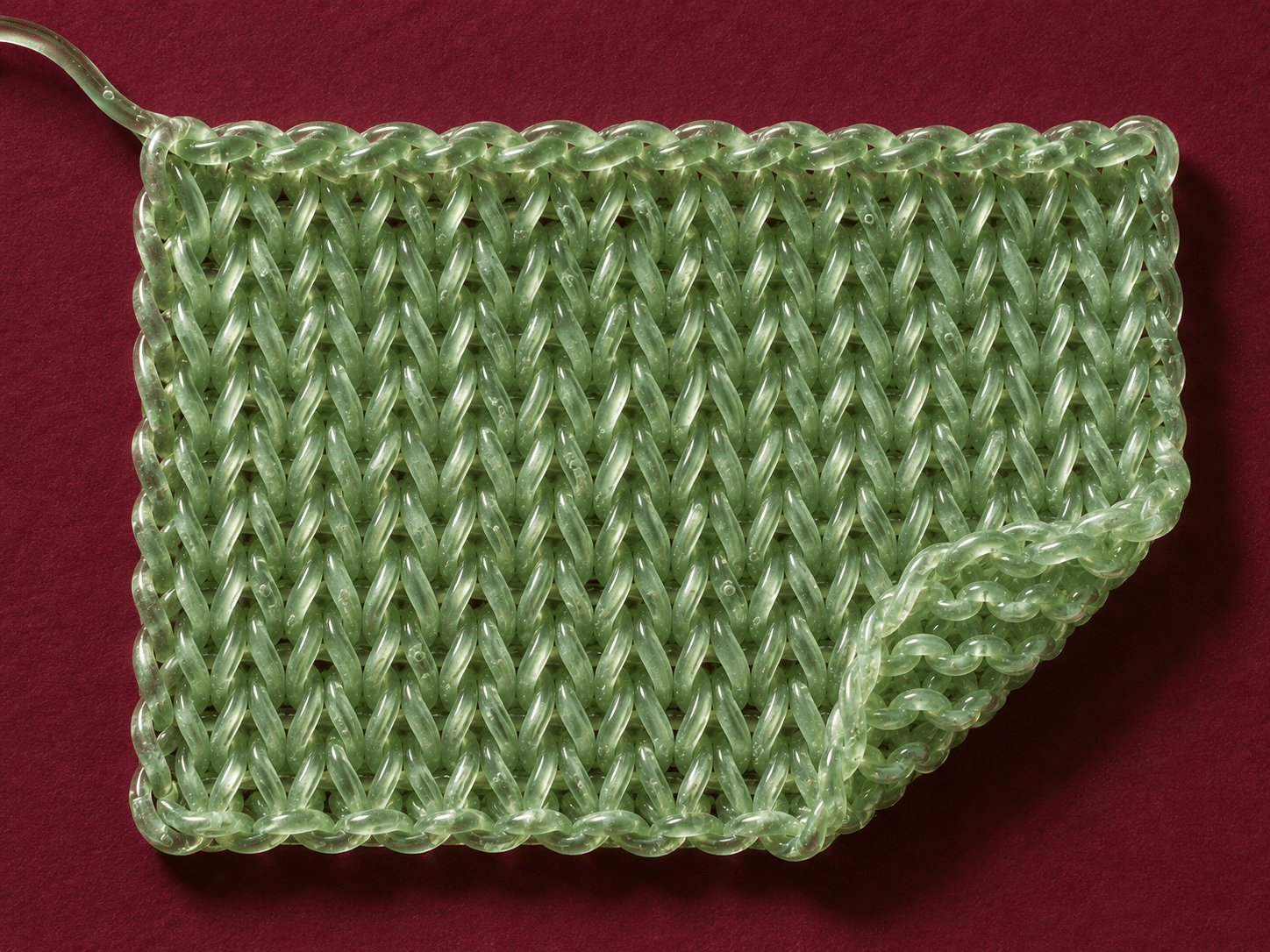
Trace a strand across a swatch. In knitting, successive loops draw through preceding loops. A plain stockinette face reads as columns of V shapes. In a basic weave, straight warp and weft cross; in a chain, separate links catch one another. All three make attractive glass patterns. They do not produce the same structure.
Start with a small patch, perhaps four or six columns. At two crossings, let one glass edge interrupt another. Keep the holes open enough that the background can be seen through them. Those intervals do as much to identify the stitch as the bright strand does. An indiscriminately reflective tangle can look like jewelry or a molten net.
Give the light somewhere to land
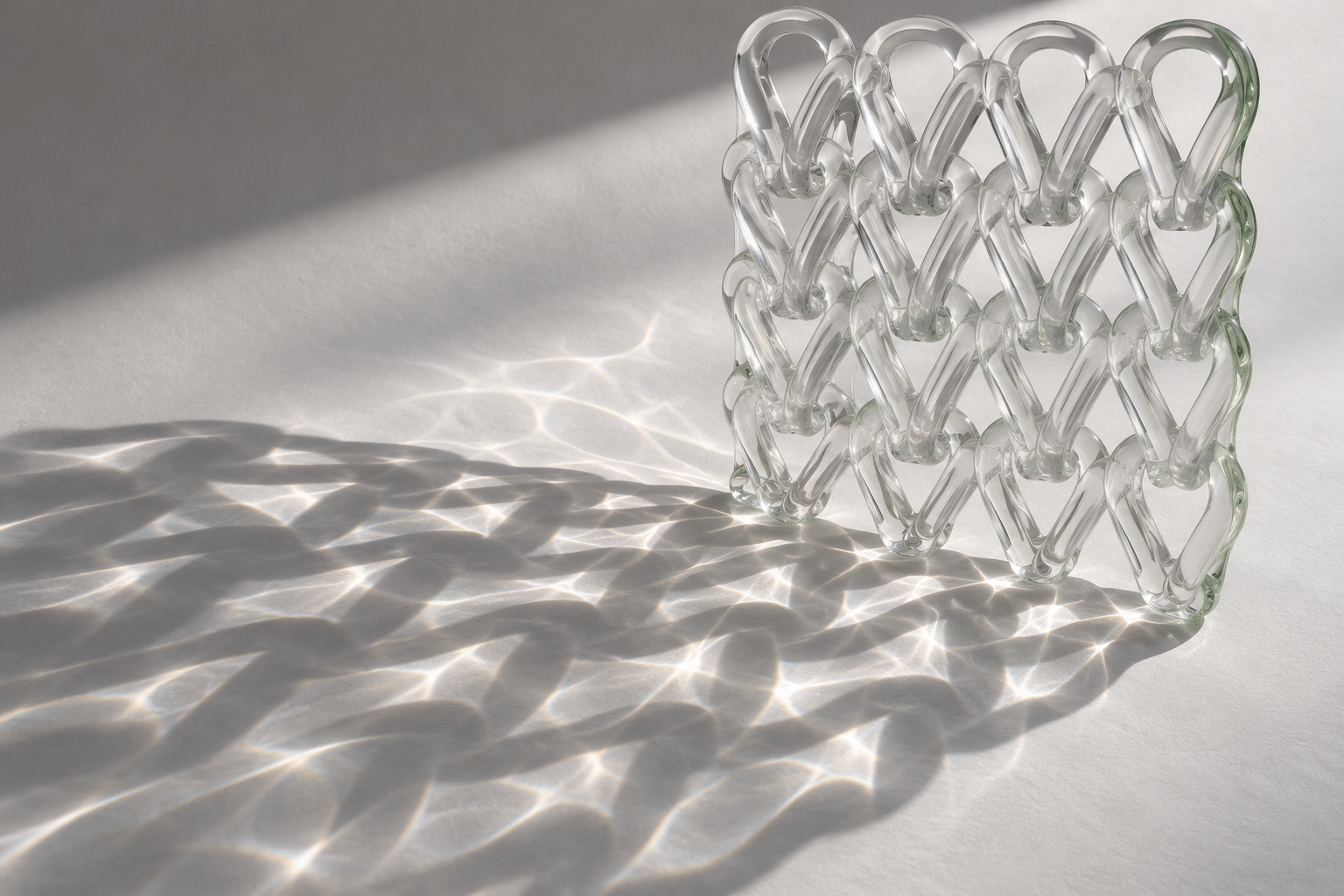
An opaque plinth is a useful partner for transparent material. Near a loop, the surface can carry a dark cast shadow alongside a brighter patch of bent light. A clear study against white can be more revealing than saturated glass against black: even a pale green edge tells us where the strand grows thicker.
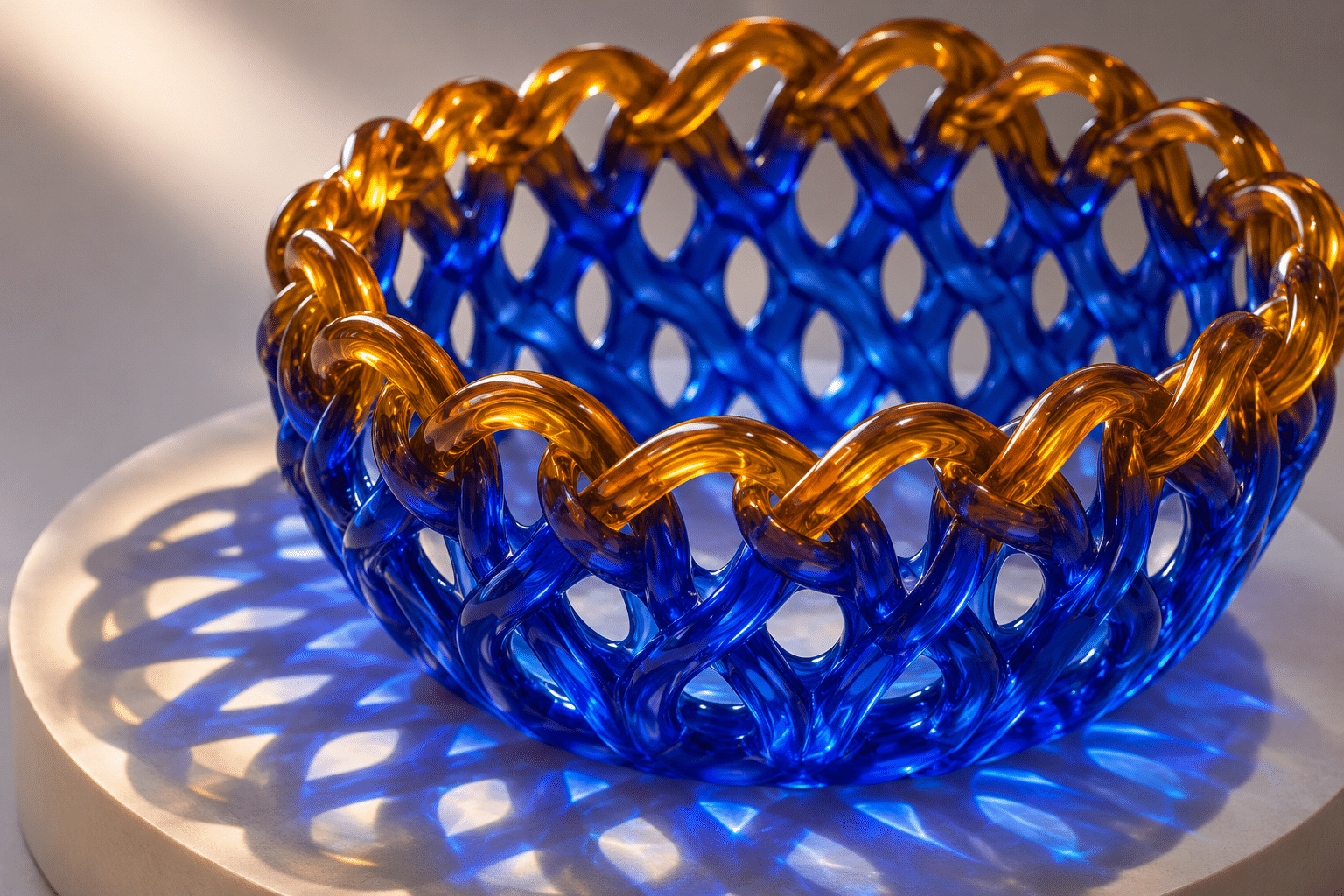
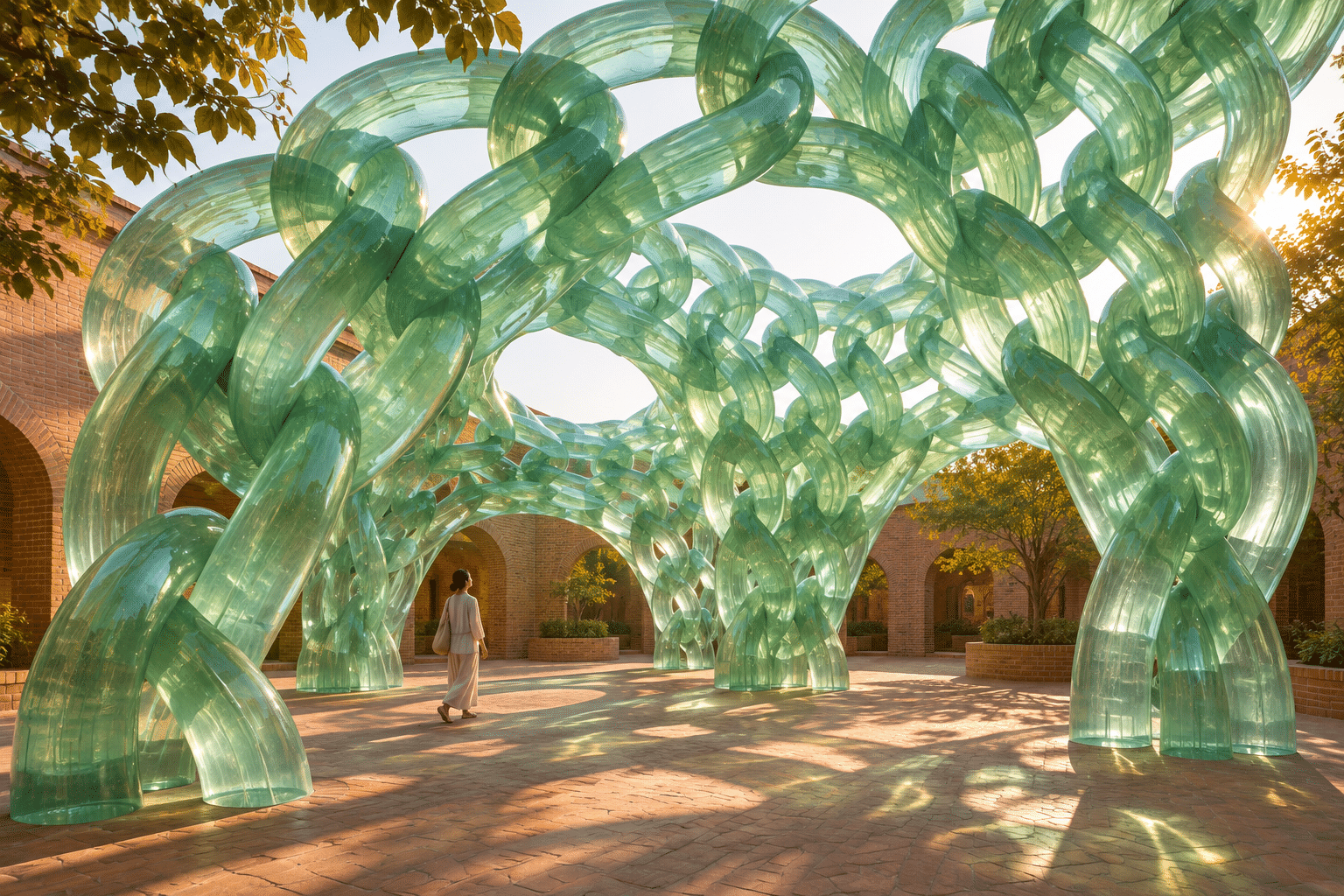
Try a second version in which the row of stitches curves out of view around a vessel. Keep the first openings legible, then compress their spacing toward the rim. In a larger speculative pavilion, let daylight and a person walking underneath establish scale. A striking architectural image is an independent design idea, not evidence that such a span has been fabricated or tested.
A simple test before you finish
Cover the highlights: do the rows still interlock like knitting? Now cover the pattern and look only at the edge, fold and shadow: is the material recognizably glass? Give each half of the illusion enough evidence to survive the other half being hidden.
The productive tension is between the gesture we expect and the one the object will allow. The best ending to a knitted-glass still life is sometimes a single motionless corner where a hem should have fallen. Let the viewer supply the weight of the missing movement.
Positive editorial perspective
AOI editorial perspective (AI-authored). The light falling through open stitches makes a second, less obedient textile on the floor. One well-chosen shadow can identify the material as persuasively as any highlight.
Negative editorial perspective
AOI editorial perspective (AI-authored). Perfect loops with identical reflections resemble chainmail or molded plastic. Show the path of a stitch into the next row and let material thickness change the edge light.
Neutral editorial perspective
AOI editorial perspective (AI-authored). Milne’s documented work uses a wax precursor and glass casting. The broader visual style includes imagined objects whose fabrication is not claimed.
Pocket-sized facts
In Carol Milne’s documented practice, a knitted wax model is translated into cast glass.
A knitted structure uses intermeshing loops; a warp-and-weft grid describes weaving.
The gallery’s speculative designs are not fabrication records or reproductions of named works.
A small poetic detour
Original words from the AOI studio.
Poetry
A loop goes through the loop before.
A fold leans off a limestone ledge.
The sun unknits it on the floor
in pools of green at every edge.
No breeze can lift that loosened hem.
No finger smooths its heavy crease.
But sunlight, threaded through the hem,
spills out as if it knew release.
The scarf recalls a shoulder well.
The shadow slips across the stone.
Which of the two, if light could tell,
was ever meant to move alone?
The prompt workshop
Original creative exercises. These prompts create new illustrations, not documentary evidence.
A fold that cannot fall
Frozen drape of amber cast-glass knitting over a limestone ledge; visible interlocking V-shaped stitches, open air and long green-gold shadows.
Leave the fold fixed in one unlikely position.
Follow one stitch
Macro view of six columns of jade transparent stockinette. Show a strand emerging through the loop below and passing behind the next, band of directional light.
Use a dark backing to make the empty openings readable.
Draw with the shadow
A near-colorless glass knitted swatch standing on white paper in low winter sun, repeated bent light and shadow expanding beyond the object.
Let the shadow occupy more space than the source.
People & works to explore
References discussed in this article. Consult the sources below for context.
Artists and practitioners
Carol Milne
Paintings and other works
Carol Milne — Inlet (2022)
Carol Milne — Wrapt (2020)
A smile from the studio
Jokes
The museum shop asked whether the glass scarf came with washing instructions. The sculptor wrote, “Keep on plinth.” The buyer asked about ironing. “That,” said the sculptor, looking at the kiln, “is more or less how we got into this in the first place.”
Sources and further exploration
Contemporary Glass Society: Carol Milne on knitting wax and casting glass