AOI creative concept · Order, continuity and the individual
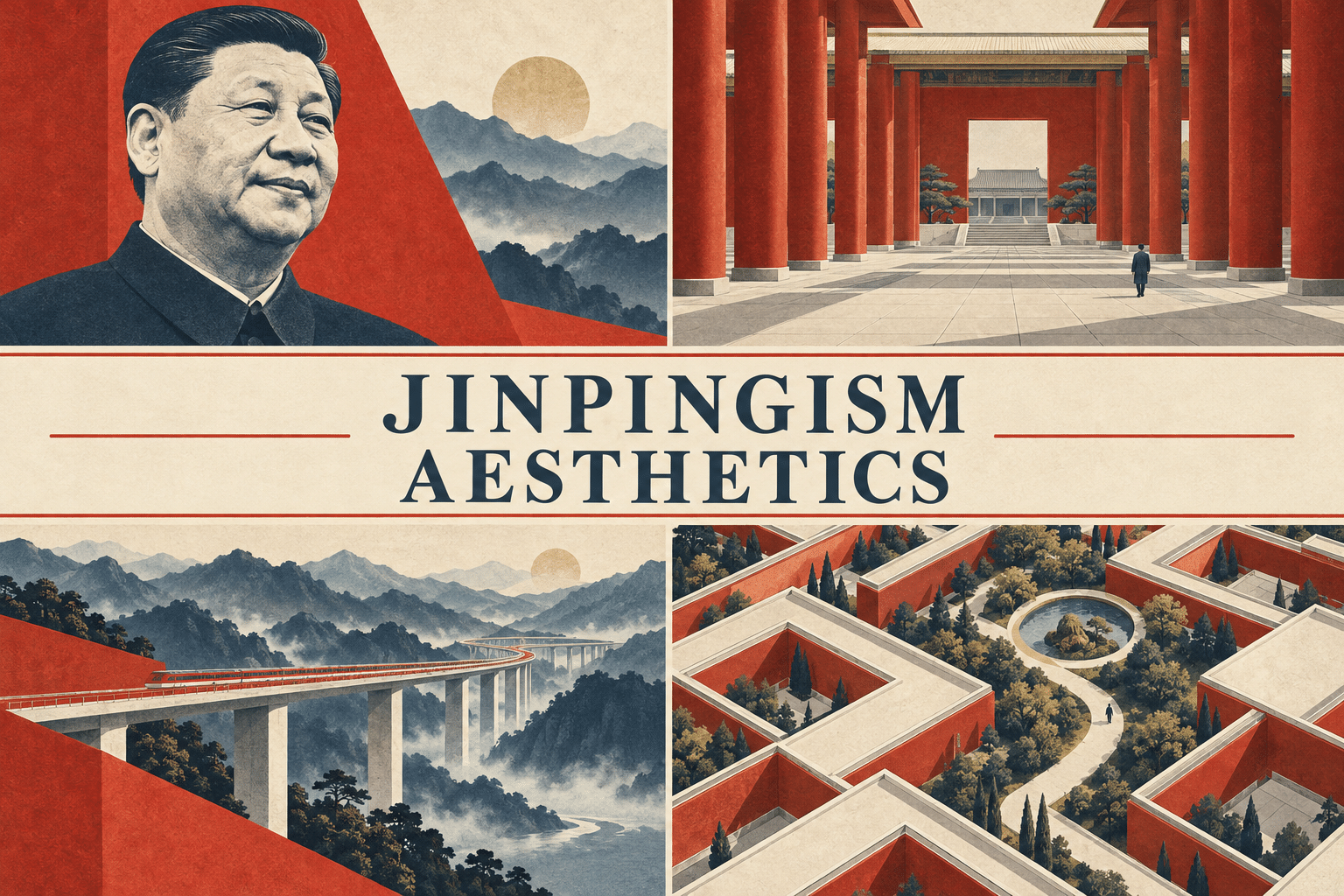
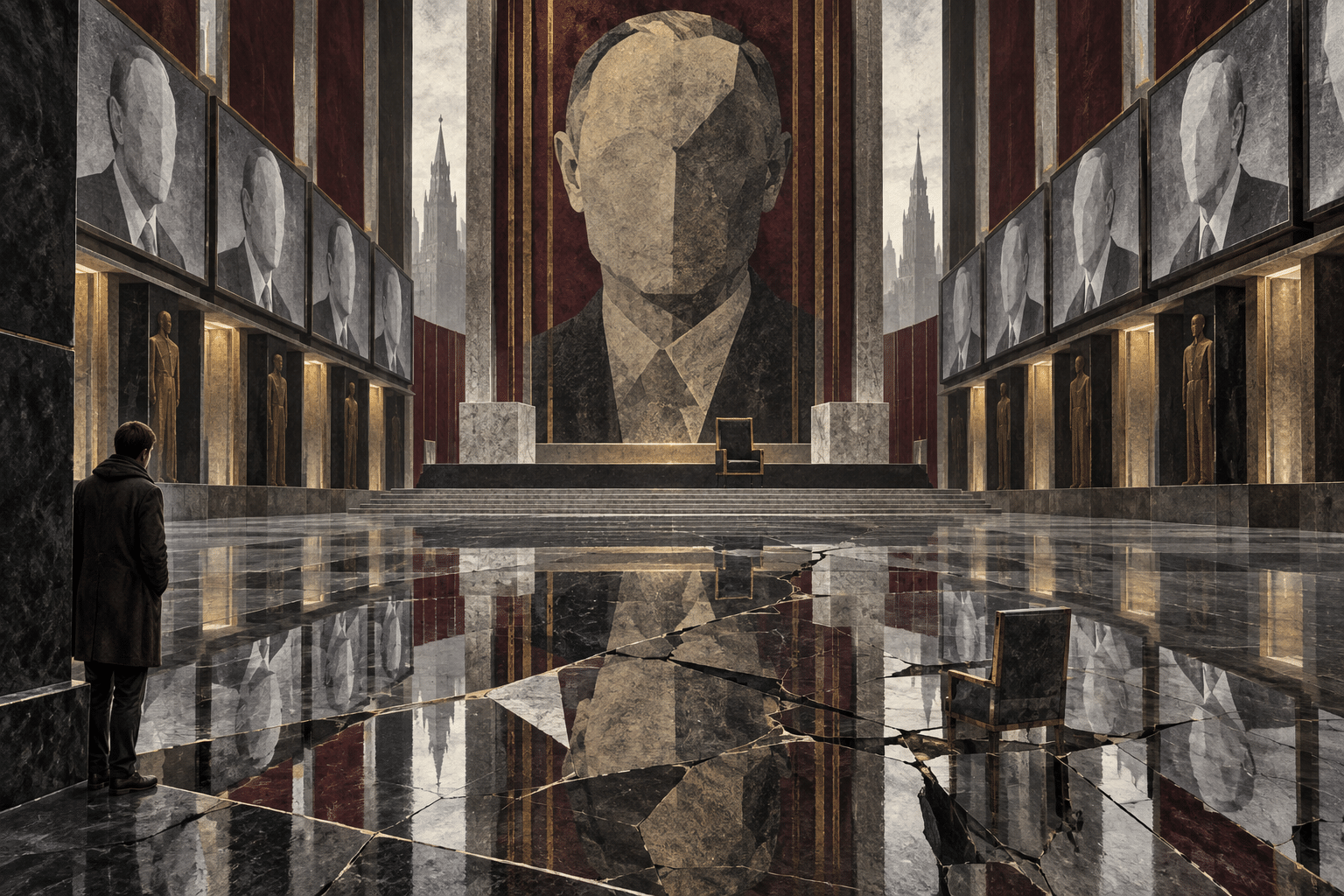
Jinpingism Aesthetics is AOI’s proposed visual language for examining political authority through ceremonial symmetry, disciplined repetition and the meeting of inherited forms with technological ambition. Its most interesting image is not perfectly obedient to its grid: a small human detail makes the order visible by interrupting it.
An A⊕I –[-.+] creαt¡ve c⊕ncept, n⊕t αn estαbl¡she∂ h¡st⊕r¡cαl m⊕vement.
A visual introduction
Two original AI-generated studies: an editorial banner and a centrally titled collage exploring portrait, civic space, infrastructure and a human interruption.
Select an image for a closer look. Use the thumbnails, arrow keys or a swipe to compare examples. Zoom in to inspect details, or share the image that inspires you.
Creative toolbox · take this style further
Choose an input and a destination. Search sends your words to the chosen site; Copy & open puts them on your clipboard to paste there.
Create with AI
Turn your chosen input into an image prompt or a new creative direction.
ChatGPT
Copy your input and paste it into a ChatGPT conversation or image request.
Copy & open ChatGPT (new tab)Claude · Anthropic
Develop an image prompt or explore the style in a new Claude conversation.
Copy & open Claude · Anthropic (new tab)Midjourney
Paste your input into the Imagine bar on the Create page.
Copy & open Midjourney (new tab)Adobe Firefly
Copy your input, open Firefly, and paste it into the prompt field.
Copy & open Adobe Firefly (new tab)Leonardo.Ai
Copy your input, open Leonardo, and paste it into the generation field.
Copy & open Leonardo.Ai (new tab)Image search
Find visual references. Short, concrete keywords usually work best.
Lexica
Search AI images and prompts using your selected input.
Search with this input Lexica (new tab)Pexels
Search the photo and video library. Short keywords often work best.
Search with this input Pexels (new tab)Pixabay
Search photos, illustrations and other images.
Search with this input Pixabay (new tab)Unsplash
Search photographs using the style name or your own keywords.
Search with this input Unsplash (new tab)Wikimedia Commons
Search photographs, artworks and historical images. Check each file for its source and reuse terms.
Search with this input Wikimedia Commons (new tab)Art & research
Explore artists, collections and the ideas behind a style.
Wikipedia
Search for background reading. A style may not have its own article.
Search with this input Wikipedia (new tab)WikiArt
Copy your input into WikiArt’s search to explore artists and artworks.
Copy & open WikiArt (new tab)Europeana
Paste your keywords into the search to explore European museum, library and archive collections.
Copy & open Europeana (new tab)Inspiration
Discover portfolios and visual ideas from creative communities.
Instagram hashtags
Search a hashtag made from your input: spaces and punctuation are removed. Instagram may require sign-in.
Search with this input Instagram hashtags (new tab)ArtStation
Paste your input into artwork search for concept art, environments, characters and visual development.
Copy & open ArtStation (new tab)Behance
Paste your input into project search for illustration, design and visual storytelling.
Copy & open Behance (new tab)A closer look
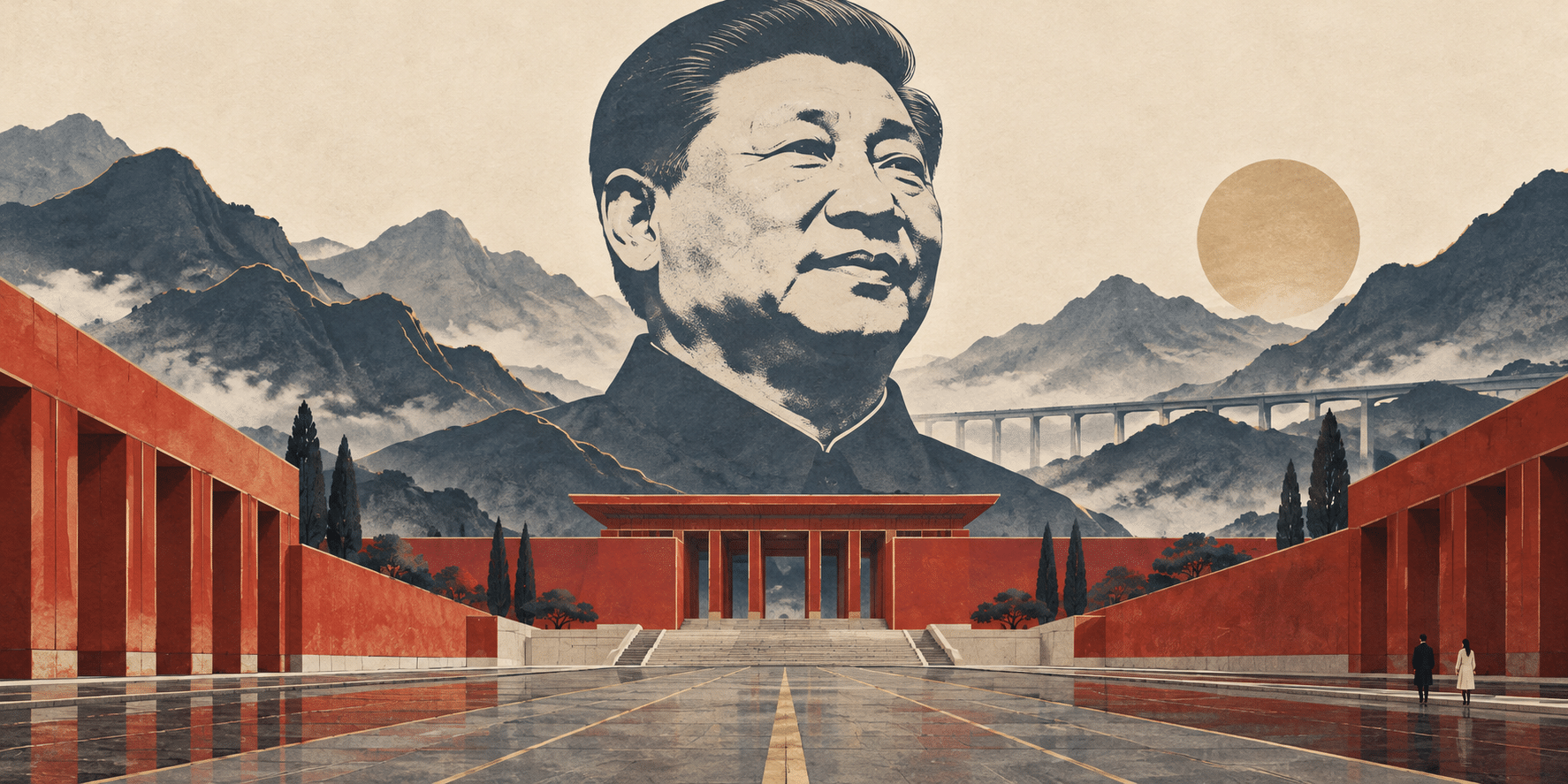
A strong central axis, vermilion planes, warm ivory ground, restrained gold accents and slate-blue distance. Monumental geometric architecture meets layered mountain contours; one small pedestrian or irregular interval introduces a second rhythm. These are AOI’s compositional choices, not rules for Chinese art.
An editorial concept with a defined scope
Here, Jinpingism Aesthetics names an original AOI studio concept concerned with the public imagery of authority associated with Xi Jinping. It is not presented as an established art-historical movement, a government-approved style or a substitute for the many traditions and contemporary practices of Chinese artists. Its subject is the staging of power; its tools are scale, repetition, framing and contrast.
The defining relationship is between the commanding center and the lived edges. An axial building can organize an entire picture, but a person waiting beside it creates another measure of time. The image becomes more expressive when both remain legible. A portrait is optional: architecture and spacing can carry the same investigation without a face.
Documented policy and AOI interpretation
A Chinese government report dated October 8, 2023 records the introduction of the term Xi Jinping Thought on Culture at a national meeting. It describes an emphasis on Party leadership in cultural work. This is an official account of policy, cited here as the government’s self-description rather than independent evidence of the policy’s success.
A separate government report from June 2, 2023 describes Xi advocating connections between Marxism, traditional Chinese culture and modernization. AOI uses that stated relationship as a starting point for juxtaposing inherited visual forms and contemporary infrastructure. The palette, mountain-and-viaduct compositions and interrupted grids proposed below are our artistic interpretation; the sources do not prescribe them as a style.
Build the picture around two kinds of order
Begin with three large values: a light ground, a dark architectural mass and a concentrated red plane. Establish one main axis with a doorway, portrait or distant opening. Repeat columns, windows or paving intervals along it, then leave enough empty space to see the pattern. Gold works best as a thin seam or restrained highlight, not a coating over every surface.
Introduce a different geometry at the edges. A mountain contour, an irregular ink-like wash or the path of a pedestrian can oppose the rectilinear center. Make that interruption purposeful and small enough to reward a second look. Avoid treating decorative cultural symbols as interchangeable shortcuts: the relationship between forms should convey the idea before ornaments are added.
The featured study and the titled collage
The featured image is an invented editorial scene combining a stylized Xi portrait, axial civic architecture and layered landscape forms. Small human figures establish the difference between personal and monumental scale. It is AI-generated illustration, not a photograph, a real building proposal or evidence of an event.
The collage separates four investigations: portrait and framing; a repeated civic space; infrastructure crossing mountain layers; and an individual pause within a grid. Its centered title identifies the AOI concept. Compare the panels for their spatial decisions rather than reading them as a catalogue of Chinese culture. No particular political attitude is implied by a red surface or a symmetrical composition alone.
Three variations that test the concept
For the ceremonial variation, keep the viewpoint frontal and the intervals regular. For the infrastructural variation, let a viaduct lead through layered terrain while one curve escapes the straight route. For the intimate variation, remove the portrait and move close to a person at the edge of a large public space. These are proposed studio variations, not documented historical subgenres.
A useful test is to repeat one composition with and without its human interruption. Keep every other element unchanged. Does the second version alter how the viewer experiences scale, time or agency? If the answer is unclear, simplify the central architecture before increasing the number of symbols. Label generated work as illustration and keep invented scenes separate from factual reporting.
A small poetic detour
Original words from the AOI studio.
Poetry
The avenue rehearses one straight line;
The mountains keep a less obedient time.
A person stops where all the shadows flow,
And gives the measured square somewhere to go.
The prompt workshop
Original creative exercises. These prompts create new illustrations, not documentary evidence.
Start here · A pause beside the axis
Original editorial illustration in AOI’s Jinpingism Aesthetics concept: an invented symmetrical civic courtyard with vermilion planes, ivory paving and slate-blue distance. Repeated columns establish a strong central axis; one small adult pauses beside an off-center bench. Crisp cut-paper geometry, subtle print texture, generous quiet space, a single restrained gold seam. Explore monumental order and individual time. No slogans, official seals, fake writing or photographic-documentary treatment.
Richer composition · Two geometries of continuity
Original AOI Jinpingism Aesthetics landscape study: a precise modern viaduct crossing layered mountain silhouettes, with a formal red civic structure aligned to a distant opening. Rectilinear construction meets irregular ink-like contours. Vermilion, warm ivory, slate blue and sparse muted gold, clearly separated depth planes and a tiny pedestrian near the foreground edge. Invented editorial composition about continuity and modernization, not a real location; no lettering, seals or signature.
Experimental · One interval refuses the grid
Original AOI Jinpingism Aesthetics conceptual print viewed from above: repeated square courtyards form an orderly ivory-and-vermilion grid, interrupted by one small circular garden and a meandering human path. Vary the scale rather than adding decorative symbols. Slate-blue shadows, tactile paper texture, a restrained gold line that stops at the garden. Let the viewer discover the exception gradually. Clearly invented visual metaphor; no political slogan, official emblem or text.
Your next inspiration
Discover another art style
Follow a visual thread to the next subject.
A smile from the studio
Jokes
The grid scheduled a meeting with spontaneity. Spontaneity arrived through the side door.
The architect asked for a little asymmetry. The columns formed a committee to discuss it.