
A quick brush with the subject · What catches the eye? · A closer look · Pocket-sized facts · Artists, objects, and paths to explore · The prompt workshop · A small poetic detour · A smile from the studio · Sources and further exploration
A quick brush with the subject
Asian art is an invitation to explore many places, periods, materials, and ways of seeing. It is an umbrella category, not a single style with a fixed palette or a shared starting date. This introduction offers four doorways into that diversity, followed by an openly imaginary workshop for your own experiments.
What catches the eye?
Look for differences before looking for a formula. Compare the shifting ink and open space of a Chinese landscape handscroll, the carved contours of a South Indian bronze, the graphic rhythm of a Japanese woodblock print, and the softly irregular volume of a Korean porcelain jar. No one of these approaches represents the whole of Asia.
A closer look
Start with a place, a date, and an object. The Met's Asian Art department brings together traditions from China, Korea, Japan, the Indian subcontinent, the Himalayas, and Southeast Asia, with a collection extending across five millennia. Even that broad departmental map is a curatorial framework rather than a definition of everything Asian art can include. Use this page as a starting point for more specific subjects, not as a checklist of traits that every artist must share.
A landscape can invite slow looking. In Guo Xi's Old Trees, Level Distance, made around 1080 in Northern Song China, trees in the foreground open onto a river valley. The handscroll uses ink and color on silk. The Met connects its misty, autumnal setting with leave-taking and retirement. Notice how an interval of apparently empty space can carry as much feeling as a tree: that is a useful question to bring to this particular work, rather than a rule for all Chinese painting.
Sculpture offers another encounter. The Met's Shiva as Lord of Dance, or Nataraja, is a late eleventh-century copper-alloy work from Tamil Nadu in the Chola period. The dancing Hindu deity brings creation and destruction into one image, with a drum and fire among the attributes. Treat the figure as a religious image with a specific context; a dramatic silhouette alone does not explain its meaning.
In Japan, Hokusai's Under the Wave off Kanagawa, usually called The Great Wave, dates to about 1830–32. It is a woodblock print in ink and color on paper, not an oil painting. Its forceful wave frames a much smaller Mount Fuji in the distance. The Met identifies both indigo and imported Prussian blue in its palette. This one print makes a fine starting point for thinking about scale, printing, and the movement of materials across borders.
For a change of pace, consider the Met's Korean moon jar from the second half of the eighteenth century. Its porcelain body belongs to the Joseon period. Such jars were made by joining two hemispheres, and their unevenness can be part of their appeal. The Met notes that they were useful vessels before their twentieth-century rediscovery as objects called moon jars. Quiet surfaces have histories too; not every memorable artwork needs a storm.
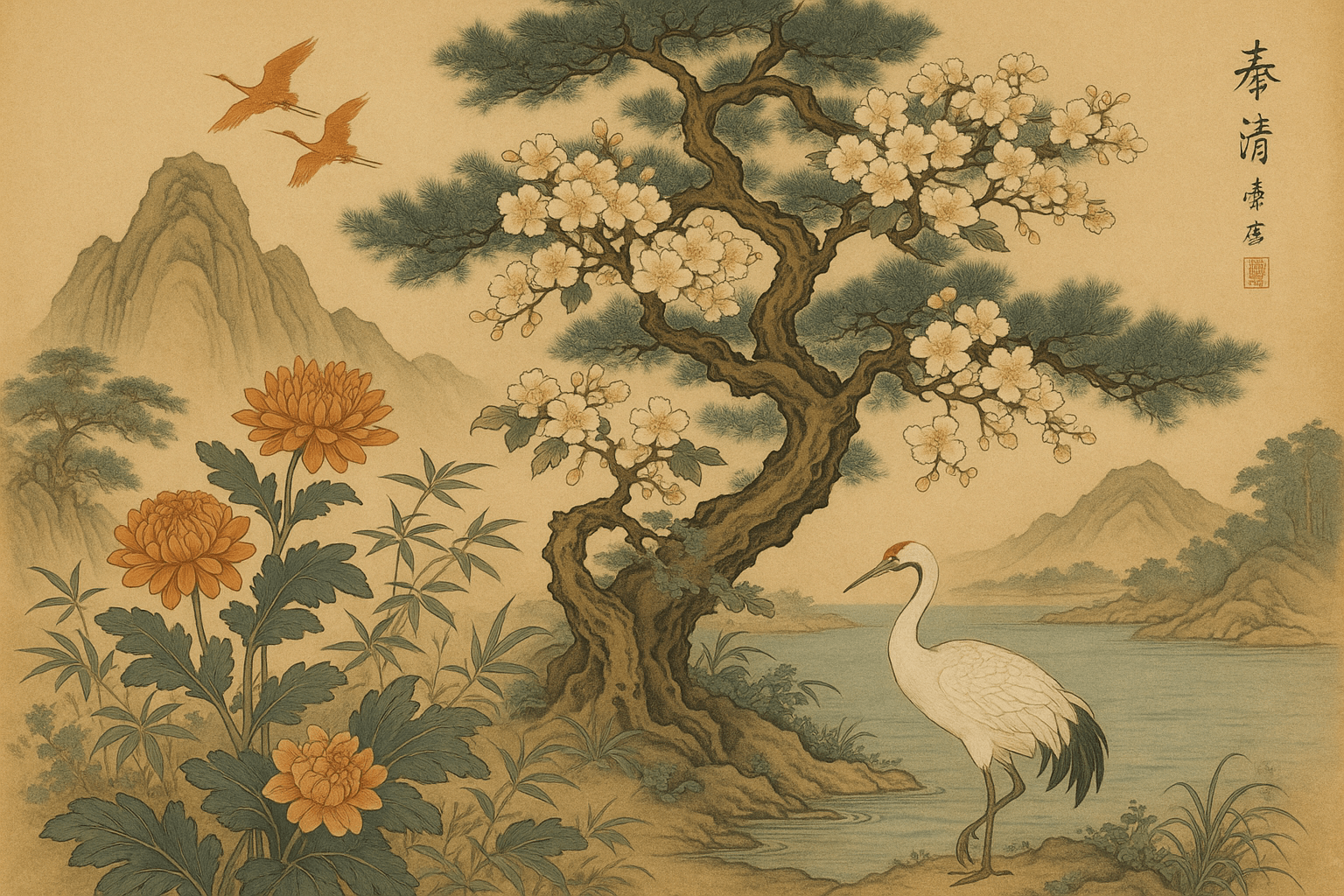
These four objects cannot stand in for a continent. They offer a practical way to keep exploring: identify the maker when known, the material, the original use, and the community or setting around an object. Follow the museum records below for object-specific evidence. In the creative sections, we deliberately step away from that evidence into invention. The featured image belongs to the AOI illustration archive; it is not one of the historical works discussed here.
Pocket-sized facts
Scope: Asian art includes multiple regional traditions and periods; it is not synonymous with East Asian art or with one historical movement.
Material matters: the examples here include silk, copper alloy, paper, and porcelain. Their techniques should not be collapsed into a universal Asian aesthetic.
Dates belong to particular works and traditions. There is no single beginning or ending date for Asian art.
Source note: the dates and object identifications below follow the linked museum records, consulted on 2 October 2026.
Artists, objects, and paths to explore
Guo Xi — Old Trees, Level Distance, about 1080, China. Ink and color on silk; a Northern Song handscroll. Source: The Met, object 1981.276.
Unknown maker — Shiva as Lord of Dance (Nataraja), late eleventh century, Tamil Nadu, India. Copper alloy; Chola period. Source: The Met, collection record linked below.
Katsushika Hokusai — Under the Wave off Kanagawa (The Great Wave), about 1830–32, Japan. Woodblock print; ink and color on paper. Source: The Met, collection record linked below.
Unknown maker — Moon jar, second half of the eighteenth century, Korea. Porcelain; Joseon period. Source: The Met, object 1979.413.1.
The prompt workshop
Creative corner: original AOI material, not historical evidence.
Invented landscape study: an imaginary river valley in ink washes on textured paper, tall bare trees near the viewer, wide intervals of mist, a tiny unoccupied pavilion. Explore depth through spacing and tonal changes. No invented calligraphy, no claim of historical authenticity.
Imaginary harbor print: three small boats under an oversized cloud, a limited indigo and warm-paper palette, crisp carved-looking contours and visible print texture. Build a new composition inspired by woodblock techniques; do not reproduce Hokusai's wave.
Contemporary ceramic still life: one slightly asymmetrical white porcelain vessel on a plain shelf, soft side light, generous negative space, a small paper moon beside it. A fictional studio scene inspired by looking at Korean moon jars, not a museum-object photograph.
A small poetic detour
Creative corner: original AOI material, not historical evidence.
Mist leaves room for trees;
A small boat crosses the page.
The ink keeps its hush.
A smile from the studio
Creative corner: original AOI material, not historical evidence.
The blank space asked the brush for a day off. The brush agreed: 'You already do half the composition.'
Sources and further exploration
The Metropolitan Museum of Art — Asian Art department: scope and regional traditions
The Met — Guo Xi, Old Trees, Level Distance
The Met — Shiva as Lord of Dance (Nataraja)
The Met — Hokusai, Under the Wave off Kanagawa (The Great Wave)