Political visual essay · AOI art framework with documented context
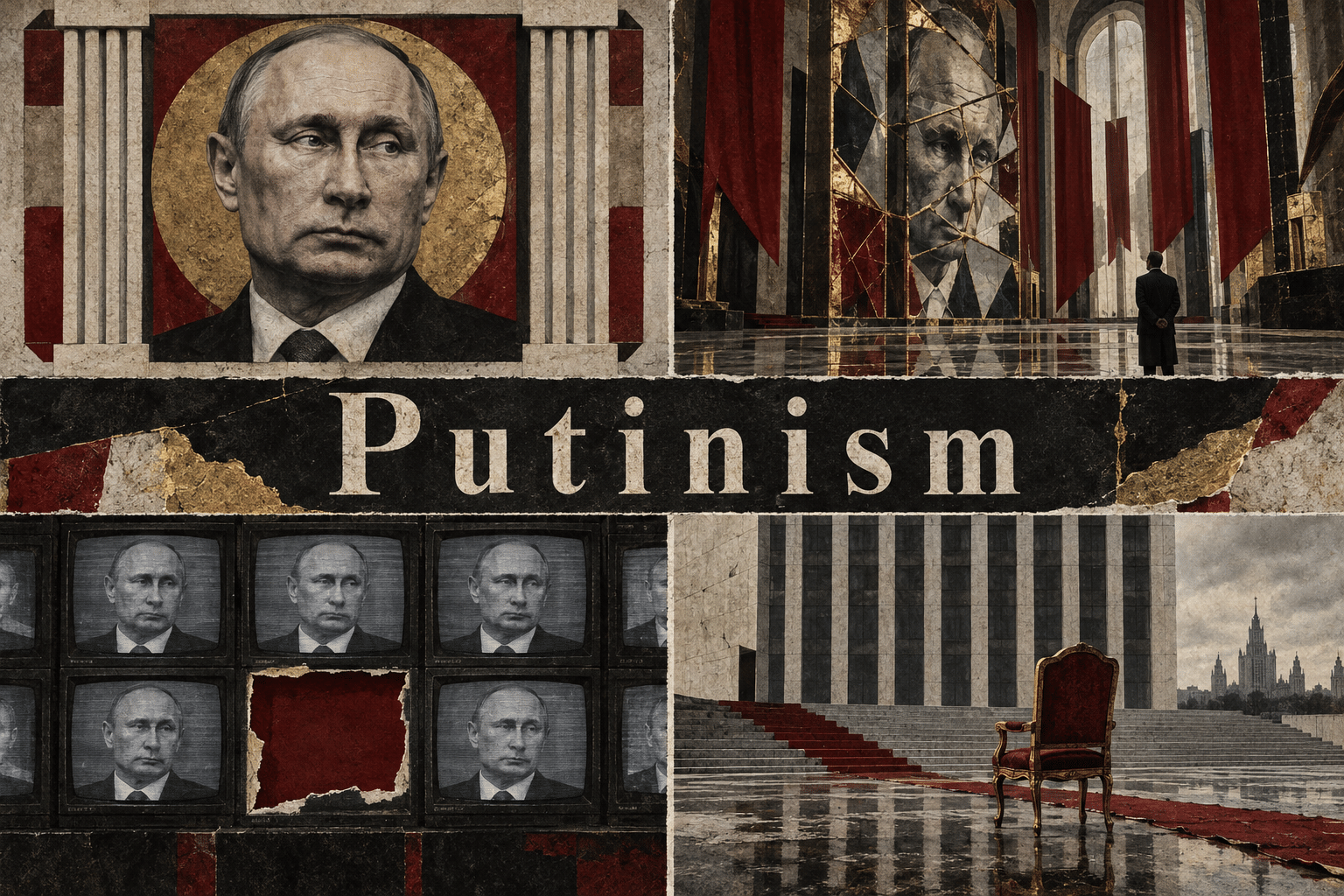
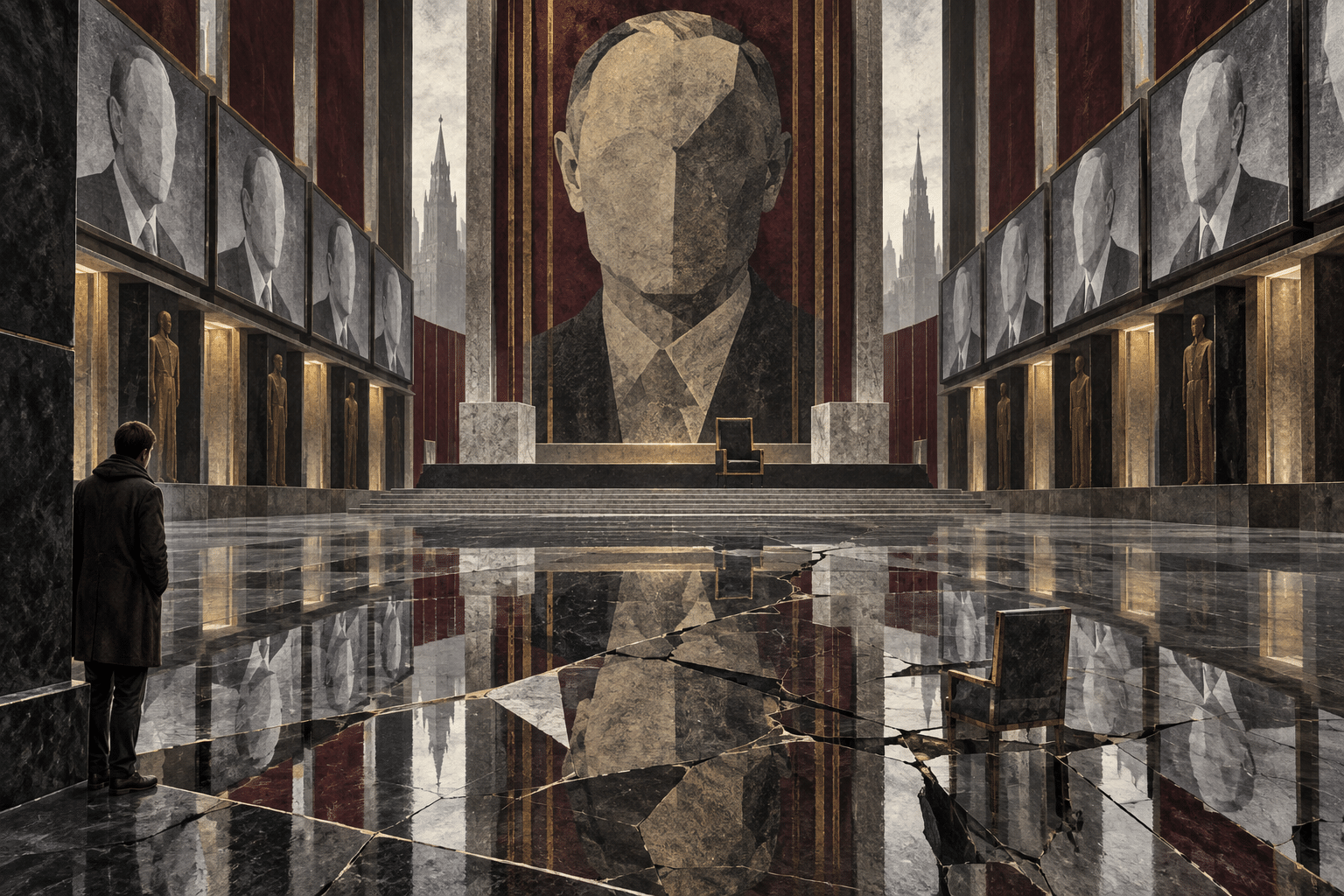
Putinism, as developed in this AOI visual essay, examines how concentrated power makes itself look inevitable. Monumental symmetry, ceremonial surfaces and repeated broadcast frames create an imposing center; a displaced witness or broken reflection interrupts its claim to total control. The result is political interpretation rather than a celebration of authority.
A visual introduction
An original example and a centrally titled collage explore this proposed political art framework. All scenes and arrangements are AI-generated illustrations.
Select an image for a closer look. Use the arrow keys or gallery controls to compare the illustrations.
Creative toolbox · take this style further
Choose an input and a destination. Search sends your words to the chosen site; Copy & open puts them on your clipboard to paste there.
Create with AI
Turn your chosen input into an image prompt or a new creative direction.
ChatGPT
Copy your input and paste it into a ChatGPT conversation or image request.
Copy & open ChatGPT (new tab)Claude · Anthropic
Develop an image prompt or explore the style in a new Claude conversation.
Copy & open Claude · Anthropic (new tab)Midjourney
Paste your input into the Imagine bar on the Create page.
Copy & open Midjourney (new tab)Adobe Firefly
Copy your input, open Firefly, and paste it into the prompt field.
Copy & open Adobe Firefly (new tab)Leonardo.Ai
Copy your input, open Leonardo, and paste it into the generation field.
Copy & open Leonardo.Ai (new tab)Image search
Find visual references. Short, concrete keywords usually work best.
Lexica
Search AI images and prompts using your selected input.
Search with this input Lexica (new tab)Pexels
Search the photo and video library. Short keywords often work best.
Search with this input Pexels (new tab)Pixabay
Search photos, illustrations and other images.
Search with this input Pixabay (new tab)Unsplash
Search photographs using the style name or your own keywords.
Search with this input Unsplash (new tab)Wikimedia Commons
Search photographs, artworks and historical images. Check each file for its source and reuse terms.
Search with this input Wikimedia Commons (new tab)Art & research
Explore artists, collections and the ideas behind a style.
Wikipedia
Search for background reading. A style may not have its own article.
Search with this input Wikipedia (new tab)WikiArt
Copy your input into WikiArt’s search to explore artists and artworks.
Copy & open WikiArt (new tab)Europeana
Paste your keywords into the search to explore European museum, library and archive collections.
Copy & open Europeana (new tab)Inspiration
Discover portfolios and visual ideas from creative communities.
Instagram hashtags
Search a hashtag made from your input: spaces and punctuation are removed. Instagram may require sign-in.
Search with this input Instagram hashtags (new tab)ArtStation
Paste your input into artwork search for concept art, environments, characters and visual development.
Copy & open ArtStation (new tab)Behance
Paste your input into project search for illustration, design and visual storytelling.
Copy & open Behance (new tab)A closer look
Axial monumentality, graphite and stone-white planes, restrained burgundy and tarnished gold, repeated image frames, then one deliberate fracture in the visual hierarchy.
Documented context and the proposed art concept
Putinism is an existing political label associated with Vladimir Putin and the system around him. It is not established here as the name of a recognized art-historical movement. AOI proposes a new visual framework for examining that political subject; neither the name nor the subject belongs exclusively to AOI.
In his Carnegie analysis, Andrei Kolesnikov describes ideology in the Putin regime through its public language and official narratives. This is an attributed interpretation by a political analyst, not a neutral definition of every Russian person. Separately, the UN General Assembly on 2 March 2022 adopted a resolution demanding an end to Russia’s invasion of Ukraine and withdrawal of its forces. These contexts matter when monumental imagery risks making power appear consequence-free.
A recognizable visual grammar
Begin with a rigid axis: a long hall, an oversized portrait plane or a compressed sequence of identical podiums. Give the center polished surfaces and unusually clear edges. Use a limited palette of graphite, pale stone, burgundy and small areas of worn gold. Repetition should suggest the management of an image, not merely supply decoration.
Introduce a second register that the central image cannot absorb. An empty chair, a misaligned reflection, a small unframed observer or a gap in a repeated pattern can expose the difference between official spectacle and lived experience. Keep this counterpoint legible at thumbnail scale. It must change the meaning of the composition, not function as ornamental damage.
Develop a political composition
Build an imaginary ceremonial hall whose floor reflects the central structure imperfectly. Place one small unframed figure near the edge, with enough visual weight to be noticed. Compare an intact version with a version containing the interruption: the second should ask who controls the view and whose experience remains outside it.
A portrait is optional. If Vladimir Putin appears, use an unmistakably illustrated likeness and identify it as a contemporary artistic interpretation. Do not fabricate a photograph of an actual event, an official document or an attributed quotation. Architecture, scale and repetition can carry the political argument without a face.
Interpretation, limits and image provenance
This framework addresses a political system and its representation; it should not equate Russian culture or Russian people with one leader. Avoid turning violence or civilian suffering into glamorous background texture. A critical composition can show the attraction of order while making its exclusions visible.
The banner and collage are original AI-generated political illustrations. Their halls, figures and arrangements are invented; they do not document a historical scene. The proposed style is an editorial lens, not a comprehensive account of Russia, a party identity or a campaign endorsement.
Technique notes
State the political interpretation in the caption; distinguish it from documented facts.
Make the composition work without a slogan or an assumed endorsement.
Label generated portraits and scenes as illustrations.
A small poetic detour
Original words from the AOI studio.
Poetry
The marble learns a single line,
The mirrors answer: all is fine.
One chair stands clear of the parade;
Its empty place will not be swayed.
The prompt workshop
Original creative exercises. These prompts create new illustrations, not documentary evidence.
Build the signature composition
Original editorial political art study for the AOI concept Putinism: an invented monumental hall with a fractured reflection and one small unframed observer. Axial monumentality, graphite and stone-white planes, restrained burgundy and tarnished gold, repeated image frames, then one deliberate fracture in the visual hierarchy. Sophisticated composition with an explicit tension between political image and lived or institutional complexity. Clearly illustrated, tactile print and collage surfaces. No copied campaign poster, party logo, invented quotation, slogan or watermark. A contemporary artistic interpretation, not a documentary image or official endorsement.
Explore an abstract variation
Original editorial political art study for the AOI concept Putinism: a sculptural field of identical broadcast frames with one empty frame breaking the rhythm. Axial monumentality, graphite and stone-white planes, restrained burgundy and tarnished gold, repeated image frames, then one deliberate fracture in the visual hierarchy. Sophisticated composition with an explicit tension between political image and lived or institutional complexity. Clearly illustrated, tactile print and collage surfaces. No copied campaign poster, party logo, invented quotation, slogan or watermark. A contemporary artistic interpretation, not a documentary image or official endorsement.
Try an illustrated portrait
Original editorial political art study for the AOI concept Putinism: an illustrated likeness of Vladimir Putin within a rigid architectural grid, contrasted with an unframed empty chair. Axial monumentality, graphite and stone-white planes, restrained burgundy and tarnished gold, repeated image frames, then one deliberate fracture in the visual hierarchy. Sophisticated composition with an explicit tension between political image and lived or institutional complexity. Clearly illustrated, tactile print and collage surfaces. No copied campaign poster, party logo, invented quotation, slogan or watermark. A contemporary artistic interpretation, not a documentary image or official endorsement.
Your next inspiration
Discover another art style
Follow a visual thread to the next subject.
A smile from the studio
Jokes
The composition requested more balance. The central axis called that unnecessary competition.
Every mirror agreed with the portrait, except the one sent back for repairs.