
National and diasporic art overview
Jamaican art encompasses many artistic practices, rather than a single national look. Sculpture, painting, printmaking and contemporary mixed media offer different ways to examine place, spiritual life, labour, identity and visibility. This overview connects documented artists with practical ways of reading images.
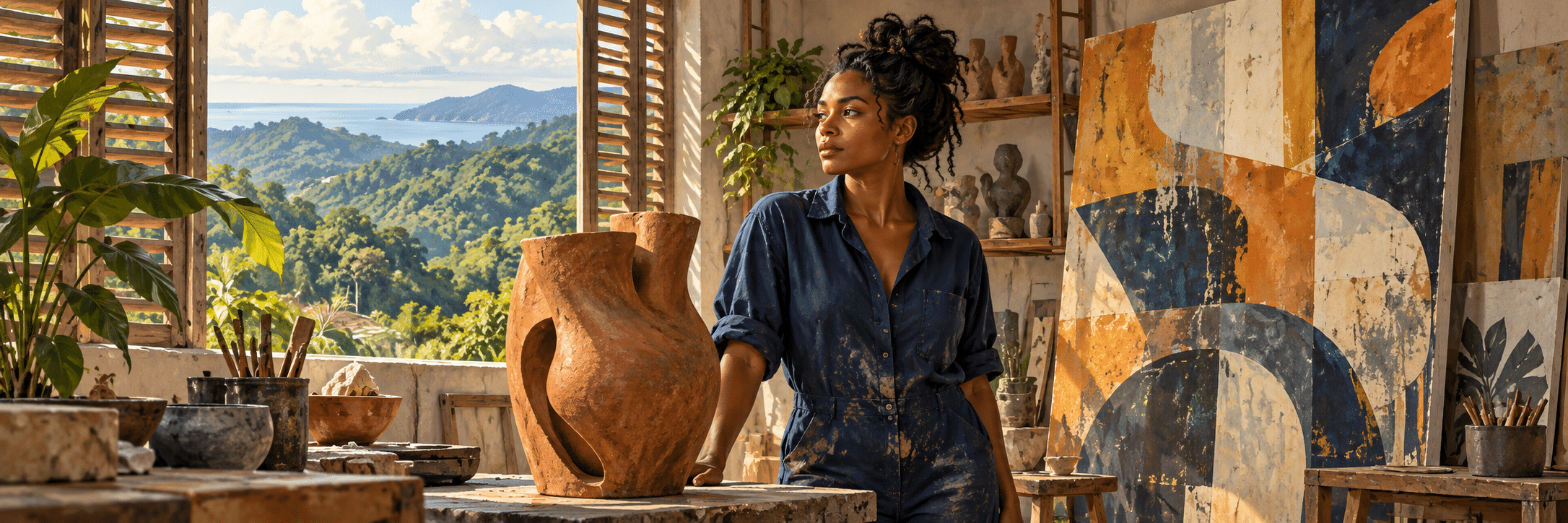
A visual introduction
Select an image for a closer look. Use the thumbnails, arrow keys or a swipe to compare examples. Zoom in to inspect details, or share the image that inspires you.


Creative toolbox · take this style further
Choose an input and a destination. Search sends your words to the chosen site; Copy & open puts them on your clipboard to paste there.
Create with AI
Turn your chosen input into an image prompt or a new creative direction.
ChatGPT
Copy your input and paste it into a ChatGPT conversation or image request.
Copy & open ChatGPT (new tab)Claude · Anthropic
Develop an image prompt or explore the style in a new Claude conversation.
Copy & open Claude · Anthropic (new tab)Midjourney
Paste your input into the Imagine bar on the Create page.
Copy & open Midjourney (new tab)Adobe Firefly
Copy your input, open Firefly, and paste it into the prompt field.
Copy & open Adobe Firefly (new tab)Leonardo.Ai
Copy your input, open Leonardo, and paste it into the generation field.
Copy & open Leonardo.Ai (new tab)Image search
Find visual references. Short, concrete keywords usually work best.
Lexica
Search AI images and prompts using your selected input.
Search with this input Lexica (new tab)Pexels
Search the photo and video library. Short keywords often work best.
Search with this input Pexels (new tab)Pixabay
Search photos, illustrations and other images.
Search with this input Pixabay (new tab)Unsplash
Search photographs using the style name or your own keywords.
Search with this input Unsplash (new tab)Wikimedia Commons
Search photographs, artworks and historical images. Check each file for its source and reuse terms.
Search with this input Wikimedia Commons (new tab)Art & research
Explore artists, collections and the ideas behind a style.
Wikipedia
Search for background reading. A style may not have its own article.
Search with this input Wikipedia (new tab)WikiArt
Copy your input into WikiArt’s search to explore artists and artworks.
Copy & open WikiArt (new tab)Europeana
Paste your keywords into the search to explore European museum, library and archive collections.
Copy & open Europeana (new tab)Inspiration
Discover portfolios and visual ideas from creative communities.
Instagram hashtags
Search a hashtag made from your input: spaces and punctuation are removed. Instagram may require sign-in.
Search with this input Instagram hashtags (new tab)ArtStation
Paste your input into artwork search for concept art, environments, characters and visual development.
Copy & open ArtStation (new tab)Behance
Paste your input into project search for illustration, design and visual storytelling.
Copy & open Behance (new tab)A closer look
Look for the choices of an individual work: compact sculptural masses, patterned or deep landscape space, rhythmic figure groupings, restrained or saturated colour, and the expressive contrast between smooth, carved, painted and assembled surfaces. None is compulsory for Jamaican art.
A country is not a preset
The label Jamaican art can refer to work made in Jamaica and to the practices of Jamaican artists working elsewhere. It does not identify one technique, ethnicity, palette or political position. A dark landscape and an exuberantly embellished installation can belong within the same discussion without sharing a style. Begin with the artist, object and context; nationality provides a starting point, not a complete explanation.
This distinction matters when generating images. A prompt that asks only for Jamaican style often returns the same palm trees, flag colours and smiling figure. Those elements may have a place in a particular image, but repetition turns a diverse artistic field into scenery. Specify what the image investigates and how its material and composition carry that idea.
Modern art and the work of building institutions
Edna Manley was a pivotal sculptor and educator in twentieth-century Jamaican art. The National Library of Jamaica records her move to Jamaica in 1922 and her role in co-founding the Jamaica School of Art in 1950. Her significance includes both artistic production and the conditions that helped other artists develop. It would nevertheless be misleading to make her arrival the beginning of all art on the island.
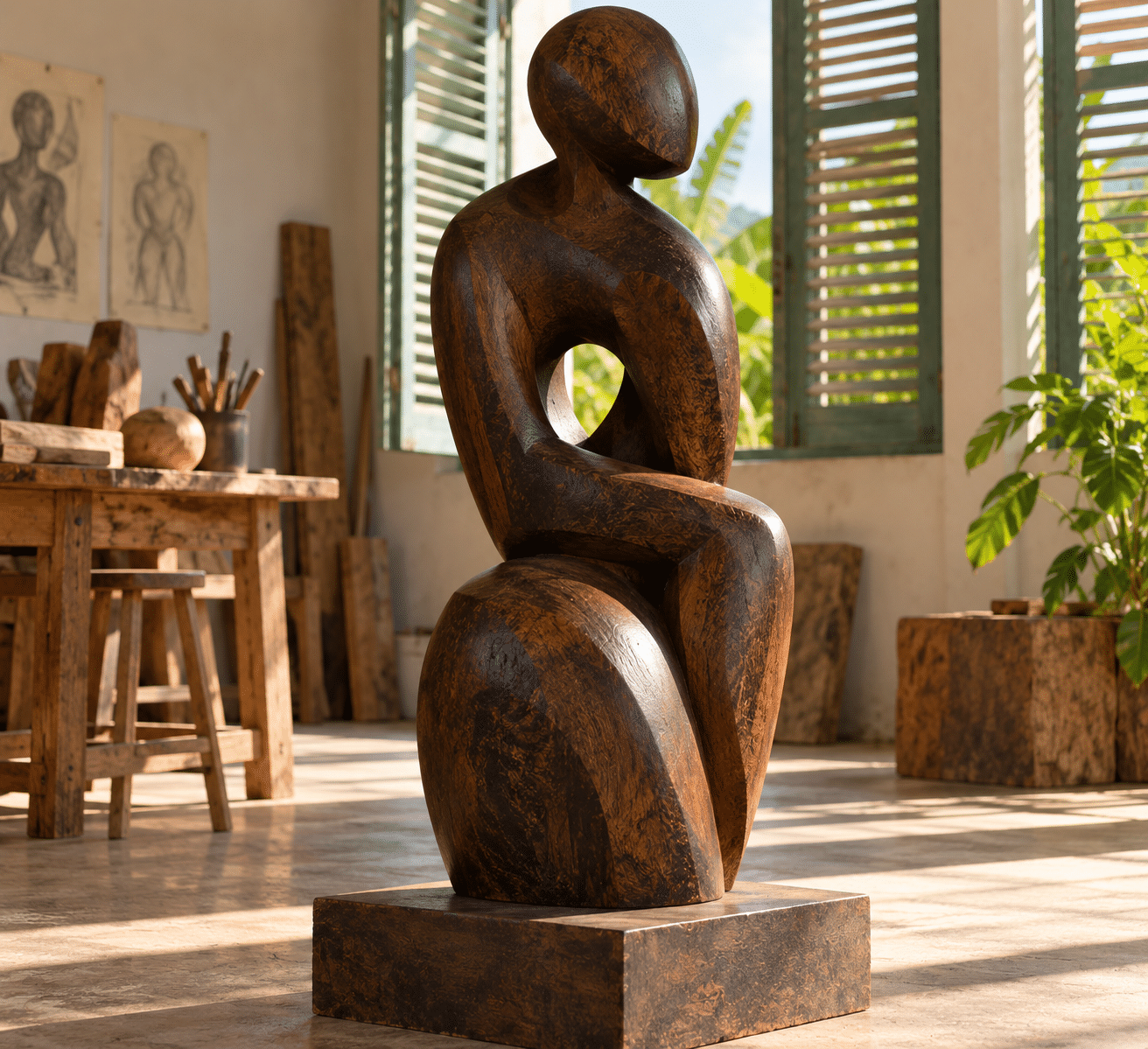
Her sculpture Negro Aroused, 1935, is a documented reference for discussions of art, labour and national consciousness. Study the compression of the figure into substantial volumes and the force carried by a directional gesture. The historical title belongs to the identified artwork; it is not terminology for a contemporary generated portrait. Sculpture should be examined through volume, weight and viewing angle, not reduced to a photograph of its subject.
Landscape can be a psychological space
John Dunkley, 1891–1947, made paintings as well as sculptures. The American Folk Art Museum describes his landscapes of the 1930s and 1940s through their dark palette and psychological suggestiveness. Back to Nature, circa 1939, provides a documented starting point. His work directly challenges the assumption that Jamaican painting must be bright, sunlit and cheerful.
For visual analysis, ask how vegetation directs attention: does it frame an opening, obstruct a path, repeat a rhythm or make the space feel enclosed? Darkness can give an ordinary landscape uncertainty without adding a supernatural figure. These are useful compositional questions, not a recipe for copying Dunkley’s paintings.
Everyday experience and self-taught practice
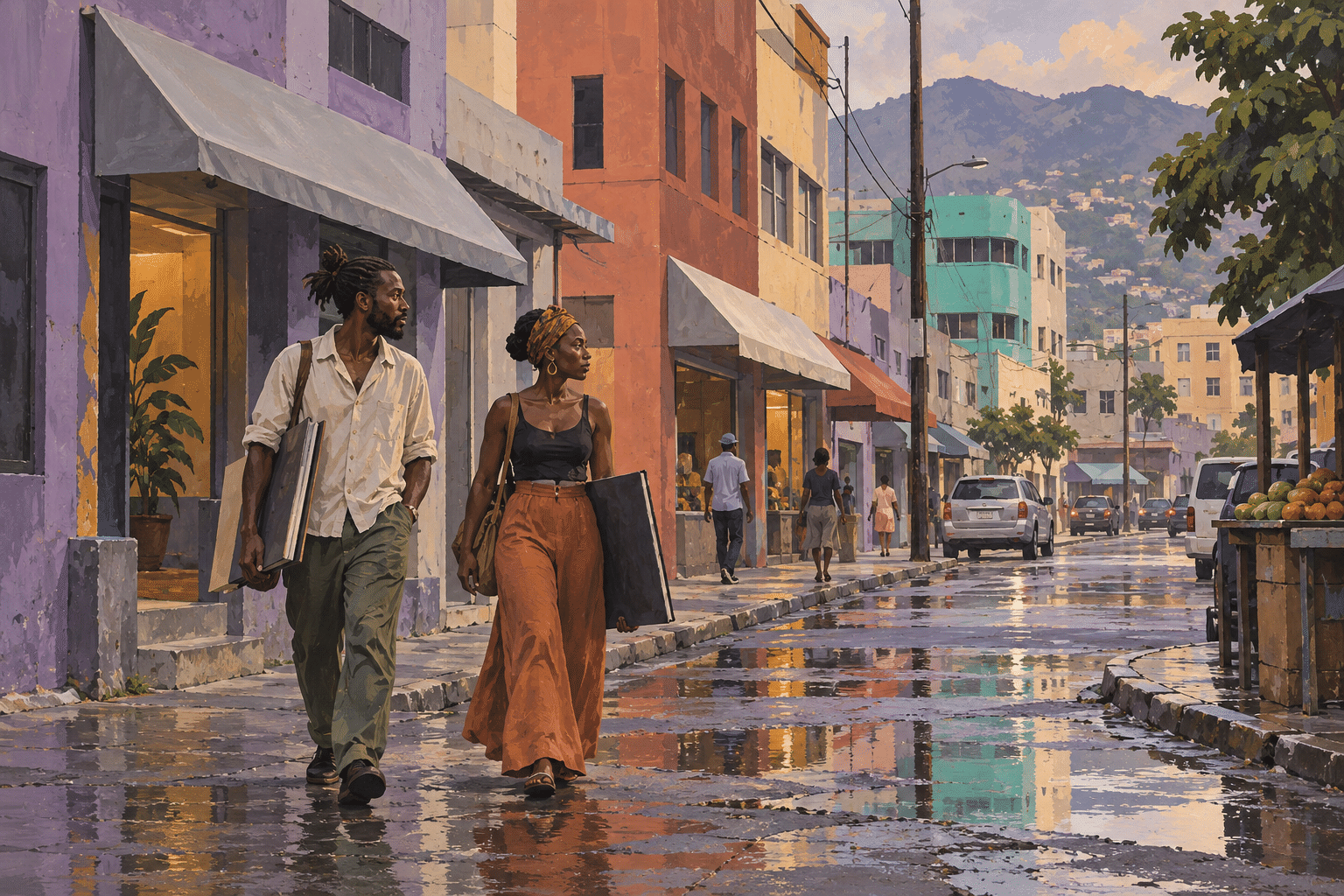
Albert Huie’s painting and printmaking brought sustained attention to Jamaican people and environments. The National Gallery of Jamaica identifies Crop Time, 1955, among his major works. Reading a scene of labour requires attention to the arrangement and agency of people as well as the land around them. A figure is more than a decorative mark that establishes scale.
Mallica “Kapo” Reynolds, 1911–1989, was a self-taught painter and sculptor whose practice is associated with religious life and the Jamaican category “Intuitives.” The National Library identifies him with other artists discussed under that term. Treat Intuitive as a historically used classification, not evidence that the work lacks thought, development or skill. Neither that category nor a particular religious tradition describes every Jamaican artist.
Contemporary work changes the questions
In a 2015 interview with the Gibbes Museum, Ebony G. Patterson describes a mixed-media practice grounded in painting while also using installation and performance. She discusses popular culture, social visibility and Jamaica as sources of inquiry. Her account offers an artist’s own perspective on how material abundance can carry difficult questions rather than simply provide decoration.
An overview should therefore leave room for work that does not look like a conventional landscape or portrait. Ask what embellishment draws us towards, what a surface conceals, and whose presence receives attention. These questions can guide interpretation without assuming that one contemporary artist represents an entire country or its diaspora.
Build a specific image, then choose its palette
Start with a visual problem: a workshop portrait built around hands and tools; a landscape in which a narrow opening interrupts dense foliage; or a still life where an old object and a new surface suggest different experiences of time. Choose a medium that contributes to the subject. Carved wood expresses mass differently from thin paint, cut paper or a photograph.
Colour should follow the intended experience. Deep greens and charcoal can create enclosure; ochre and cool grey can emphasize sun and shade; one bright accent can organize a busy interior. Compose large masses before small detail, keep a clear path for the eye, and distinguish the focal action from its surroundings. These are practical options for individual images, not a national visual formula.
Using this gallery responsibly and imaginatively
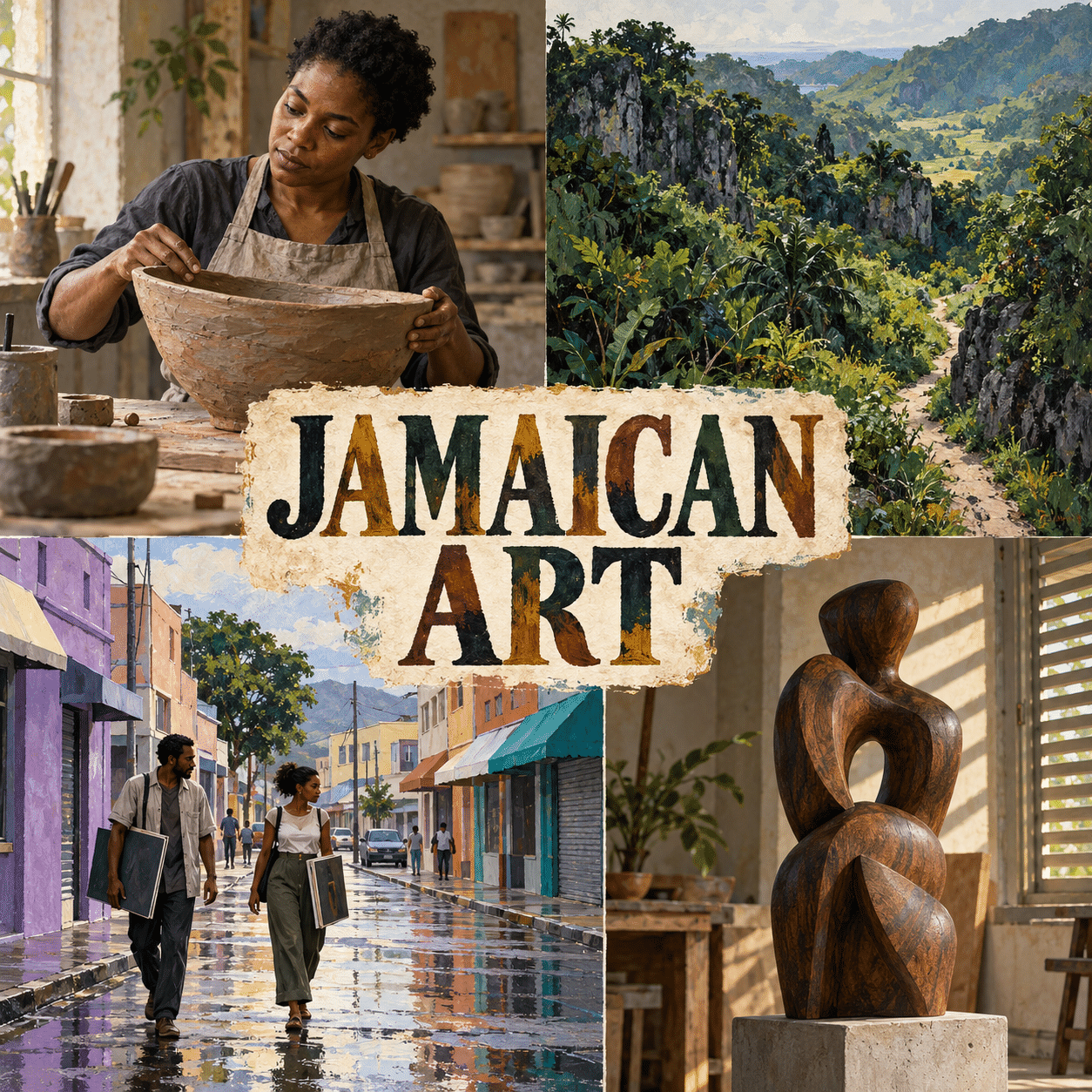
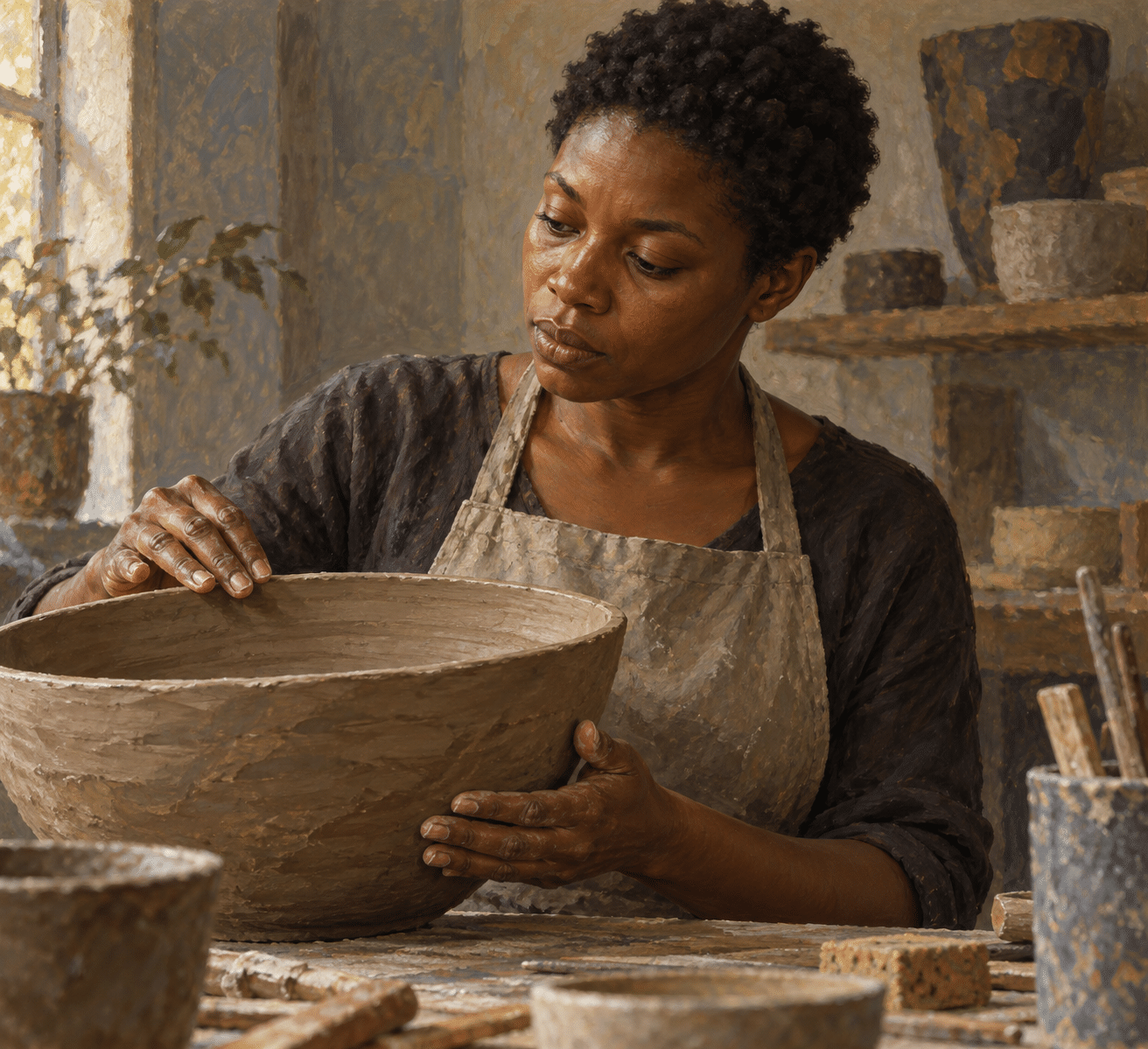
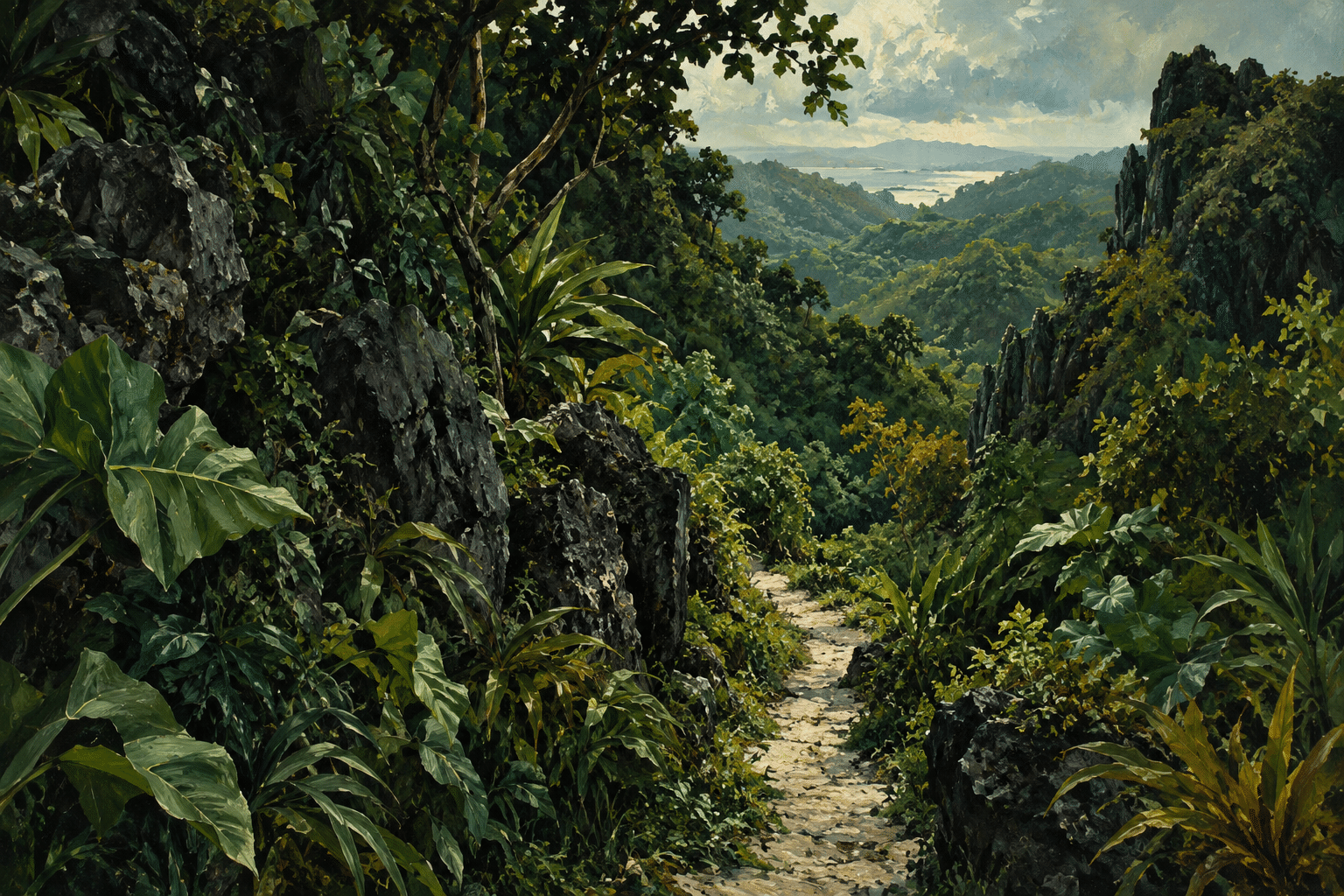
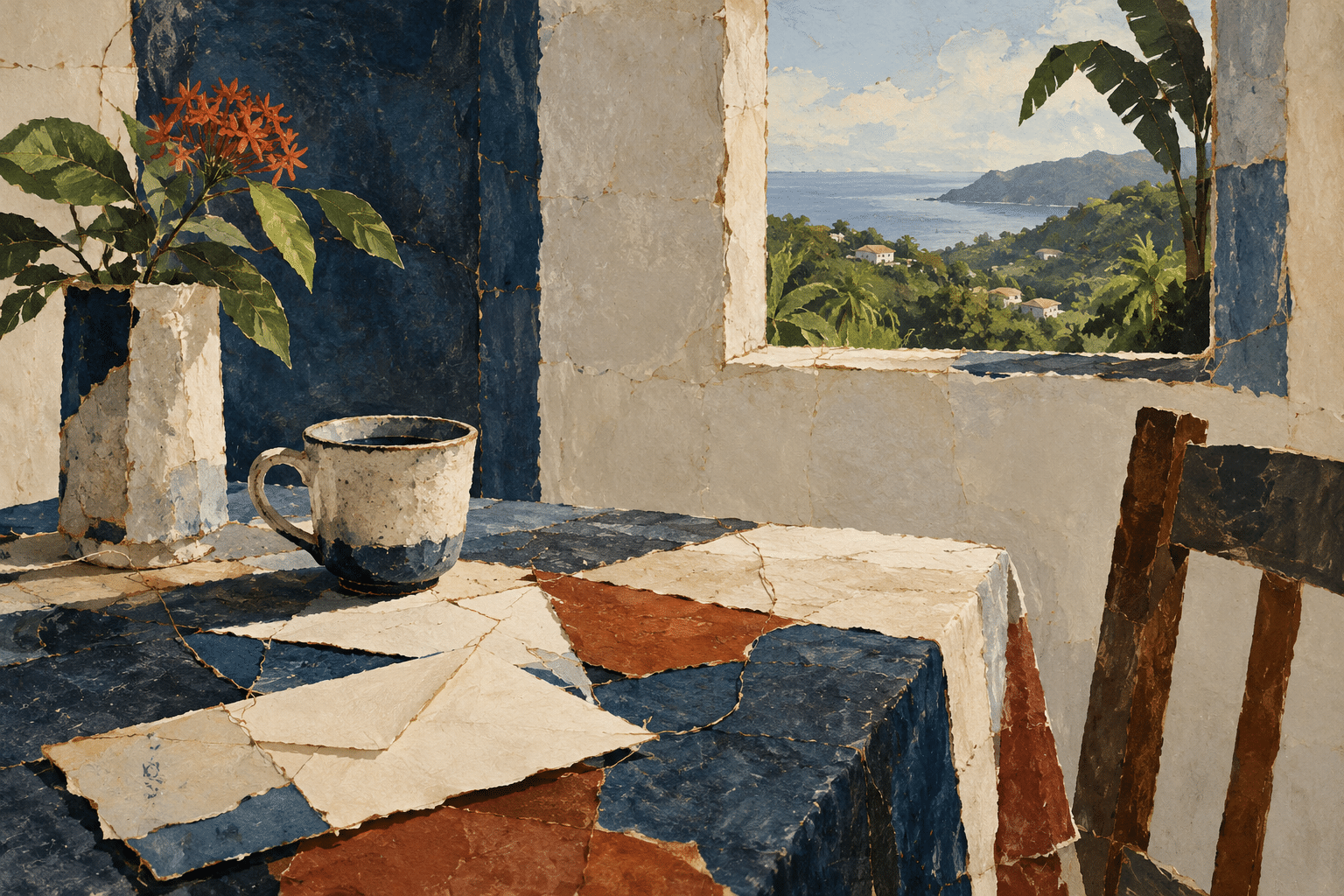
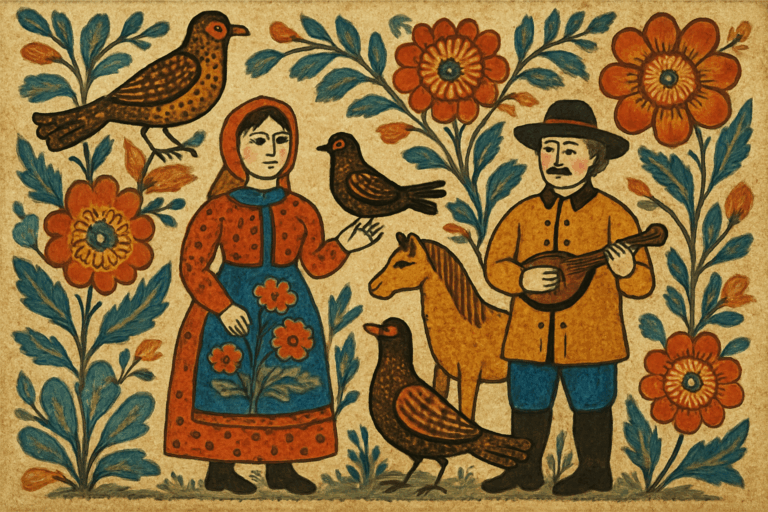
The new artworks here are AI-generated editorial interpretations, not historical objects, documentary photographs or works by the artists discussed above. They vary subject, palette and material to demonstrate why a country-wide overview needs more than one visual example. The retained earlier portrait is one limited interpretation, not a representative image of all Jamaican people or art.
For further study, follow the museum and library sources to named works and artist accounts. In a prompt, identify the imagined scene and process explicitly. Avoid inventing ritual details, attributing a generated image to a real artist, or treating nationality as a claim of cultural authenticity. Good specificity creates more interesting pictures and more useful comparisons.
Positive editorial assessment — AI-authored
A broad Jamaican-art overview can connect striking formal differences with questions of place, agency and visibility. Its value lies in those relationships: the weight of sculpture, the uncertainty of a dark landscape and the social address of contemporary mixed media can sharpen one another when viewed together.
Critical editorial assessment — AI-authored
The weakest overview substitutes a national mood for artists and objects. Tropical scenery, compulsory bright colour and a handful of celebrated names can make a page attractive but historically empty. Improve it through identified works, distinct media and explicit limits on what each example demonstrates.
Neutral editorial assessment — AI-authored
Jamaican art is a geographic and cultural field rather than a uniform movement. This introduction selects several documented practices and offers compositional exercises. It supports further investigation, but neither its artist selection nor its generated gallery is a comprehensive account of the field.
Pocket-sized facts
The label covers different media, periods and individual practices.
Dunkley’s dark landscapes challenge the stereotype of uniformly bright Jamaican painting.
The new gallery images are editorial interpretations, not historical examples.
A small poetic detour
Original words from the AOI studio.
Poetry
One window gives the hill a frame;
another opens on a street.
The wood remembers neither name
nor slogan, only weight and heat.
A painted path withdraws from view;
a thread returns across a seam.
No single colour tells us who
is doing the looking, or the dream.
The prompt workshop
Original creative exercises. These prompts create new illustrations, not documentary evidence.
A considered studio portrait
Create an original painted portrait of a fictional adult Jamaican ceramic artist in a modest contemporary studio, calmly checking the rim of a vessel. Give the hands a clear believable action, warm clay against cool grey walls, soft side light, measured brushwork and a dignified individual presence. This is an invented editorial scene, not a documentary portrait or work by a named artist.
An opening in the landscape
Create an original imagined Jamaican hillside landscape in deep green, charcoal and muted earth, where dense foliage nearly closes around a narrow path and one pale opening. Deliberate repeated leaf shapes, compressed space and a restrained luminous accent. Psychological atmosphere without monsters, no copied painting, no text.
Objects and distance
Create an original contemporary mixed-media artwork about distance and connection: an invented domestic table reconstructed from painted paper, thread and fragments of a blank envelope, a ceramic cup and a window opening onto an imagined Jamaican hillside. Strong negative space, visible joins and limited indigo, rust and cream. No fake historical documents, signatures or claimed cultural artifact.
Your next inspiration
Discover another art style
Follow a visual thread to the next subject.
A smile from the studio
Jokes
The palette was asked to represent an entire country. It requested a larger studio and several more artists.
Sources and further exploration
National Library of Jamaica: Edna Manley — biography, sculpture and art education
Jamaica Information Service: Edna Manley — the documented 1935 sculpture and its context
American Folk Art Museum: John Dunkley — paintings, sculptures and named works
National Library of Jamaica: Kapo — biography and the Intuitives classification