
Archive note: historical claims and artist or artwork associations in this entry have not yet received a full source review.
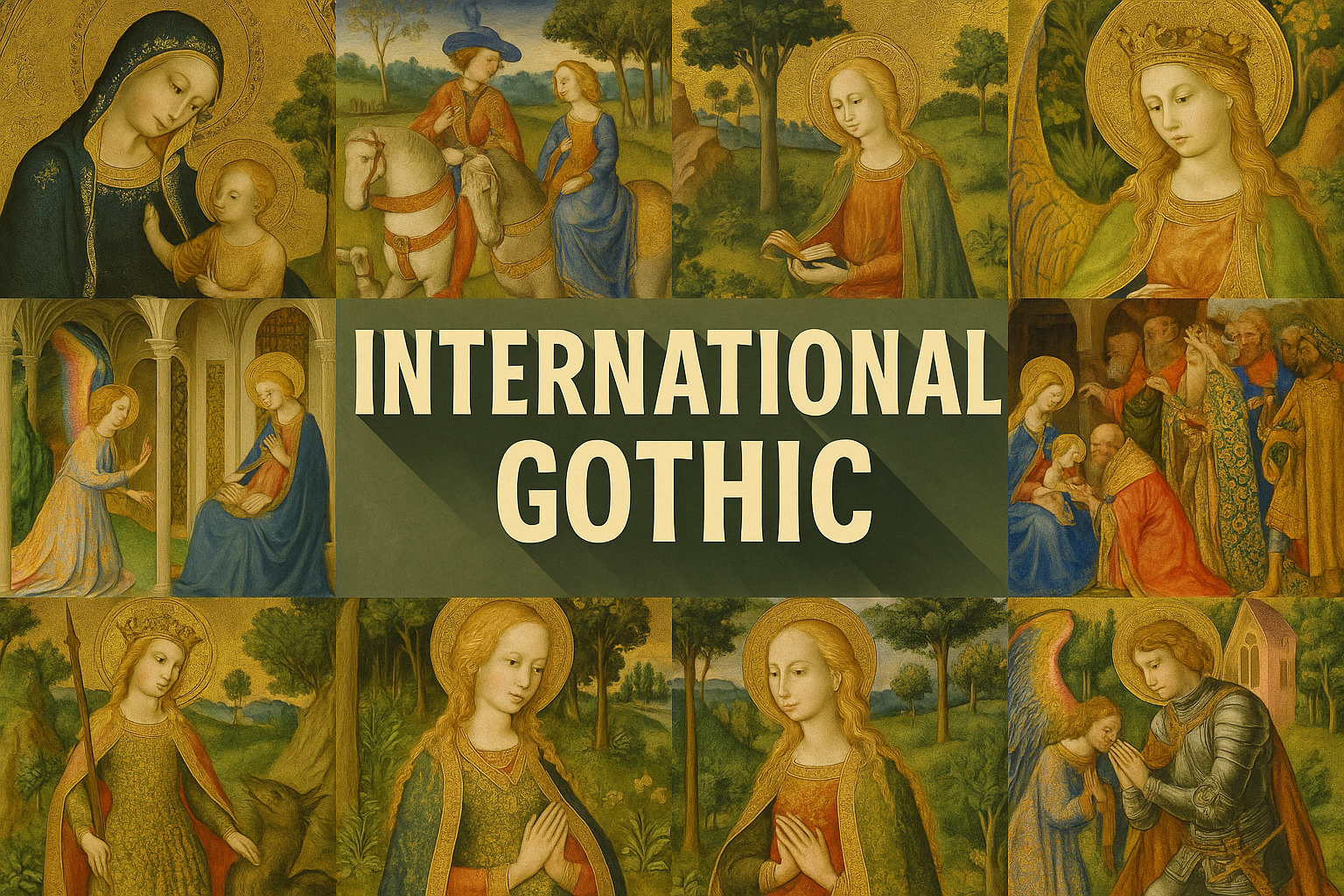
International Gothic
The art style International Gothic is characterized by its ornate, dramatic style. The colors are often very bright and the overall effect is very dramatic.
AOI thinking about International Gothic [+_~]-/
Overview and quick facts
International Gothic is a period of art that began in the late fourteenth century and lasted until the sixteenth century. It is characterized by its ornate, dramatic style, featuring intricate details and bright colors. International Gothic artists often drew inspiration from religious and mythological subjects, as well as the natural world. This period of art was influential in shaping the Renaissance, which followed shortly afterwards.
Can understand it also, as:
Global, worldwide, transnational
Categorize it as:
Impressionism, Modernism
Detailed description
The International Gothic style was a late medieval art movement that lasted from the late 13th century to the late 14th century. The style was characterized by its ornate, dramatic, and often fantastical style. Gothic art was initially popularized in France, and then spread to other parts of Europe, such as Italy, Spain, and Germany. Gothic art is often associated with the spooky, dark, and haunted elements of medieval life. Some of the most famous Gothic artists include Giotto, Simone Martini, and Duccio. Gothic art is often characterized by its use of light and shadow to create a sense of depth and drama. Gothic paintings often depict religious scenes, such as the Last Judgment, or scenes of martyrdom. Gothic art is also known for its use of intricate details and its often grotesque style.
Archive notes — claims to verify
1. International Gothic is a period of art history lasting from the late 14th century to the early 15th century.
2. It is characterized by a move away from the naturalism of the earlier Gothic period to a more ornate, decorative style.
3. International Gothic artists were influenced by the work of the Italian painter Giotto, as well as by the Sienese school of painting.
4. The International Gothic style was first seen in the paintings of the German artist Hans Memling, who worked in the city of Bruges in Belgium.
5. Other important artists associated with the International Gothic style include the English painter John Everett Millais, the French painter Jean Fouquet, and the Italian painter Gentile da Fabriano.
6. International Gothic art is often characterized by its use of bright colors, as well as by its use of gold and other precious metals.
7. International Gothic paintings often depict religious subjects, such as the life of Christ or the Virgin Mary.
8. However, other subjects, such as mythology and the lives of the saints, are also commonly found in International Gothic art.
9. The International Gothic style was particularly popular in Northern Europe, and many of the most important works of the period were produced in the countries of Belgium, the Netherlands, and Germany.
10. The International Gothic style continued to be popular into the early 15th century, when it began to be replaced by the Renaissance style of art.
Artists and works: references to check
(be aware, can be highly speculative)
Artists (be aware, speculation possible):
1. Albrecht Dürer 1471-1528 2. Jan van Eyck 1390-1441 3. Rogier van der Weyden 1400-1464 4. Hans Memling 1430-1491 5. Fra Angelico 1395-1455 6. Piero della Francesca 1415-1492 7. Antonello da Messina 1430-1479 8. Andrea Mantegna 1431-1506 9. Giovanni Bellini 1430-1516 10. Botticelli 1445-1510 11. Ghirlandaio 1449-1494 12. Filippino Lippi 1457-1504 13. Leonardo da Vinci 1452-1519 14. Perugino 1450-1523 15. Pinturicchio 1454-1513 16. Raphael 1483-1520 17. Michelangelo 1475-1564 18. Domenico Ghirlandaio 1449-1494 19. Fra Bartolommeo 1472-1517 20. Pontormo 1494-1557 21. Parmigianino 1503-1540 22. Bronzino 1503-1572 23. Titian 1488-1576 24. Tintoretto 1518-1594 25. Veronese 1528-1588 26. Caravaggio 1571-1610 27. Bernini 1598-1680 28. Rembrandt 1606-1669 29. Velázquez 1599-1660 30. Goya 1746-1828
Artworks (be aware, speculation possible)
1. The Annunciation, 1340, by Simone Martini 2. The Annunciation Triptych, 1433, by Jan van Eyck 3. The Arnolfini Portrait, 1434, by Jan van Eyck 4. The Birth of Christ, 1340, by Simone Martini 5. The Book of Hours of Jeanne d’Evreux, 1325-1328, by Jean Pucelle 6. The Breviary of Jean de France, 1324-1328, by Jean Pucelle 7. The Crucifixion, 1340, by Simone Martini 8. The Death of the Virgin, 1340, by Simone Martini 9. The Golden Legend, ca. 1470, by Hans Memling 10. The Heures de Jeanne d’Evreux, 1325-1328, by Jean Pucelle 11. The Hours of Catherine of Cleves, ca. 1440, by the Master of Catherine of Cleves 12. The Life of Christ, 1340, by Simone Martini 13. The Life of the Virgin, 1340, by Simone Martini 14. The Madonna and Child, 1340, by Simone Martini 15. The Madonna and Child with Saints, 1340, by Simone Martini 16. The Madonna of the Pomegranate, ca. 1487, by Piero della Francesca 17. The Melun Diptych, ca. 1452, by Jean Fouquet 18. The Miraflores Altarpiece, ca. 1445, by Juan de Flandes 19. The Nativity, 1340, by Simone Martini 20. The Nativity of Christ, ca. 1470, by Hans Memling 21. The Pietà, ca. 1455, by Andrea Mantegna 22. The Pisa Altarpiece, 1340, by Simone Martini 23. The Portinari Altarpiece, ca. 1475, by Hugo van der Goes 24. The Presentation in the Temple, 1340, by Simone Martini 25. The Resurrection, 1340, by Simone Martini 26. The Temptation of Christ, ca. 1470, by Hans Memling 27. The Three Living and the Three Dead, ca. 1470, by Hans Memling 28. The Triumph of Death, ca. 1470, by Hans Memling 29. The Virgin and Child, ca. 1470, by Hans Memling 30. The Virgin and Child with Saints, ca. 1470, by Hans Memling
Epoch
The International Gothic art style began in the late 14th century and continued into the 15th century.
Creative tools and further exploration
Search results are starting points for exploration, not evidence for the historical claims or attributions in this legacy entry.
- Practical AI tools and critical guidance
- Build a repeatable image workflow
- Search Wikipedia for this subject
- Search Lexica for visual interpretations
- Browse the Art Style Database
Creative studies to try
Explore these collected prompts as creative interpretations. They are starting points for image-making, not reproductions of historical artworks or evidence about a tradition.
Visual cues: Elegant detail in a jeweled world
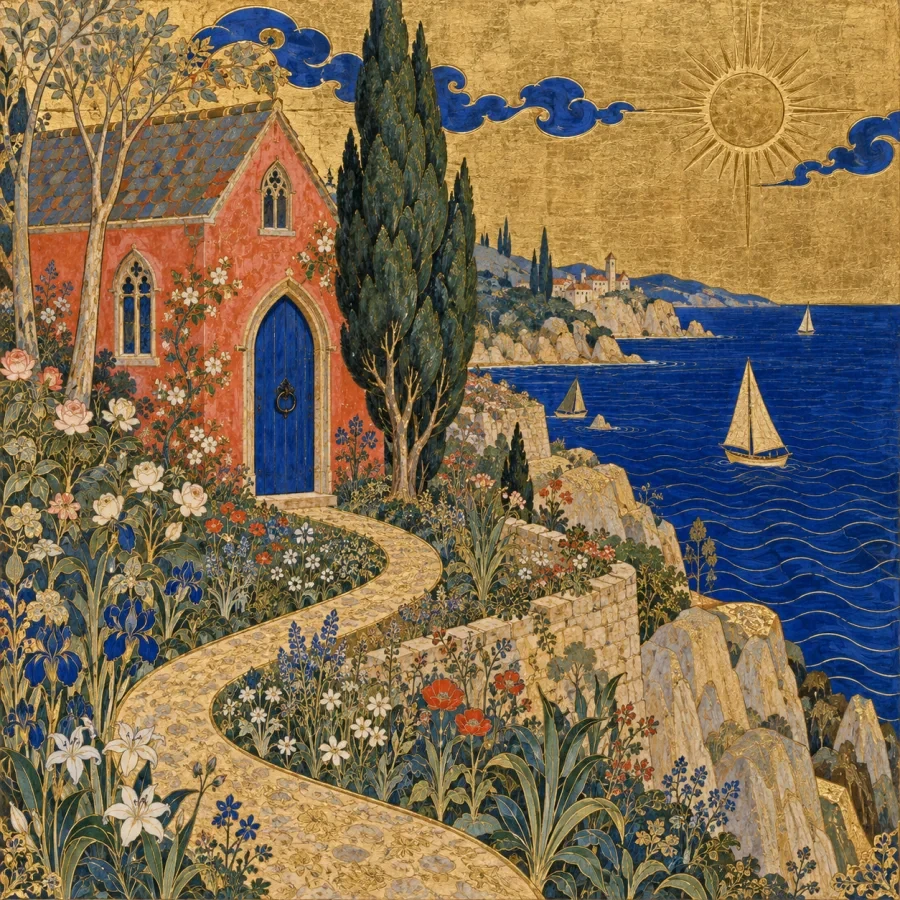
Study 1 — International Gothic
Apply the following visual approach to my subject or project, preserving its core content and purpose. Use slender graceful contours, intricate botanical detail, jewel-like colors, patterned surfaces, and decorative spatial layering inspired by International Gothic painting. Treat this as a contemporary interpretation of the named visual tradition, not a historical artifact. Adapt the composition to my subject. Do not add text unless my project calls for it.
Prompt source: Emergent Mind Style Atlas. Select the text to copy, then adapt the subject and composition.