
A quick brush with the subject · What catches the eye? · A closer look · Pocket-sized facts · Artists, objects, and paths to explore · The prompt workshop · A small poetic detour · A smile from the studio · Sources and further exploration
A quick brush with the subject
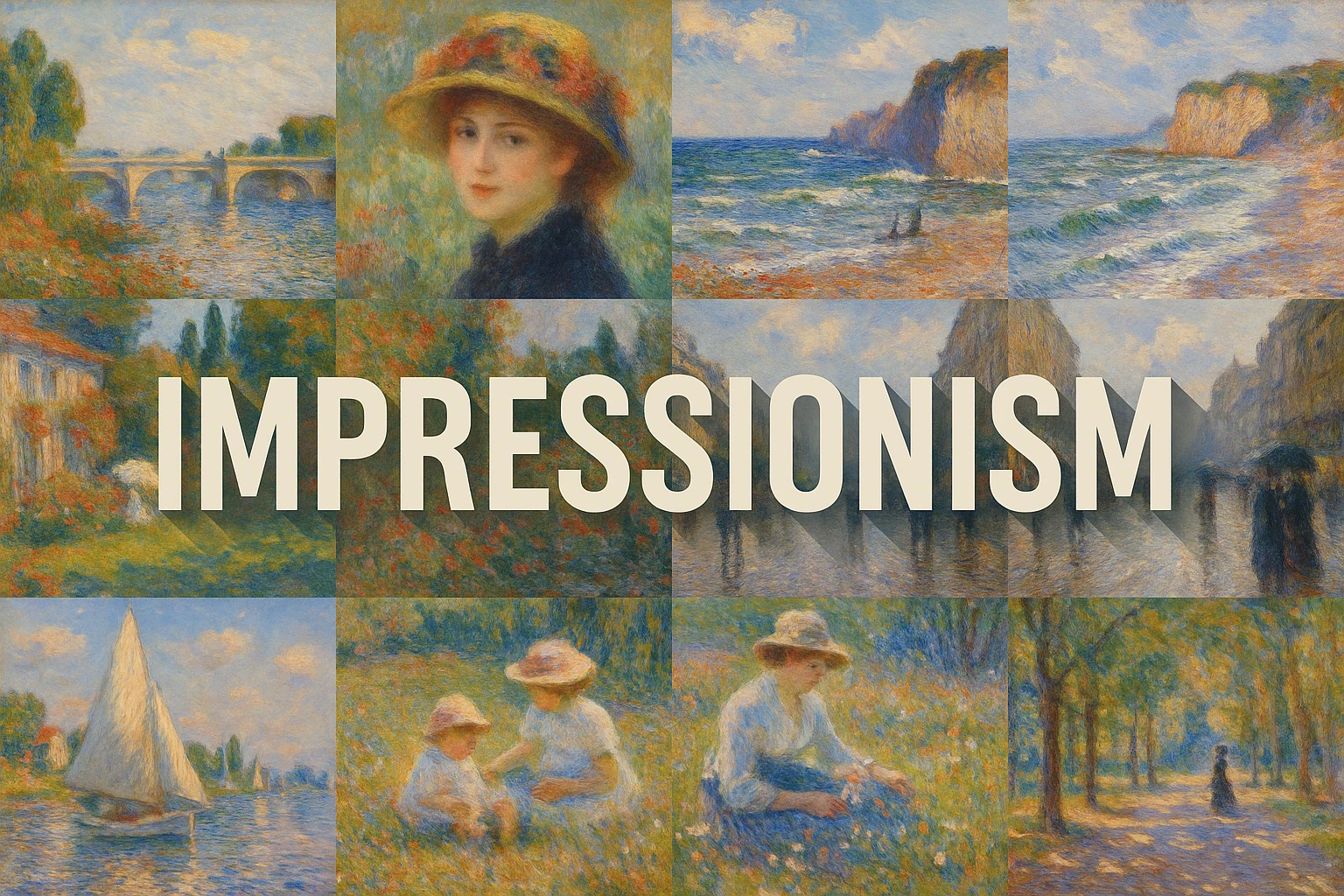
Impressionism makes looking feel like an event: reflections shift, figures pass through a scene, and a patch of color becomes sunlight. The historical movement also involved artists making their own opportunities to exhibit. A useful introduction needs both the paintings and the circumstances in which people first encountered them.
What catches the eye?
Watch how separate touches of paint build a surface rather than disappearing into a smooth finish. Edges may soften, shadows carry color, and a cropped composition can suggest a passing encounter. These effects depend on relationships between marks; simply making an image blurry or brightly colored will not explain Impressionism.
A closer look
In Paris in 1874, an independent group of painters and other artists organized the first of the exhibitions now associated with Impressionism. Their shared position was independence from the official Salon, not obedience to one painting method. The Met notes that Monet's Impression, Sunrise helped give the group its name through a critical response. Eight group exhibitions took place between 1874 and 1886, with changing participants. That history is more precise than treating every loosely painted image as Impressionist.
Monet's La Grenouillère, 1869, offers a concrete starting point. The Met identifies its setting as a boating and bathing resort on the Seine near Paris, where Monet and Renoir worked that summer. It predates the first group exhibition. Instead of asking only whether the water looks realistic, compare the painted marks for reflections, boats and distant people. The same surface has to hold a recognizable leisure scene and the activity of paint. Studying one such painting is more useful than memorizing a long list of loosely related artists.
Berthe Morisot's The Cradle, 1872, brings attention indoors. According to the Musée d'Orsay, it shows her sister Edma watching her sleeping daughter Blanche; Morisot exhibited it with the group in 1874. The museum draws attention to the diagonal relationship between the mother, child and curtain. That arrangement makes the quiet subject formally purposeful. It is a useful corrective to the idea that Impressionism is exclusively landscape painting or that an intimate domestic scene has little to say about composition.
A lively painted surface need not mean an unplanned picture. The Met emphasizes that an appearance of spontaneity could conceal careful construction. When looking at a work, move between two questions: what fleeting effect does it suggest, and what arrangement keeps the image coherent? The tension between those questions is often more rewarding than a rule about brush size or a claim that the artist merely recorded a moment.
For your own experiment, choose something ordinary and observable: a patch of shade beside a path, light on a cup, or people waiting near water. Make two studies from the same viewpoint with different lighting. Describe the actual color relationships rather than adding the word beautiful to every instruction. This is a contemporary exercise in looking, not a way to manufacture a newly discovered historical painting. The featured AOI image is clearly identified as a generated illustration.
Pocket-sized facts
The independent exhibitions ran from 1874 to 1886; their participants did not share one fixed technique.
Outdoor scenes are important, but Morisot's The Cradle demonstrates the place of domestic interiors in this history.
Keep later movements and individual artists' changing practices distinct. A colorful surface alone is not enough to classify a work.
Artists, objects, and paths to explore
Claude Monet — La Grenouillère, 1869, oil on canvas. The Metropolitan Museum of Art, object 29.100.112. Compare reflections with the solid forms of boats and the landing place.
Berthe Morisot — The Cradle, 1872, oil on canvas. Musée d'Orsay, RF 2849. Follow the diagonal connecting the watching mother and sleeping child.
The prompt workshop
Creative corner: original AOI material, not historical evidence.
An original riverside study in broken strokes: small boats beside a landing stage, cool blue-green reflections interrupted by warm sunlit patches, figures suggested with a few marks. Keep the view coherent and avoid copying a known composition.
The same quiet garden path at morning and late afternoon, painted as two separate studies. Change shadow direction, temperature and contrast while keeping the viewpoint fixed. A contemporary observation exercise, not a historical attribution.
A small poetic detour
Creative corner: original AOI material, not historical evidence.
A breeze breaks the pond.
Blue slips between strokes of gold;
The shore comes apart.
A smile from the studio
Creative corner: original AOI material, not historical evidence.
The reflection asked the painter to hold still. 'I would,' said the painter, 'but you started it.'
Sources and further exploration
The Met — Impressionism: Art and Modernity
The Met — Claude Monet, La Grenouillère
Musée d'Orsay — Berthe Morisot, The Cradle
Creative studies to try
Explore these collected prompts as creative interpretations. They are starting points for image-making, not reproductions of historical artworks or evidence about a tradition.
Visual cues: broken light, atmospheric color, observed mood; A moment of changing outdoor light
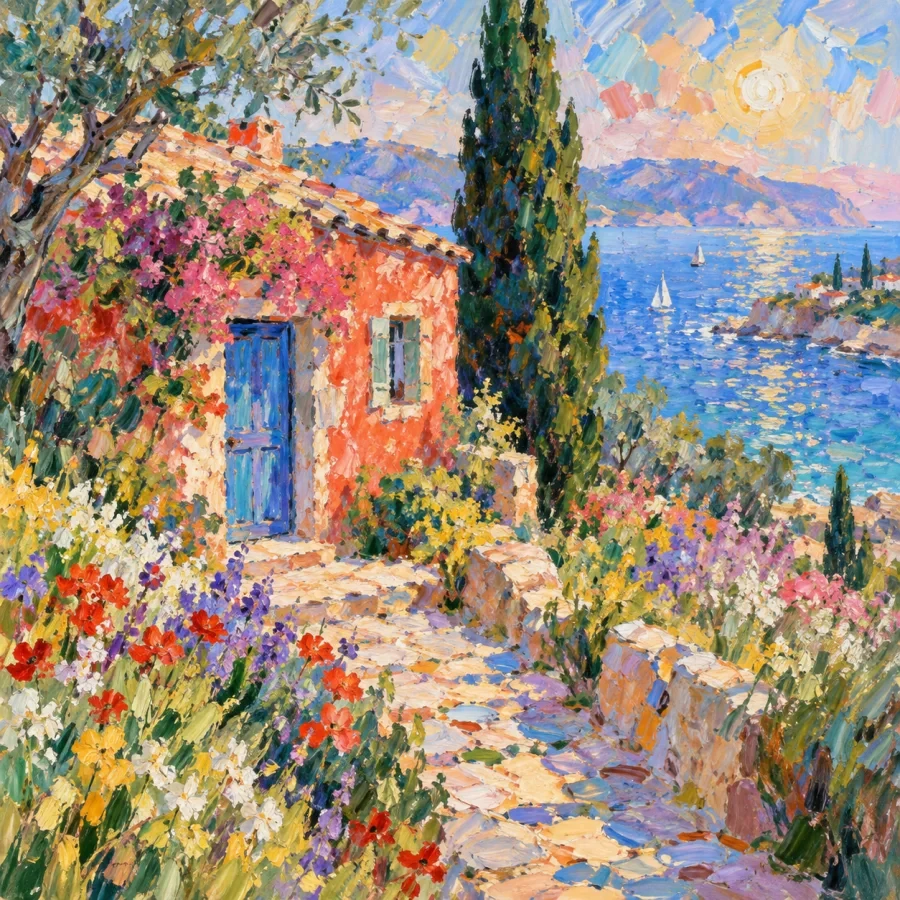
Study 1 — Impressionism
Ultra-wide panoramic banner, a human hand and a sleek robotic hand reaching toward each other, fingertips almost touching, a bright luminous spark of intelligence between them, a subtle world map behind them with global data network lines, symbolizing human-AI collaboration and digital transformation, rendered in Impressionism style, with visible brushstrokes, broken color, atmospheric glow, soft luminous edges, high quality, high detail, balanced composition, no text, no logo, no watermark, exact aspect ratio 1584:396
Prompt source: 1001 Art Styles. Select the text to copy, then adapt the subject and composition.
Study 2 — Impressionism
Apply the following visual approach to my subject or project, preserving its core content and purpose. Use broken brushstrokes, bright reflected color, softened contours, and shifting daylight; suggest detail through color relationships rather than meticulous outlines. Treat this as a contemporary interpretation of the named visual tradition, not a historical artifact. Adapt the composition to my subject. Do not add text unless my project calls for it.
Prompt source: Emergent Mind Style Atlas. Select the text to copy, then adapt the subject and composition.