
Historical painting context
The Heidelberg School names a network associated with Australian Impressionism, especially artists working around Melbourne in the late nineteenth century. Outdoor observation, light and modern life connect varied practices rather than one uniform formula.
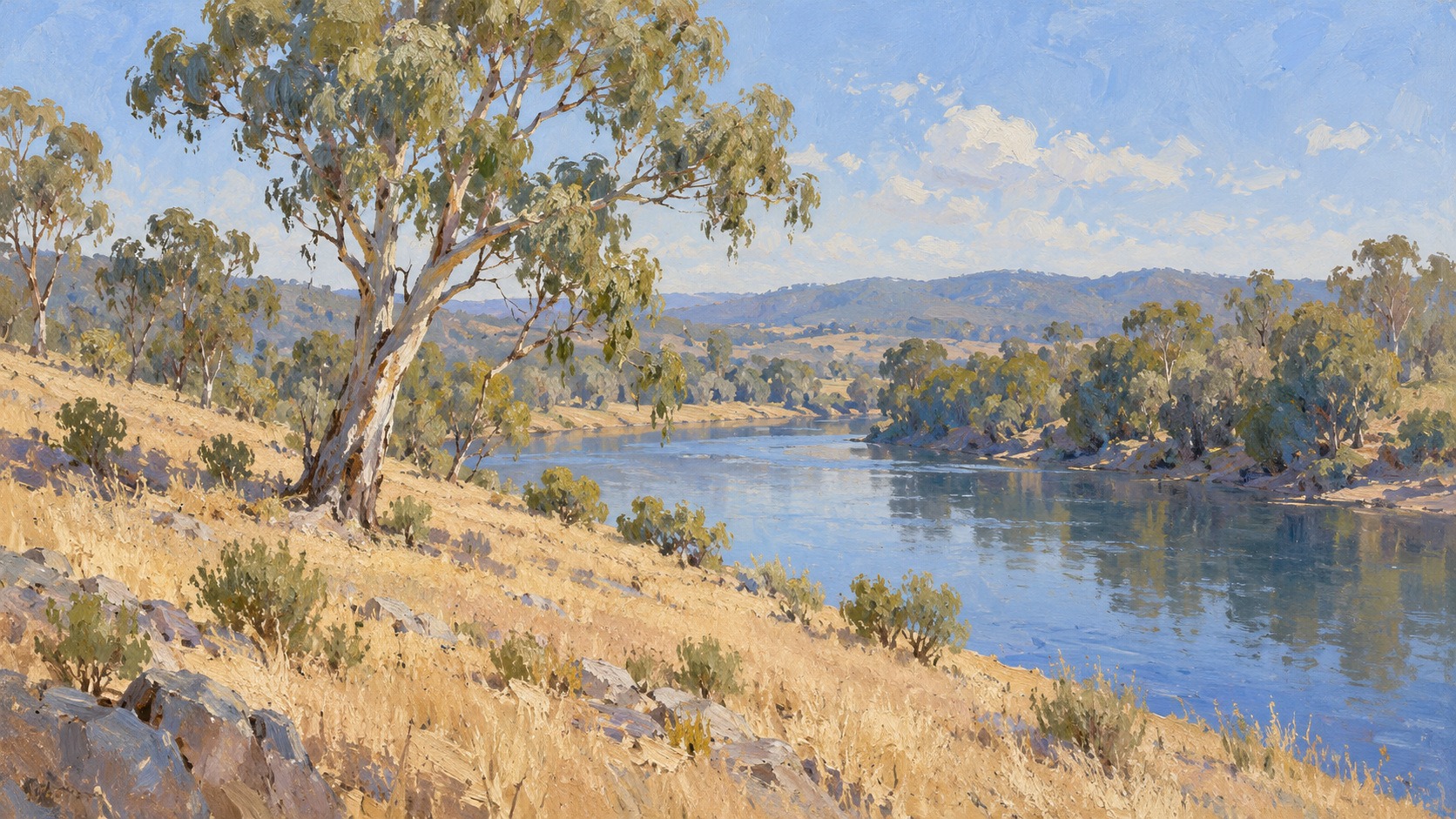
A visual introduction
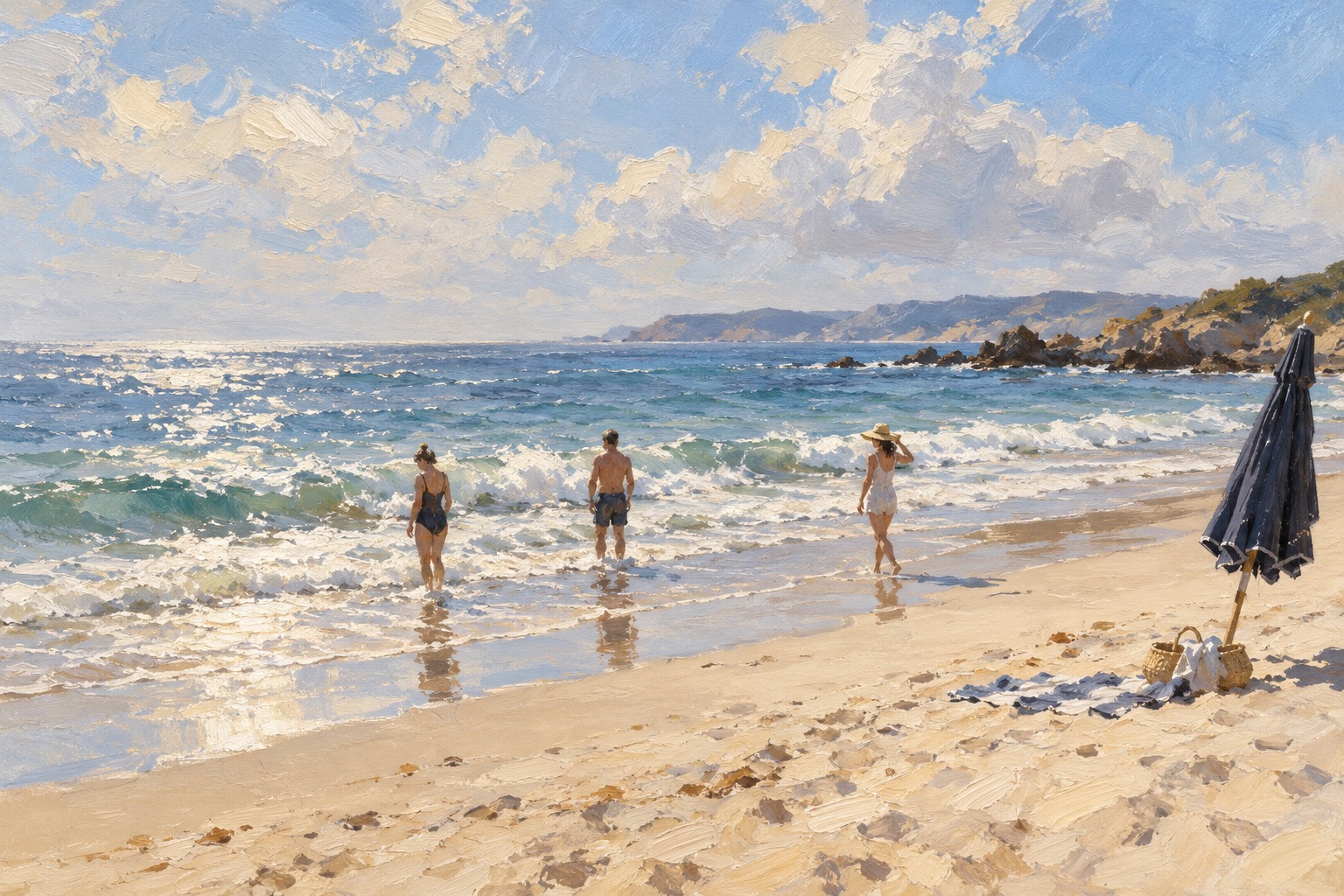
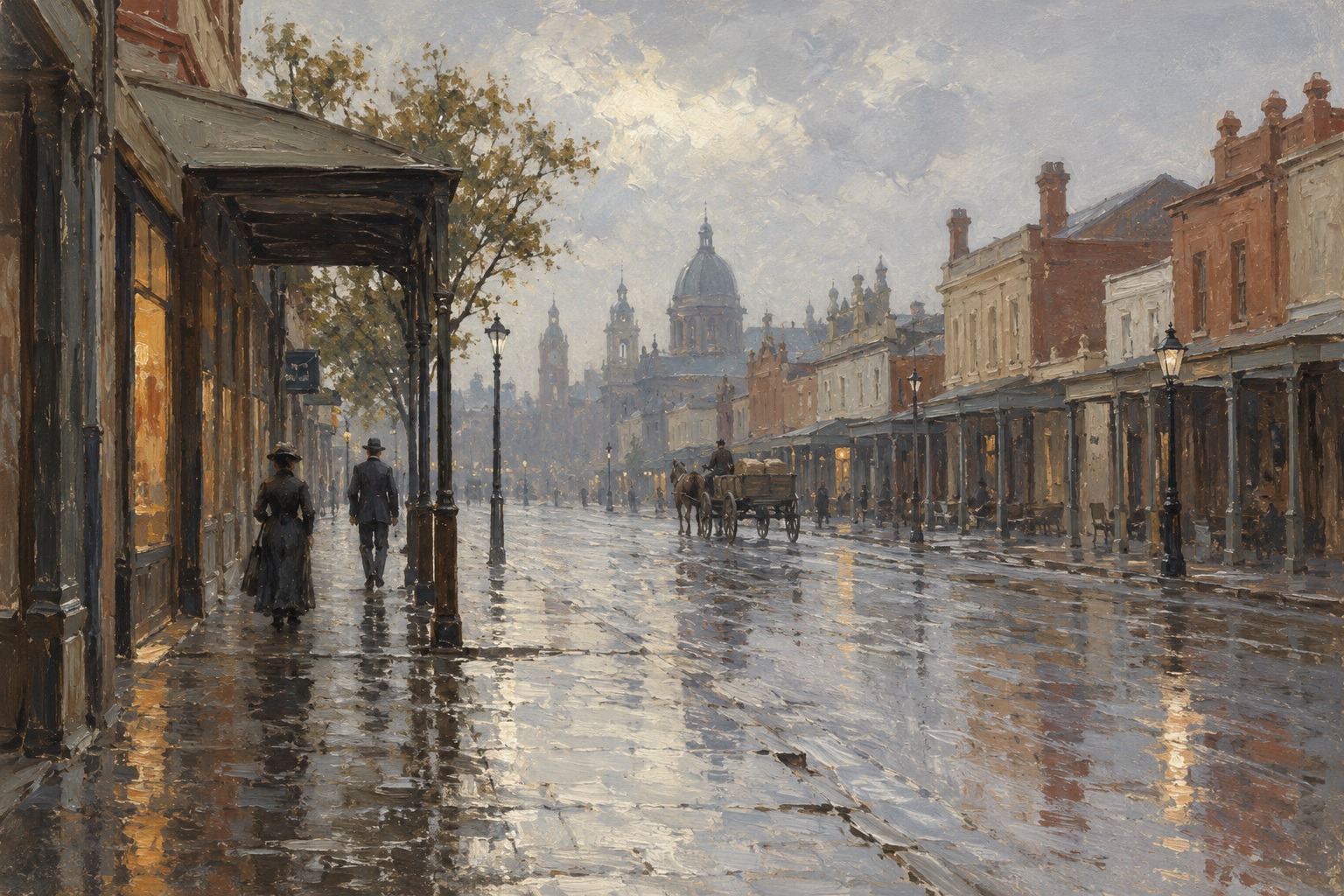
Earlier AOI landscape and collage studies accompany new river, beach and urban interpretations. These images are original illustrations, not reproductions of named Heidelberg School paintings.
Select an image for a closer look. Use the thumbnails, arrow keys or a swipe to compare examples. Zoom in to inspect details, or share the image that inspires you.


Creative toolbox · take this style further
Choose an input and a destination. Search sends your words to the chosen site; Copy & open puts them on your clipboard to paste there.
Create with AI
Turn your chosen input into an image prompt or a new creative direction.
ChatGPT
Copy your input and paste it into a ChatGPT conversation or image request.
Copy & open ChatGPT (new tab)Claude · Anthropic
Develop an image prompt or explore the style in a new Claude conversation.
Copy & open Claude · Anthropic (new tab)Midjourney
Paste your input into the Imagine bar on the Create page.
Copy & open Midjourney (new tab)Adobe Firefly
Copy your input, open Firefly, and paste it into the prompt field.
Copy & open Adobe Firefly (new tab)Leonardo.Ai
Copy your input, open Leonardo, and paste it into the generation field.
Copy & open Leonardo.Ai (new tab)Image search
Find visual references. Short, concrete keywords usually work best.
Lexica
Search AI images and prompts using your selected input.
Search with this input Lexica (new tab)Pexels
Search the photo and video library. Short keywords often work best.
Search with this input Pexels (new tab)Pixabay
Search photos, illustrations and other images.
Search with this input Pixabay (new tab)Unsplash
Search photographs using the style name or your own keywords.
Search with this input Unsplash (new tab)Wikimedia Commons
Search photographs, artworks and historical images. Check each file for its source and reuse terms.
Search with this input Wikimedia Commons (new tab)Art & research
Explore artists, collections and the ideas behind a style.
Wikipedia
Search for background reading. A style may not have its own article.
Search with this input Wikipedia (new tab)WikiArt
Copy your input into WikiArt’s search to explore artists and artworks.
Copy & open WikiArt (new tab)Europeana
Paste your keywords into the search to explore European museum, library and archive collections.
Copy & open Europeana (new tab)Inspiration
Discover portfolios and visual ideas from creative communities.
Instagram hashtags
Search a hashtag made from your input: spaces and punctuation are removed. Instagram may require sign-in.
Search with this input Instagram hashtags (new tab)ArtStation
Paste your input into artwork search for concept art, environments, characters and visual development.
Copy & open ArtStation (new tab)Behance
Paste your input into project search for illustration, design and visual storytelling.
Copy & open Behance (new tab)A closer look
Broken or economical brushwork, broad tonal relationships, sunlit land, beaches and urban scenes recur. Individual works range from small impressions to carefully developed narrative paintings.
A network rather than a literal school
The Heidelberg School is a familiar name for artists associated with Australian Impressionism, including Tom Roberts, Arthur Streeton, Charles Conder and Frederick McCubbin. The NGV emphasizes friendships, shared work and different locations rather than a single unified movement. Jane Sutherland, Clara Southern and other women also belong in the discussion. Reducing the subject to four men painting one hillside gives a misleadingly narrow picture.
These artists worked within an already inhabited continent and a much longer history of art. Their paintings must not be described as the beginning of Australian art. The NGV places Australian Impressionism alongside First Peoples’ continuing cultural production and identifies the Country on which artist camps operated. A landscape image can construct a settler identity while leaving other relationships to that land outside the frame.
The small impression mattered
The 1889 9 by 5 Impression Exhibition in Melbourne took its name from the approximate dimensions of many small supports, including cigar-box lids. The NGV describes landscape, beach, city and figure subjects among its works. Quick records of changing light challenged assumptions about how finished a painting needed to look. Small scale encouraged concentrated decisions, but an apparent sketchiness should not be mistaken for a lack of design.
Read the light as a structure
Begin by identifying the largest light and shadow masses. A sunlit field can form one broad plane, interrupted by a darker tree group and a small path that carries the eye through the image. In a beach scene, a narrow dark accent may give scale to a much larger expanse of sand. Trees should contribute directional movement and value rhythm before receiving leaf detail.
Palette depends on the particular scene. Warm dry ground, cooler distance and violet-gray shadows offer one useful study; they are not a national color formula. Overcast harbor light or an enclosed bush interior requires a different set of relationships. Avoid applying orange to every surface or treating blue shadows as a compulsory effect. Observe which adjacent colors make the light convincing.
A contemporary outdoor study
For an original exercise, choose a familiar place and make three short studies from the same viewpoint at different times. Limit each to a few large shapes and record the changing shadow direction. Keep the horizon and principal masses consistent so that you can compare light rather than three unrelated compositions. A digital exercise can use separate timed layers, but label it as a contemporary study.
Make one small study and then a larger version. Decide what the larger painting gains: a more developed spatial rhythm, a figure relationship or carefully controlled edges. Enlarging every small brush mark mechanically often produces noise. Keep some passages broad and allow the focal area a few sharper accents. An image of physical paint should show plausible mark scale, not equally heavy texture across sky, figures and distant trees.
Narrative, place and the frame
The broader context includes works about labor and modern Australian life, not only outdoor color sketches. Read a narrative painting by asking who is working, who is looking and what the composition asks you to admire. A beautifully organized image is also a selection of experience. Museum labels and historical context can reveal what the visual arrangement alone does not tell you.
Use the term carefully in prompts: specify the late-nineteenth-century context, observed light, restrained detail and a particular compositional problem. For newly generated scenes, avoid claiming a real painter, historical date, documented camp or exact location unless supported. An imagined riverbank should remain an imagined riverbank. The useful lesson is concentrated observation and pictorial judgment, not a decorative claim to cultural authenticity.
About this guide
This AI-authored AOI guide appears under Penny Wraiter, AOI’s editorial persona. Sources support the historical context; exercises, prompts and poetry are original editorial interpretations. Image captions distinguish generated studies from documented works.
A small poetic detour
Original words from the AOI studio.
Poetry
The field is broad; the brush is brief.
A strip of shade divides the day.
The river turns beneath the trees
where little strokes have found their way.
The panel fits inside a hand,
but weather will not fit a frame.
We look again before we paint,
and leave the borrowed view unnamed.
The prompt workshop
Original creative exercises. These prompts create new illustrations, not documentary evidence.
A small light study
Make an original small-panel oil-painting interpretation of a quiet riverbank in late afternoon. Use broad warm ground, cool distant foliage and a few decisive broken marks. Clear dark-light masses, no excessive impasto, no signature. Identify it as a contemporary exercise informed by Australian Impressionism, not a historical work.
Modern life at the shoreline
Compose an imaginary beach scene with three small figures beneath a broad pale sky, a diagonal shore and a concentrated dark accent near the water. Economical brushwork, coherent cast shadows and subtle color temperature. The figures establish scale; avoid postcard spectacle or copied historical compositions.
One place, three moments
Plan three separate contemporary studies of the same modest tree-lined path under morning, overcast noon and late-afternoon light. Keep the major shapes and viewpoint unchanged. Let shadow length, edge contrast and color relationships distinguish the moments. No invented historical attribution or claims about a specific Country.
A smile from the studio
Jokes
The small panel asked for fewer details. The painter finally listened to something smaller than the landscape.