
An aesthetic quality explored through a small image-generator study
Three handles on a brown jug are already one more than most people need. Ask an image generator for a grotesque jug and the belly grows knobbly. Tell it to make one handle as big as the vessel, and the entire object leans sideways before you even pick it up. This guide tests what the adjective and the instruction did in five original images.
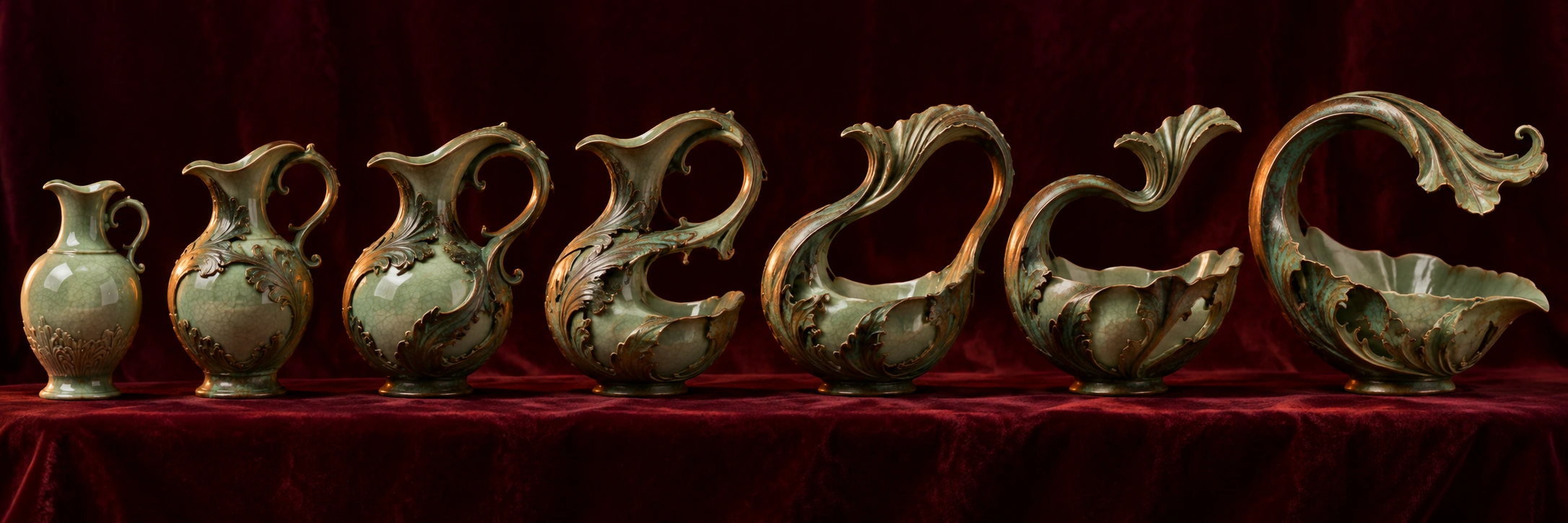
A visual introduction
Five independently generated jug studies use the same base subject and lighting instructions. The actual contours, handle counts and finish can vary between runs. The shortened prompts below are for further experiments.
Select an image for a closer look. Use the thumbnails, arrow keys or a swipe to compare examples. Zoom in to inspect details, or share the image that inspires you.
Creative toolbox · take this style further
Choose an input and a destination. Search sends your words to the chosen site; Copy & open puts them on your clipboard to paste there.
Create with AI
Turn your chosen input into an image prompt or a new creative direction.
ChatGPT
Copy your input and paste it into a ChatGPT conversation or image request.
Copy & open ChatGPT (new tab)Claude · Anthropic
Develop an image prompt or explore the style in a new Claude conversation.
Copy & open Claude · Anthropic (new tab)Midjourney
Paste your input into the Imagine bar on the Create page.
Copy & open Midjourney (new tab)Adobe Firefly
Copy your input, open Firefly, and paste it into the prompt field.
Copy & open Adobe Firefly (new tab)Leonardo.Ai
Copy your input, open Leonardo, and paste it into the generation field.
Copy & open Leonardo.Ai (new tab)Image search
Find visual references. Short, concrete keywords usually work best.
Lexica
Search AI images and prompts using your selected input.
Search with this input Lexica (new tab)Pexels
Search the photo and video library. Short keywords often work best.
Search with this input Pexels (new tab)Pixabay
Search photos, illustrations and other images.
Search with this input Pixabay (new tab)Unsplash
Search photographs using the style name or your own keywords.
Search with this input Unsplash (new tab)Wikimedia Commons
Search photographs, artworks and historical images. Check each file for its source and reuse terms.
Search with this input Wikimedia Commons (new tab)Art & research
Explore artists, collections and the ideas behind a style.
Wikipedia
Search for background reading. A style may not have its own article.
Search with this input Wikipedia (new tab)WikiArt
Copy your input into WikiArt’s search to explore artists and artworks.
Copy & open WikiArt (new tab)Europeana
Paste your keywords into the search to explore European museum, library and archive collections.
Copy & open Europeana (new tab)Inspiration
Discover portfolios and visual ideas from creative communities.
Instagram hashtags
Search a hashtag made from your input: spaces and punctuation are removed. Instagram may require sign-in.
Search with this input Instagram hashtags (new tab)ArtStation
Paste your input into artwork search for concept art, environments, characters and visual development.
Copy & open ArtStation (new tab)Behance
Paste your input into project search for illustration, design and visual storytelling.
Copy & open Behance (new tab)A closer look
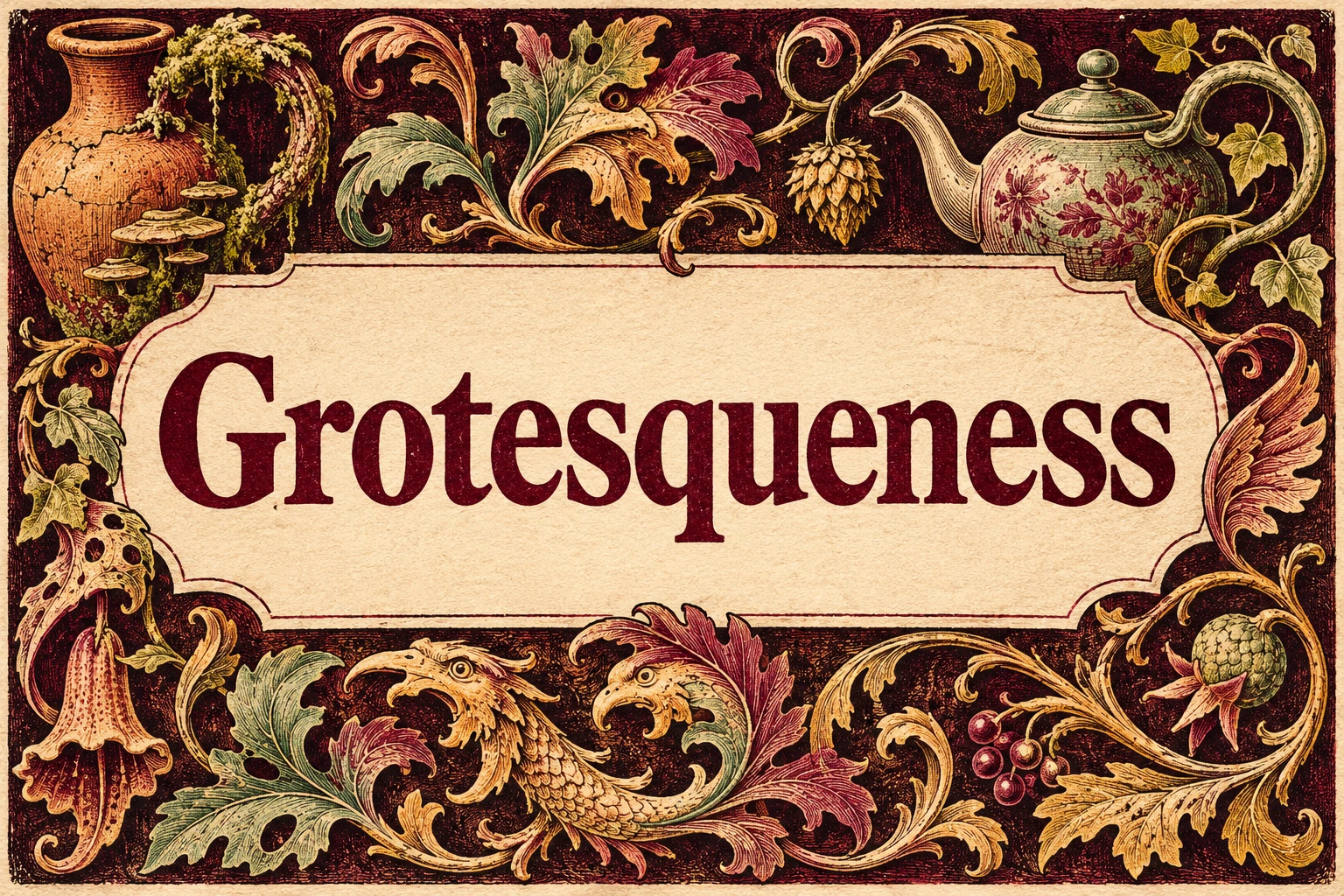
Grotesqueness can live in a silhouette, an impossible transition between materials, a change of scale or a small feature that has taken over the whole object. Look for the ordinary form that remains readable beneath the interference.
An ordinary shape with a troublesome part
A shape becomes grotesque when the viewer can still recognise a rule and can see something tugging it out of joint. A teapot can have a handle that suggests a vine. Let that vine make a second loop large enough to swallow the pot’s silhouette and the familiar act of pouring becomes peculiar. Grotesqueness can be funny, unsettling, tender or severe. It can work in a clean white room with no monsters present.
The word has a particular art history as well as a wider modern use. The Met’s Ornament Panel, attributed to Agostino Veneziano, shows how a framework of scrolls can support unlikely combinations. The museum traces the term grottesche to the grotto-like rooms where Roman wall decoration was rediscovered. That is one history of ornament. It does not give every later misshapen jug a Renaissance pedigree.
What this generator was actually asked to do
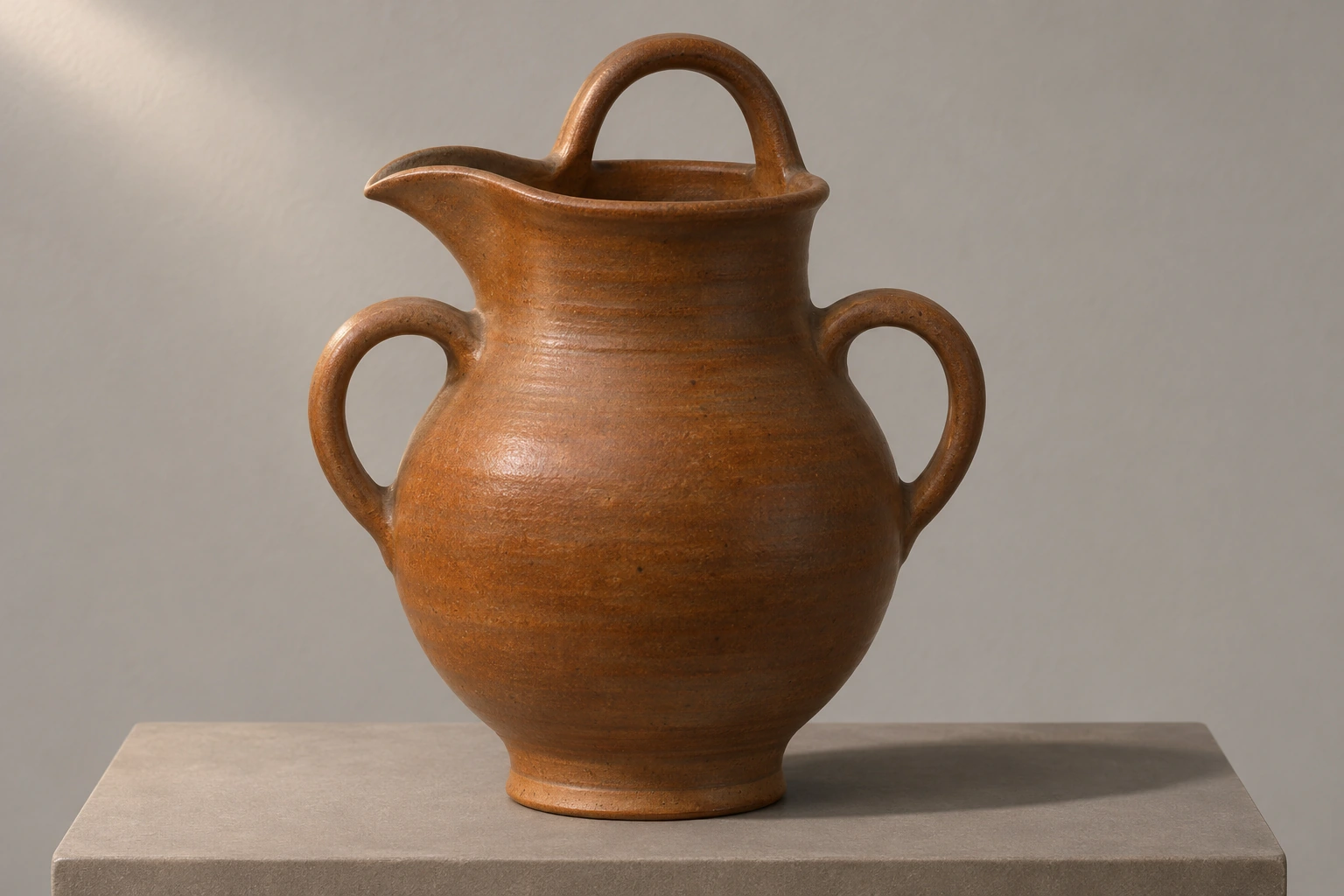
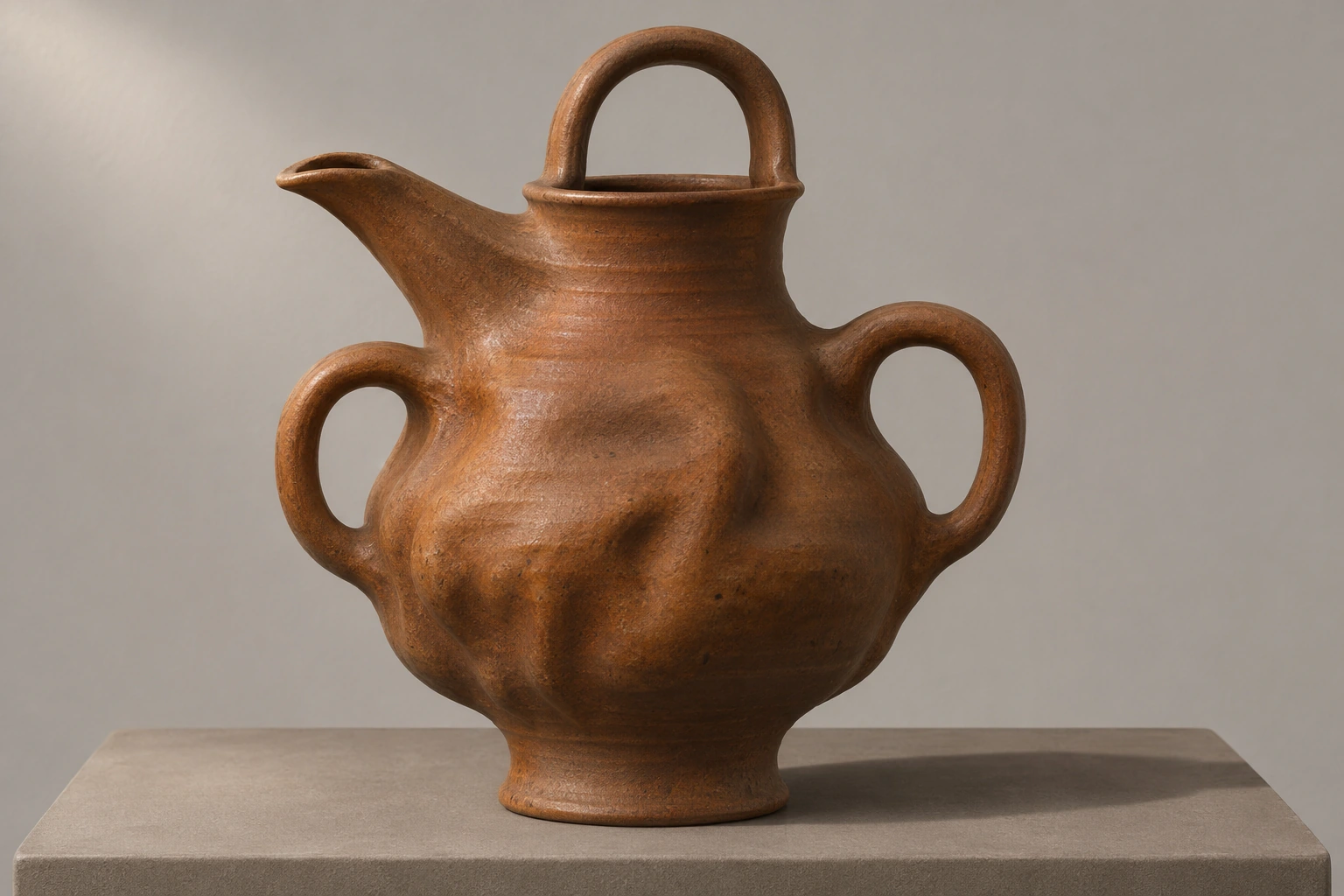
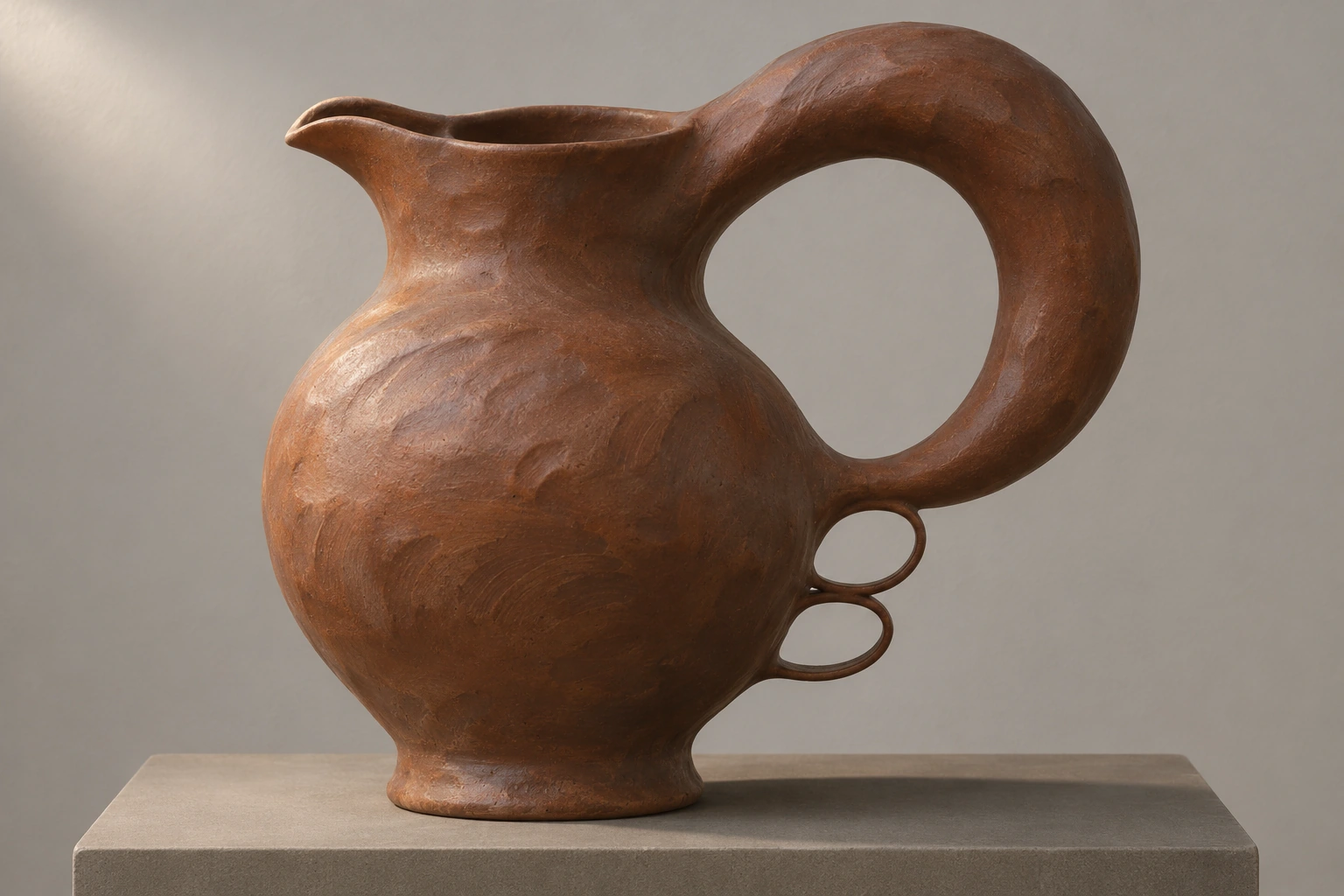
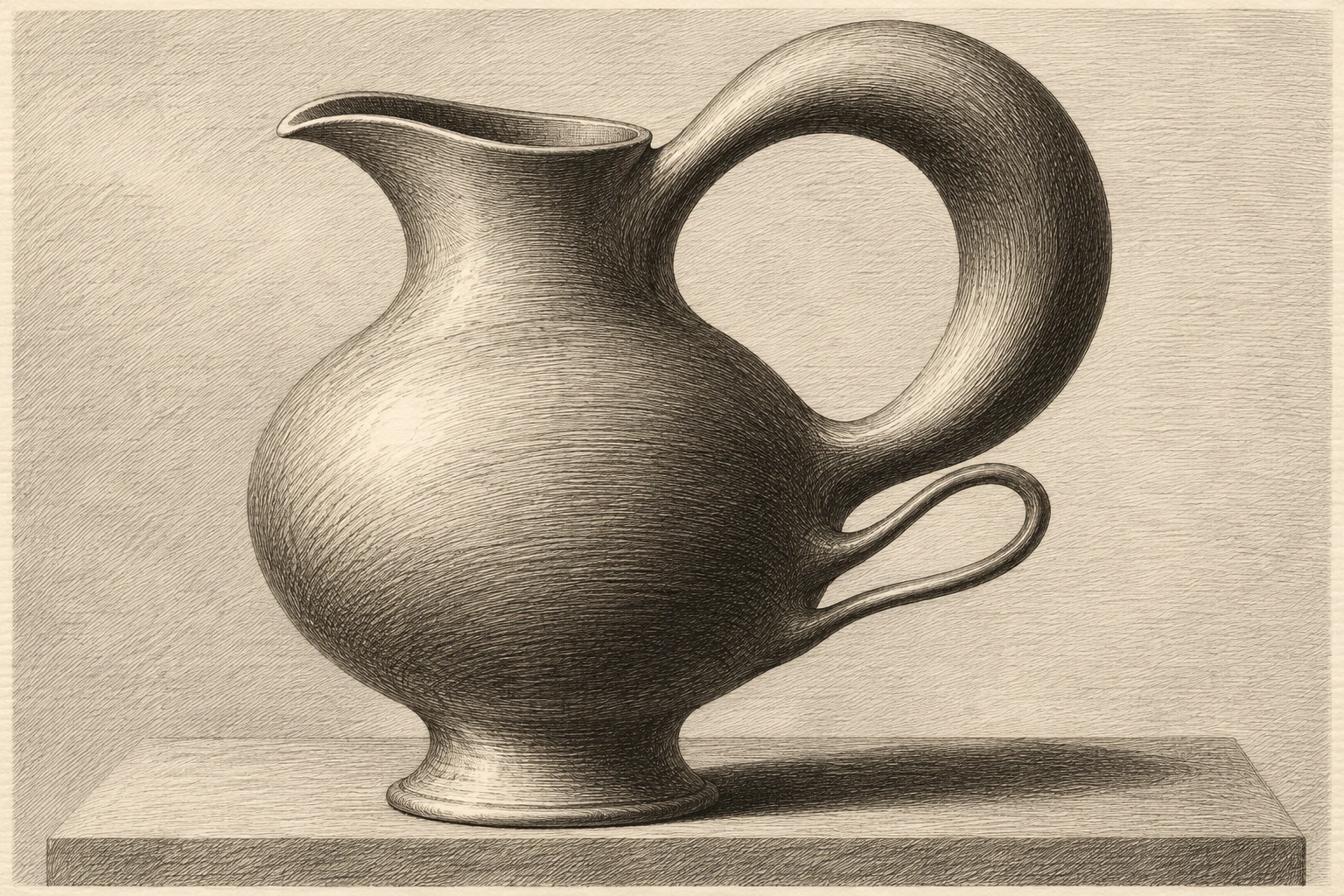
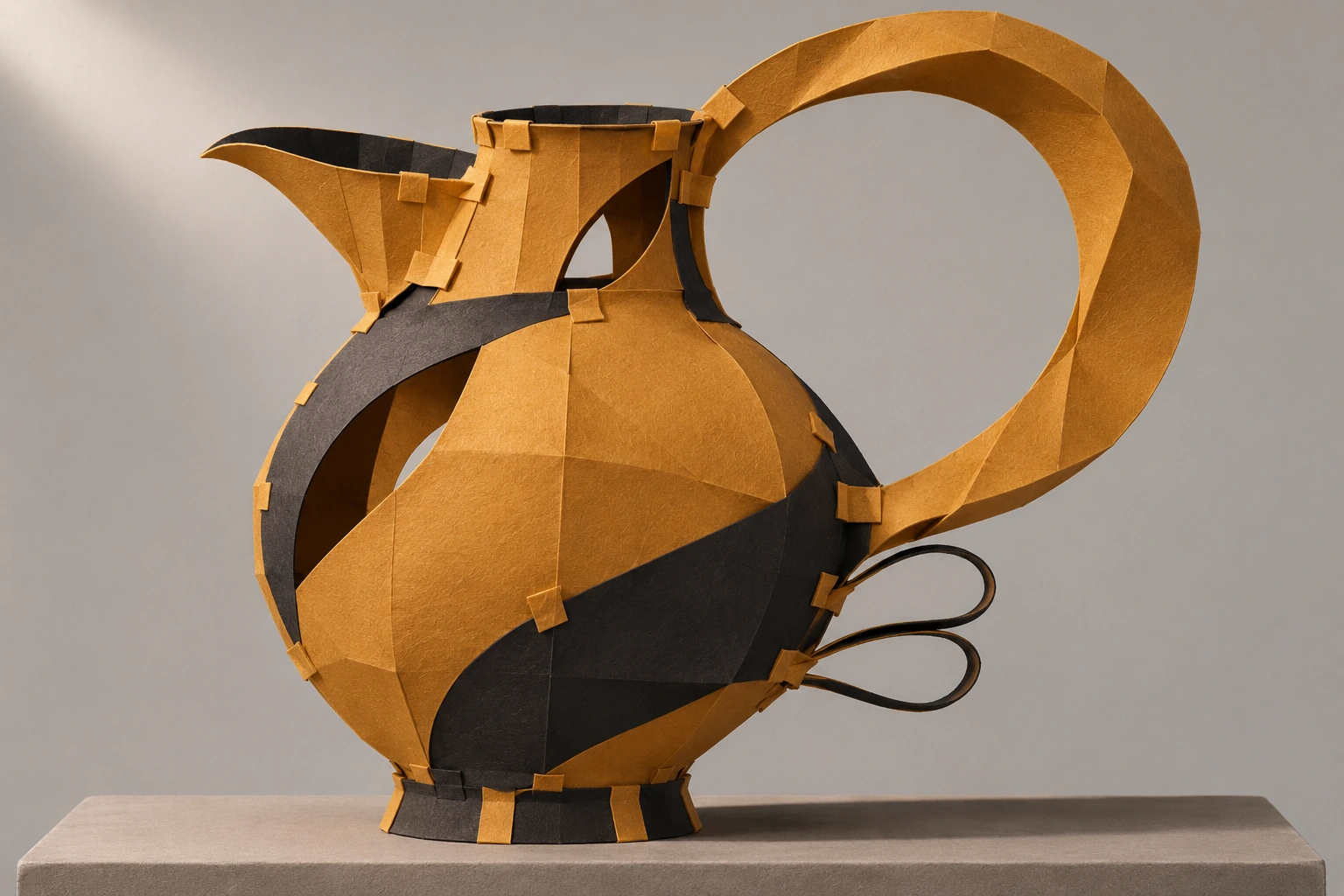
Each of the five images began with the same invented three-handled jug, a plain grey plinth, an eye-level view and light from the upper left. The first requested ordinary wheel-thrown earthenware. The second substituted the word grotesque for ordinary. The third specified a disproportion. The final two carried that same disproportion into an imagined copperplate etching and a cut-card object.
Each is a separate generation. Differences of camera distance, outline and modelling came along with the intended changes. This is a close reading of five pictures from one session. The point is to give another artist an experiment they can repeat with a kettle or a chair, not to predict the behaviour of every generator.
What changed in the five jugs
In the control, a loop stands above the mouth and two smaller handles balance the sides. The adjective-only jug keeps that arrangement. Its spout projects further and the belly develops little ridges that catch the side light. Cover the belly and much of the difference disappears.
With one oversized handle, the main event moves outside the body. The large loop sits to the right, balanced by two small loops squeezed beneath it. You can read the intervention in silhouette. The etching turns a similar design into white spaces bounded by black lines. The paper version gives the handle corners and visible tabs. Its black facets split the belly too, an extra change the prompt did not isolate.
A cabinet of historical comparisons
In Giuseppe Arcimboldo’s The Gardener, held in Cremona, a bowl of vegetables becomes a face when the picture turns. The motif changes category while the paint stays put. The Rijksmuseum’s 1614 Lidded Ewer by Adam van Vianen offers a different puzzle. Metal folds like something much softer, yet the object keeps the bearing of a vessel. Try those mechanisms separately. One asks the eye to recognise a second figure. The other makes a single material act against expectation.
A richly ornamented page need not be disquieting. An odd object need not be densely ornamented. The simple loop in the third jug says more about impossible weight than a dozen unrelated tentacles would. The companion comparison tests what happens when that visual contradiction attracts the eye before the larger shape does.
A small poetic detour
Original words from the AOI studio.
Poetry
The jug acquired another handle.
Nobody asked the table.
One loop grew fat on the afternoon light,
two small ones practised being commas.
Pour, said the lip,
before the sentence gets away.
The prompt workshop
Original creative exercises. These prompts create new illustrations, not documentary evidence.
Change one adjective
Generate two views of one three-handled matte earthenware jug on a grey plinth. Keep the camera, light and background instructions. Use ordinary in the first description and grotesque in the second. Compare the belly, spout and handle openings.
Give the oddity a dimension
Picture a pourable brown jug with a clear foot and lip. One handle must grow as large as its belly. Place two thin loops below it. Ask whether the object still gives your hand somewhere believable to grip.
Keep the silhouette, exchange the material
Reinterpret the oversized handle as a cut-paper construction. Fold it into facets, expose a few tabs and keep the three handle openings legible. Compare it with a line engraving of the same brief.
People & works to explore
References discussed in this article. Consult the sources below for context.
Artists and practitioners
Agostino Veneziano, to whom the Met attributes Ornament Panel
Giuseppe Arcimboldo
Adam van Vianen
Paintings and other works
Ornament Panel, engraving attributed to Agostino Veneziano
The Gardener, the reversible vegetable painting in Cremona
Lidded Ewer (1614) by Adam van Vianen
A smile from the studio
Jokes
The jug insisted that all three handles were essential. Its application for a fourth is under review.