
Fractal-based rendering · AOI painterly study
Fractal Impressionism can be approached as a meeting between nested pattern and painterly light. This article separates documented work on fractal-based rendering from AOI’s creative exercise, rather than assigning the phrase an invented school or roster of founders.
A visual introduction
Select an image for a closer look. Use the thumbnails, arrow keys or a swipe to compare examples. Zoom in to inspect details, or share the image that inspires you.
Creative toolbox · take this style further
Choose an input and a destination. Search sends your words to the chosen site; Copy & open puts them on your clipboard to paste there.
Create with AI
Turn your chosen input into an image prompt or a new creative direction.
ChatGPT
Copy your input and paste it into a ChatGPT conversation or image request.
Copy & open ChatGPT (new tab)Claude · Anthropic
Develop an image prompt or explore the style in a new Claude conversation.
Copy & open Claude · Anthropic (new tab)Midjourney
Paste your input into the Imagine bar on the Create page.
Copy & open Midjourney (new tab)Adobe Firefly
Copy your input, open Firefly, and paste it into the prompt field.
Copy & open Adobe Firefly (new tab)Leonardo.Ai
Copy your input, open Leonardo, and paste it into the generation field.
Copy & open Leonardo.Ai (new tab)Image search
Find visual references. Short, concrete keywords usually work best.
Lexica
Search AI images and prompts using your selected input.
Search with this input Lexica (new tab)Pexels
Search the photo and video library. Short keywords often work best.
Search with this input Pexels (new tab)Pixabay
Search photos, illustrations and other images.
Search with this input Pixabay (new tab)Unsplash
Search photographs using the style name or your own keywords.
Search with this input Unsplash (new tab)Wikimedia Commons
Search photographs, artworks and historical images. Check each file for its source and reuse terms.
Search with this input Wikimedia Commons (new tab)Art & research
Explore artists, collections and the ideas behind a style.
Wikipedia
Search for background reading. A style may not have its own article.
Search with this input Wikipedia (new tab)WikiArt
Copy your input into WikiArt’s search to explore artists and artworks.
Copy & open WikiArt (new tab)Europeana
Paste your keywords into the search to explore European museum, library and archive collections.
Copy & open Europeana (new tab)Inspiration
Discover portfolios and visual ideas from creative communities.
Instagram hashtags
Search a hashtag made from your input: spaces and punctuation are removed. Instagram may require sign-in.
Search with this input Instagram hashtags (new tab)ArtStation
Paste your input into artwork search for concept art, environments, characters and visual development.
Copy & open ArtStation (new tab)Behance
Paste your input into project search for illustration, design and visual storytelling.
Copy & open Behance (new tab)A closer look
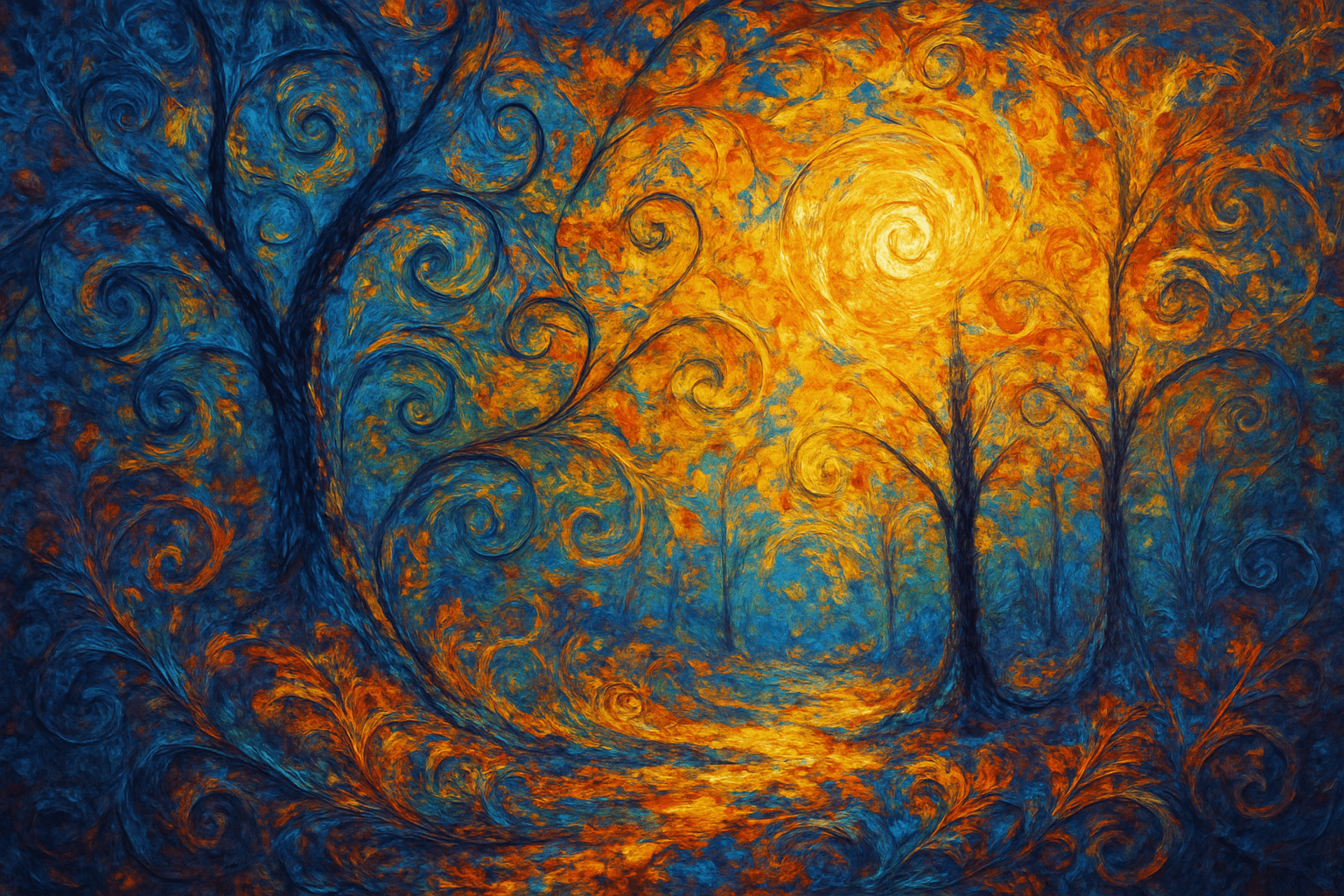
The archive scene uses branching blue trees and repeated curling marks around a bright gold clearing. Large trunks establish the landscape while smaller motifs carry its ornamental rhythm.
Research context and a creative distinction
In Fractal-based Impressionist Style Rendering, Farès Belhadj and Vincent Boyer describe an image-processing approach that extracts constraints from photographs and uses a constrained fractal model to produce painterly results. That documented method is distinct from simply adding spiral decoration. The retained AOI illustration and exercises here are visual interpretations, not claimed outputs of the authors’ method.
Build the visual structure
For an artistic study, repeat a shape at a few distinct scales instead of filling every area with equally small detail. A tree branch can suggest the rhythm of smaller twigs, while broad light and dark masses keep the scene readable. Approximate visual repetition should not be presented as proof of mathematical self-similarity.
The practical challenge is to keep pattern subordinate to illumination. Let the brightest area gather simpler marks, or soften detail in the distance. A scene can suggest recursive growth without making every brushstroke an identical miniature of the whole; controlled differences help it remain a landscape rather than a pattern sample.
A focused studio exercise
Paint one grove with large, medium and small branching marks. Remove the smallest marks from the focal clearing and compare whether the light becomes easier to read.
Compare the studies at the same size and save the chosen prompt or process settings with each result. Keep the subject and viewing angle fixed during this test so the effect of the changed variable stays visible.
A small poetic detour
Original words from the AOI studio.
Poetry
Spirals of chaos,
Digital winds softly blow,
Nature's echo breathes.
The prompt workshop
Original creative exercises. These prompts create new illustrations, not documentary evidence.
Starting study
Create an original Fractal Impressionism interpretation: a blue-and-gold grove with branching marks at three scales. Repeat branching motifs at three scales, keeping the brightest focal area comparatively simple. No lettering or logos.
Composition variation
Create an original Fractal Impressionism interpretation: a sunlit orchard with nested leaf clusters and broad quiet shadows. Repeat branching motifs at three scales, keeping the brightest focal area comparatively simple. No lettering or logos.
Experimental variation
Create an original Fractal Impressionism interpretation: a painterly riverbank whose repeated curls become softer with distance. Repeat branching motifs at three scales, keeping the brightest focal area comparatively simple. No lettering or logos.
Your next inspiration
Discover another art style
Follow a visual thread to the next subject.
A smile from the studio
Jokes
Why don't fractal artists use alarm clocks? Because they prefer recursive loops to wake-up calls.
Sources and further exploration
Farès Belhadj and Vincent Boyer — Fractal-based Impressionist Style Rendering